How I learned to stop worrying and love powerlines: A sunny update

Three years ago, we in North Carolina’s Polk and Henderson counties learned that Duke Energy wanted to string old-fashioned powerline pylons through our corner of western North Carolina as part of a plan to “modernize” our electrical grid. As they say, it didn’t go well.

The grassroots campaign that sprang up to oppose the erection of the 190-foot steel towers successfully convinced Duke to abandon that aspect of its plans, and there was much rejoicing. I told the story with visual aids (and references) in this TEDx talk. Since then, Duke has also given up on its plan to include a “peaker” power plant to supplement the two modern, efficient, 280-megawatt combined-cycle natural gas turbines that will replace the aging 376 MW coal-fired plant at Lake Julian just south of Asheville. It also agreed to build at least 15 MW of solar capacity, and even threw in 5 MW of battery storage. Again, there was much rejoicing. (Although, 5 MW seems awfully paltry, given that Tesla recently installed 100 MW of battery storage at a wind farm in South Australia. The project was completed in under 100 days and earned the host utility $800,000 in just 48 hours.)

But the celebratory spirit may not last long. The new turbines, scheduled to be spinning by early 2020, will cost north of $1 billion, and that expense will be picked up by Asheville rate-payers. As it should in a state where all electricity is supplied by a regulated monopoly. The problem is, as many energy experts pointed out three years ago, it takes decades to recover the costs of new fossil-fuel power plants. Long before that, Duke could find its new facility has turned into what economists call a “stranded asset” — a white elephant that will need to be decommissioned before it’s paid off.

A recent report from the Rocky Mountain Institute, which has proved remarkably prescient about these matters for decades, concluded that:

because of recent innovation and rapid cost declines in renewable energy … technologies, clean energy portfolios can often be procured at significant net cost savings, with lower risk and zero carbon and air emissions, compared to building a new gas plant.

Master explainer David Roberts sums it up this way:

More strikingly, “the new-build costs of clean energy portfolios are falling quickly, and likely to beat just the operating costs of efficient gas-fired power plants within the next two decades.” Depending on gas prices, within two decades — well under their rated lifespan — natural gas plants built today will be uncompetitive. That’s a lot of potential stranded assets.

Duke Progress customers could end up paying for a power plant they don’t need because solar and wind power is much cheaper to install and generate.

Which brings us back to power lines. There’s no doubt that western North Carolina’s mountains can accommodate a certain amount of solar farms, and we should be building them as fast as humanly possible. But the topography here means that particular tech is probably won’t be able to meet all our commercial, industrial and residential demands. We could probably build a fair bit of wind, too, if we gave up worrying about untouched mountain ridge vistas. Realistically, though, running our entire economy on renewables will almost certainly mean transmitting those electrons from more suitable (i.e., flat) locations — specifically eastern North Carolina, including off-shore.

In the three years since Duke floated its ill-fated proposal to more closely connect eastern and western North Carolina’s electrical grids, falling cost trends for solar and wind have only accelerated. Again, David Roberts tells you what you need to know. In addition, the data gaps in our understanding of just how problematic natural gas combustion can be for the Earth’s energy balance — at best it’s a wash with coal, at worst it could tip us over dangerous climate change thresholds — are shrinking almost as quickly. We’re finally getting some good numbers on how much methane leaks from wells and pipelines directly into the atmosphere, and it looks like things are nowhere as optimistic as the energy industries would have us believe.

The bottom line is the case for new power lines that supply renewably generated electricity has only strengthened. Fortunately, those lines can be much shorter and less obtrusive than Duke’s original plans called for. So there’s really no good reason to oppose the idea of more power lines in principle. We just need to keep pressuring Duke to keep up with the latest technological trends.

All of this was foreseen by more forward-thinking observers long before Duke unveiled its modernization plan. Yet Duke chose to embrace yesterday’s technology. Just like it did with Cliffside Steam Station Unit 6 in Mooresboro, N.C., a coal-fired plant that only fired up in 2012. The chances that plant will ever pay back its $2.4 billion cost are vanishingly small, given that coal is already more expensive than competing technologies — and that’s without carbon pricing, which is inevitable, Donald Trump’s atavistic attitudes toward fossil fuels notwithstanding.

But there are reasons for hope that Duke is getting with the program. Cliffside 6 may have been a fool’s errand, but it’s probably the last coal-fired plant the company will ever build. And North Carolina is now the second-largest generator of solar power in the country, after Calfornia, a position that would be only possible with Duke’s enthusiastic cooperation, given that it’s illegal for any N.C. generator to sell any electricity to anyone but Duke. Plus, this month the state finally introduced a new rebate program to put solar arrays on your roof.

So cheer up, Brian. Always look on the bright side of life. That’s the side the solar panels should face.

Way to repurpose that content

I freely concede that this blog rarely lives up to its tagline of “warm planet, cool science.” Most climate science is derived from computer modeling and at its most interesting takes advantage of well-studied proxies like ice cores or coral reefs. But today comes a genuinely ingenious use of unconventional data. If there was a prize for “cool science” of the year I’d award it to Pieter De Frenne et al. for “Using archived television video footage to quantify phenology responses to climate change.” (Bonus points for publishing in an open-access site.

De Frenne’s team of Belgian researchers dug into video archives of the Tour of Flanders bicycle race and looked at the leaf cover of specific trees on the route, which is held in the same place and time each year. Since 1980, the climate in the region has warmed by 1.5°C, although precipitation was essentially flat. They write:

As a response to these changes in the climate system, we detect surprisingly strong shifts in the phenology of leaf-out and flowering of trees in the historical video footage over four decades.

The finding that the trees are flowering earlier is not surprising, and I’m sure horticulturalists and gardeners in Flanders could have reported as much if anyone had bothered to ask. But with a few exceptions, amateur observations tend to be anecdotal, not data-oriented. So this kind of research represents a clever way to quantify what everyone has long suspected. The authors suggest applying the technique to other climatological questions:

… for instance, phenology of understudied species (e.g. introduced plants which are less monitored in traditional time se-ries), sowing and planting dates of agricultural crops, and urban versus rural phenology (Li et al., 2017). In addition, archived video footage makes it possible to quantify species distribution range shifts, for example by georeferencing locations and calculating the annual spread of both native and introduced species visible in the footage. Such an analysis was recently also performed by using geolocated Google street view imagery (Hardion, Leriche, Schwoertzig, & Millon, 2016). Plant fitness (e.g. by assessing de-foliation, discoloration, fruit number, occurrences of visible pests and pathogens) and processes at the landscape scale such as land-use changes, forest management and landscape phenology (sensu Thackeray, 2016) can also be considered. Applications outside the field of global change biology are also possible, such as temporal monitoring of water levels of rivers and lakes.

What we’re talking about is an unanticipated but extremely valuable side-effect of the surveillance society that we’ve built over the past few years. Yes, tiny cameras can be intrusive and privacy concerns should never be dismissed. But omnipresent monitoring turns out to be good for more than just improving safety. Yet another factor to take into account as we chart these unexplored waters of an hyper-connected world.

David Roberts on the problem with Democrats

The Evidence Squared Podcast invites on Vox’s David Roberts to talk about how to talk about climate change with a conservative. But the really good exchange takes place when the subject turns to the Democratic Party.  When Americans with a brain hear Democratic leaders talking about climate change:

“They hear the words, and they sound a little hollow because there’s no sense of urgency.”

Exactly. Democrats say they care about the climate, but never act like they believe it’s important enough to actually do anything.

By the way, Roberts is not just one the best climate journalists working today, but he’s one of the most astute observers of American politics.

Worrying about the near term

Much is being made of a new paper in Nature Geoscience in which the authors recalculate “Emission budgets and pathways consistent with limiting warming to 1.5 °C.” Whether the authors are justified in their marginally optimistic conclusions — and there’s plenty of debate about that — there really isn’t much in the way of policy guidance here. Just look at this money quote in Nature:

“The Paris goal of 1.5 °C is not impossible — it’s just very, very difficult,” says lead author Richard Millar, a climate researcher at the University of Oxford, UK.

Or as Millar and his colleagues put in in their abstract:

Hence, limiting warming to 1.5 °C is not yet a geophysical impossibility, but is likely to require delivery on strengthened pledges for 2030 followed by challengingly deep and rapid mitigation.

Yes, well. Ahem. “Challengingly deep” isn’t exactly cause for breaking out the champagne, now, is it? But there is a policy lesson hiding elsewhere in this paper, regardless of just how mind-bendingly difficult it will be to keep temperatures and sea-level rise to manageable levels.  What Millar et al. did was delve into the tricky world of short-term climate projections, which rely a heck of a lot on economic and technology factors.

The Nature story addresses the problem at the end.

Uncertainty about the details of humanity’s carbon budget don’t matter so much when scientists are modelling the cumulative effect of greenhouse gases over the course of centuries. But fine details matter a great deal when researchers are looking at what level of greenhouse-gas emissions would bump warming to 1.5 °C, because, in that case, scientists’ goal is to tease out the precise effects of heat-trapping gases over a few decades.

“When we start thinking about really ambitious mitigation goals in the really near term, everything starts to matter,” Millar says.

Consider that last line for a second. “Everything starts to matter.” That would include factors like short-lived radiative forcing elements such as fugitive methane emissions. Plenty of climatologists who focus on long-term modeling tend to pooh-pooh the influence of the methane that escapes into the atmosphere before it’s turned into CO2 in gas-fired power plants. And that makes sense because methane turns into CO2 in a matter of a few decades, so why worry about it? It’s how countries like the US and the UK can claim to have reduced carbon footprints by converting from coal to natural gas.

But in the near-term, say 20 years, methane is 86 times as powerful a greenhouse gas as CO2, so it has a massive potential impact, if only briefly, and even if only a small fraction of the natural gas leaks out from the wells and pipes. Indeed, those lower emission rates from switching to natural gas, while reducing CO2 levels, may actually increase total carbon emissions, in the near-term.

So if what you care about is what happens in the near-term, then natural gas and everything else really does matter. And what happens if the climate forcing resulting from briefly elevated methane emissions is enough to trigger positive feedback loop of carbon release from the permafrost or ocean depths? What are the implications for the expected need for carbon-drawdown technologies once we’ve peaked emissions, but end up with atmospheric carbon levels that are way too high? These are not esoteric questions.

Besides, from a political point of view, near-term effects are far more powerful motivators of policy-making than is the specter of a miserable world 100 years from now. Why not take advantage of this new understanding that “everything matters” and run with it?


The data gap problem

“The monitoring of the atmosphere, of the surface of the Earth, of what’s going on in the ocean and under the ice — all of that is overwhelmingly funded by the federal government.”

— Former Obama science adviser John Holdren

The other day a friend of mine who works in Beijing as a foreign correspondent suggested that of all the acts of stupidity committed by Donald Trump since assuming office, the thing that bothers him the least is the decision to withdraw from the Paris climate change agreement. Haven’t we actually moved beyond relying on government to reduce carbon emissions? he asked. Isn’t the private sector basically doing that for us?

This is a common observation. And he wasn’t just speaking from the position of someone who’s paid to pay attention to what China is doing. A few months ago, you could read all sorts of exhortations about the apparent, or at least impending, decoupling of carbon emissions and economic growth rates. Such predictions are practically a growth industry themselves. And it’s true so far as it goes. But it doesn’t go very far. Yes, wind and solar power are rapidly becoming economic options. But we haven’t been able to record a significant global decoupling, and nothing like that for any meaningful length of time. Even if it does come about, we still have to worry about the climate madness that’s already been baked into the system by the last 200 years of emissions.

The more troubling part of this idea is that it leads to complacency about the public sector’s role in dealing with climate disruption. To do that we need data. Lots of it. And this is why we should be worried about Trump and his allies, Paris or not.

The New York Times‘ Jon Gertner explores what might happen if and when some of the current crop of Earth-0bservation satellites fall out of the sky and aren’t replaced. His magazine piece, “What Could We Lose if a NASA Climate Mission Goes Dark?,” focuses on a pair of aging satellites that are the Gravity Recovery and Climate Experiment, or GRACE. At the beginning of this month, they were falling 250 feet a day. And when they burn up, as they will within months, there goes a massive amount of important data that climate analysts — including the people who are building Climate City here in Asheville, N.C. — need to be able to tell their clients how to anticipate the ecological changes that warming the world is already bringing.

… if Grace goes dark or perishes before then, there will be a break in NASA’s continuous observation of Earth’s gravity field and water dynamics. Climate researchers will be confronted with what’s known as a “data gap,” which can leave them at a loss for drawing scientific conclusions about environmental trends.

Replacements are getting ready, but they won’t be launched until sometime next year. Hence the data gap. And if the Trumpistas get their way, this sort of thing is going to become a new normal. As Gertner points out, “the recent Trump budget proposal … made the unusual request of turning off the Earth sensors on an orbiting spacecraft, Dscovr, to save $1.2 million.”

This kind of data-gathering is exactly what the private sector can’t do, nor should it. Elon Musk, for all his accomplishments and his desire to save the planet, isn’t interested in doing science experiments. He just wants to help governments carrying out that part of the plan. For one thing, scientists are terrible at predicting how useful their data will turn out to be, and how it will be applied. Corporations are loathe to take stabs in the dark. And then there’s the cost. Satellites are expensive and by their very nature, operate in a global context. Only governments — and international collaborations of governments — can afford to engage in these types of ventures. And there are other incompatibilities, as Gertner describes:

Private-sector satellite companies have in recent years been expanding the business of collecting and selling Earth observational data, but it’s very unlikely that such firms (or a group of tech philanthropists) could adequately replace NASA’s work. “These are projects that are too expensive or require a large and diverse group of collaborators that can only be assembled as an international project,” said Rush Holt, a former Democratic congressman who is now the head of the American Association for the Advancement of Science. “Or this is work that has to be sustained for a longer period of time than any board of directors from a private company would consider, because it’s not clear enough that it would produce a return on investment in anyone’s lifetime.”

Another problem that occurs to me is the potential conflict between private and public interests. What happens if a firm that gathered some very useful datasets decides, for whatever reason, not to share them with the scientific community? Some things should never be kept secret.

So the next time you hear the claim that the free market will take care of climate change, the best response might be: Yeah, it’s great that business is finally getting on board. But business can’t do it alone, and in fact, without the active and aggressive participation of government, we’re not going to be able to handle existing climate trends, let alone what’s coming down the pipeline if we don’t get those same businesses to stop burning fossil fuels.

A surprisingly subversive look at what the coming energy transformation will look like

The Conference Board of Canada, usually described as a business-friendly think tank, has come out with a report that is refreshingly honest, and even a bit subversive — especially if you pay extra attention to some sidebars, consider what the authors deliberately left out, and are at least a little familiar with the science of power consumption and generation.

The full report, which is behind a freewall — it is downloadable for the cost of supplying your contact information — concludes that converting Canada’s economy to a carbon-free energy mix won’t actually cost all that much. But what I find more interesting is that much of the report’s details support the notion that even optimistic predictions are unnecessarily (small-c) conservative. This suggests the authors (Len Coad, Robyn Gibbard, Alicia Macdonald, and Matthew Stewart) are trying to serve two audiences: the captains of industry who are their patrons on the one hand, and the folks who will do the real heavy-lifting during the coming transition period on the other.

The report’s main thrust is calculating the economic impact of impending carbon taxes, which are scheduled to come into effect next year. You don’t need to worry about the precise numbers, which are all really not much more than barely educated guesses. The important part is even the more aggressive scenarios (like taxes rising to $200/tonne,  several times even the highest of the carbon taxes now in effect) show that the country won’t fall apart.

Overall, the economic impact of eliminating most fossil fuels from the power generation mix is significant—but not overwhelming. The total impact on GDP, at $7.2 billion, is comparable to the output of a relatively small Canadian industry.

So that’s good news.

The even-better news is how much the authors of The Cost of a Cleaner Future: Examining the Economic Impacts of Reducing GHG Emission have managed to misrepresent about the likely future, either deliberately or disingenuously.

First, there is scant mention of the role of either energy efficiency or electrification on future power demand, even though both of these factors are critical to any useful understanding of what’s to come. First, Moore’s Law is pretty much still in effect and something similar continues to hold sway over how much energy we need to do most of what passes for work these days. Not to take into account expected declines in demand thanks to more efficient technology is bizarre to say the least.

Even more puzzling is the failure to address what happens when you switch from running your economy on fossil fuels to running on electricity. The bottom line is you lose a lot less energy to waste heat. Much effort has been made by others to anticipate this effect and the outcome of those calculations. As Mark Jacobson  and Mark Delucci have demonstrated repeatedly, switching to an economy based on wind, water and solar will actually mean demand will fall, not rise, even when you take into account population and economic growth. The difference is actually about 30%. Some have taken issue with Jacobson’s numbers, but even if he’s missed something (which I doubt) and his estimates are off by a bit, the idea deserves at least some mention in a document that pretends to be running sophisticated model of future energy needs.

Instead we get lines like “To eliminate fossil fuels from the grid, over 20 gigawatts of installed generating capacity will need to be replaced.” If Jacobson is right, we’ll actually only need 14 GW. That’s significant, and if you’re a jurisdiction like Alberta or Saskatchewan, now relying on coal, oil and gas for  70-78% of your electricity, every gigawatt is going to count.

Coad et al. also seem to be stuck in old-school thinking when it comes to what generating electricity means from an industrial point of view. They write:

Acceptance of large-scale projects: Substantial investment in large-scale hydro, nuclear, wind, and transmission projects will be required in all parts of the country. Large-scale projects typically attract their share of controversy, and acceptance of these projects among environmentalists, Indigenous groups, and the public is necessary.

Yes, some large-scale projects will be built. Cities are hungry beasts. The controversial Site C hydro dam in northern B.C. will almost certainly overcome the opposition it now faces because there’s just to much potential energy sitting there for it not to be used — mostly by Alberta, which will need something to replace all the coal it’s now burning.  But nuclear? Doubtful, unless we can come up with economical options for fancy  new thorium reactors. The more problematic aspect of this vision is the idea that centralized electricity generation has a major role to play in the future. It probably does, but only to an extent. Decentralized, small-scale generation in the form of wind, solar, run-of-river hydro and geothermal are widely understood to be more likely candidates.

All of this means things will probably be even less disruptive, create even more jobs, and cost even less to the economy, than the report foresees. And what they foresee isn’t that dark to begin with. There are hints that the authors know this. Sprinkled throughout are references and asides that cast doubt on the conventional thinking they ostensibly embrace. For example, there’s a sidebar devoted to debunking (politely) the idea that closing the coal-fired power plants in Ontario is responsible for the recent hikes in electricity bills in the province. In reality, the causes are many and the situation is much more complicated than that. For one thing, “the province has ended up with far more generation capacity than it needs.”

There’s also a fair bit of speculation about the bigger picture, especially when the more dramatic scenarios are explored:

The fact that the GDP hit is so small relative to the lost investment in this pathway provides an interesting insight. It suggests that the investments being given up in this pathway were contributing relatively little to GDP in Canada, as most of the forgone investment would have been spent on imported goods and services.

…if we broaden the scope beyond just looking at the required investments and assess how behavioural and policy changes can impact the results, it is evident that deep emissions reductions are possible at a much smaller cost.

Indeed. Even the Conference Board of Canada is telling you to stop worrying so much about giving up fossil fuels. How about that?

The limits of adaptation

The release of carbon dioxide to the atmosphere by the burning of fossil fuels is, conceiveably, the most important environmental issue in the world today.

— “Costs and benefits of carbon dioxide,” Nature, May 3, 1979

Actually, the scientific understanding of the dangers posed by rising CO2 levels date back much further — at least 100 years — but 1979 was a watershed year, with all sort of reports and high-level meetings organized in response to the growing recognition that we had a serious problem on our hands. Since then, no major corporation, government or organization can justify being taken by surprise by what’s happening in Houston this week. Eric Holthaus puts it bluntly in Politico Magazine:

We knew this would happen, decades ago. We knew this would happen, and we didn’t care. Now is the time to say it as loudly as possible: Harvey is what climate change looks like. More specifically, Harvey is what climate change looks like in a world that has decided, over and over, that it doesn’t want to take climate change seriously.

Wagging an “I told you so” finger isn’t very helpful, though, and it’s not Holthaus’s main point. That would be pouring cold water on the idea that adaptation is a viable response to the mess we’re in. “Incremental” tweaks to the prevailing model for civilization aren’t going to cut it. He’s talking about the model in which large numbers of humans pave over large portions of the Earth with impermeable surfaces, not to mention doing exactly that in service of vast, sprawling industrial operations dedicated to the conversion of fossil carbon chains into liquid fuels.

Adapting to a future in which a millennium-scale flood can wipe out a major city is much harder than preventing that flood in the first place. By and large, the built world we have right now wasn’t constructed with climate change in mind. By continuing to pretend that we can engineer our way out of the worsening flooding problem with bigger dams, more levees and higher-powered pumping equipment, we’re fooling ourselves into a more dangerous future.

We will have to adapt, of course. More and more scientists have already turned their attention from the study of climate change to the provision of “climate services.” This embryonic sector is less interested in mitigating global warming, a certain degree of which is now baked into our ecosystem over the next few decades regardless of what we do about our carbon emissions, than in helping communities and corporations anticipate the effects of that warming and minimize the consequences. To be fair, most of these scientists-turned-consultants are also genuinely worried about the consequences and very much support aggressive mitigation efforts; it’s just that they know we are way past the point of no return on threats like sea-level rise, desertification, and catastrophic flooding.

But Holthaus and many other professional observers are calling for much more dramatic changes to our standard operating procedures than just making sure new developments aren’t built in floodplains. They’re talking about abandoning not just poorly-cited buildings, but entire communities. It is really hard to deny, if you want to be honest, that there are portions of New Orleans that simply shouldn’t be rebuilt, but left instead to the mercies of the ever-wandering Mississippi, land subsidence and the rising waters of the Delta. Likewise, the summer homes of the Outer Banks of North Carolina are probably not worth saving. Do desert cities like Phoenix and Scottsdale, Ariz., or Las Vegas, Nev., really make sense in the long term, what with the cost of importing water?

Pretty soon, for some communities, the only responsible answer to the question of “What do we do to combat the looming effects of climate change?” will be “Leave.” No one is keen on going there first, but it is inevitable. Most of us won’t turn into climate refugees, of course. But there will be sacrifice enough to go around, especially if you’re particularly enamored of private automobiles, golf, or beach houses. (Unless, that is, you’re a member of the upper 0.1%, who will be able to hold onto those kind of affectations regardless of what we do to the atmosphere.)

The alternative is to continue to pay the 11- or 12-figure price tags of Houston-scale floods and similar not-entirely natural disasters. And along with the economic costs will come social and political side effects. If you think the country is polarized now, just wait a few years. Indeed, why not wait a little more? We’ve been putting off making the hard decisions for almost 40 years now.

Image: Houston from Landsat

The grid is smarter than you think

The most charitable comment I can come up with for the just-released Department of Energy Staff Report to the Secretary on Electricity Markets and Reliability is the refusal of the authors to use what is surely a candidate for Most Overused Term of the Year: resilience. Not that resilience isn’t important, but it’s to their credit that the staffers responsible for telling Secretary Rick Perry sort-of what he wanted to hear understand that reliability is really what it’s all about.

After all, if there’s one thing that defenders of fossil fuels and nuclear power like to remind us more than anything else, it’s that the sun only shines during the day and the wind only blows some of the time. It’s a mantra meant to sear into our brains the idea that renewable electricity isn’t reliable. And as much as the Staff Report tries to skirt the issue by eliminating the findings contained in a leaked earlier draft, it still manages to conclude that the nation’s grid is more reliable now than ever:

Overall, at the end of 2016, the system had more dispatchable capacity capable of operating at high utilization rates than it did in 2002.

The New York Times put it this way:

The Energy Department report concedes that the nation’s electricity system remains reliable today, even with a sharp rise in intermittent wind and solar power, in part because natural gas generators and existing hydropower can easily fill any gaps in renewable generation.

Joe Romm has a good summary of how the authors “botched” their task of spinning the report in favor of fossil fuels, and how Perry manages to misrepresent the findings by recommending subsidies for coal and nuclear plants.

But none of this should come as a surprise to anyone who’s been paying attention to the evolution of grid management. The fact is that computational capacity to anticipate minute-by-minute power-load shifts has increased dramatically in recent years. Add to that relatively modest growth in demand and the move away from large, centralized sources of electricity in favor of smaller, distributed, local sources, and you have a grid that can easily handle whatever nature and humankind can throw at it. And this is all going to continue to be the case in the case in the future, only more so. Even during this week’s total eclipse, the grid was easily able to accommodate the large drops in solar’s contribution to the network by drawing on gas and hydro.

Technology has a way of creeping up on you if you’re not paying attention. One day you’re trying to unfold a road map, the next the car is driving itself across the state.

There’s no place like home (for now)

The number of people who still aren’t worried about climate change — or the number of voters willing to elect someone who feels that way, which is pretty much the same thing — is still depressingly high. But many others have long since moved on to the practical issues of how to respond to the consequent ecological disruption. This category includes scientists, artists, captains of industry, and those who are actually charged with dealing with the myriad problems involved.

They all seem to be coming to the same conclusion: humans would rather stay at home and adapt rather than move to safer territory. Not exactly the most draw-dropping of findings, I know. But how realistic is it?


PHOTO: Nature Climate Change
(DOI: 10.1038/NCLIMATE3344)

A new paper in Nature Climate Change takes what could be considered a peek into the future by examining the response of the inhabitants of several small low-lying islands in the Philippines to the kind of inundation that rising sea levels are expected to bring. “Small-island communities in the Philippines prefer local measures to relocation in response to sea-level rise” uses the recent case of earthquake-generated subsidence on four islands on a barrier reef off the north coast of the major island of Bohol to see what people will do when faced with the choice of becoming climate refugees or toughing it out a home. “In doing so, the study will also challenge the notion that sea-level rise directly leads to migration,” write Laurice Jamero and her co-authors.

The islanders, mostly subsistence or artisan fishers, wouldn’t have had to move too far if they chose relocation. You can see Bohol from some of their homes, and there’s a good chance at least some of them could continue to pursue their livelihood even after relocation. I spent a couple of weeks in the region back in 2003, and am familiar with the communities in question, which is why this paper tweaked my interest. Even with water lapping at their doors (see image above), they chose to adapt. Why? Considering how different island life is to that of the nearby larger cities like Cebu, their decision isn’t hard to understand. The paper dances around the answer:

This paradox indicates that, more than environmental factors (that is, degree of flooding severity), the decision to relocate is influenced by social factors, such as the level of human adaptation strategies and the determination of communities to remain in their islands to secure their fishing-based livelihoods. It also therefore refutes the assumption of the mass migration theory that sea-level rise alone could directly lead to relocation. However, it remains to be seen whether there are social limits to adaptation by island communities, what the limiting factors might be (if any), and how these could be overcome.

In other words, people are homebodies.

Of course, things might be different if the seas were understood to keep rising. The strategies they used to adapt to a relatively modest increase (between 20 and 43 cm), including raising their homes on stilts and their walkways on stones, proved workable in the face of a one-time change. But they would rapidly become pointless if the world’s oceans rise as fast as James Hansen and company fear they will. (We’re talking multiple meters by the end of the century.) Migration might start to look like the only reasonable option under such scenarios. Most of these islands are only a metre or two above sea level at most.

Jamero et al. then make the point that it’s a lot easier for rich communities to build much more dramatic defenses, like sea walls, than it is for subsistence fishers to do the same, implying that developed-world responses are probably going to involve even more stubborn refusals to pick up and leave.

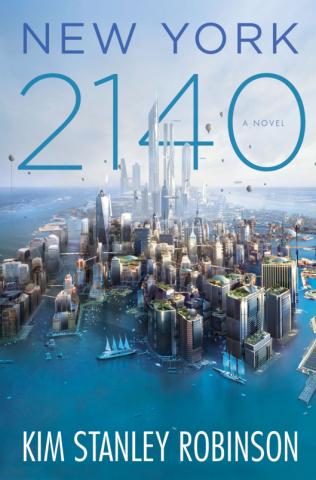
Indeed, this is what a growing list of science fiction authors are postulating. Coincidentally, just a few days before coming across that paper, I finished reading Kim Stanley Robinson’s latest epic, New York 2140. The novel picks up after two pulses of ice melt from Greenland and Antarctica have pushed up the ocean surface by 15 metres or so, turning New York City into Venice. Eventually, another Sandy-sized storm looms on the horizon and, well, spoilers ensue.

The point is that Robinson’s depiction of a city populated by people who refuse to give up even in the face of nearly insurmountable odds parallels the one detailed by Jamero. I haven’t come across any decent cli-fi that is primarily concerned with migration. (Well, there is Stephen Baxter’s Flood, but that’s a wildly implausible story.)


PHOTO: Brett Duke/NOLA.com/Times-Picayune/Associated Press

Anyone anticipating that well-off Americans will be willing to become climate refugees is probably fooling themselves. Yes, it would cost untold billions to surround Manhattan with a seawall of any real use. But look what New Orleans has spent since Katrina —$15 billion — and yet “few here are confident the fixes can keep the city dry for long,” according to the Washington Post, reporting after this month’s rainfall overwhelmed the new pump network. And that was just rain; no hurricane required.

The rational response to rising sea levels would be to move away from the coast. Or least abandon communities that sit below sea level. But don’t tell that to the folks of NOLA. Or the Dutch, for that matter. Home is where the heart is. Besides, we’ve already got plenty of cause for internal migration in the form of a low unemployment rate and blue-collar jobs evaporating in the heat of automation, but few Americans are willing to go where the jobs are. This is in part because they can’t afford to live where the jobs are. So why would a migration forced, not by robots, but the loss of waterfront property, be any different?

By the way, this explains the “climate services” community emerging in Asheville, N.C., the one where private analysts use public climate data to help companies and communities make themselves more resilient to climate change. Seems there’s not a lot of money to made telling people where to go.

Not yet, anyway. But all bets are off if the worst-case scenarios start coming true. Deep roots are fine — until salt-water intrusion begins to rot them, that is.


An Inconvenient Review


ILLUSTRATION:
THE CLIMATE PROJECT

Eleven years ago David Guggenheim and Laurie David managed to turn a documentary about a most unlikely subject — a slide show by a man famous for being too dull to be elected president — into an Oscar-winning international hit. The reaction to An Inconvenient Truth convinced the film’s star to assemble and train an army of climate-crisis presenters now known as The Climate Reality Project.

Guggenheim and David are gone, replaced by a new editorial team, but the star is back with An Inconvenient Sequel: Truth to Power. Most of the reviews so far are less than complimentary, and for good reason. But I’m going to go out on a limb and recommend the film anyway, largely because it’s a more honest portrayal of Al Gore the human being — and his approach to addressing the biggest public policy challenge of our time — than was the 2006 vehicle.

First, though, let’s address the problems with the film, beginning with its raison d’ĂŞtre. It’s really not a sequel at all, more like An Inconvenient Remake. Just as Gore’s Keynote slide show has managed to stay current without actually evolving much over the past decade (not necessarily a bad thing), so the film preserves many key elements, swapping out each pivotal moment for a modern analog, and sticking close to the guiding philosophy of balancing tales of desperation with testimonials of hope.

Gone is the graph in which the trendline of rising greenhouse-gas emissions goes so high that Gore needs a cherry-picker to reach the end point. But the 2017 replacement, a column chart of the annual contributions of new solar power to Chile’s electricity mix, gets effectively the same treatment. Flood videos from 2015 replace flood videos from 2005. And there is still the requisite example of Gore getting all verklempt in front of his trainees as he describes the rising death tolls from extreme weather. So even with a new director and production crew, Gore is firmly in charge of the both the theatrical and cinematic formulas.

There’s nothing inherently wrong with this. But do we really need an updated version of something we’ve already seen? One can argue that, yes, we do. Just as Hollywood seems to have a inexhaustable supply of Spiderman remakes because it knows that there’s always a younger audience who will prefer the latest version, so Gore understands the need to keep it fresh. The scientific underpinnings of the story notwithstanding, this is popular culture we are talking about here.

To be fair, there are significant differences between the two docs. The first one managed to sear certain images into viewers’ brains. The cherry-picker scene or the one where New York City gets inundated by sea-level rise are perfect examples. In fact, despite the emphasis on Gore’s personal odyssey, I submit that what people remember most about AIT is the evidence for the urgency of doing something about global warming, which is, after all, the whole point of the film.

By contrast (I could be wrong here, but all I can do is reflect my own reactions, and those of the folks sitting near me in the cinema), what most viewers will likely take away from AIS is images of Gore himself. Gore the frustrated presidential candidate, Gore the jet-setting volunteer diplomat, Gore the dear leader, Gore the high-stakes interlocutor, Gore the tired crusader. This is more problematic.

The film hadn’t even been officially released and the same old misleading complaints from the science-denial crowd about his Tennessee home’s electrical bills started flooding the far-right echo chambers. Gore is still hated by much of the country, although for no readily explainable reason, as far as I can tell. Putting him even more front and center is probably not the best way to make friends and influence people.

I am sure many will be surprised by the relatively short shrift given to the presenters, who are, after all, a direct consequence of the original film and a big part of Gore’s legacy. Surely a sequel would pay some attention to them. Yet the only presenter who gets any screen time is a Filipino who is still traumatized by the devastation caused by a typhoon that tore through his island. And even here, Gore gets the last word.

Maybe, though, this is exactly the point. Both Gore’s strengths and flaws are laid bare in the film. Sure, we get far more of him than we probably want. There was no need to rehash his reaction to the Supreme Court ruling that handed the presidency to George W. Bush. That was well explored the first time around. Plus, it’s hard to believe that Gore is responsible for the success of the 2015 Paris Agreement, even though the film makes his critical role as a broker in getting India on board a fundament part of the narrative.

But we get the bad with the good. At times Gore looks like he’s seen better days. Some of the shots feature his less-than-trim physique. There’s the embarrassingly brief encounter in Paris with the newly elected Canadian prime minister, Justin Trudeau, who dismisses Gore’s words of appreciation for bringing Canada back from the dark side by humbly quipping that “it was the Canadian people, not me,” before running off to whatever important appointment he was trying to keep. The film even wraps up with a self-righteous declaration of certainty of purpose.

This level of honesty make AIS worth the 98 minutes it asks of your time. We see both the impact one human being can have, and the limits of such power. Gore could have chosen to close with an admission of the latter, something along the lines of “Maybe I’m just titling at windmills (so to speak), but what else can one man do?” But he didn’t. For better or worse, that’s not who he is. And as carefully scripted as this documentary is, it succeeds much better than its predecessor at revealing the personality that has driven so much of the public conversation around climate change.

By the way, I’m one of the thousands Gore has trained to deliver his presentation, a task I still do from time to time. (As I was finishing off this review, in a public library, someone who had seen one of talks a few years ago walked up and asked me if I’d be doing another one thanks to the attention AIS is getting.) Like all my colleagues, I still care more about the message than about the messenger. But why a decade spreading a brilliantly crafted and compelling message has changed so few minds is a vital question, to which no convincing answer has yet been supplied. If nothing else, this new look at Gore and his methods gets us little closer to one.