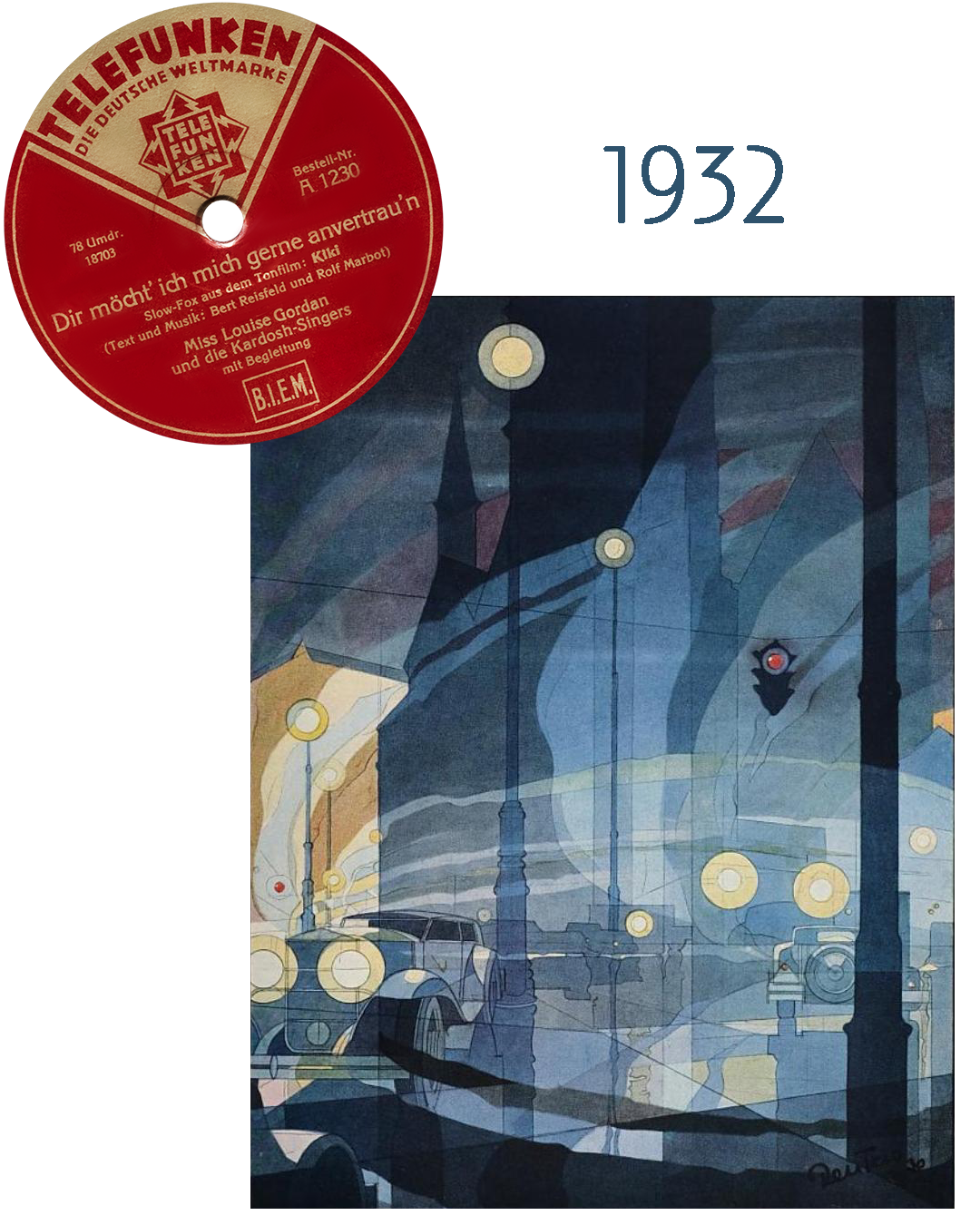
Die Kardosh-Singers & Miss Louise Gordan – 1932


“Dir möcht’ ich mich gerne anvertrau’n”
Miss Louise Gordan und die Kardosh-Singers
October 8, 1932  (Telefunken A 1230 mx 18703)
“Irgendwo auf der Welt gibt’s ein kleines bisschen Glück”
Die Kardosh-Singers
October 8, 1932  (Telefunken A 1230 mx 18702)


Note: Some of the links below are to non-English language websites. Most modern browsers provide a built-in translation feature that will either automatically offer a translation or can be activated through the browser’s settings menu. If you are unable to get the translation feature to work, you can always paste the website’s URL into the Google Translate service. 

Here are two recordings from the closing months of the Weimar Republic by a vocal harmony group, the Kardosh-Singers, that was regarded as the closest rival to the better-remembered Comedian Harmonists.  After the Nazis came to power, despite their enormous popularity, both groups were ultimately forced to dissolve because some of their members were Jewish.

Joining the group on one of the recordings is a jazz and scat singer credited as Miss Louise Gordan, who has long been a source of mystery for fans of the era’s music. On other recordings, she was credited as Louise Jordan.  Some sources suggest that she was American.  Others suggest she was British.  Other than the fact that she performed and made several recordings in Germany and appeared in engagements in other European countries during the early 1930s, little is known about her, including her real name.

Note: A reader has advised that Miss Louise Gordan appeared in a 1934 Danish film called 7 19 13. That film is available in its entirety on YouTube, and you can see her appearance in which she sings in English, scats, and starts to tap dance by scrolling to 35 minutes 30 seconds into the film:

https://youtu.be/wW79HJDNMOw?si=FBJiVi_hP0KIDo7c&t=2130

The reader also notes that she provides the vocal, here, too, in English, for a 1932 waltz recording by Jack Presburg’s orchestra on the Pallas label, credited as F. Gordon, which can also be heard on YouTube:

https://youtu.be/3-vAFOEDn0c?si=Bz98R2gOOZp4yY38

The Kardosh-Singers were founded in May 1932 by Hungarian pianist, arranger, and composer István Kardos, who, for his work in Germany, used the Germanized spelling of his name, Stephen Kardosh.

Kardos had already been working in Germany for a few years when he took over as the musical director for the Abel-Quartett, a successful vocal harmony group, after the 1929 departure of its founder, Pál Ábel.  Like the Comedian Harmonists, the Abel-Quartett based its style on the American harmony group, The Revelers, whose recordings were popular in Europe.  Under Kardos, the group remained successful under the name The 5 Songs.

By 1932, Kardos determined that leading his own group offered greater potential career and financial rewards than leading the 5 Songs as a mere employee.  Once he formed the Kardosh-Singers, he was quickly able to line up stage performances, recording sessions, and even a film appearance.

By 1935 the group had made around 80 recordings, toured Europe, appeared in several films, and was regularly heard on radio broadcasts.

What the German public and even the other members of his group were not aware of, however, was that István Kardos and his wife Olga were both born to Jewish parents.

After the Nazis came to power in late January 1933, it quickly became difficult for Jewish entertainers to find work, as venues that hired them were at risk of disruption and even violence by Brownshirt thugs. In September, all musical activities in Germany were brought under state control through the creation of the Reich Chamber of Music.  All professional musicians, composers, and teachers were required to join the chamber in order to legally work. To join, one had to prove “Aryan” lineage.  Members whose works and performances strayed from what the Nazis considered to be “good German music” risked having their membership revoked, thus rendering them unemployable.

Because he was a Hungarian, not a German citizen, Kardos was initially able to avoid the difficulties faced by German Jews by simply not disclosing his or his wife’s Jewish lineage.  Over time, however, keeping this secret became increasingly difficult and stressful.

Ironically, the Kardosh-Singers’ performances received positive reviews in official Nazi publications, and the group was engaged to perform at official Party events.  While such performances must have been extremely uncomfortable for Kardos, to turn down such an engagement would have been extremely risky.

By 1935, the regime had become increasingly zealous about sniffing out and targeting “disguised Jews,” those in mainstream German society who had successfully hidden their Jewish ancestry.  This was one of the motives for the notorious Nuremberg Laws, which required people to provide documentation of the racial background of their grandparents in order to maintain their jobs in various professions, enroll in high school or college, or marry.

While the Nuremberg Laws did not come into effect until after Kardos left Germany, they shed light on the atmosphere he faced during his final months in the country.  Because venue operators and booking agents were coming under scrutiny by Goebbels’ Ministry of Propaganda for being lax in verifying membership status with the Reich Chamber of Music, his situation became increasingly precarious.

In autumn 1935, Kardos was summoned to a police station in Berlin and informed that if he failed to produce documentation of his ancestry within 30 days, his residency permit would be revoked and he and his wife would be deported back to Hungary.

Deportation, however, was the least of his worries.  Kardos feared the summons was the result of someone already discovering his lineage and reporting him, which, if true, would likely mean he would be arrested before the 30-day deadline. Thus, he and his wife quickly and secretly fled back to Hungary.

During a failed effort in the 1950s to obtain reparations payments from the German government, Kardos explained:

“…the revelation of my ancestry after I had been publicly active for about 3 years on stage, on the concert podium, in film, on the radio and even in party events would have been dangerous, even life-threatening for me, I was forced to flee the Reich; even my singing partners only found out later, when I wrote to them from Hungary.”

The group’s bass vocalist Paul von Nyiri was also eventually forced to flee back to his native Hungary because of his wife’s Jewish ancestry.

Unfortunately, in 1935, Hungary was ruled by a highly authoritarian and deeply anti-Semitic regime.  Kardos was able to resume his career in Hungary, but was not able to replicate the success he had enjoyed in Germany. In 1938, the government implemented the first of a series of anti-Semitic laws and, by 1939, he was unable to find employment and his only source of income was providing semi-illegal private music lessons.

While Hungary entered World War II on the side of Germany, its government did resist German pressure to deport Hungarian Jews to the concentration camps.  However, the situation became dire in 1944 when Germany invaded after learning of Hungarian efforts to broker a separate peace agreement with the Allies.

Like all Jews in Budapest, Kardos and his wife were forced to wear a yellow star, expelled from their home, and forced to relocate to a single room inside a so-called “yellow star house,” one of about 2,000 apartment buildings throughout Budapest where Jews were concentrated as a temporary way station before deportation to the death camps.

Fortunately, they were both able to escape from the yellow star house and, with the aid of forged documents, successfully went into hiding for the remainder of the German occupation.  While Kardos and his wife both survived, 23 members of his family lost their lives in the Holocaust.

After the war, he was at least able to earn a living in music, working as a pianist for Hungarian radio, a music teacher, and a music journalist.  He died in Budapest in 1975.

For more information about the Kardosh-Singers, I highly recommend Kardosch-Saenger.de, which provides a wealth of information about the group and its members. For a detailed biography of István Kardos, visit this page on the website.

Both songs are from 1932 German films and feature what I think are very captivating and memorable melodies.

“Dir möcht’ ich mich gerne anvertrau’n” (“I’d Like To Entrust Myself With You”), written by Bert Reisfeld, Rolf Marbot, and Curt Lewinnek, is from the film Kiki.

“Irgendwo auf der Welt gibt’s ein kleines bisschen Glück” (“Somewhere In The World There Is A Little Bit of Happiness”), composed by Werner R. Heymann with lyrics by Robert Gilbert, is from the film Der blonde Traum (The Blonde Dream).

While the German electronics company and radio pioneer Telefunken dates back to 1903, its record label had been in existence for only a few months when this record was made.

Both sides were recorded in the concert hall of the Sing-Akademie, a choral group founded in 1791. The concert hall was built in 1827 and was world-renowned for its outstanding acoustics.  During the 1920s, the hall was occasionally used for recording sessions by the Electrola label.

The facilities used for the recordings here were installed by Ultraphon, a multinational record label that appeared in Germany in 1929 and was known for its sound quality.  By 1932, after economic conditions forced the company into liquidation, all of its German assets, including its matrices, manufacturing plants, and the recording facilities in the Sing-Akademie, were acquired by Telefunken and used to create its namesake label.

Telefunken continued to record at the Sing-Akademie until 1943, when the building was gutted by an incendiary bomb.  After the war, East German authorities restored the building’s burned-out shell to its 19th-century appearance and constructed a new building inside its walls that has, since 1952, functioned as the Maxim Gorky Theater.

One of the things that has always haunted me about German recordings from this period is the contrast between the music, which is so often beautiful, joyous, benevolent, and incredibly life-affirming, and the unimaginably horrific events unfolding outside the studio walls, events that would later affect and, in some cases, claim the lives of the performers and composers.
Posted in Uncategorized | Tagged , , , , , , | Leave a comment

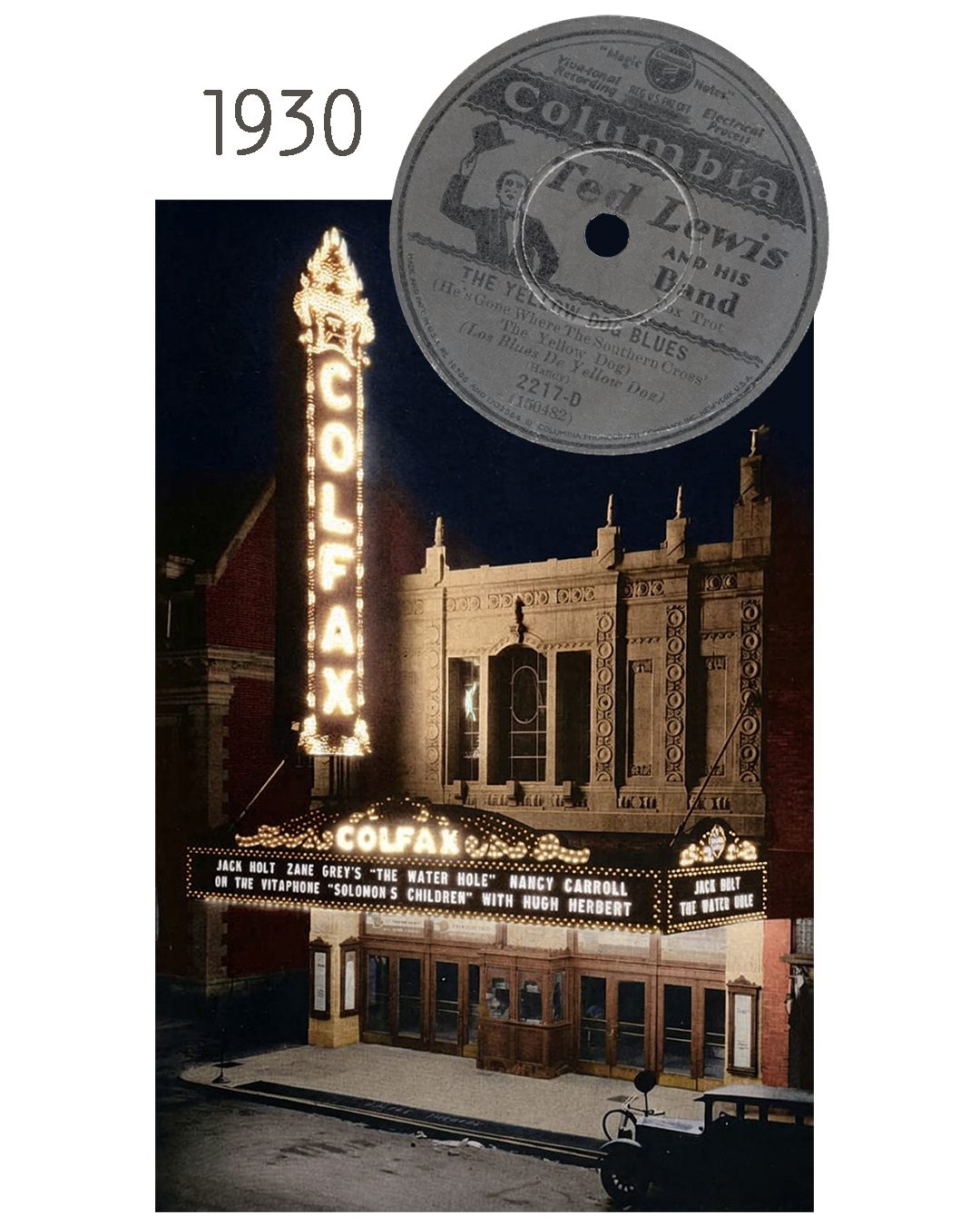
Ted Lewis And His Band – 1930


Colfax Theater, South Bend, Indiana. Opened in 1928. Destroyed in 1994.


“The Yellow Dog Blues”
Ted Lewis And His Band
April 18, 1930  (Columbia 2217-D mx 150482)
“Sobbin Blues”
Ted Lewis And His Band
April 24, 1930  (Columbia 2217-D mx 150490)


From the Edward Mitchell collection, here are two jazzy instrumental recordings by Ted Lewis and His Band that will be included in Radio Dismuke’s next playlist update. Both songs were already several years old and well on their way to becoming jazz standards when Lewis recorded them.

The record features a special picture label that Columbia used on all Ted Lewis pressings between 1929 and 1933.  Columbia had previously provided a special picture label for Paul Whiteman’s recordings as part of its effort to lure Whiteman after his contract with Victor expired in 1928.  Ted Lewis was one of the highest-paid bandleaders of the 1920s and one of Columbia’s best-selling artists. I suspect that offering Ted Lewis his own picture label was part of Columbia’s negotiations to retain him when his contract came up for renewal in 1929.

The Ted Lewis label was not as elaborate or colorful as the Paul Whiteman label (an example of which can be seen and heard in this blog’s July 14 posting) and featured a gray background with descriptive text and a silhouette of Lewis in black.

Unfortunately, the quality of the ink, the paper, or perhaps both used in the label was not as high as that used for the Whiteman label or for Columbia’s standard labels. More often than not, even when the playing surface of such records is in great condition, the ink is faded and, in some spots, worn off. The paper is also more prone to being soiled from routine handling.

Columbia also introduced picture labels for Rudy Vallée and Harry Richman.  However, they were much more minimalistic, featuring an etching-like line drawing of the artist and his signature in place of the “Magic Notes” at the top of the label.  By 1933, the Ted Lewis picture label had also been simplified to this design.  Ted Lewis picture labels with this later style, as well as the Harry Richman picture label, are rare, as they were made during the worst period of the Great Depression for the record industry, and pressing numbers tended to be extremely low.

“Yellow Dog Blues,” originally published in 1914 as “Yellow Dog Rag,” was a W. C. Handy composition inspired by Shelton Brooks’s 1913 song “I Wonder Where My Easy Rider’s Gone?”  Yellow Dog refers to a local nickname used in the early 20th century for the Yazoo Delta Railroad in Mississippi.

“Sobbin’ Blues” dates back to 1923 and was composed by Art Kassel (link via Google Translate) and Vic Berton.

While Lewis was as much a showman as he was a musician, his band was always staffed with top-tier talent.  According to Brian Rust, at the time of these recordings, the band’s roster included Muggsy Spanier, Harry Raderman, and Jimmy Dorsey.

Posted in Uncategorized | Leave a comment

Bidgood’s Broadcasters – 1928

|

“I Think Of What You Used To Think Of Me”
Bidgood’s Broadcasters with Stoll Theatre Organ; Tom Barratt, vocal
November 14, 1928  (Broadcast 315-B)
“All By Yourself In The Moonlight”
Bidgood’s Broadcasters, John Thorne, vocal
November 15, 1928  (Broadcast 315-A)


Here are two very different recordings by British bandleader Harry Bidgood’s orchestra from an eight-inch Broadcast record.  The record’s label describes it as “The Long Playing Record.”  In this context, long-playing meant that, although it was only an eight-inch record, it provided the same playing time as a standard ten-inch record.

I have been a fan of the song “I Think Of What You Used To Think Of Me” ever since I added the version recorded on Brunswick by Abe Lyman’s California Orchestra to Radio Dismuke’s playlist in 2012.

James F. Hanley composed the song and Roy Turk wrote the lyrics.  Abe Lyman was also credited as a co-composer, but I do not know what his contribution was.  In those days, it was common for bandleaders to be given composer credit (which made them eligible for a share of a song’s composer royalties) in exchange for performing and promoting the song.

Apparently, the song enjoyed more popularity in the United Kingdom than it did in the United States, where it originated.

What made Abe Lyman’s recording stand out to me, beyond the song’s catchy melody, was that the band was accompanied by a pipe organ operated by well-known theater organist Eddie Dunstedter (link opens to .pdf file) from the auditorium of Chicago’s Temple of Labor, a venue that Brunswick occasionally used for recording sessions.  The organ gave the peppy and upbeat recording a certain haunting quality. (The building where the recording was made still stands and remains in use as a union hall at 328 S Marshfield Ave in Chicago, though apparently the organ is no longer there).

Harry Bidgood’s version of the song was clearly inspired by the Abe Lyman recording, as it also features a theater organ, which was located in the Stoll Picture Theatre on Kingsway in London’s West End.

The theater opened in 1911 as the London Opera House and was built by impresario Oscar Hammerstein I as a home for his own productions.  The lavish and massive theater had a seating capacity of 2,660 and was one of the grandest in the city.

In 1916, it was purchased by Oswald Stoll and renamed the Stoll Picture Theatre, functioning as a grand movie palace until 1941, when it was once again used for live performances.

The organ heard in the recording was a 3-manual, 27-stop tubular pneumatic orchestra organ built by Jardine & Co. that was installed in 1922.  Initially, it accompanied silent films.  The organ was updated and rebuilt in 1930.  Even after the advent of talking pictures, daily organ recitals remained a popular feature.

Tragically, this grand and spectacular theater was demolished in 1958 and replaced by a dreary-looking rectangular office building with a much smaller theater in its basement.  Rather than finding a new home for the organ, it was scrapped for parts.

Fortunately, the theater and the organ were used for several recording sessions by the Broadcast label, so we have at least some approximation of what it might have sounded like in person.

“All By Yourself In The Moonlight” is a 1928 novelty song with words and music credited to Jay Wallis, a pen name for British songwriter Ralph Butler.  The song was well-known and widely recorded on both sides of the Atlantic.

Harry Bidgood was the music director for the Vocalion Gramophone Co., which became independent shortly after its American parent, the Aeolian Company, had sold the American Vocalion label to Brunswick in 1924.

Vocalion introduced the Broadcast label in 1927.  The eight-inch records had somewhat narrower grooves and a much smaller label area than standard records, enabling them to provide the same playing time as competing ten-inch records.

The label was so successful that Vocalion discontinued its namesake label, as well as its budget-priced ten-inch Aco label, to focus on Broadcast.  In 1928, the company introduced a companion label, Broadcast Twelve, a ten-inch record with a playing time comparable to standard twelve-inch records.

In 1926, in response to the HMV and Columbia labels obtaining licenses through their respective American affiliates to use the electrical recording system developed by Western Electric, Vocalion licensed a rival electrical recording system developed by the Marconi Company. The letter M inside a circle, which appears on the label of Broadcast records, indicates that it was recorded using the Marconi system.

The vast majority of dance records issued on Broadcast featured Bidgood leading the company’s in-house band. Some, like the record featured here, were issued under his name.  Others were issued under a wide array of pseudonyms, including The New York Nightbirds, Ciro’s Club Band, The Manhattan Melody Makers, Al Benny’s Broadway Boys, and Nat Lewis and his Dance Band to mask the fact that they were, in fact, by the same band. Many of these recordings can be regularly heard on Radio Dismuke.

In 1932, Vocalion went into liquidation and was acquired by rival record manufacturer Crystalate, which produced the low-priced Imperial label as well as its own eight-inch record label, Eclipse, which was sold exclusively through the British branch of the F. W. Woolworth company.  The Broadcast label was discontinued in 1934.

Harry Bidgood stayed on in a similar capacity under Crystalate.  During this period, the accordion experienced an explosion of popularity in the United Kingdom, with thousands of people taking accordion lessons through correspondence schools.  This, in turn, led to popular interest in accordion bands, which Crystalate eagerly capitalized on with records by accordion-enhanced studio orchestras under Bidgood’s direction, disguised by pseudonyms such as Don Porto and His Novelty Accordion Band, and Rossini’s Accordions.

You can hear three recordings that Bidgood made for the Eclipse label as Don Porto and His Novelty Accordion Band in this blog’s October 29, 2023 posting.

One of the accordion band pseudonyms that Bidgood began to use during his years with Crystalate would largely define the rest of his career: Primo Scala and his Accordion Band, which evolved from being a made-up name used to market low-priced records into a top-name musical act in its own right, with live appearances, regular radio broadcasts, and recordings for Decca (which acquired Crystalate in 1937) well into the 1950s.

While some of his records are better than others, and, of course, individual musical tastes vary, for those who enjoy happy and cheerful 1920s and 1930s dance band recordings and aren’t frightened away by certain types of critics who denounce them as “commercial” or as “not real jazz,” it’s generally hard to go wrong with a Harry Bidgood recording whenever one is available at an affordable price.

Posted in Uncategorized | Tagged , , , | Leave a comment

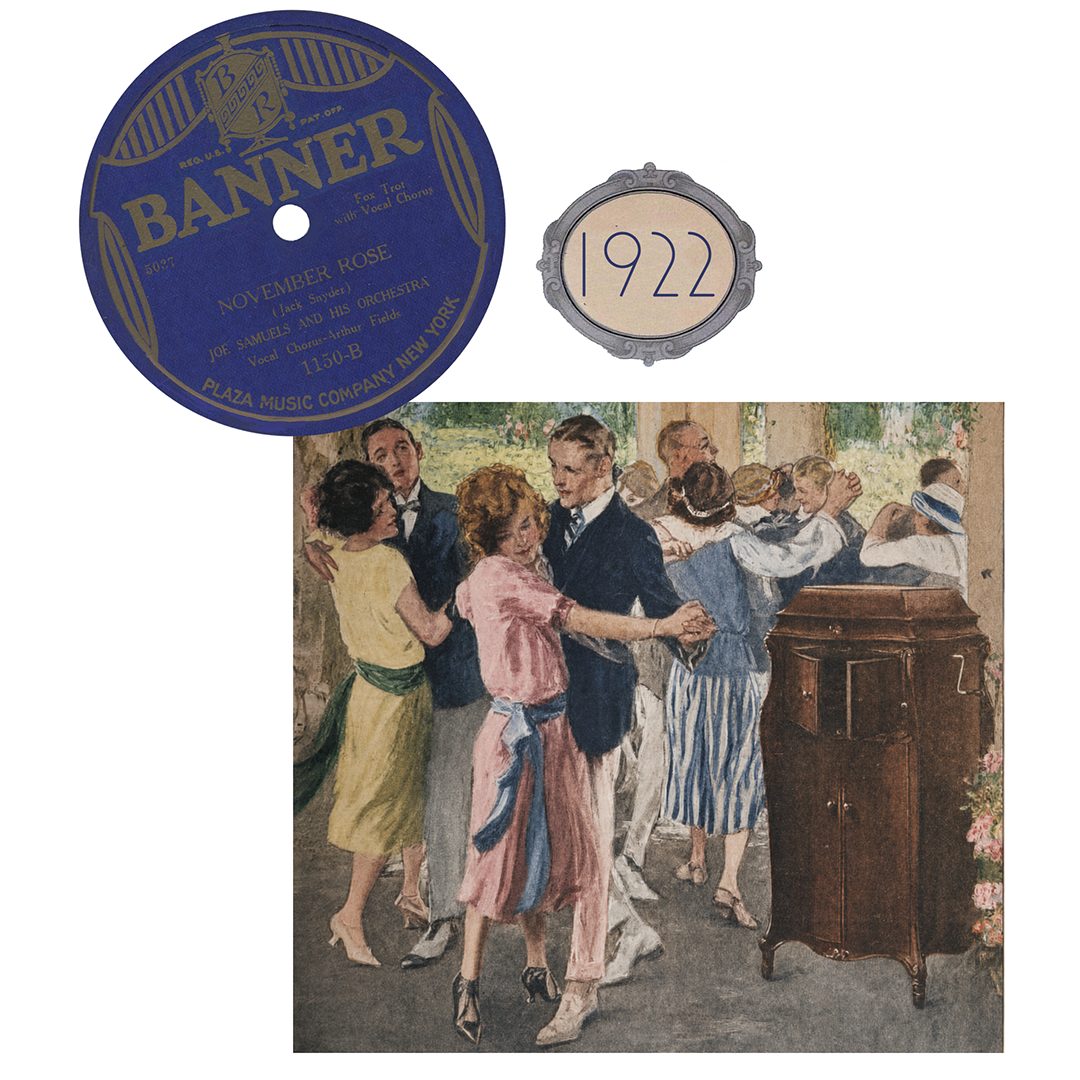
Joe Samuels And His Orchestra – 1922


“November Rose”
Joe Samuels and His Orchestra; Arthur Fields, vocal
circa December 1922   (Banner 1150-B mx 5027)


Here’s a recording I recently came across while auditioning records in the Edward Mitchell collection for digitization and inclusion in Radio Dismuke’s playlist. I thought the tune was incredibly catchy and was immediately charmed by it.

What struck me most was the fact that, in many respects, it sounds more like a recording from the World War I era than from late 1922, when the Jazz Age was well underway.

Popular music styles evolved at such a rapid pace throughout the 1920s that recordings from just a very few years earlier were perceived as dated – and that’s not counting the decade’s rapid advances in recording technology.

Indeed, there are passages of this recording that very much remind me of a ragtime-influenced World War I song from 1918, “Oui Oui Marie,” which happens to be among my favorite tunes from that era (which you can hear performed by the same vocalist who appears on the recording here, Arthur Fields, in a YouTube upload at this link).

“November Rose” was composed and published in 1922 by Jack Snyder, who should not be confused with Ted Snyder, who wrote well-remembered hits such as “The Sheik of Araby’ and “Who’s Sorry Now.”

Several recordings of the song were made in late 1922 and early 1923.  Most, however, were performed either as a ballad or a waltz.  While the few that I have been able to find and listen to online are certainly pleasant, I personally think its delightful melody is much better suited to the sort of happy, peppy dance-tempo arrangement heard on this recording.

Jack Snyder was the son of Herman Snyder, treasurer of the Crown Music Company, a major Tin Pan Alley music publishing firm that had previously been one of Scott Joplin’s publishers (and had no connection to the 1950s-era music publishing company of the same name).

A 1921 trade publication announced that Jack Snyder was forming his own music publishing company, the Jack Snyder Music Company, and that its general manager would be May Waterson, sister of music publisher Henry Waterson, who, at one point, had been one of Herman Snyder’s partners at the Crown Music Company.

Based on mentions in period publications, the Jack Snyder Music Company seems to have enjoyed modest success throughout the rest of the 1920s.  But I was not able to determine what became of it or of Jack Snyder afterwards.

Nor was I able to find the answer to whether Herman and Jack Snyder were relatives of the much more famous and previously mentioned Ted Snyder.

Herman Snyder’s partner in the Crown Music Company, Henry Waterson, was also a partner with Ted Snyder and Irving Berlin in the prominent music publishing firm Waterson, Berlin & Snyder.

Because none of the information I found on Ted Snyder suggested a family connection, my strong hunch is that the shared last name and mutual business partner were merely coincidental.

Between 1919 and 1926,  Joseph Wilson Samuels’ band was one of the era’s most prolific in the recording studios, with over 400 sides.

For the OKeh label, the band made a number of jazz recordings under its own name and under the pseudonym Tampa Blue Jazz Band.  The band also accompanied early black blues vocalists such as Maimie Smith and Lucille Hegamin.  It was one of the first, if not the first, white bands to record with black vocalists.

Samuels also recorded for Pathé, Edison, Emerson, Grey Gull, and Gennett.  However, the majority of his recordings were with Banner and other affiliated low-priced “dime store” labels, credited under his own name or under a multitude of recording pseudonyms.  After 1925, however, his recordings suddenly stopped, and he abruptly disappeared from the public spotlight.

A contributor to Samuels’ Wikipedia entry writes that, per data from Ancestry.com, he lived in Brooklyn, New York, into the 1940s and, in the 1930 census, described his occupation as “musician in a band.”  He was described in the 1940 census as an employee of the Kollsman Instrument Co., which made aviation instruments, not musical instruments.  He died on July 19, 1953.

The vocal on the recording is provided by Arthur Fields, who was also extremely prolific, recording on over 800 sides between 1914 and the early 1930s.  He was also the co-composer of the very charming, and still occasionally performed, 1914 ragtime-era composition “The Aba Daba Honeymoon” (which you can hear performed by Arthur Collins and Byron G. Harlan on YouTube at this link).

As with Joseph Samuels, Arthur Fields also died in 1953.  Fields suffered a stroke in March 1953 and, soon after, moved into the Littlefield Nursing Home in Largo, Florida. Early in the morning of March 29, the poorly built and highly combustible building caught fire, resulting in 33 deaths, including Fields.

In addition to Banner 1150, this recording was also issued on Regal 9419 and credited to Joseph Samuels.  In Canada, it was issued on the Apex label under the pseudonym The Music Masters.

Posted in Uncategorized | Leave a comment

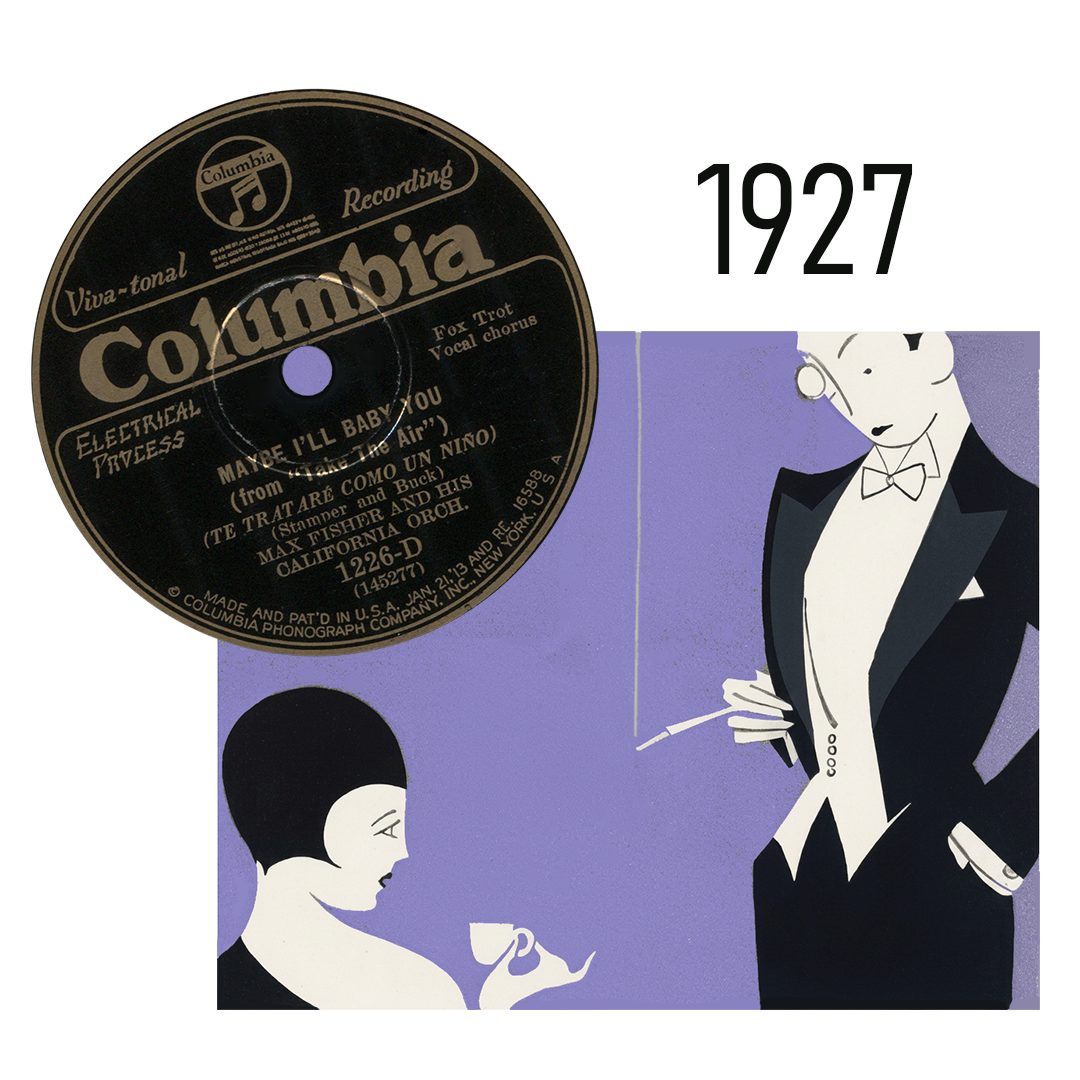
Max Fisher And His California Orchestra – 1927

“Lullaby”
Max Fisher And His California Orchestra; Johnny Murray, vocal
December 9, 1927   (Columbia 1226-D mx 145290)
“Maybe I’ll Baby You”
Max Fisher And His California Orchestra
Leonard Layson, Johnny Murray, Richard Newlin, vocal

December 6, 1927 (Columbia 1226 D mx 145277)


From the Edward Mitchell collection, here are two songs from the 1927 musical Take the Air, composed by David Stamper with lyrics by Gene Buck, who produced and directed the show. Buck was a friend and neighbor of F. Scott Fitzgerald.  Some historians have suggested that Buck’s lifestyle and lavish parties may have inspired certain elements of Fitzgerald’s novel The Great Gatsby.

Bandleader Max Fisher is largely forgotten, even among enthusiasts of 1920s popular music, it seems.   When I started writing this post, I knew little about him and was unable to find any online summary of his life or career.  After I began going through old news articles and trade journals, I was surprised to learn that his band was highly prominent during the 1920s, performing at elite venues, catering to wealthy audiences on both coasts.

Max E. Fisher was born in Cripple Creek, Colorado, on May 26, 1894, to Hyman and Matilda Fisherson and raised in Los Angeles, where he learned to play violin.

A February 28, 1914, article in Goodwin’s Weekly mentions a “ragtime violinist” named Max Fisher appearing at the Pantages Theater (now called the Arcade Theater) in Los Angeles.  I was not able to confirm that this was the same Max Fisher, but the chances are good that it was.

At some point during the 1910s, Fisher was recruited by famed film director Cecil B. DeMille to become his on-set violinist/music director at the Famous Players-Lasky studio.  That might seem like a rather strange job, given that all films in those days were silent.  But silent film sets could be noisy and chaotic. DeMille wanted Fisher to provide “mood music” while a scene was being filmed to help put the cast in the proper emotional state.

During World War I, Fisher served as director of the band at the Liberty Theater, located within the Camp Lewis military base near Tacoma, Washington.

1921 provided Fisher with two significant career breaks, which came in rapid succession.

On New Year’s Day, the legendary Ambassador Hotel (which I discussed in my last blog post) opened in Los Angeles with Max Fisher leading the hotel’s first resident band.  The band performed at the Ambassador’s high-priced restaurant/nightclub, the Zinnia Grill. The venue was so successful that hotel management converted the hotel’s huge ballroom into a nightclub, the Cocoanut Grove, which would remain one of the nation’s premier celebrity hotspots for decades.

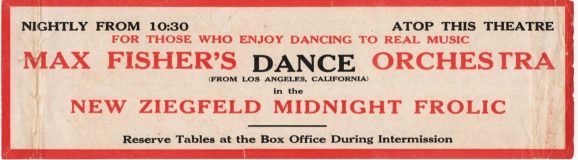
The Cocoanut Grove opened on April 21, 1921, a little over four and a half months after the hotel’s opening.  Max Fisher’s band, however, would not be part of that opening, as it had been invited to New York by Florenz Ziegfeld to perform at Ziegfeld’s Midnight Frolic, a rooftop nightclub atop the New Amsterdam Theatre that Ziegfeld established to capture the money that patrons would have spent elsewhere after the performance of his Follies downstairs had concluded.

Even though the band had only been at the Ambassador for a few months,  it must have been highly regarded by the hotel, as a farewell party was held at the Zinnia Grill, and the hotel’s manager presented each member of the band with a Morocco leather and gold-bound billfold with his name stamped on it.

Art Hickman’s band, which had appeared at the Zirgfield Follies the year before, as well as previously, replaced Fisher’s in time for the opening of the Cocoanut Grove.   Fisher’s band would once again become the Ambassador’s house band in 1924 when Hickman’s successor, Abe Lyman, stepped down to take his band on a national tour with the Orpheum Circuit.

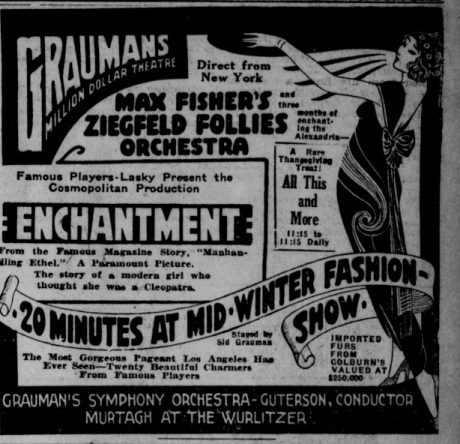
After concluding its run at the Midnight Frolic, the band was booked at the recently opened Ritz-Carlton Hotel in Atlantic City.  The band then returned to Los Angeles for an engagement at the Alexandria Hotel, owned by the same company that owned the Ambassador, billed as “Max Fisher and his Midnight Frolics Orchestra from the Ziegfeld Roof” followed by another engagement at Grauman’s Million Dollar Theater, billed as “Max Fisher’s Ziegfeld Follies Orchestra.”

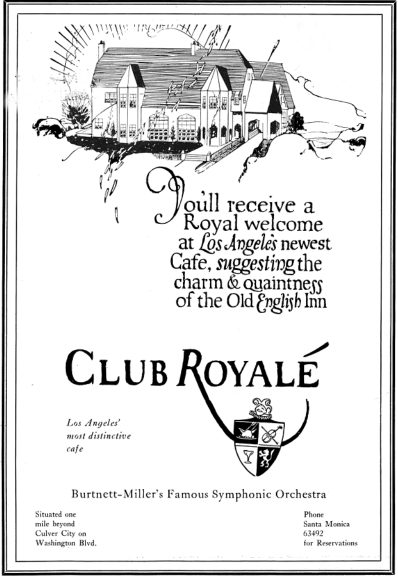
In October 1922, Fisher started his own high-end nightclub, which some referred to as a speakeasy, the Club Royale, on Washington Boulevard in Culver City, a street with multiple nightspots known to attract “gamblers, prostitutes and members of the movie crowd.”  Because Culver City was, at the time, relatively remote, though still close to Hollywood and Beverly Hills, enforcement of Prohibition laws was a bit more lax.

A June 1925 hotel trade publication reported that Fisher had “signed a contract to appear for six months at the new Prince of Wales Club, the most exclusive supper cafe in London’s West End.”  I don’t know whether this engagement actually took place, as this was the only reference to it that I could find.

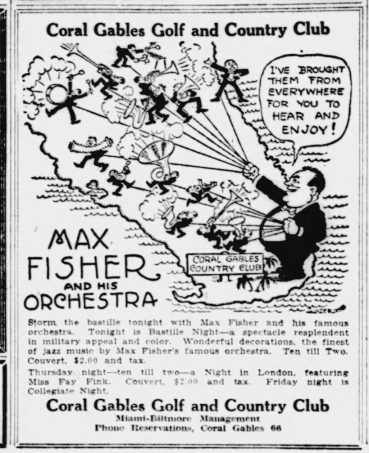
In April 1926, the band had another high-profile engagement when it followed the Paul Whiteman and Jan Garber bands for a thirteen-week engagement at the Coral Gables Golf and Country Club near Miami at the tail end of Florida’s frenzied 1920s real estate boom, which was brought to an abrupt end a few months later by the devastating 1926 Miami hurricane.

In 1928, the band appeared in and was the subject of a ten-minute single-reel Fox Movietone musical short feature titled Max Fisher and His California Orchestra. I have not been able to determine if copies of the film still exist or if, like many other films from the 1920s, it has been lost.

Among Fisher’s sidemen who went on to lead their own bands was Earl Burtnett, Fisher’s pianist, who eventually led the house band at the Ambassador Hotel’s archrival, the Los Angeles Biltmore.  Harry Owens, whose band at the Royal Hawaiian Hotel in Waikiki became famous for Hawaiian-themed dance music, played trumpet with the Fisher band.  In 1925, Fisher’s trombone player, Glenn Miller, came to the attention of highly regarded bandleader Ben Pollack, who offered Miller his next opportunity on his road to eventual international celebrity.

All of the above information comes from period source material I located through quick online searches and likely only scratches the surface of Fisher’s 1920s accomplishments.   So why has so little been written about him since then, and why has he become relatively obscure even among record collectors and 1920s enthusiasts?

My theory is that much of it has to do with the fact that his band did not make very many records.  It recorded a single side in 1921 for Vocalion while in New York, appearing at Ziegfeld’s Midnight Frolic.  In October 1922, it recorded two sides for Gennett Records at their studio in Richmond, Indiana, neither of which were issued.

The band did not record again until April 1927, when it made two sides for Columbia in New York.  It recorded an additional side for Columbia in New York the following month.

The recordings here come from a New York Columbia session held on December 6 and December 9, 1927, during which they also recorded a third side, “Is She My Girlfriend.”

The band recorded its final two sides in Chicago at the end of March 1928, also for Columbia.

Given how well-known and well-received the band was in various parts of the country, why did it only have a one-off side with Vocalion in 1921 and just eight sides for Columbia in 1927 – 1928?

I suspect we will never know for sure.  But my speculation is that much of it has to do with the fact that the band spent most of its time either in the Los Angeles area or on tour.  Prior to Brunswick setting up a recording studio in Los Angeles in December 1927, the only label with a permanent studio in California was Victor.   Prior to that, Brunswick and Columbia relied on occasional field trips to record West Coast talent.

The most prolific West Coast band of the era in terms of recordings was Abe Lyman’s band, which recorded for Brunswick.  But the majority of his 1920s sides were recorded either in New York or Chicago, where Brunswick was headquartered.

My guess is that all of Fisher’s recorded sides coincided with the band’s touring schedule.  If the band was elsewhere when the labels were in Los Angeles, then its only option for recording was to travel elsewhere.  Even if the record label was willing to pay for the band’s travel expenses, it still might not have made sense for a band to do so.  Then, as now, most musicians earned their living through live performances, not through record sales.  The cost of a couple of days’ worth of gigs to record in a distant city might very well have exceeded what they would have earned from the recording session.

Sadly, no matter how prominent a band might have been on radio and at various nightspots around the country, to the degree that it did not make records, it was doomed to be forgotten, as all that remains to remember it by are references in old newspapers and trade publications.

As for what became of Max Fisher after his last recording session with Columbia and his Movietone musical short feature in 1928,  period media mentions become less frequent. And, unfortunately,  research on what bands were up to after 1930 becomes more difficult, as many archives are reluctant to make copies of publications less than 95 years old available online due to fears of copyright infringement.

I was able to find brief references to his band performing at various venues through about 1933.

The May 8, 1943, issue of Billboard included a brief mention stating:

“Max Fisher, a big name in coast music circles 20 years ago, is rehearsing a crew in Hollywood, with GAC [General Amusements Corporation] set to book…”

This suggests that Fisher had become significantly less prominent by 1943, but it doesn’t indicate whether he had previously retired from leading a band and, if so, how long ago it was.   And it is questionable whether that band ever got off the ground, as Fisher died that same year on October 12 at the Veterans’ Hospital in Sawtelle, California. His obituary stated that he had been ill for six months with a heart ailment.

Both of the songs featured here are from the musical Take the Air, which opened at the Waldorf Theater on November 22, 1927.   The show’s plot had an aviation theme, in an attempt to capitalize on the aviation craze that followed Charles Lindbergh’s transatlantic flight.

Gene Buck, a longtime collaborator with Florenz Ziegfeld, decided to create his own production and, as a result, wrote, produced, and directed Take the Air. He even went so far as to purchase the Waldorf Theater, which had opened in 1926, and renamed it the Gene Buck Waldorf Theater.  The show enjoyed a 206-performance run before closing the following May.

The Waldorf Theater, located at 116 West 50th Street, was ultimately not successful and closed as a live theater in 1933 when its ground floor was converted into retail shops.  The theater’s balcony was extended and converted into a cinema.  After struggling to compete with the larger, grander Radio City Music Hall and the Roxy Theater, both of which were nearby, the cinema closed in 1941, and the entire building was used as retail space until it was demolished in 1968.


Posted in Uncategorized | Tagged , , , | Leave a comment

Jimmie Grier And His Orchestra – 1937

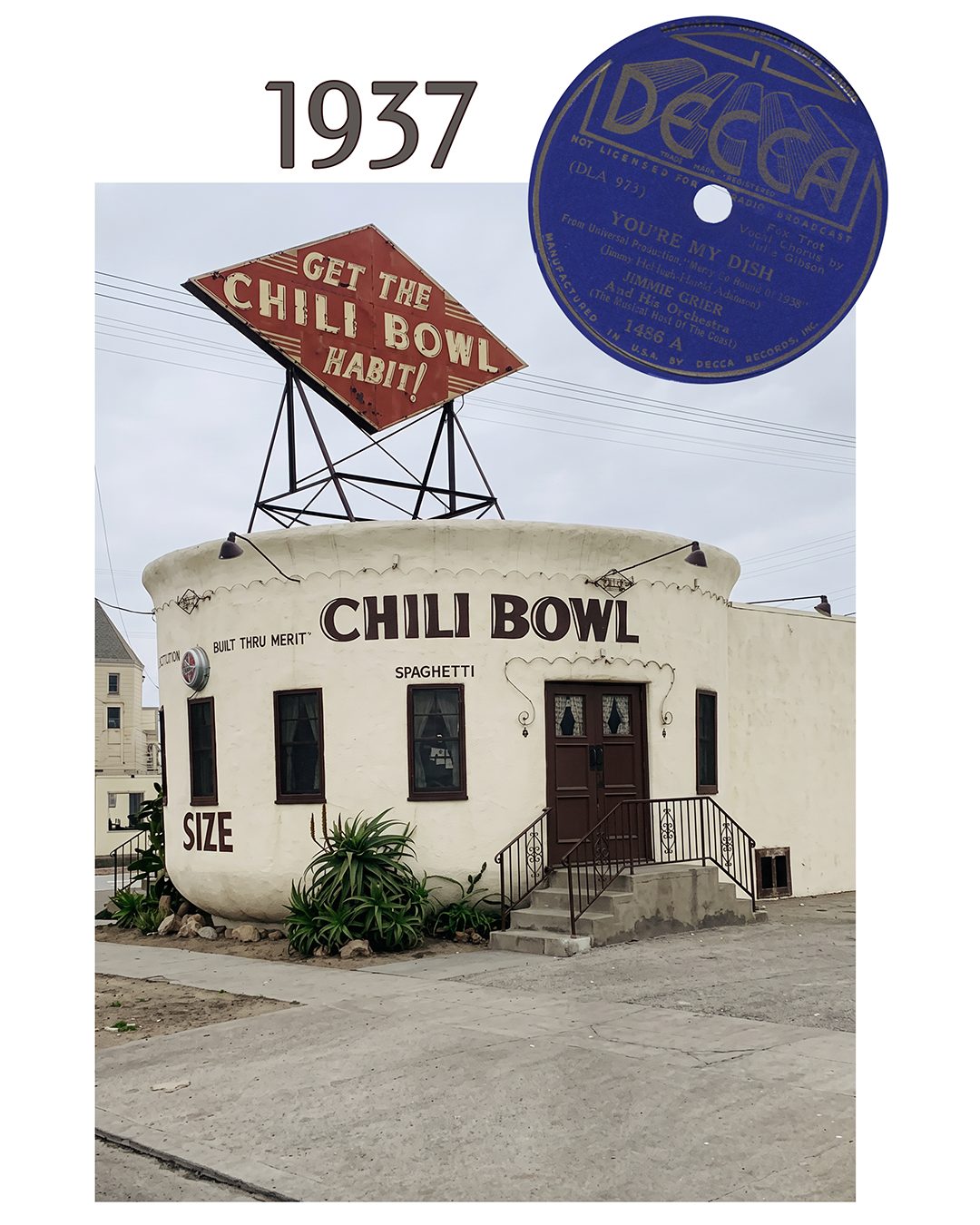
1937 image of the 801 N. La Brea Avenue location of the Chili Bowl restaurant, one of several that existed in the Los Angeles area in the 1930s.


“You’re My Dish”
Jimmie Grier And His Orchestra; Julie Gibson, vocal
October 1, 1937   (Decca 1486-A mx DLA 973)

Here’s a recording by a Los Angeles-based band that enjoyed national fame in the 1930s.

“You’re My Dish,” composed by Jimmy McHugh with lyrics by Harold Adamson, comes from the 1937 Universal Pictures film Merry-Go-Round of 1938. The film was not successful at the box office and proved to be a big financial setback for Universal.

The song is best remembered for Thomas “Fats” Waller’s September 7, 1937 recording of it on Victor, deservedly so, in my opinion.  Waller had a special talent for making even trite lyrics sound anything but.

As for this song’s lyrics being trite, in fairness, they are far from being the era’s worst offenders.  However,  they have always struck me as a not-so-subtle knock-off of Cole Porter’s lyrics for his 1934 composition “You’re the Top,” which I do not consider to be at all trite.

Regardless of the lyrics, I personally think this is a very nice recording.  Not only is the tune very catchy, the arrangement and the band’s execution possess a wonderfully opulent, symphonic grandeur.

Julie Gibson, the vocalist on the recording, eventually became Mrs. Jimmie Grier after marrying him in March 1939.   The marriage was short-lived, and she filed for divorce in October 1940.  She went on to become a film actress with Paramount Pictures, as well as a voice and dialogue coach.  She died in 2019 at the age of 106.

During the same session, the band also recorded the very haunting “Everything You Said Came True,” which ranks among my favorite late 1930s dance band recordings.  That recording has long been in Radio Dismuke’s playlist, and you can also hear it on demand on YouTube at this link.

Unlike many bands that struggled in obscurity before finding fame, Jimmie Grier’s band debuted in 1932 at one of the West Coast’s most renowned venues,  the Cocoanut Grove nightclub at the Ambassador Hotel in Los Angeles.  A talented musician proficient with multiple instruments, Grier had been a member of both the Abe Lyman and Gus Arnheim bands during their residency at the Cocoanut Grove.

While with the Arnheim band,  Grier also served as its principal arranger and crafted the band’s unique sound. Over time, however, he felt that Arnheim was not compensating him commensurately with his contribution to the band’s success and began to contemplate forming his own band.

That opportunity came in 1932 when Arnheim decided to take advantage of the national fame his band had earned as the featured band on the weekly NBC radio program The Lucky Strike Dance Hour and embarked on a lucrative nationwide tour.

Leveraging close connections he had built over the years, Grier convinced Ambassador Hotel management that he could form his own band to provide the same sound and format that had been so successful under Arnheim.  Several of Arnheim’s featured vocalists remained at the Cocoanut Grove and joined Grier’s band, helping provide additional continuity.

As a result of his arrangements, his amiable demeanor, and high-profile radio broadcasts,  Grier was soon billed as “The Musical Host of the Coast,” which appears under Grier’s name on this record’s label credits.

In 1933, Grier’s band had moved to the Cocoanut Grove’s archrival, the Biltmore Bowl, where it remained, performing six nights per week until 1937.   The Biltmore Bowl was a nightclub with a massive ballroom located in the basement of the Los Angeles Biltmore Hotel.  Both venues fiercely competed for the same elite, celebrity-studded clientele.

In addition to its own recordings,  Jimmy Grier’s band also provided the uncredited musical accompaniment on several recordings by Bing Crosby, the Boswell Sisters, and Russ Columbo.  He also wrote arrangements for motion pictures and, for a while, starred in two different radio programs.

Grier’s biggest hit was his October 1934 Brunswick recording of “The Object of My Affection” with Pinkie Tomlin on vocal, which, by the end of the year, had risen to number 1 on the sales charts.  Grier and Tomlin shared composer credit for the song with Coy Poe.  That recording enjoyed renewed visibility decades later when it was featured in the soundtrack of the 1973 film Paper Moon.

Two months later, the band made a second recording of the song, this time with a vocal by the Boswell Sisters.  That recording made its way to the top of the sales charts in early 1935.

Another highly successful Jimmie Grier recording featured in Paper Moon came from the band’s first recording session in March 1932 for Victor.  “One Hour With You” was the title song of the 1932 pre-code film directed by Ernst LubitschDonald Novis, who was a vocalist with the Grier band, performed the song in the film.  A few days after the film was released, Novis provided the vocal for Jimmie Grier’s recording of the song, which eventually climbed to the number 2 position on the sales charts.

Paper Moon and One Hour With You are films that I highly recommend for fans of 1930s era recordings and popular culture.

Though the Grier band made its last recordings in 1938, it remained active until 1942, when the wartime military draft made it difficult for bands to find staff.  Grier himself enlisted in the Coast Guard and served as assistant director to Rudy Vallee, who had also volunteered for the Coast Guard and led the 11th Naval District Coast Guard Band.  When Vallee transitioned back to civilian life in 1944, Grier assumed leadership of the band throughout the remainder of the war.

After the war, Grier formed a new band in 1946 which enjoyed a one-year residency at his old haunt, the Biltmore Bowl.  By that time, however, large dance bands and the number of venues willing to book them were in rapid decline.  For a period, Grier had a small Hollywood-based musical combo.  By the 1950s, after a stint as a radio disc jockey, Grier retired from the music industry and transitioned to a career in real estate.

Sadly, in 2005, despite being a highly significant historical and cultural landmark and organized efforts to save it, the entire Ambassador Hotel complex was destroyed by the Los Angeles Unified School District.

Happily, the Los Angeles Biltmore remains standing with much of its ornate 1920s interior still intact.  The Biltmore Bowl, however, did not fare so well and was destroyed by a fire in the 1950s.  The space that it occupied in the hotel’s basement was subsequently reconfigured and “modernized.”

Posted in Uncategorized | Tagged , , , | Leave a comment

Paul Biese And His Orchestra & Henry Halstead And His Orchestra – 1924

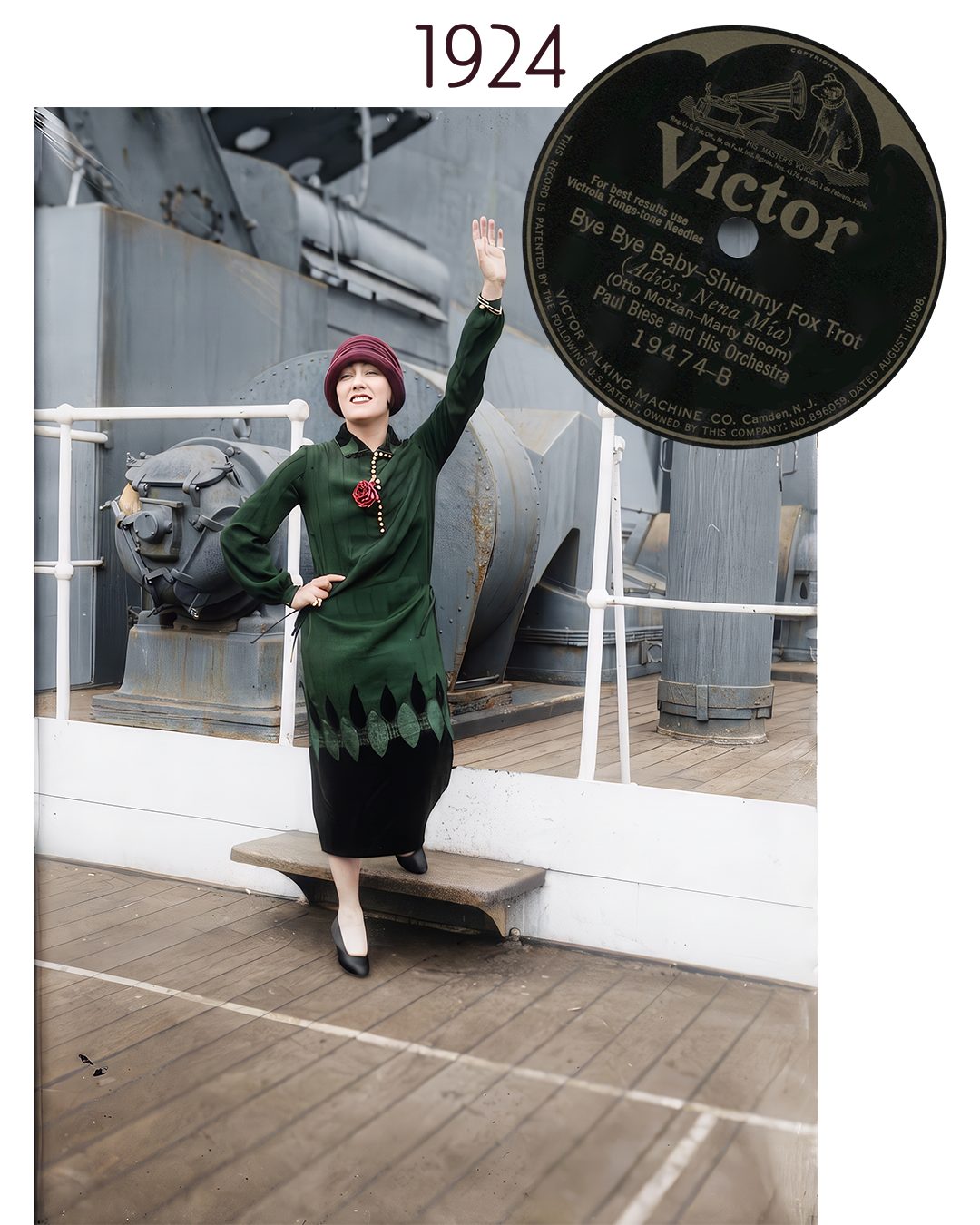
Actress Gloria Swanson, circa 1924


“Bye Bye Baby”
Paul Biese And His Orchestra
September 6, 1924   (Victor 19474-B)
“Tessie! Stop Teasin’ Me”
Henry Halstead And His Orchestra
August 30, 1924  (Victor 19474-A)


From the Edward Mitchell collection, here are two pre-microphone-era recordings by bands that have been mostly forgotten, but enjoyed significant popularity in the early 1920s.

Paul Biese was born in 1885 as Percy Hawthorne Sudborough. His Chicago-based band entered its brief period of national prominence in 1919, when the dominant inspiration of popular music was rapidly transitioning from ragtime to jazz.

By the time he was a teenager, Biese was already proficient at playing the violin, the clarinet, as well as the instrument he would become famous for, the saxophone. In 1899 and 1900, he spent two seasons touring as a member of Roney’s Boys Concert Company, a then-famous all-boy touring band led by Professor Henry B. Roney that performed for entertainment-starved audiences before the advent of mass media venues ranging from Chautauqua tents in backwoods towns to the White House.

During the 1910s, Biese enjoyed success as the co-composer of several popular ragtime compositions, including “Squirrel Rag” and “Dynamite” (whose sheet music cover can be seen above in this blog’s header image).

Biese’s band and recordings became well-known for his pioneering saxophone style, often billed as the “moaning saxophone.”  He was one of several artists who were instrumental in popularizing the once-obscure saxophone and helped make it a key musical component and cultural symbol of the 1920s Jazz Age.

Biese recorded around 50 issued sides for Columbia between 1919 and 1922, both with his full band and as Paul Biese and his Novelty Trio.  For a period, his records sold well and received good press coverage and strong promotional support from Columbia. However, after his last recording session with Columbia in December 1922, his contract was not renewed.  Biese did not make any more records until an April 1924 Victor field trip to Chicago, during which his band recorded six sides, only three of which were issued.

The recording featured here is from Biese’s last recording session, which was held in Los Angeles on September 6, 1924.  Another song, “Tell Me What To Do,” was also recorded during the session but was not issued.

Leading up to the recording session, Biese had been in Los Angeles since July 3, appearing at Solomon’s Penny Dance Arcade, a large, popular ballroom where patrons were charged a penny per dance (two cents a couple).  A couple of weeks after the recording session, the band also performed for the grand opening ceremonies of the Wurlitzer Building.  The trip westward immediately followed the Biese band’s defection from the Benson Organization, an early Chicago-based band booking agency operated by bandleader Edgar A Benson, to the newly formed Music Corporation of America (MCA), which would eventually become a powerful media conglomerate.

Biese had long struggled with his weight and, at one point, weighed over 400 pounds.  In 1922, over half a century before the advent of liposuction, he underwent a procedure by noted surgeon Dr. Max Thorek to remove 100 pounds of fat from his abdomen.  Surgery of any sort in the 1920s carried a high risk, as widespread usage of antibiotics was still a couple of decades away.  Fortunately, Biese fully recovered from the surgery.

In October 1925,  while the band was appearing at the Castle Farm Road House in Cincinnati, Biese became ill and was admitted to a hospital, where he underwent surgery for a strangulated hernia. This time, he was not as fortunate and died of complications shortly after the surgery at age 40.

Biese’s band was subsequently taken over by another MCA-affiliated, heavy-set saxophone player, Jack Crawford, and renamed Jack Crawford and his Slaves of Music, and completed the Castle Farm engagement.  Though it only recorded a handful of sides for Victor in 1927, Crawford’s band remained active into the early 1940s.

For more information on Paul Biese’s life and career, see Bill Edwards’ in-depth article at this link.

Henry Halstead was one of the more prominent West Coast bandleaders during the early 1920s, thanks in large part to his band’s residency at San Francisco’s St. Francis Hotel, where its regular radio broadcasts over radio station KGO could be heard throughout California and the wider region.

The year after the recording here was made, the band broke up, and Halstead formed a new one that was eventually billed as the “Favorite Band of Movieland.”

In 1927, the band became one of the first dance bands to appear in a Warner Brothers/Vitaphone sound-on-disc musical short feature, Carnival Night in Paris, which was also the first Vitaphone short feature filmed in Hollywood, rather than at the company’s studios in Brooklyn, New York.  It was also the first film appearance of future actor Lew Ayres, who, at the time, played banjo in Halstead’s band.

While Halstead’s band remained active into the 1940s, it made its last records in 1929. The devastating impact and subsequent consolidation that the Great Depression brought to the record industry significantly reduced opportunities for many bands to record.  Then, as now, most musicians earned their money from live performances, not through record sales. Indeed, there were countless, perfectly talented bands that remained active throughout the 1920s and 1930s and beyond that never stepped into a recording studio.

You can hear a recording that Halstead made of a rather unusual song a few months earlier in this blog’s July 8 posting.

“Bye Bye Baby” was co-composed by Otto Motzan and Rube Bloom.

“Tessie! Stop Teasin’ Me,” co-composed by bandleader Brook Johns and Ray Perkins, was recorded at Victor’s new West Coast pressing plant in Oakland, California.  The title shown on the record differs slightly based on the plant at which it was pressed.  The copy in Eddie’s collection was pressed at Victor’s East Coast facilities and contracted the word “teasing” to “teasin’.”  Copies pressed at the Oakland plant, which are distinguished by a small letter “O” at the top of the label immediately underneath the word “copyright,” spell the word out in full.

You can read biographical information about Brook Johns and hear one of his band’s recordings in this blog’s June 18 posting.


Posted in Uncategorized | Tagged , , , | Leave a comment

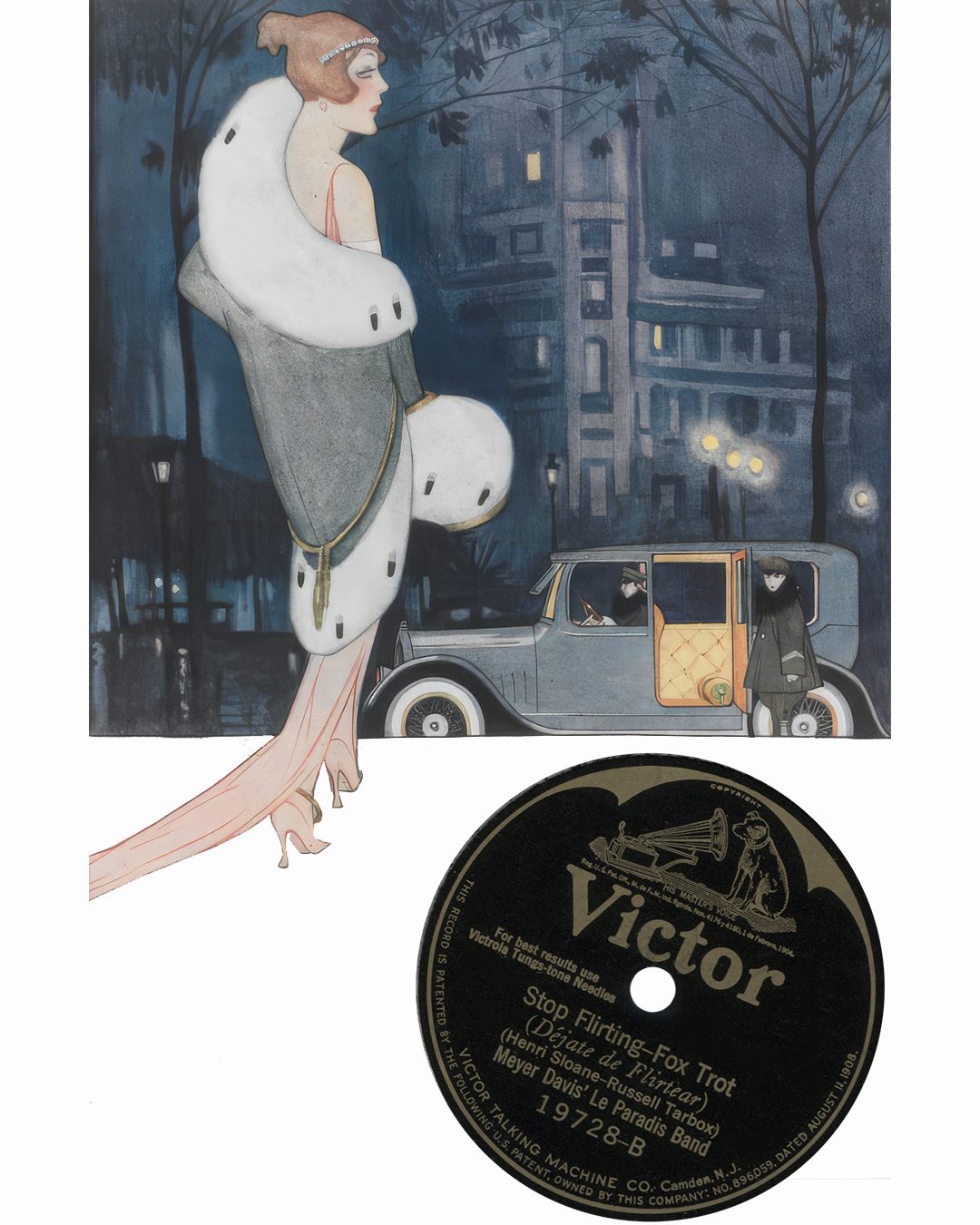
Meyer Davis’ Le Paradis Band & Coon-Sanders Original Nighthawk Orchestra – 1925

“Stop Flirting”
Meyer Davis’ Le Paradis Band
July 10, 1925   (Victor 19728-B)
“Alone At Last”
Coon-Sanders Original Nighthawk Orchestra; J. L. Sanders, vocal
July 13, 1925   (Victor 19728-A)


From the Edward Mitchell collection, here are two recordings from the period when Victor and Columbia had begun issuing records made using microphones but had not yet announced their new, vastly improved electrical recording technology to the public.

Part of the reason was that the new phonographs capable of reproducing the improved frequency range of the new records would not be available until later in the year. The other reason is that both companies wanted an opportunity to sell off their existing stock of records before they became perceived as obsolete.

Meyer Davis’s career as a bandleader spanned more than 60 years, including performances at inaugurations and White House events for every United States president from Woodrow Wilson to Gerald Ford shortly before Davis passed away in 1976.

Davis is best remembered not just for his band but also for the large music contracting empire he built around it.   At its peak, he controlled more than 80 bands employing more than 1,000 musicians that performed as the Meyer Davis Orchestra, primarily along the East Coast but also in other parts of the United States.  He was sometimes known as the “Millionaire’s Bandleader” because of the high demand for his orchestras at debutante balls and various resorts and nightspots popular with wealthy and socially prominent audiences.

One such venue was the Le Paradis Restaurant in Washington, D.C., one of the city’s hottest night spots in the 1920s, which Davis owned and built out to his specifications. You can find an interesting article about the history of the Le Paradis, including its Prohibition-era legal difficulties, at this link.

“Stop Flirting” was composed by Russell Tarbox, with lyrics by Henri Sloane, and was inspired by the success of the 1925 silent comedy film Stop Flirting. The film was an adaptation of the 1922 Broadway musical For Goodness Sake, which starred Fred and Adelle Astaire.  In 1923, the show moved to London under a new name, Stop Flirting, marking the Astaires’ debut on the London stage. The production was a favorite of the Prince of Wales, who attended ten performances and helped thrust the Astaires into London social prominence.

The song, however, came later and was not part of the stage production or the silent film score.

As mentioned in our June 28 posting, the Coon-Sanders Original Nighthawk Orchestra, led by Carlton Coon and Joe Sanders, was originally based in Kansas City, where it was among the first local, Midwestern bands to achieve national fame through radio, thanks to its late-night broadcasts beginning in 1922 from that city’s Muehlebach Hotel over radio station WDAF.

The band relocated to Chicago in 1924.  At the time this recording was made, the band was based out of that city’s Congress Hotel, where it had another successful late-night program, The Insomnia Club, broadcast over radio station KYW.

“Alone At Last” is a rather haunting tune composed in 1925 by bandleader Ted Fio Rito with lyrics by Gus Kahn. Fio Rito’s own band, however, apparently never recorded it.  Around eleven other recordings of the song were issued in the United States in 1925, including versions by the California Ramblers, Lee Morse, and Fletcher Henderson, as well as British recordings by the Jack Hylton and Geoffrey Goodhart bands.

Posted in Uncategorized | Tagged , , , , , | Leave a comment

Tuxedo Orchestra (Harry Reser) 1925

“Just A Little Drink”
Tuxedo Orchestra; Irving Kaufman, vocal
March  19, 1925  (Vocalion B 15007)
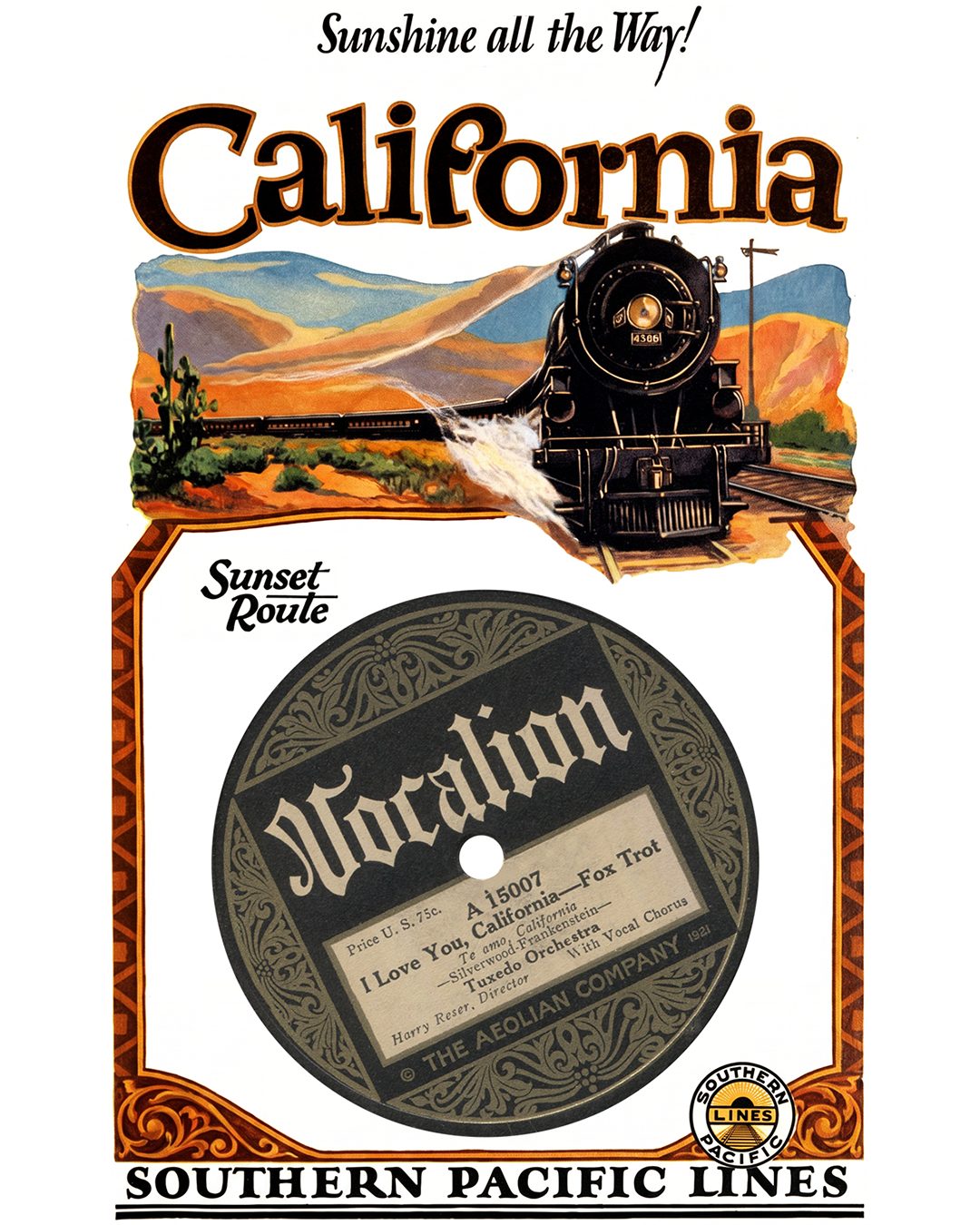
“I Love You California”
Tuxedo Orchestra; Irving Kaufman, vocal
March  19, 1925  (Vocalion B 15007)


From the Edward Mitchell collection, here are two recordings from a 1925 Vocalion record made just a few months after Brunswick Records had acquired the Vocalion label in November 1924.

At the time these were recorded,  Brunswick was still in the early stages of setting up its studios for the pallophotophone-based, so-called “Light Ray” electric recording system that it licensed from General Electric to compete with the microphone-based system licensed by Victor and Columbia, which they had already started using.

Thus, these recordings were made using the older acoustic recording horn technology.

The Tuxedo Orchestra credited on this record is merely a recording pseudonym and was in no way associated with the New Orleans-based  Original Tuxedo Jazz Orchestra.  Nor was it related to the Tuxedo Orchestra that appeared on Pathe and its subsidiary label Perfect, which was also a recording pseudonym.

The Tuxedo Orchestra pseudonym on Vocalion was used mostly for its in-house band, though a few recordings were made by bands such as Red Nichols’s, Charlie Straight’s, or, in the case of these two recordings, Harry Reser’s.

“Just A Little Drink” is a 1925 prohibition-themed novelty song with music and lyrics by Byron Gay.

“I Love You California,” composed by Abraham Franklin Frankenstein with lyrics by Francis Beatty Silverwood, dates back to 1913.  In 1951, the California State Legislature passed a resolution proclaiming it to be “an official state song.”  Additional legislation passed in 1987 further clarified it as the official state song.

Irving Kaufman provides the vocals on both recordings.

This recording of “I Love You California” was also issued under different pseudonyms on low-priced British labels: Washington Dance Players on Aco, Southern States Dance Orchestra on Beltona, and Maryland Dance Orchestra on the Coliseum label.


Posted in Uncategorized | Tagged , | Leave a comment

Six Black Diamonds – 1925


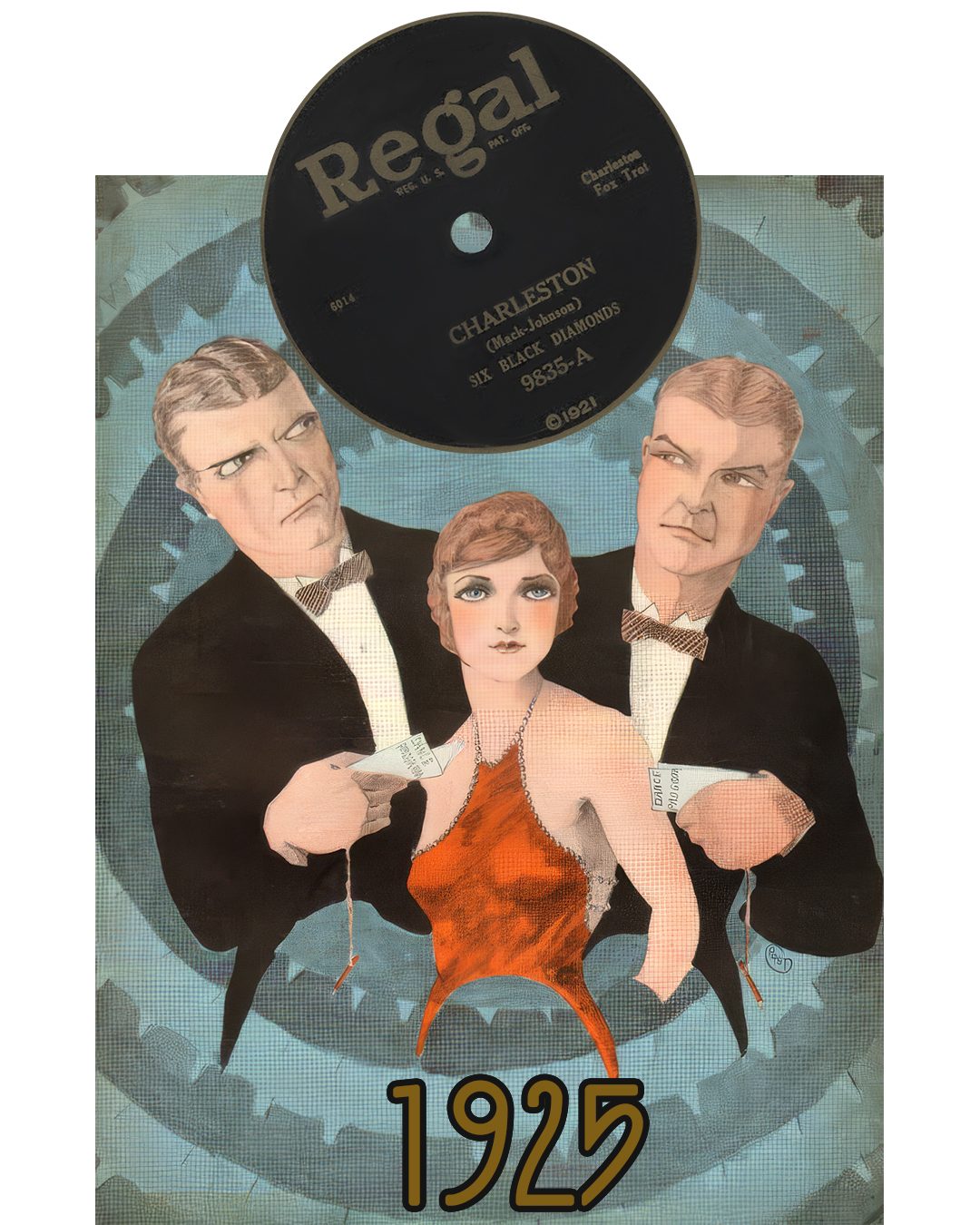
“Charleston”
Six Black Diamonds
May 14, 1925  (Regal 9835 A mx 6014)
“Sweet Georgia Brown”
Six Black Diamonds
circa May 1925  (Regal 9835 A mx 6015)

From the Edward Mitchell collection, here are recordings featuring “hot” arrangements of two iconic 1920s songs that are still familiar to modern audiences.

“Charleston” was composed in 1923 by James P Johnson and featured lyrics (though rarely heard in most recorded versions) by Cecil Mack for the all-black cast Broadway musical comedy Runnin’ Wild. The song inspired the dance and subsequent dance craze of the same name and remains closely associated with the culture and spirit of the 1920s in the popular imagination. This will be the eighth version of the song to be added to Radio Dismuke’s playlist.

“Sweet Georgia Brown” was composed by bandleader Ben Bernie and Maceo Pinkard with lyrics by Kenneth Casey.  Bernie’s own Hotel Roosevelt Orchestra was the first of many to record the song, and the record was a big seller.  Since 1952, the song has been well-known as the theme song of the Harlem Globetrotters.

By May 1925, Victor and Columbia were already making recordings with microphones, and Brunswick was using its own alternative version of electrical recording.   However, records on smaller labels, such as the ones these recordings were issued on, were still made using acoustical recording horns.

The Six Black Diamonds was a recording pseudonym used for a variety of bands on a multitude of mid- to low-priced labels produced by the Regal Record Company and distributed by the Plaza Music Company.  Regal/Plaza also supplemented its revenues by leasing its masters to other record manufacturers.

As was typical of Regal/Plaza recordings, both of those featured here were issued under a dizzying assortment of pseudonyms on multiple labels.

In addition to the copy here on Regal 9835,  this recording of “Charleston” was also issued as the Six Black Diamonds on Banner 1540.  On Domino 3510, it was credited to the Six Black Dominos.  On Oriole 413, sold through the McCrory dime store chain, it was credited to the Dixie Jazz Band.   On the mail-order National Music Lovers label, it was credited to the Manhattan Musicians.  And on the Sears Roebuck Co. in-house label Silvertone, it was credited as Lanin’s Roseland Orchestra, which was the name of an actual band, but that does not necessarily mean that it was the band appearing on the record.

It also appeared on Perfect 14432, credited to the Blues Chasers.   Perfect was the lower-priced subsidiary of the Pathe label.  Pathe was a completely separate company from Regal/Plaza and had its own recording facilities.  But the company would sometimes supplement its offerings by leasing masters from other labels.

I was not able to find any consensus as to whose band made the recording.  One source provides contradictory information depending on which label the identical recording was issued on, while the Discography of American Historical Recordings (DAHR) credits it to Regal/Plaza’s in-house studio band.

The recording of “Sweet Georgia Brown” did not appear on as many labels. DAHR credits it as being by Jack Stillman’s Orchestra, the name also used on its Bell label pressing, which featured a completely different song on its flip side.  On Regal, Banner, and Oriole, it had “Charleston” on the flip side and used the same pseudonyms mentioned above.  It was also issued on Silvertone 2490, but I have not been able to locate the pseudonym used on that issue.

My personal guess is that, given that the two recordings have consecutive matrix numbers, there is a decent possibility that they were made during the same recording session, which would suggest that they were both made by the same band.

The good news for collectors seeking their own copy of these recordings is that their issuance on so many labels increases one’s chances of eventually finding one. The bad news is that if a collector already has a copy and stumbles across a record of the same song by a different band, they may not realize that it is merely another copy of what they already have.

Posted in Uncategorized | Tagged , , | Leave a comment