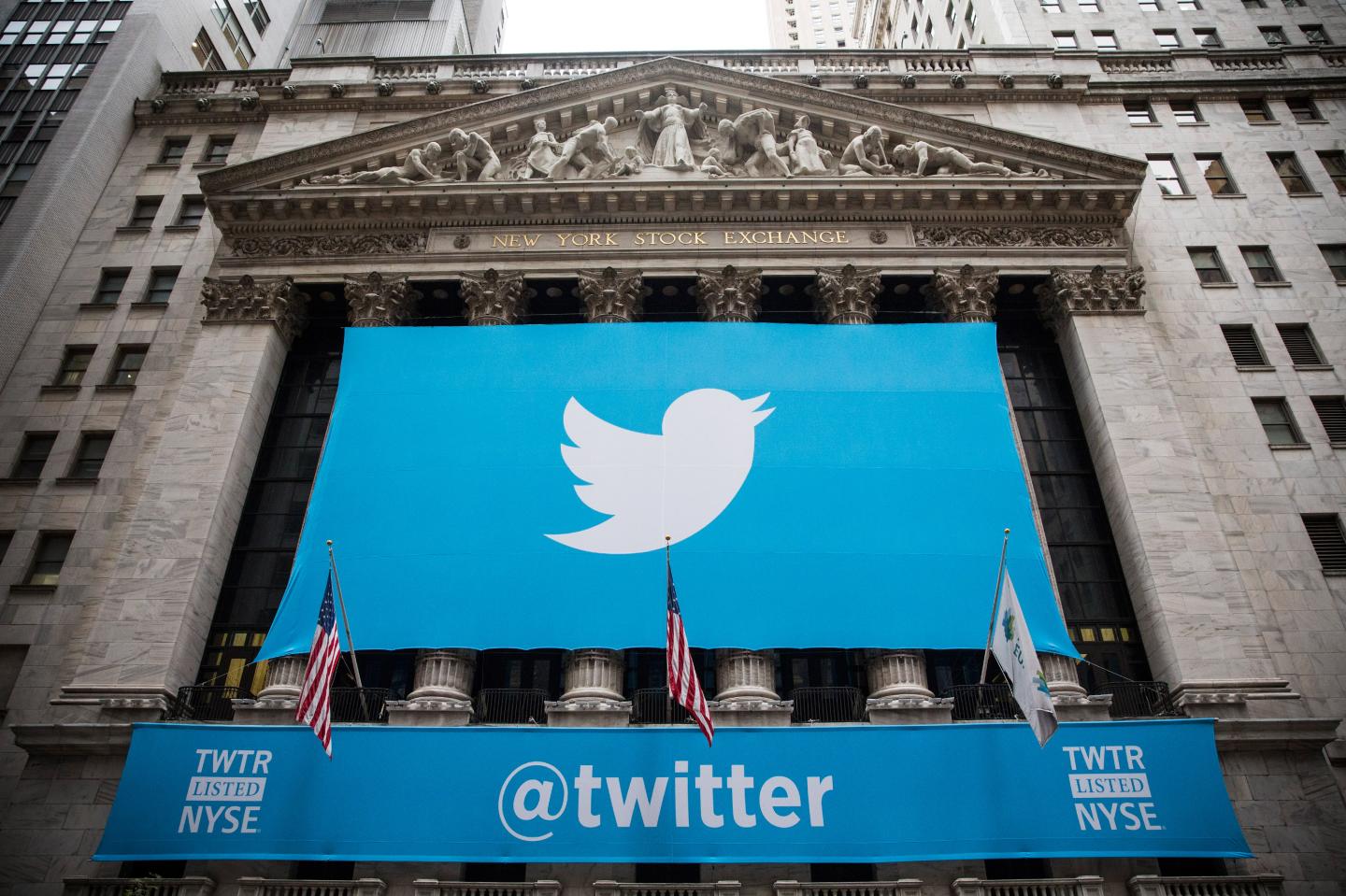
After Twitter’s stock performance (TWTR) in the past few months—it has fallen by more than 40% since May—you might think all the bad news was priced into the shares. But you would be wrong.
The company’s latest financial report took the stock down another 10% or so, which means that Twitter has lost close to $15 billion in market value in the last six months. It’s not that the company isn’t making money: It pulled in $569 million worth of revenue in the most recent quarter. That’s almost 60% higher than its revenue in the same quarter of last year, and higher than analysts expected.
If Twitter just made that same amount of revenue every quarter, it would have annual sales of $2.3 billion. That’s nothing to sneeze at. So then why did the stock fall off a cliff? Because the company said it will only have $700 million in sales this quarter, much lower than consensus estimates. And subscriber growth was beyond anemic: Twitter’s user base grew by just 1.3% in the quarter, which might as well be zero.

The problem isn’t Twitter’s revenues, or its user base—which is around 300 million—or even its profitability. It’s that those things aren’t growing quickly enough to justify the premium investors are paying. Even at its current depressed level, the share price works out to about eight times revenues, which is a lot to pay for a company that isn’t growing very quickly. Twitter hopes new features such as Moments can help boost the user base, but there’s no sign of that happening.
The big issue is the ad model
In many ways, user growth is just a subset of a larger problem, which is the company’s ad model. Most of Twitter’s focus has been on brand advertising, the kind where the sales team goes out and lands big-name clients like McDonald’s. But that kind of advertising requires huge audiences to be cost-effective, and Twitter’s 300 million users pales next to Facebook’s 1.5 billion. It’s even smaller than the user base at Instagram, which is becoming more of an advertising force.
Twitter has been trying to build a direct-response ad business alongside the brand business, but it has been having mixed success, in part because it doesn’t have the behavioral data to convince advertisers that the business is working. It also isn’t able to target users in quite the same laser-like manner that Facebook (FB) can. The result has been lower prices, which is putting pressure on advertising revenue growth.
For a time, investors were willing to pay a premium for Twitter because its advertising revenue was growing by double digits every quarter, and the rate of growth was also increasing. But that no longer seems to be the case—and boosting the amount of ads in the stream could make it worse. As tech analyst Ben Thompson put it in a recent issue of his subscription newsletter Stratechery:
“Brand advertising is the sort of advertising most adversely affected by Twitter’s lack of scale: brand advertisers want to reach the largest possible audience at the lowest possible cost in both dollars and in effort. In other words, given the reality of Twitter’s growth problem, the company has been building the exact wrong sort of advertising business.”
Cost per engagement
Speaking of ads, if you look underneath the hood of the latest financial results, one number jumps out: Twitter’s CPE, or cost per engagement. That’s what the company charges advertisers for each click or share or retweet of their message, and it dropped by almost 40% year-over-year. According to analysts, that’s almost entirely because of auto-play video ads, which are notoriously poor performers, and are priced accordingly.
Twitter’s head of revenue, Adam Bain, says the low CPE for video means a better return on investment for advertisers, which will encourage more to use them. But if they don’t, it means Twitter makes a lot less money. And while ad-engagement levels were up sharply—which helps explain why revenue rose even though CPE fell—the recent shift to auto-playing videos boosted those engagement levels substantially, because each play is considered an engagement.

Whether the combination of auto-play videos and a low CPE pulls in more high-value advertisers remains to be seen, however. And some agencies complain that Twitter’s cost-per-engagement model doesn’t actually translate into “conversions,” which is what advertisers want to see—namely, a user clicking to go to a website (Twitter recently added a new feature that also lets advertisers pay per click).
Here’s the hypothetical future investors are wrestling with: Twitter’s user growth remains slow to non-existent, which means large brands are likely to be less interested; that in turn means more low-rent, direct-response advertising. Twitter is touting its reach to “logged out” users of the service, but they are probably worth even less. All of which leads to the possibility that Twitter’s revenue growth continues to decelerate.
What you have then is a company with an audience of 300 million, and a relatively low-growth and low-value advertising business attached to it (along with maybe a smattering of e-commerce, etc.). It’s not that this would be a bad thing—it might even be a pretty good business for a small to medium-sized company. But is it worth $20 billion? Probably not.
You can follow Mathew Ingram on Twitter at @mathewi, and read all of his posts here or via his RSS feed. And please subscribe to Data Sheet, Fortune’s daily newsletter on the business of technology.
