Before beginning lesson two, I think it’s necessary to mention that
each lesson is the continuation of the previous one. Consequently, you
may find yourself unable to understand the new lessons perfectly if you
ignore the previous lessons. So, I strongly recommend that you study the
lessons step by step without skipping any of them. I’m sure you will
make great progress in near future if you follow the instructions. In
the case you followed the instructions as you are being told and still
found it difficult to learn, then you would have the right to angrily
blame me for wasting your time and I would certainly shut down this site
forever! It’s a deal!
Lesson 2 (Welcome back!)
Ok. How was lesson one? Was everything clear? If not, please let me
know. Your suggestions will certainly improve the quality of this site
to help you get most out of these pages.
Last week, we learned many things, such as short vowels, three big
letters along with their small forms, the correct pronunciation of the
letters and so on. We also learned how to write these letters. Do you
remember those letters? Perfect! Now try to review them before we
proceed.
Today, we are going to learn long vowels with the help of
the same letters. Then, you will be able to pronounce each letter with
six vowels (sounds, as used more frequent in Persian). From now on, make
the habit of pronouncing each letter with these six vowels. If this is
correctly done, you will become unbelievably fluent in learning and
pronouncing the letters.
Ready? Let’s begin!
As you know, we have three long vowels in Persian. Although we can put some signs on or under the letters as we did it with the short vowels, I am trying to avoid doing this with the long vowels here. Therefore, we are not going to put some symbols on or under the letters. We can find these long vowels by detecting some letters. This will make it easier.
If you remember, I told you that all big letters come at the end of
the words and may stand either attached or separated from other letters
with only one exception. Today, we will see that exception.
Look at this letter.  This is the big letter ‘A’ in Persian, which unlike all other big letters comes at the beginning of the words only. Do you still remember the big letter B and P? As you remember, they come at the end of the words and may stand either attached or separated from other letters. But, here, the big letter (the only exception) does not attach to other letters. It stands separated only.
The pronunciation of this letter is not so difficult. It has only one
pronunciation, and does not accept any other short and long vowels. You
have to pronounce it as /a:/ in arm.
In one word, this is the big letter ‘A’ in Persian and pronounced as /a:/ in arm.
Is that clear? If you need to know how the big letter is pronounced in Persian, click here to listen. Okay i can write an instance for:look at here:
آبی = Blue

آب = Water
 This one is the small letter ‘a’ in Persian. It may appear anywhere in
words: beginning, middle, and in the end. This letter can accept all six
main vowels, including short and long vowels.
This one is the small letter ‘a’ in Persian. It may appear anywhere in
words: beginning, middle, and in the end. This letter can accept all six
main vowels, including short and long vowels.
Now that we are familiar with the long vowel /a:/ in Persian, we are
ready to learn two other long vowels. Those are /i:/ as in see. And /u:/
as in two.for example
 :
:
(æbr)ابر = Cloud

(i:n)این = This-it
That = آن
آن ها = those
این ها = these
 This is the big letter ‘Y’ in Persian. Only this letter can be pronounced as /i:/ sound. /i:/ as in see.
Note: like all other big letters, this comes at the end of the words
and may stand either attached or separated. This can be pronounced as
/i:/ Mostly when it is attached to other letters.for example:
 This one is the small letter ‘y’ in Persian. Like all other small
letters, it comes at the beginning or middle of the words and accepts
all six vowels.
This one is the small letter ‘y’ in Persian. Like all other small
letters, it comes at the beginning or middle of the words and accepts
all six vowels.
The last one is the long sound /u:/.
As I told you before, some Persian letters have only one form. That is to say, their small and big forms are equal.
This letter is one of them.  This is the only letter that may be pronounced as /u:/. /u:/ as in two.
I guess you may find these explanations a little bit confusing.
Nevertheless, this is the only way to explain the long vowels. I am now
trying to make it easier to understand through writing.
As you remember, this is ‘B’ in Persian:  . Last week, we learned how to pronounce this letter with short vowels:
  . Toady we will pronounce it with the long vowels too.
1-  this is pronounced as /ba:/ in barter.
2-  this is pronounced as /bi:/ in beat.
3-  this one is pronounced as /bu:/ in boot.
Now, try to pronounce  with the help of these three long vowels. You will say: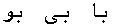
Well done! Was it really difficult? Now, we pronounce the letter with the help of six main vowels. Ready? Don’t forget to read from right to left.

(b:ab:a)بابا = Dad
(b:us)بوس = kiss
(b:i k:ar)بی کار = unemployed
From now on, we should pronounce each letter with these six sounds.
Now it’s your turn.
 This is ‘p’ in Persian. Try to pronounce it with the six vowels. You will say:
  . Great job! If you need help, look at this exaple
 :
:
(p:uy:a)پویا = dynamic
(p:ap)پاپ =(pop(music
(p)پول = money
Finally,  this is’T’ in Persian. Try to pronounce it with the six vowels. You will say:
  .
.
I'll show you some words:look at here:

(t:ut)توت = berry
(t:ab)تاب = swing
(tiæhr:a)راحتی = Convenience
All right. This is the end of lesson two. Please remember that the
most difficult part of our job is pronouncing the letters with these six
vowels, which is the start point of entering into a new language. We
wouldn’t have this much problem after we learned the letters
successfully. From next week, all we have to do is practicing some new
letters with these vowels till we complete the letters. So, you may
consider today’s lesson the most difficult one for weeks to come.