On the Frequency of Parasha Doublings
The number of Shabbatot in a Hebrew year can be 50 or 51 in a regular year or 55 in a leap year, and every year one or more ḥaggim also fall on Shabbat. Since the Torah is divided into 54 parashot for the weekly reading, almost every year there are some Shabbatot where two parashot are combined into a single reading. The procedures for which parashot are combined and when seem to be similar in almost all Jewish communities today (I believe there are exceptions, but have not yet been able to collect information on them). I do not know when these procedures were established or by whom (Saadia Gaon in his Siddur and Maimonides in the Mishne Tora refer to them, but do not state every detail of the practice as we know it today), but part of the reason behind the procedures is to maintain certain constraints on when specific parashot are to be read:
- The tokhaḥa in Parashat Beḥukkotai to be read two or three weeks before Shabuʿot
- The tokhaḥa in Parashat Ki Tabo to be read two weeks before Rosh Hashana
- Parashat Debarim to be read the Shabbat before Tishʿa BeʾAv
- And of course, though this may be stating the obvious, to begin with Parashat Bereshit the Shabbat after Simḥat Torah and reach Ha’azinu the Shabbat before the next Sukkot so as to finish with Vezot Haberakha on Simḥat Torah.
The procedures also vary between Israel and the Diaspora, for the obvious reason that the second days of festivals observed in the Diaspora add more instances when a festival falls on Shabbat and its reading replaces the weekly Parasha. Let us examine the occurences of each pairing and their frequencies.
- Vayakhel–Pekudei
- The first example is the last two parashot in Exodus. These are combined in every non-leap year, except when Rosh Hashana is on Thursday in a "full" year when Marḥeshvan has 30 days. This happens on average about 3 times in 5 years (59.82%)
- Tazria–Meṣora
Aḥarei Mot–Kedoshim
Behar–Beḥukkotai - The three pairs of parashot in Leviticus are all combined every non-leap year and separated every leap year, so they are each combined in 12 years out of every 19 (63.16%). There is one exception: in a non-leap year in Israel when the first day of Pesaḥ is on Shabbat, Behar and Beḥukkotai are read separately. This means that they are paired in Israel only about 9 times in 20 years (45.11%).
- Ḥukkat–Balak
- Ḥukkat and Balak are only paired in the Diaspora, and only when the second day of Shabuʿot is on Shabbat. This happens on average twice in seven years (28.57%)
- Mattot–Masʿei
- Mattot and Masʿei are paired in every year, except in leap years where Rosh Hashana is on a Thursday, and in Israel also except in leap years when the first day of PesaḤ is on a Shabbat. In the Diaspora this happens almost 9 times in 10 years (89.91%), in Israel almost 8 times in 10 years (79.49%).
- Niṣabim–Vayyelekh
-
Niṣabim and Vayyelekh are read together when either of Rosh Hashana or Yom Kippur in the upcoming year is on Shabbat. On average this happens about 3 times in 5 years (60.46%).
Note: precisians will tell you that I should have put this differently — Parashat Niṣabim is split into two separate readings when neither Rosh Hashana nor Yom Kippur is on Shabbat, and therefore there is an extra Shabbat before Sukkot; also I should have begun by saying that there are 53 parashot in the Torah, not 54 — but this is a rabbit hole we will not be going down in the current discussion.
So how often does it happen that no parasha is paired with another throughout the whole year? In the Diaspora this is a rare event: it only happens in leap years in which Rosh Hashana is on Thursday and the first day of Pesaḥ not on Tuesday (which would make the following Yom Kippur on Shabbat) — a combination which only occurs about once in 26 years (3.87%). This occurred twice at the beginning of this century, in 5765 (2004–5) and 5768 (2007–8), but the next time will not be until 5812 (2051–2). In Israel it also happens in leap years where the first day of Pesaḥ is a Shabbat, altogether nearly once every seven years (13.86%). The last time was last year, 5782 (2021–2) and the next will be 5803 (2042–3).
Tagged Jewish calendar

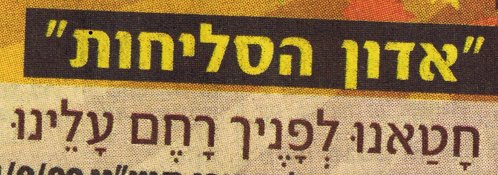 . אני סופר 4 שגיאות. ואתם?
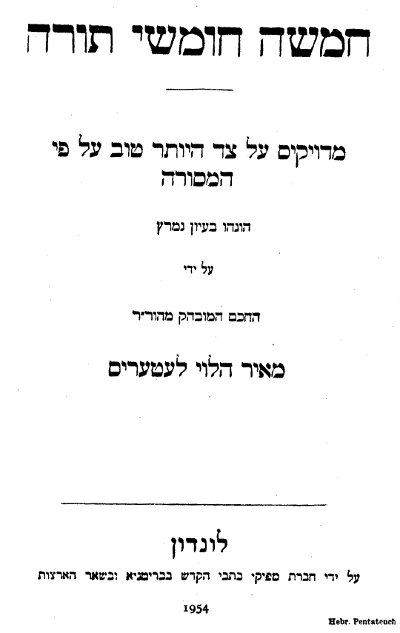
 . The editor has chosen to emend the text by omitting the word מוּמָם, but the other words of the verse are left with their original accents. The result is nonsense, because the accent system of the Hebrew Bible operates with longer units than single words. I’m not sure myself that the emended text improves the reading*, but that is beside the point. In terms of the accent system, omitting one word implies an emendation to the surrounding words as well. In this case “בָּנָיו” has become the last word of the clause, but the editor has left it with a conjunctive accent. This may seem like a quibble to people unaccustomed to reading the Bible with the accents, but I personally was unable even to parse the result until I had worked out what was intended by reading the critical notes.