
Women's Trending Fall Arrivals
Buy New
-28% $16.66
FREE delivery Saturday, September 26
Ships from: kozybooks85
Sold by: kozybooks85
$16.66 with 28 percent savings
List Price: $22.99
FREE delivery Saturday, September 26. Details
Only 1 left in stock - order soon.
$$16.66 () Includes selected options. Includes initial monthly payment and selected options. Details
Price
Subtotal
$$16.66
Subtotal
Initial payment breakdown
Shipping cost, delivery date, and order total (including tax) shown at checkout.
Shipper / Seller
Returns
30-day refund/replacement
Quick refund
Usually issued within 24 hours. See exceptions
Shipping fee
May apply, not eligible for free return. See details
Convenient dropoff
At any of our 50,000 US locations.
See return policy
Payment
Secure transaction
Your transaction is secure
We work hard to protect your security and privacy. Our payment security system encrypts your information during transmission. We don’t share your credit card details with third-party sellers, and we don’t sell your information to others. Learn more
$1.67
Item in very good condition! Textbooks may not include supplemental items i.e. CDs, access codes etc... Item in very good condition! Textbooks may not include supplemental items i.e. CDs, access codes etc... See less
$3.98 delivery Saturday, September 26. Details
Only 1 left in stock - order soon.
$$16.66 () Includes selected options. Includes initial monthly payment and selected options. Details
Price
Subtotal
$$16.66
Subtotal
Initial payment breakdown
Shipping cost, delivery date, and order total (including tax) shown at checkout.
Access codes and supplements are not guaranteed with used items.
Added to

Sorry, there was a problem.

There was an error retrieving your Wish Lists. Please try again.

Sorry, there was a problem.

List unavailable.
Kindle app logo image

Download the free Kindle app and start reading Kindle books instantly on your smartphone, tablet, or computer - no Kindle device required.

Read instantly on your browser with Kindle for Web.

Using your mobile phone camera - scan the code below and download the Kindle app.

QR code to download the Kindle App

  • The Republican War on Science

Follow the author

Get new release updates & improved recommendations
Something went wrong. Please try your request again later.

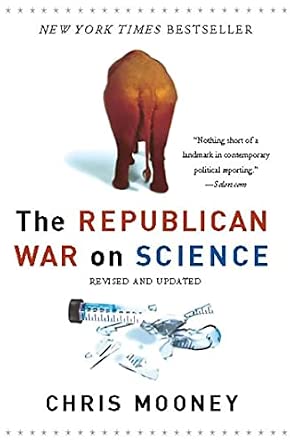
The Republican War on Science

4.4 out of 5 stars (128)

{"desktop_buybox_group_1":[{"displayPrice":"$16.66","priceAmount":16.66,"currencySymbol":"$","integerValue":"16","decimalSeparator":".","fractionalValue":"66","symbolPosition":"left","hasSpace":false,"showFractionalPartIfEmpty":true,"offerListingId":"d0J%2BtYsJ9e9qa70kemKtRrcRFGSyxZeYrOmW70r%2FWZg35qSMp%2BtcUjGGnRdk1F%2BL2BVsn9wdoW1ZeIbYGTADa%2F9jcXGAcc89biGX3U9wC9ftOvTOE7R2%2B63vInaFRtr8PUfw3P22Ad4Z8vS55b1M%2FXTRGSWFEDs1I%2Fe0hHFjtYUAias%2Fuiohhg%3D%3D","locale":"en-US","buyingOptionType":"NEW","aapiBuyingOptionIndex":0}, {"displayPrice":"$1.67","priceAmount":1.67,"currencySymbol":"$","integerValue":"1","decimalSeparator":".","fractionalValue":"67","symbolPosition":"left","hasSpace":false,"showFractionalPartIfEmpty":true,"offerListingId":"d0J%2BtYsJ9e9qa70kemKtRrcRFGSyxZeYTypwSj6Bbkwf1XesE32GljK2xfXtnHnkCawad6XaQovmX%2BrsuriHK%2B9vNYudF5lEaTUOSgKoYR%2BNDoz1WcQ8NQoFrx3YFba%2B5%2B1CXk3%2FkQSlLesi%2FOo1euSiyGzYNRvxqJVTadkQkctEWpVBUiAFUBqyzcler971","locale":"en-US","buyingOptionType":"USED","aapiBuyingOptionIndex":1}]}

Purchase options and add-ons

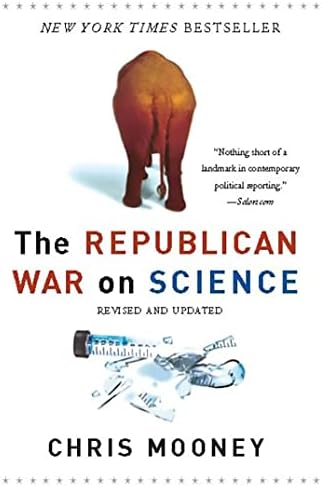
Science has never been more crucial to deciding the political issues facing the country. Yet science and scientists have less influence with the federal government than at any time since the Eisenhower administration. In the White House and Congress today, findings are reported in a politicized manner; spun or distorted to fit the speaker's agenda; or, when they're too inconvenient, ignored entirely. On a broad array of issues-stem cell research, climate change, missile defense, abstinence education, product safety, environmental regulation, and many others-the Bush administration's positions fly in the face of overwhelming scientific consensus. Federal science agencies, once fiercely independent under both Republican and Democratic presidents, are increasingly staffed by political appointees and fringe theorists who know industry lobbyists and evangelical activists far better than they know the science. This is not unique to the Bush administration, but it is largely a Republican phenomenon, born of a conservative dislike of environmental, health, and safety regulation, and at the extremes, of evolution and legalized abortion. In The Republican War on Science , Chris Mooney ties together the disparate strands of the attack on science into a compelling and frightening account of our government's increasing unwillingness to distinguish between legitimate research and ideologically driven pseudoscience.
The%20Amazon%20Book%20Review
The Amazon Book Review
Book recommendations, author interviews, editors' picks, and more. Read it now.

Frequently bought together
This item: The Republican War on Science
$17.83
Get it as soon as Friday, Sep 25
In Stock
Ships from and sold by Amazon.com.
+
$33.14
Get it as soon as Friday, Sep 25
Only 18 left in stock - order soon.
Ships from and sold by Amazon.com.
Total price: $00
To see our price, add these items to your cart.
Details
Added to Cart
One of these items ships sooner than the other.
Choose items to buy together.

Customers also bought or read

Loading...

Editorial Reviews

About the Author

Chris Mooney is the author of The Republican War on Science and Storm World. A Knight fellow in science journalism at MIT, he contributes to many publications, including Mother Jones, Wired, the Boston Globe, and Slate. He lives in Cambridge, Massachusetts.

Product details

  • ASIN ‏ : ‎ 0465046762
  • Publisher ‏ : ‎ Basic Books
  • Publication date ‏ : ‎ August 29, 2006
  • Language ‏ : ‎ English
  • Print length ‏ : ‎ 376 pages
  • ISBN-10 ‏ : ‎ 9780465046768
  • ISBN-13 ‏ : ‎ 978-0465046768
  • Item Weight ‏ : ‎ 13.8 ounces
  • Dimensions ‏ : ‎ 8.5 x 0.89 x 11 inches
  • Best Sellers Rank: #2,372,128 in Books (See Top 100 in Books)
  • Customer Reviews:
    4.4 out of 5 stars (128)

About the author

Follow authors to get new release updates, plus improved recommendations.
Chris Mooney
Brief content visible, double tap to read full content.
Full content visible, double tap to read brief content.

Chris Mooney is a science and political journalist, blogger, podcaster, and experienced trainer of scientists in the art of communication. He is the author of four books, including the New York Times bestselling The Republican War on Science and most recently The Republican Brain: The Science of Why They Deny Science and Reality (April 2012). He blogs for Science Progress, a website of the Center for American Progress and Center for American Progress Action Fund, and is a host of the Point of Inquiry podcast.

Sponsored

Customer reviews

4.4 out of 5 stars
128 global ratings
Sponsored

Top reviews from the United States

  • 5 out of 5 stars
    Author surpasses a high bar to prove his point
    Reviewed in the United States on November 25, 2006
    Brief content visible, double tap to read full content.
    Full content visible, double tap to read brief content.

    Given the provocative title of the book, I had several questions I researched in the reader reviews as well as by monitoring the author's blog site prior to purchasing this book. After my research and after reading the book, I believe Mr. Mooney passed those tests with flying colors and I highly recommend the paperback edition since it's updated with more recent attacks on the misuse of science as a premise to develop unsound public policy.

    The questions I was concerned about are as follows:

    Was the book an ideological hit-job by a Democrat on Republicans for mere political gain, or has there been a systemic attack by Republicans to mutate from using scientific knowledge as a major factor when developing public policy?

    Did the book provide mere anecdotal evidence where the anecdotes didn't have a significant impact on public policy or the public's well-being, or did Mr. Mooney provide meaningful information that presented a pattern of attacks by Republicans with ancedotes that weren't trivial, but instead illuminated a reality where Republican policy led to less than optimal, and even dangerous results?

    If Republicans were in fact engaged in a pattern of abuse, who were the benefactors and who were the victims and is this practice bad enough that a Republican like me should use Republican abuse of science as a factor to sway me to vote against Republican abusers and if so, should my rejection be individual republican politicians or the party as a whole?

    What is the root cause of the creation of this abuse, assuming it exists, and why should I assume the Democrats wouldn't maintain this supposedly new status quo of misuing science if they came into power?

    I believe Mr. Mooney did a great job of providing solid evidence that the abuse exists, how it came into being, and how voters can fight back. In fact, as I write this President Bush is in the process of appointing Dr. Eric Keroack to be deputy assistant secretary of population affairs within the Department of Health and Human Service, the agency responsible for federal family planning policy; Dr. Keroack happens to believe and has supported by actively managing a group who supports policies to eradicate the use of contraception, even for married couples, the group, "A Woman's Concern", also

    "provides scientifically false health information--for instance, that condoms "offer virtually no protection" against herpes or HPV. Keroack also promotes a wacky piece of pseudoscience: the claim that premarital sex disrupts brain chemistry so as to create a physiological barrier to happy marriage. . . "

    (Slate On-line, By Amanda Schaffer - Posted Tuesday, Nov. 21, 2006, at 4:50 PM ET)

    Mr. Mooney covers the factors that led to Republican abuse of science, the areas where Republicans abuse science and their motivation for doing so, and suggestions by the author as to how citizens should respond. I'm glad Mr. Mooney kept his own recommendations to a minimum and at the end of the book. The meat of this book is the cause, motivation, and impact; Mr. Mooney deserves big kudos for the investigative journalistic effort he expended on our behalf.

    16 people found this helpful
    Sending feedback...
    Thank you for your feedback.
    Sending feedback...
    Thanks, we'll investigate in the next few days.

    We'll check if this review meets our community guidelinesOpens in a new tab. If it doesn't, we'll remove it.

  • 4 out of 5 stars
    Our Scientific Dark Age
    Reviewed in the United States on October 25, 2007
    Brief content visible, double tap to read full content.
    Full content visible, double tap to read brief content.

    In 1995, Speaker of the House, Newt Gingrich fired the first political salvo in the war on science by abolishing the Office of Technology Assessment (OTA). This was an impartial scientific committee that provided scientific consensus on issues brought to them from the political arena. Many of their findings conflicted with the interests of tobacco, energy, pharmaceutical, anti-environmnental, coal and oil lobbies, lobbies that contributed heavily to republican campaigns. With the dissolution of this organization, our lawmakers began to politicize science. The Gingrich campaign reached a new level of low by demanding "sound science" in making public policy. This was doublespeak for allowing every maverick scientist who was friendly to polluting industries or on their payroll, to dispute respected scientific consensus. Now, real science was denigrated as "being PC."

    James Inhofe, republican senator from Oklahoma and anti-environmentalist carried on the tradition of the Gingrich revolution and the war on science. His formula is to 1) emphasize a commitment to "sound science;" 2) seize the remaining window of opportunity to challenge and dispute the scientific consensus; and 3) find experts "sympathetic to your view and make them "part of your message." This three-step approach is designed to convince the ignorant that he is for sound science when he is only interested in preventing scientific inquiry or conclusions interfering with his biggest campaign contributors--oil, gas and electric companies.

    Through these pretensions of sound science, verbal legerdemain, and the passage of the Data Quality Act, the republican-led Congress has essentially been able to mire any environmental, climate or pollution control or public health bill in years of research and legal wrangling to prevent laws that will stymie the needs of their biggest contributors.

    The White House has also made its contribution in many ways to misinform and mislead the public. This occurred early in 2001 when Bush lied about the number of viable stem cells for research. Official reports on global warming, for instance, have been redacted, changes ordered to make decisive conclusions equivocal ones, and even have environmental studies on the impact of carbon emissions written by a former oil executive. The White House also barred scientists from the Department of Health and Human Services from consulting with the World Health Organization without prior political approval.

    The White House had been drifting in this direction for years with Ronald Reagan insisting on Star Wars even though shooting down missiles in space with other missiles was as likely as a man in Boston shooting the cigarette out of the mouth of a man in New York. Bush Sr. continued his "evolution" to the right with a pro-life stance, and his belief in a thousand points of light.

    Under a republican banner, the Christian right having lost two landmark cases where they failed to keep evolution out of the classroom, and failed to get creationism in the classroom, created a marketing miracle with restyling the latter in a new package of intelligent design. Attempting to influence a scientifically ignorant public with fallacious claims of unexplained missing links, and evolution's lack of certainty, they have made inroads with the more intellectually gullible and naïve. To bolster their cause, they have enlisted a few "contrarian" scientists who have carried their guidon, but have failed to publish their stance in any peer-reviewed journal.

    The Christian right has also promoted very flawed studies that supposedly revealed that adult stem cells are as viable as embryonic ones for research, that abortion was linked to breast cancer and psychosis, that condom use was ineffective against sexually-transmitted disease, and that abstinence-centered programs were the most successful sex education programs. They have even gone so far as to lobby against over-the-counter sale of the "day after" pill even though the drug works by blocking ovulation rather than interfering with implantation.

    The author's counter-offensive on the republican war on science is devastating. His writing is lucid and well organized. He interviewed scores of people in preparation for writing this book. His facts are verifiable, and he has answers to every obfuscating argument the republicans, the White House, and the Christian Right can hurl. He is able to make dry topics interesting, and this book is a cornerstone for those looking for scientific answers to misleading "science."

    Mooney concludes that science must be elevated to what it once was. OTA or an organization just like it should be reinstituted and reinvigorated. The presidential science advisor, relegated to insignificance, as a toady for the Bush administration, should be also elevated to its former level of prestige. A press should be more concerned with getting a scientific story right than worrying if they are giving equal time or space to those who would advocate the world is flat. An enlightened public should send the science imposters and their legislators packing back to private life.

    This is rousing and informative. It tells us how to avoid an American Scientific Dark Age.

    50 people found this helpful
    Sending feedback...
    Thank you for your feedback.
    Sending feedback...
    Thanks, we'll investigate in the next few days.

    We'll check if this review meets our community guidelinesOpens in a new tab. If it doesn't, we'll remove it.

  • 5 out of 5 stars
    Read this book to understand how far we have descended
    Reviewed in the United States on October 14, 2005
    Brief content visible, double tap to read full content.
    Full content visible, double tap to read brief content.

    In the middle of the 2004 presidential election campaign a report released by the Union of Concerned Scientists, endorsed by thousands of respected academics, accused the Bush administration of an unprecedented pattern of distortion and censorship of important scientific evidence. In typical fashion, the administration responded only when the UCS report gained media attention, and then only to dismiss it as a partisan attack from the left.

    Chris Mooney's book documents in plain and incontrovertible fashion why the UCS report was not only non-partisan truth, but significantly understated the case. The current political abuse of science is only the culmination of a consistent strategy fostered by a "hard right" alliance of corporate and religious conservatives that has gained control of the Republican party since the 1960's.

    Corporate attacks on science started with tobacco industry efforts to undermine studies on the health effects of smoking and second-hand smoke. The pattern laid down by the tobacco industry has been consistently followed since: the terms "sound science" and "junk science", meaningless in any scientific sense, originated with tobacco lawsuits and have been parlayed by conservatives into codewords for science that respectively supports or threatens "conservative" ideology.

    Mooney categorizes the attacks on science as falling into two main categories. The first of these is an undermining of the processes of science by suppression of information, targeting individual scientists (many of whom work for the government or rely on government grants), or rigging review and advisory committees. The second form these right-wing attacks take is through the communication process to the public after reports are released. This includes "spinning" the science through misrepresentations or distortions, magnifying uncertainty, relying on and promoting fringe scientists and "contrarians", and putting scientific clothing on "values" and ideology.

    "Manufacturing uncertainty" was a key to the tobacco industry strategy that has been repeated again and again on issues from global warming to evolution. Finding a token scientist to magnify "contrarian" claims isn't hard: science's health comes from the weathering of constant attacks by those who choose to think differently. But sadly there are also too many scientists willing to distort their own research to conform to the ideologies of funding sources, and a disturbing number of government scientists working for regulatory agencies have been encouraged to alter conclusions of their reports. Mooney notes the sharp distinction in conclusions on the effects of second-hand smoke between industry-funded and independent scientists.

    It is one thing to argue and make political decisions based on all the best facts available. That's what we expect our leaders to do. But the right wing attack on science is not satisifed with the facts as they are on the environemnt, biology or medicine. Rather they seek to distort those facts, imposing ideology at an earlier stage, so that decision makers and the public don't even have the truth available to them to make good decisions.

    Many of the "contrarian" scientists who have been selected by the Bush administration to sit on major oversight and advisory panels have very little research background at all. Unfortunately, science's ivory tower makes it far too easy to "play scientist" for the public - there are no external credentialing mechanisms that effectively separate real experts from impostors. Tellingly, for these political hacks the arguments change with time as the facts on the ground become increasingly inconvenient to their ideology. Denial of global warming becomes denial of human causation, now morphing into assertion that global warming will be good for us. Creationism becomes "intelligent design".

    The broad range of regulatory and scientific areas where the same anti-science tactics have been used forces the conclusion that this is more than separate isolated incidents. Similar issues with failed intelligence on 9-11 and Iraq's WMD, and other apparent efforts to conceal the facts on the ground by the administration imply this pattern of ideological decision making extends far beyond the areas where science is the central source of facts.

    There are examples of liberal science abuse too, where individuals are tempted to spin the facts to fit their ideology. Mooney cites a few cases, but the only systematic pattern seems to be one of exaggeration of direct effects and perhaps denial of uncertainty. Of the examples in question, almost all show liberal statements to be much closer to the scientific facts than the right-wing spin on the same issues. Even so, neither side should try to twist science to their benefit, and to his credit Mooney does criticize both.

    The book has a few flaws: there are occasional jarring repetitions of previous arguments that suggest chapters were rewritten several times in mid-stream, without reconsidering the book as a whole. Mooney also seems reluctant to state as baldly as possible what's going on here: some people are lying about the facts, and as a result, other people are dying needlessly. Isn't there legal recourse for such fraud, as happened in the case of tobacco?

    Mooney makes a number of sensible suggestions beyond legal action: reinstate the congressional Office of Technology Assessment, pass legislation to bar political litmus tests for committees, roll back the "sound science" regulatory reform that has done so much harm. More skepticism and understanding of the processes of science from journalists would be a big help, as would some reforms in the science community itself. But as he also points out, significant change will be impossible in our democracy as long as the current ideologues hold all the strings of power. Getting the information out somehow and persuading the public to vote for moderates instead of ideologues is the most important thing we can do - will it be enough?

    51 people found this helpful
    Sending feedback...
    Thank you for your feedback.
    Sending feedback...
    Thanks, we'll investigate in the next few days.

    We'll check if this review meets our community guidelinesOpens in a new tab. If it doesn't, we'll remove it.

  • 5 out of 5 stars
    This one really got to me
    Reviewed in the United States on March 8, 2007
    Brief content visible, double tap to read full content.
    Full content visible, double tap to read brief content.

    I admit, while reading books such as Fiasco, One Per Cent Doctrine and Hubris, that I frequently set the books aside to vent against this Administration with some well chosen X-rated words. But reading The Republican War On Science tops them all for the visceral nature of its impact. I was on verge of nausea numerous times. Mooney's work is not a book about science per se and its applications, though necessary scientific content to elucidate the issues he discusses is, of course, present. This is above all a close well-documented look at how the Conservatives have conducted a War on Science for nearly three decades, with emphasis, of course, on the near-total politicization of science. As such, this current Administration with its well-documented manipulation of science, even within the government, is only building on what was perfected during the Gingrich Congress (with the assistance of Republican pollster and spin-master, Frank Luntz). Anyone entertaining any thought that Newt Gingrich should return to political life should have more than second thoughts after reading this book. Mooney masterfully demonstrates what many of us have suspected. The Republican message is indeed Orwellian double-speak in its emphasis on rhetoric and the abuse of language. The pages devoted to the genesis and spread into mainstream discourse of terms such as "sound science", "junk science", "consensus", etc - so prevalent in today's Global Warming "debate" (another Orwellian Republican spin term) - clearly demonstrate that these people are indeed, especially in their slavish obedience to the corporatocracy, a very clear and present danger. And it is enlightening in another manner. With the Republican emphasis on rhetoric over real discussion, on "message" over authentic content, it's no surprise that when they do get power they can't govern well.

    In short, this is a book I would force-feed to the "Republican base", in the hope (perhaps vain) that for once

    they might be swayed by a clear, in-depth, unblinking look at yet another example (and a critical one) of what their party has become under the control of its Conservative wing. As one of the comments on dust jacket says, "Read it and Weep". And be afraid. Be very afraid.

    13 people found this helpful
    Sending feedback...
    Thank you for your feedback.
    Sending feedback...
    Thanks, we'll investigate in the next few days.

    We'll check if this review meets our community guidelinesOpens in a new tab. If it doesn't, we'll remove it.

  • 5 out of 5 stars
    Solomon would recommend this book
    Reviewed in the United States on December 18, 2005
    Brief content visible, double tap to read full content.
    Full content visible, double tap to read brief content.

    The beauty in the book is how sorely a concise review of the abuses of science is needed. Mooney picks out several topics in physical and natural sciences and one by one describes attempts to distract, discredit, or otherwise deceive the American people from the scientific truth.

    Science stakes its reputation on the fact that credible theory can be repeated. Today, scientific theory is being met head on by "industry-based" research, which defines the role of research as producing a result that will justify the case of the industry. Mooney lists specific processes that an industry will employ to justify a case, or in essence, to defeat science where scientific experiment doesn't support the case of the industry. Industry-based research may not be repeatable, and, sadly, quite often not founded in wisdom. Certainly, Solomon's wish deserves new focus for religious conservatives today.

    The fall of tobacco companies is an instance in which an industry could not defeat science. Whereas the cigarette industry can make a lot of money selling cancer sticks, it was never the cigarette industries goal to produce cancer. While we have become very attached to our capitalistic system for its material wealth, too few people will admit in a capitalistic society that an industry can make a lot of money while hurting a staggering number of people.

    The book rarely ventures into social sciences. Economics, health, education, human resources and employment all suffer similar abuses, but their cases are not suggested. I would suggest there is yet more to be told.

    25 people found this helpful
    Sending feedback...
    Thank you for your feedback.
    Sending feedback...
    Thanks, we'll investigate in the next few days.

    We'll check if this review meets our community guidelinesOpens in a new tab. If it doesn't, we'll remove it.

  • 4 out of 5 stars
    Science & Tech Move Forward; Money Stays Put
    Reviewed in the United States on May 5, 2017
    Brief content visible, double tap to read full content.
    Full content visible, double tap to read brief content.

    I love science and have been involved in it (not as a researcher) for years. Lately it has utterly dismayed me how those who lead us seemingly either have little understanding of it. And or little regard. Why? I read this book looking for answers.

    Focusing a bit on the Bush years (so this has nothing to do with this Administration, or at least not in detail), Mooney explores just how it is that the very thing that fuels our economy, saves our lives and informs our existence can be disregarded by the powerful.

    Short answer: It's all for the money, honey.

    The long answer--which is very eye-opening indeed--is well worth this read. Well worth it. Some of the players in the mess are still playing, and using the same toys.

    I found Mooney's writing to be fairly streamlined--here and there a little dull--but rather full of abbreviations for committees and associations...but that was truly the only annoying thing.

    It's also heavily annotated, which may reassure some readers that the book is basically full of dry but disturbing facts, instead of dry but disturbing opinion.

    4 people found this helpful
    Sending feedback...
    Thank you for your feedback.
    Sending feedback...
    Thanks, we'll investigate in the next few days.

    We'll check if this review meets our community guidelinesOpens in a new tab. If it doesn't, we'll remove it.

  • 3 out of 5 stars
    Tough Buying the Whole Enchilada
    Reviewed in the United States on October 16, 2005
    Brief content visible, double tap to read full content.
    Full content visible, double tap to read brief content.

    I think the author attempts to be fair and is so in his own mind. However, there is an obvious bias towards what we have come to know as the far left. I always say that most Republicans are blind in their left eye, as are Democrats blind in their right eye. Throughout history, the Democrats have also perverted science to meet their political agendas. Whenever government is in bed with science, it is no better than when corporate America, which is already in bed with government, is in bed with science. As a past member of the American College of Sports Medicine, I saw these blatant attempts to misalign the truth coming from all these entities. That's why the public doesn't know what or whom to believe. There is simply too much bias and subjective reasoning from all sides of the scientific equation, not to mention the scientists themselves who often realize all too well where paychecks come from. This fellow has got some great points against the Republicans, but comes from a too Democratic slant despite some attempts to "open his right eye." This makes it a less than scientific work from someone that admits he is not a scientist. However, I think the title sells and gives plenty of ammo for the left to fire at the right. Me, I prefer the Libertarian point of view on the subject. Keep the government out of science altogether.

    22 people found this helpful
    Sending feedback...
    Thank you for your feedback.
    Sending feedback...
    Thanks, we'll investigate in the next few days.

    We'll check if this review meets our community guidelinesOpens in a new tab. If it doesn't, we'll remove it.

  • 5 out of 5 stars
    Undermining the fundamentals of science
    Reviewed in the United States on October 7, 2005
    Brief content visible, double tap to read full content.
    Full content visible, double tap to read brief content.

    There have always been disputes about scientific conclusions, especially when the science is at the cutting edge. Both the ozone hole of 15 years ago and more recent differences about the human contribution to global warming are examples. What is frightening, however, are efforts to undermine the nature of science itself and the criteria by which scientists reach their conclusions. To me, this is the scariest part of Cris Mooney's excellent book. He has done a service by bringing together under one cover the familiar stories about industry and government efforts to suppress or ignore scientific input on topics ranging from tobacco smoke to missile defense to global warming. But even more valuable, and less familiar, is Money's expose of recent efforts to alter the way science works and the standards of evidence it accepts. Those who wish to protect the integrity of science need to become sensitive to the pernicious re-definitions being imposed on such terms as "sound science", "data quality", and "peer review". (Unfortunately, Washington Post reviewer Keay Davidson appears to have missed some important subtleties in these areas, namely that these terms as used by the current Administration have lost their original meanings.) This is an important book, of interest to anyone who is concerned about the future of science in America.

    21 people found this helpful
    Sending feedback...
    Thank you for your feedback.
    Sending feedback...
    Thanks, we'll investigate in the next few days.

    We'll check if this review meets our community guidelinesOpens in a new tab. If it doesn't, we'll remove it.

Top reviews from other countries

    Translated by Amazon
    See original
  • 5 out of 5 stars
    The Republican War on Science
    Reviewed in Mexico on March 4, 2017
    Brief content visible, double tap to read full content.
    Full content visible, double tap to read brief content.

    Es un excelente libro que relata los mecanismos mediante los cuales el movimiento conservador del Partido Republicano trata de disminuir la participación de la ciencia (y de la evidencia empírica) en los debates sobre políticas públicas. Si bien se centra en lo que ocurrió en el gobierno de Bush II se trata de un buen antecedente de lo que vemos en la administración de Trump.

    Sending feedback...
    Thanks, we'll investigate in the next few days.

    We'll check if this review meets our community guidelinesOpens in a new tab. If it doesn't, we'll remove it.

    Translated from Spanish by Amazon
    See original
  • 3 out of 5 stars
    Three Stars
    Reviewed in the United Kingdom on July 30, 2018
    Brief content visible, double tap to read full content.
    Full content visible, double tap to read brief content.

    A bit polemical and the examples covered are out of date and no longer relevant to the Trump era.

    Sending feedback...
    Thanks, we'll investigate in the next few days.

    We'll check if this review meets our community guidelinesOpens in a new tab. If it doesn't, we'll remove it.