Follow the author
OK
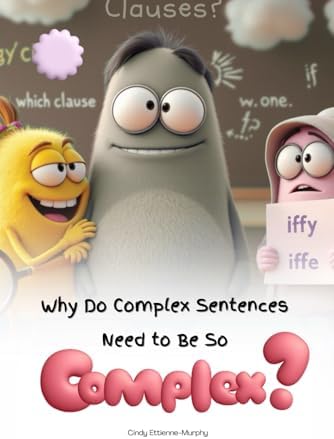
Why Do Complex Sentences Need to Be So Complex?
Purchase options and add-ons
Why Do Complex Sentences Need to Be So Complex?
By Cindy Ettienne-Murphy
If you’ve ever stood at the front of a classroom explaining subordinate clauses while your students quietly glaze over… this book is for you.
Written by British educator and trainee psychologist, Cindy Ettienne-Murphy, this refreshingly honest guide makes grammar not only understandable, but actually enjoyable. Drawing on more than two decades of classroom experience, Cindy breaks down the chaos of complex sentences into clear, relatable, and neurodivergent-friendly strategies that actually work.
You’ll find:
Practical, brain-friendly explanations that ditch the jargon.
Step-by-step activities for teaching complex sentences with humour and creativity.
Tips for supporting dyslexic and neurodivergent learners.
Real examples that connect grammar to meaning, not just rules.
Guidance for teachers and parents who want to help kids write with confidence and clarity.
This isn’t your average grammar book, it’s part empathy, part education, and part comic relief for anyone who’s ever wondered why “because,” “although,” and “if” can cause so much chaos.
Why Do Complex Sentences Need to Be So Complex? is a toolkit for teachers, a lifeline for parents, and a friendly reminder that grammar doesn’t have to feel like punishment, it can be connection, creativity, and even fun.
- Reading age12 - 18 years
- Print length76 pages
- LanguageEnglish
- Dimensions15.24 x 0.46 x 22.86 cm
- Publication date14 Nov. 2025
- ISBN-13979-8274474672
From the Publisher
Why Do Complex Sentences Need to Be So Complex?
Why It’s Worth the Effort
Teaching and learning complex sentences is messy, hilarious, and occasionally despair-inducing, but it’s also sacred work.
Because every time a child learns to connect two ideas, they’re learning to connect parts of themselves.
They’re learning empathy, logic, and imagination, all in one breath.
“Although I was tired, I kept going.”
“Because it was hard, I learned something new.”
“When I tried again, it finally worked.”
That’s not grammar.
That’s growth.
Product details
- ASIN : B0G2C36SJM
- Publisher : Independently published
- Publication date : 14 Nov. 2025
- Language : English
- Print length : 76 pages
- ISBN-13 : 979-8274474672
- Item weight : 168 g
- Reading age : 12 - 18 years
- Dimensions : 15.24 x 0.46 x 22.86 cm
About the author

Cindy Ettienne-Murphy BA (Hons) QTS NPQH MCC MSc, is a UK educator, author, and education consultant with a knack for turning real-world experience into resources that actually make life easier for teachers, parents, and the wonderfully neurodiverse young people they support. With more than 25 years in education, she’s worn just about every hat the profession has to offer, and somehow managed to keep her sense of humour intact.
As the founder and managing director of Diamond Education Hub, Cindy creates online learning resources, training programs for teachers, and specialist support for neurodiverse learners, especially those with dyslexia.
Her virtual school champions high aspirations and empowers children, to thrive, not just survive.
Diagnosed with dyslexia as an adult, Cindy brings a personal edge to her advocacy. She writes children’s books, including the Daisy-Mae’s Adventures series, along with accessible tools for teachers and parents who want learning environments to feel more inclusive, human, and supportive.
She also runs a lifestyle blog for educators and shares insights across social platforms like LinkedIn and YouTube, where she talks about mental health in education, effective teaching strategies, and creating classrooms kids actually want to be in.
When she isn’t carrying out psychological research, you’ll probably find her sipping coffee, challenging assumptions, and refusing to accept that “good enough” is ever good enough for learners.