If you peruse the website of INC Architecture & Design, you’ll be captivated by the beauty and innovation of their work…as well as their words. Statements like “To lead is to listen” and “Our creative process is driven by a reverence for the social and cultural contexts of our projects,” ring true when taken in context with their vast portfolio. “Our projects take their place in the urban context or in the hearts of their users by creating a sincere dialogue with their physical, cultural and historical conditions,” is a particular favorite. INC’s “design for humans” and the environments they create are those you’d love to inhabit, or at the very least, while away in for a few hours.
Based in New York City with 50 employees, the award-winning firm behind the TWA Hotel, 1 Hotel Brooklyn Bridge Park, The Line Hotel DC, and many other notable projects, was founded in 2006 by Adam Rolston, Drew Stuart, and Gabriel Benroth. A graduate of the University of Cincinnati with degrees in both architecture and interior design, Benroth also serves as Studio Director and CTO.
As resident tech wizard, Benroth recalls that INC’s history with BOXX first began in 2008 with the purchase of renderBOXX dedicated rendering systems and continues to this day with BOXX APEXX deskside workstations and the deployment of the FLEXX data center platform. But before we delved deep into computer hardware, I asked him to take me through the creative process for a firm that at present focuses primarily on hospitality, hotels and restaurants, wellness, fantasy of authenticity, and residential design.
 For INC, it begins with programming and concept boards, particularly the utilization of Pinterest, Stable Diffusion, and PowerPoint, followed by plan layout and white views. “We do your classic planning,” says Benroth. “We work in Revit exclusively and now we're using Enscape (real-time rendering and virtual reality plug-in) for all of our visualization, so it’s very GPU heavy and all on local workstations.”
The INC team also relies on Stable Diffusion, a generative AI, text-to-image model that produces photorealistic images from text and image prompts. After the plan layout and white views, it’s time for rendering and sampling, again using Revit, Enscape, and Stable Diffusion, along with IO, Adobe Substance 3D Designer, and Photoshop. The result is a virtual presentation that allows clients to digitally experience the space.
“When we present to clients, we’re recreating that experience,” says Benroth. “They can see what it’s like to enter through the front door, walk around the spaces, sit in this booth, and this is what you see. It's not just about still renderings anymore. Clients want to see everything, which is more work for us because we have to design everything. You can't hide things behind the curtain…unless you literally model a curtain.”
After the client presentation, the team moves into the document production phase, where they continue to rely on Revit, as well as Unifi. Lastly, it’s contract administration, procurement, and installation.
According to Benroth, the project views and the computer hardware required to support them present the most critical workflow challenge. “The hardware is huge,” he admits. “You can send pre-pictures, which we still do, and you can put that on the board, but you can't really send someone an Enscape model that's a gigabyte and it requires16 gigabytes of RAM for them to watch it. With 360 panoramas, it ends where you can stand there and look around at one spot and then move to another spot and look around. But the full, 3D, live walking around? The client’s hardware can't support it. Even then, if we're presenting offsite, we're remoting into a local computer that must have the hardware to present it to them.” INC tried VR headsets in the early stages, but opted to stick with computer monitors and television screens as VR was impractical for a number of reasons, primarily since most presentations are to a full group of stakeholders.

 Benroth first became aware of BOXX, or more specifically renderBOXX at an Autodesk University tradeshow event where he admits being impressed that Pixar animation studio was a user. When I ask what computer systems INC was using prior to BOXX, he runs down a list of Macs running Windows, Dell workstations, the aforementioned renderBOXX and BOXX APEXX 1 compact workstations (both products since retired by BOXX), all as precursors to FLEXX.
For some time, INC was remoting into renderBOXX systems and the firm’s networked render farm using V-Ray, but the arrival of Enscape ushered in a change to a full VR solution which, in turn, pushed the need for high-end GPUs on team members’ workstations. They also needed a remote/hoteling financial model which allowed access to a high-end system via computer, laptop, or phone. And lastly, says Benroth, “We didn’t want to deal with managed virtual systems—especially due to the high GPU usage issues.”
“We thought instead of going for larger desktop workstations, let's just go remote,” he recalls. “The FLEXX units enable us to have powerful GPUs in these systems, and everybody can work from wherever. We’re also not supporting complex hardware anymore. Our users can get on the tablet and do their work.”

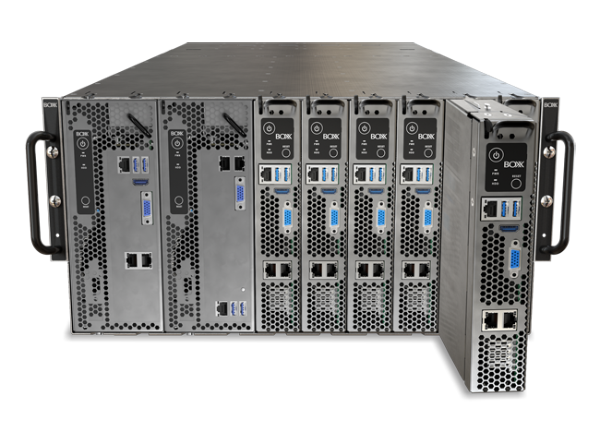
A multi-module, data center-ready system, FLEXX is capable of simultaneously supporting multiple types of compute modules providing the highest application performance for professional content creators working onsite or remotely. Compute modules can be accessed from any connected device, delivering performance previously available only in desk side workstations, as well as multi-CPU render nodes and multi-GPU workstation or render nodes. With the FLEXX system, enterprises can provision virtual workstations in minutes, enabling remote creators to stay productive.
At present, INC has ten creators with access to FLEXX modules. They also have an order into BOXX for ten more. INC’s team consists of a hybrid of in-office and remote architects and designers and some employees who are fully remote. Benroth says the office users rely on thin clients, while those at home (including one in Pittsburgh) can access FLEXX “however they want.”
When I ask Benroth how FLEXX differs from INC’s previous systems, he cites remote use (obviously), but quickly follows with the flexibility of the thin client, the freeing up of physical space, the fact FLEXX offers more power planning than a traditional rackmount system, and that real-time 3D can be done via remote computer as opposed to relying on an expensive gaming laptop or restrictions of the owner’s hardware.
He also highlights easier offsite management. “The FLEXX enclosure offers more network tools to restart, access, and troubleshoot,” says Benroth. “It’s redundancy with power, redundancy with networking. We have a Slack channel for remote people dealing with computer crashes. ‘Can I get a restart?’ they ask. For those not on FLEXX, there has to be someone in the office going around physically restarting computers because they've just frozen or something. But these FLEXX systems, they hardly ever go down. And if they do freeze, they're very easy to remotely restart. That has really helped a lot.”
When the conversation turns to workflow issues solved by the deployment of the BOXX data center platform, Benroth credits FLEXX for being more stable (with better management) than standalone units, along with the benefits of remote computing.
“Remote work allows users access to powerful workstations for virtual reality and Revit,” he says, “and we don’t need to provide our team with high-end computers in environments we cannot control. The standalone real-time 3D VR files can be 1-2 GB so having a solution on a LAN is important.”
Benroth also mentions time savings, citing a significant reduction in time necessary to turn around live presentations and complete design iterations and options. “Flexibility and remoting,” he insists. “Anyone can get onto one of these boxes and render something out if there's a last-minute change.”
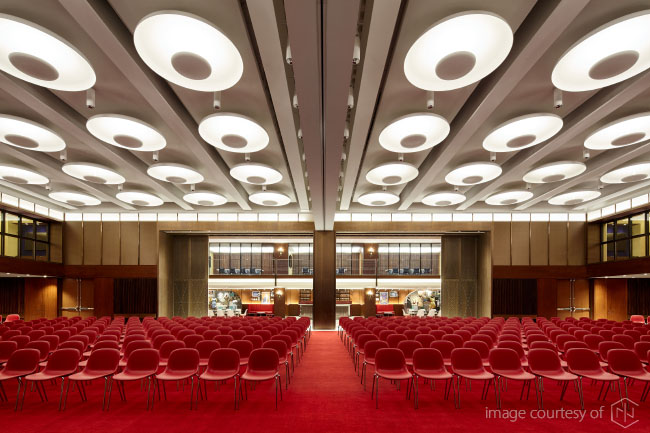
Speaking of changes, Benroth mentions INC’s outstanding work for the Rockefeller Center—a master plan and redesign of the rink level that gives visitors greater access to natural light and views of the ice skating rink. “It's all these different buildings connected under one space,” he says, describing the project, “with different construction from the 1920s and ‘30s through the ‘50s. We were able to walk around and present different options in real-time on remote computers within the offices of Tishman Speyer and it just wowed them. I think being able to do this is part of the reason we won that job. Through the whole process, we were using 3D, and 3D during construction administration in real- time and FLEXX helped facilitate that.”
Beyond actual design, Benroth also credits FLEXX (and its flexibility) for making INC a more successful firm in other ways, particularly hiring, as they are able to attract better talent due to offering the ability of remote work. “It allows us that flexibility,” he insists. “We hired people who left companies because they had to go back in the office. They asked post-COVID if we were requiring returning to the office full-time, and I said no, we're going to stay hybrid. Probably 10% of our workforce has come over because they love that about INC and FLEXX has been pivotal to that.”
Benroth also appreciates the flexibility FLEXX provides him. “I have been able to let an outside company manage more, which is cheaper and allows me to focus on my smaller business,” he says, “and with FLEXX, there is less to track in terms of hardware and accessories, less cost to manage, and more uptime for employees.”
On a few occasions, Benroth has had to rely on legendary BOXX Technical Support for what he refers to as part replacement or system configuration issues. “The experience is great, always super responsive,” he says. “They’ve expedited parts, walked me through a fix, and followed up. The flexibility is nice. You talk to people who understand the systems. We used (a competing manufacturer) for many years, always got the bureaucracy, and felt like we knew more than the person fixing the computer. With BOXX, it seems like I'm talking with the guy who's building the computers. They’re just light-years ahead in service.”
BOXX customer service is also personified by BOXX performance specialist Lang Etheridge, whom Benroth has known for some time, referring to him as his “personal concierge”. “We touch base in January when I give him the rough plan for the year,” says Benroth. “He follows up with a few key milestones, helps configure, follows up again after the product is delivered, and points us to the right people to solve various challenges.”


 Looking toward the future of INC, Benroth discusses the hottest topic in tech—AI and his experimentation with running AI models, a task requiring multi-GPU compute power. “That’s probably something in the future,” he says. “But I’d like to have remote systems where you can run these models for image generation, especially for product design like finishes for furniture. Using these models, we can place them in the space to try options.”
He’s also deeply interested in a virtualized BOXX Cloud system. “We're invested in FLEXX now, so we want to convert all the designer stations to the BOXX FLEXX system so that we can be fully cloud,” he says. “I'm excited to see what BOXX is going to do there.”
As our interview concludes, I ask Benroth what he sees as the chief selling point of FLEXX. “For a small company, its flexibility and space,” he says. “It's such a tight, powerful little system and it works really well. You get the space savings, you get the great BOXX support, and you get more features and robust performance.” Then laughing, he adds, “In this remote world, you could just have FLEXX on a rack and you’d have a company. That's all you need.”
But as an architect (and still laughing), Benroth quickly catches himself. “I don't think we want to go there…”
I reply (laughing), “Probably not.”