


Hugging Face is basically the go-to spot for any AI developer. It’s a massive library packed with powerful, open-source models that can do some incredible things. It’s a fantastic starting point.
But then reality hits. You find a brilliant model and want to use it to solve an actual business problem. Suddenly, you’re not an AI explorer anymore, you’re an infrastructure manager, a deployment expert, and a custom coder all in one. Getting from a cool model to something that actually helps your business is often a long, winding, and surprisingly expensive road.
This guide isn't for the die-hard developers building from scratch. It’s for teams who want something more practical. I’m going to walk through some real-world Hugging Face alternatives that are designed to solve specific problems, not just hand you a box of parts. I'll cover everything from serious MLOps platforms for custom projects to business-ready tools that start working in minutes.
I've spent the last few years wiring AI into the helpdesks and knowledge bases that support and IT teams actually live in, and the question I hear most from non-developers is some version of "the Hugging Face model is cool, but how do I ship it?" The honest answer is that Hugging Face is a model library, not a solution, so the right alternative depends entirely on who you are.
If you just need a model behind an API, Replicate and the OpenAI API are the fastest path. If you're building from scratch with a real engineering team, Northflank and Amazon SageMaker give you full-stack control. If you must keep data on your own servers, DagsHub is built for that. And if your team wants the work itself done (customers answered, reports pulled, follow-ups sent) without hiring ML engineers, a finished teammate beats a toolkit.
That last case is where eesel fits: an AI teammate that joins the apps your team already uses and does the work there, with nothing to host or fine-tune. It's one fixed monthly price, from $299 for 500 credits, with no per-seat charge, and you can start free with 100 credits, no card.
What is Hugging Face?
The easiest way to think of Hugging Face is as the "GitHub for machine learning." It’s a central hub where developers and researchers share open-source AI models, datasets, and code. If you want to experiment with the latest AI tech or find a model for, say, text generation or language translation, it’s the place to be.
Their libraries, especially Transformers, are the standard for anyone building a custom AI app. But that's the catch: you're building it from the ground up. Hugging Face gives you the five-star ingredients, but it doesn't give you the recipe, the kitchen, or the chef. You’re still on the hook for building, deploying, integrating, and maintaining the final product.
Why you might need Hugging Face alternatives
Developers love the freedom Hugging Face provides, but that freedom can be a massive headache when a business just needs something that works. Here’s why you might be looking for another option.
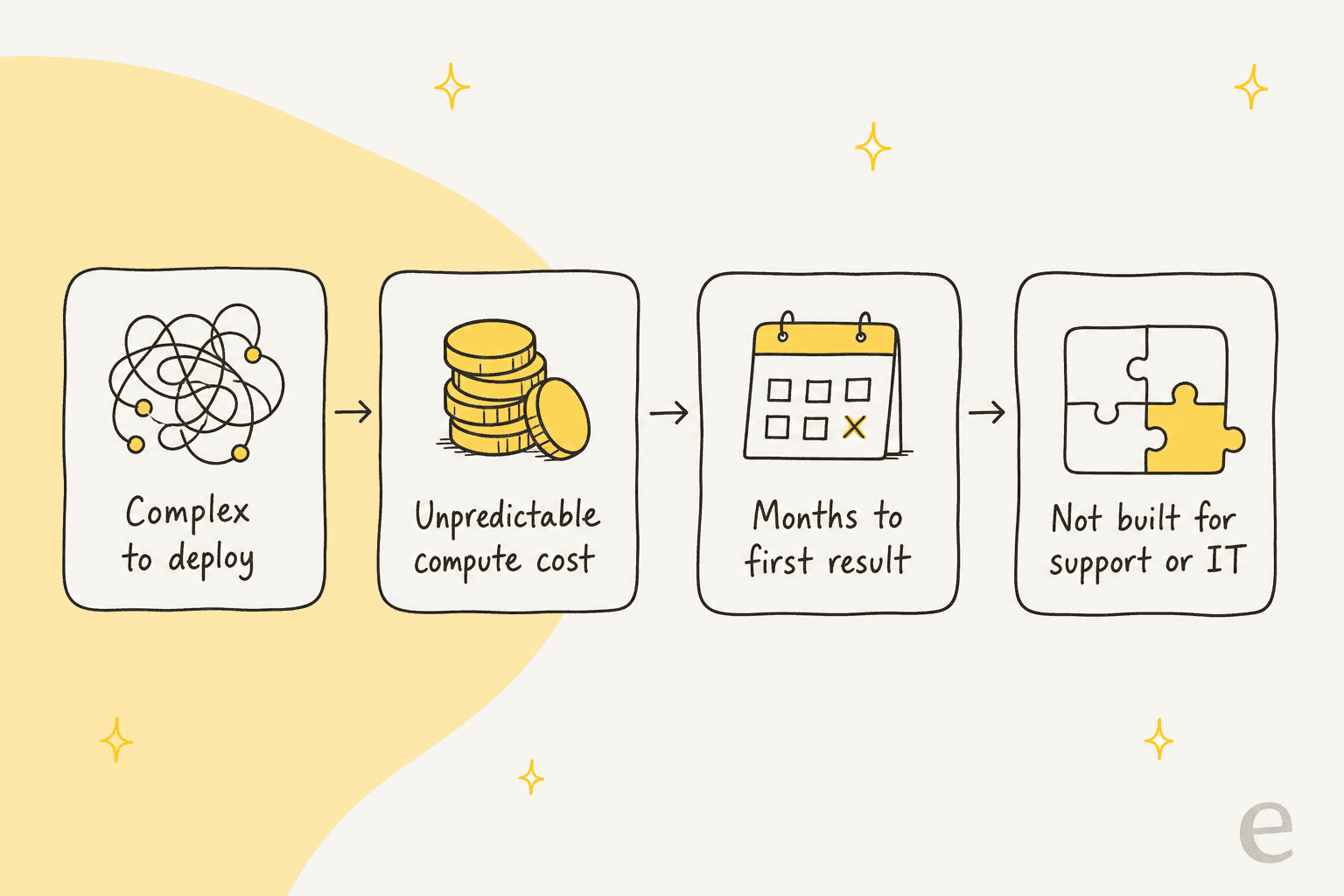
First off, it's just plain complicated. To get a Hugging Face model ready for production, you need a team of expensive AI engineers and DevOps pros. You have to juggle cloud infrastructure, write custom code to connect everything, fine-tune the model, and make sure it’s all secure and can handle the load. For most customer support, IT, or operations teams, that’s just not realistic.
Then there’s the cost. The models might be free, but the computing power, storage, and engineer salaries to run them are anything but. Even Hugging Face's own paid services can have usage-based pricing that leads to some nasty surprise bills at the end of the month.
It also takes a long time to see any results. A typical project can easily burn through months just to get from picking a model to launching a basic application. If you need to move fast, that’s a lifetime.
And finally, it’s not built for specific business tasks. Hugging Face offers general tools. It doesn't have a ready-made solution you can plug in to automate customer service, tag and triage support tickets, or power up your internal knowledge base.
What I looked for in the best Hugging Face alternatives
This list isn't about finding another model library. It's about finding platforms that get a job done. I ranked these options based on what actually matters when you're trying to solve a problem.
-
Ease of Use: How quickly can someone who isn't a machine learning engineer actually use it?
-
Time to Value: How long does it take to sign up and have a working solution that’s helping your team?
-
Use Case Fit: Is this a general toolkit for developers, or is it specifically designed for a business function, like customer service?
-
Total Cost: Is the pricing easy to understand and predictable, or is it full of confusing, usage-based fees that are impossible to budget for?
A quick look at the top Hugging Face alternatives
Before I dive into the details, here’s a quick rundown of the contenders and who they're for.
| Tool | Ideal User | Pricing Model | Key Feature |
|---|---|---|---|
| Northflank | DevOps/Engineering teams | Usage-based + Platform fee | Full stack control |
| Replicate | Developers | Pay-per-second | Easy API access to models |
| Amazon SageMaker | Enterprises on AWS | Usage-based | Deep AWS integration |
| DagsHub | Teams needing on-premise | Per user/month | Git-based collaboration |
| OpenAI API | Developers needing SOTA models | Pay-per-token | Access to GPT-5.5 family |
| ModelScope | China-focused teams | Free | Chinese-language models |
| eesel | Teams that want work done | Monthly plan (from $299/mo) | AI teammate in your apps |
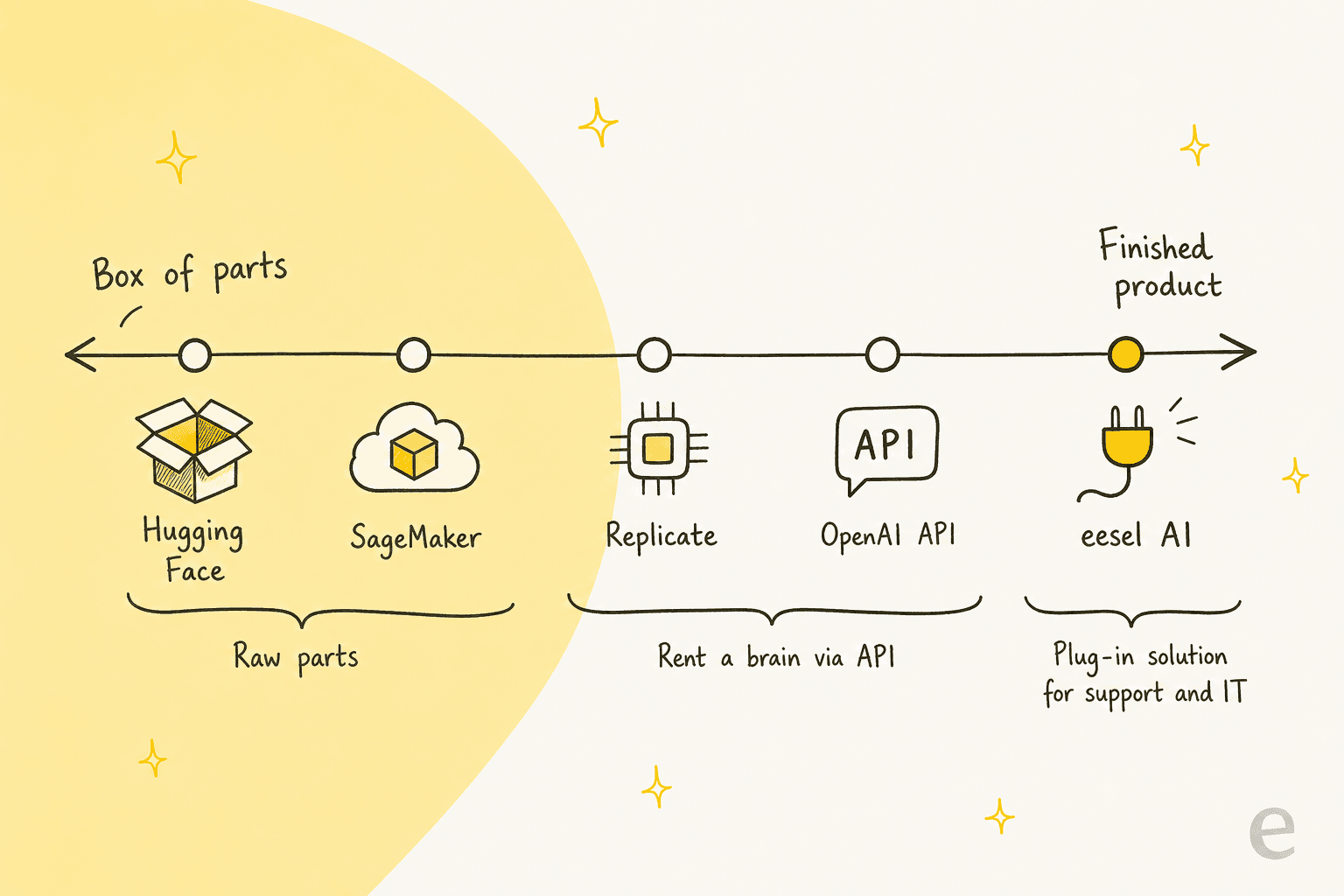
Some platforms, like Amazon SageMaker and Northflank, are heavy-duty toolkits for technical teams that want to build and manage everything themselves. Others, like Replicate and the OpenAI API, make it easier to "rent" a model's brain through a simple API call. Then you have hubs like DagsHub and ModelScope that are closer to Hugging Face itself but solve specific needs like on-premise hosting or regional model access.
And then there's eesel, which is in a different category altogether. It isn't somewhere to run a model. It's an AI teammate that's already built and does work inside the apps your team uses, so it only fits one kind of reader here, and I've put it last.
The 7 best Hugging Face alternatives for businesses
Let me break them down so you can find the right fit for your team, budget, and what you’re trying to accomplish.
1. Northflank
Northflank is an internal developer platform for teams that want total control over deploying their applications, including AI models. This is for groups with serious DevOps and engineering skills who want to manage their entire tech stack, from APIs to databases to the GPUs running the models.
Think of it as a middle ground. It runs on your own cloud infrastructure (like AWS or GCP), but it gives you a managed layer to help organize everything. It's for teams who find raw cloud services too chaotic but fully managed platforms too restrictive.
The big plus here is that it's highly customizable and lets you use your own cloud account. The catch is the very steep learning curve for anyone who isn't an engineer. You're still responsible for managing your own infrastructure underneath it all.
- Pricing: Northflank’s pricing is a mix of a platform fee plus usage-based costs for computing resources. There's a free sandbox tier for testing. The pay-as-you-go plan bills you for what you use, for example, about $2.74/hour for an NVIDIA H100 GPU.
2. Replicate
Replicate is all about removing the pain of deploying open-source models. You find a model you like (many of which are also on Hugging Face), and Replicate gives you a simple API to run it. No messing with servers, Docker containers, or CUDA drivers.
It's one of the quickest ways to get from a model to a working API, which makes it great for developers who need to prototype an idea or plug an AI feature into an app without committing to a whole MLOps platform.
It's incredibly easy to use and has a huge library of models ready to go. The downside is that it can get very expensive if you're running it a lot, and you don't have much control over performance.
- Pricing: Replicate bills you per second of compute time, and the cost depends on the GPU. A standard Nvidia T4 GPU is around $0.81/hr, while a powerful A100 is about $5.04/hr. You pay for what you use.
3. Amazon SageMaker
If your company is all-in on Amazon Web Services, Amazon SageMaker is the default choice. It’s an end-to-end machine learning platform that does everything from data labeling and model training to deployment and monitoring.
SageMaker is an absolute beast, built for large, experienced teams with complicated MLOps needs. Its main advantage is its deep integration with every other AWS service, but it's also overwhelmingly complex and can be wildly expensive. It's complete overkill for smaller teams and locks you tightly into the AWS ecosystem.
- Pricing: SageMaker's pricing is famously complex. You pay for every little thing separately, from computing instances to storage and data processing. This makes it incredibly difficult to predict your monthly bill.
4. DagsHub
DagsHub is a collaborative MLOps platform built on open-source tools that developers already know, like Git. It’s a great option for companies that need to keep their data and models on their own servers, especially since Hugging Face stopped offering an on-premise version.
The platform is focused on data privacy and security, letting you maintain full control. It combines a familiar Git-based workflow with tools made for data science, like data versioning and experiment tracking.
It’s great for collaboration and works for on-premise deployments, but it still requires a lot of technical skill to set up and manage.
- Pricing: DagsHub has a free tier for individuals. The Team plan is $119 per user/month ($99/user/month if billed annually). For on-premise setups, you'll need a custom Enterprise plan.
5. OpenAI API
Another path is to just skip the open-source world entirely and use a top-tier proprietary model through an API. The OpenAI API gives you direct access to frontier models like GPT-5.5, which are often better at general language tasks than their open-source cousins.
For many businesses, the raw performance of a model from OpenAI can save a ton of time compared to finding, training, and fine-tuning an open-source one. It's a practical choice if you just want the best possible result, fast.
The pros are obvious: you get access to state-of-the-art models through a simple API. The cons are that it's a black box, so you can't customize it, and the costs can add up for high-volume use. Plus, their data privacy policies might not work for every company.
- Pricing: OpenAI uses a pay-per-token model. For GPT-5.5, it's $5.00 per 1 million input tokens and $30.00 per 1 million output tokens. Costs vary a lot depending on the model you use.
6. ModelScope
Backed by Alibaba, ModelScope is a model-sharing community that feels a lot like Hugging Face but has a strong focus on the Chinese-language market and models from Asian research groups.
It’s on this list as a good reminder that the AI world is global. If your business operates in or targets a specific region, a specialized hub like ModelScope might have more relevant models and community support than a general platform.
It has a great collection of Chinese-language models, but it’s less diverse globally, and a lot of the documentation can be tough to navigate if you don't speak Chinese.
- Pricing: Just like Hugging Face, ModelScope is free to browse and download models.
7. eesel
Every other tool on this list gives you a model or a place to run one. eesel answers the same frustration from the other end: it's an AI teammate that's already built, so there's no model to pick, host or fine-tune. It joins the apps your team already works in (Slack, email, your helpdesk, Shopify, Confluence, Google Docs and more), takes requests from anyone there, and does the work inside those tools, from answering customers to pulling the weekly report. Support is the job most teams give it first.
What you'd otherwise have to build yourself is the rules. You set what it may do for each kind of person who asks, and each tool runs on its own, asks a person first or stays off.
It's a fair pick only if you want that work done. If you're shipping an AI feature inside your own product, the six tools above are the right shelf.
- Pricing: one fixed monthly price with no per-seat charge and no platform fee: $299/month for 500 credits or $499/month for 1,000, with bigger plans above that. A ticket or chat is 1 credit however many replies it takes, and Slack questions, reports and scheduled jobs use credits too. You can start free with 100 credits for 7 days, no card.
How to choose the right Hugging Face alternative for you
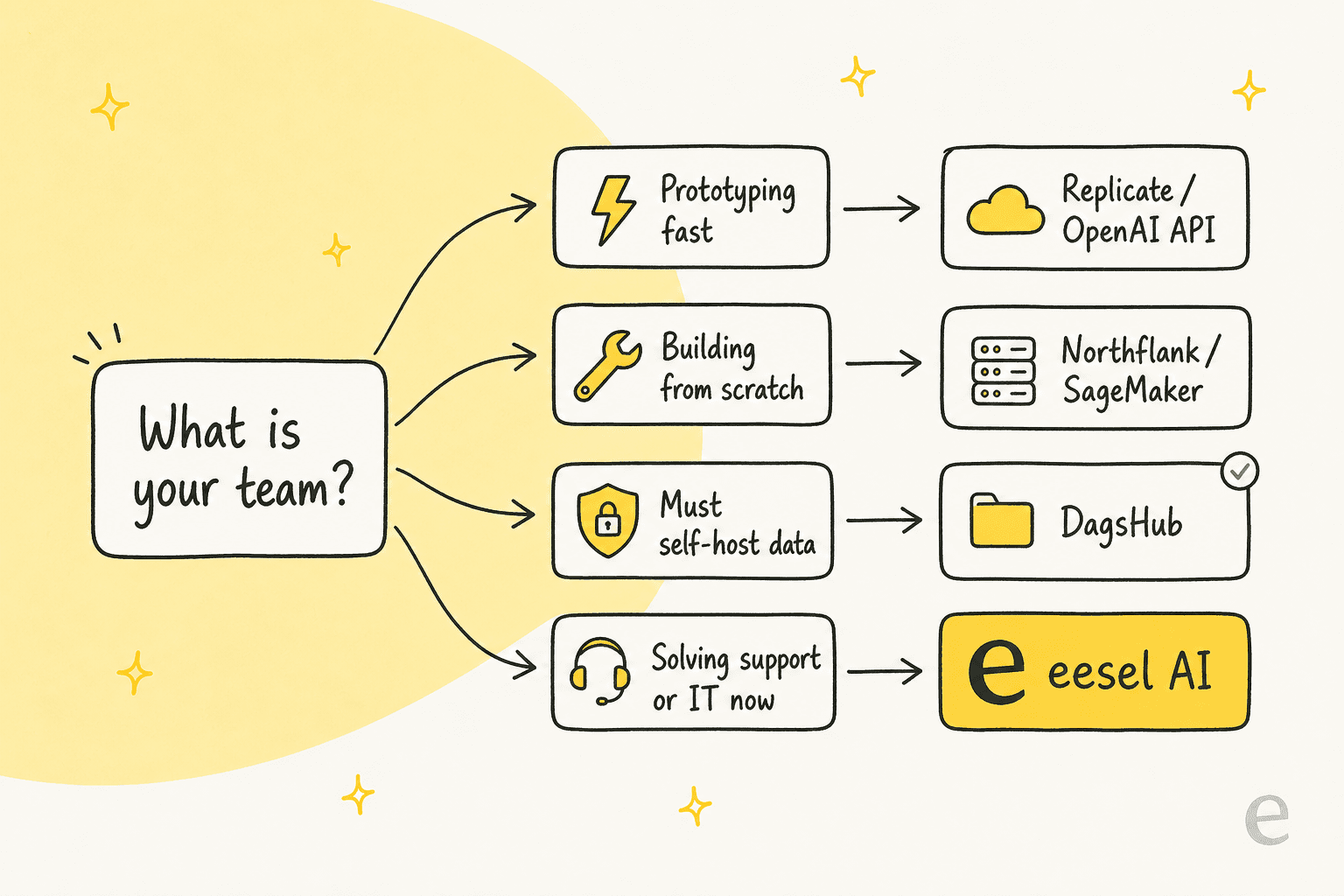
Okay, that was a lot. Here’s a simpler way to think about it based on who you are.
-
If you're a developer needing to quickly test a model for a prototype, check out Replicate or the OpenAI API. You’ll have a working endpoint in minutes.
-
If you're an engineering team building a complex AI application from scratch, you need the power of a platform like Northflank or Amazon SageMaker.
-
If your business has strict security rules and needs to host everything itself, then DagsHub is built for you.
-
But if you're a business leader who wants the work done, not a model to deploy, look at eesel. It's an AI teammate that starts working in your team's apps without you building an AI stack from the ground up.
Focus on the solution, not just the model
Hugging Face is an amazing place to get AI building blocks, but a box of bricks isn't a house. The best alternative for you really depends on whether you want to be the architect or just move into a finished home.
You can build it all yourself with powerful MLOps platforms, get a head start with easy-to-use APIs, or you can adopt a ready-made solution that's already designed for your specific business problem.
For most business teams, the goal isn't to become AI developers. It's to get work off people's plates: customer questions answered, reports pulled, follow-ups sent. A finished teammate like eesel lets you start from that outcome instead of the overhead.
Where eesel fits if you'd rather not build at all
Hugging Face hands you a model and leaves the rest to you: hosting it, writing the code that connects it to your tools, and deciding what it may touch. If what you were going to build is an assistant that does work for your team, eesel is that, already built. It joins the tools your team already uses, like Slack, email, your helpdesk and your knowledge base, takes requests from anyone there, and starts work on its own from events and schedules.
The part you'd otherwise write yourself is who may do what. In eesel you set what it may do for a teammate, for named people, for a verified customer and for an anonymous visitor, and each tool runs on its own, asks a person first or stays off, as the actions and approvals docs explain. It's one fixed monthly price from $299, with no per-seat charge.
Try eesel for free with 100 credits and no card, and give it a real job from your team's week.
Frequently asked questions
Why should my business consider Hugging Face alternatives if it's such a popular platform for AI?
Hugging Face is excellent for developers, but businesses often hit deployment complexity, unpredictable compute costs, long development times, and a lack of ready-made business solutions. The best Hugging Face alternatives offer more tailored, plug-and-play options that solve a real job from day one.
Which Hugging Face alternative is the best fit for my company's needs?
It depends on your team's technical depth and your goal. Developers testing prototypes might prefer Replicate or the OpenAI API; engineering teams building complex systems should look at Northflank or Amazon SageMaker; and teams that want the work done rather than a model to build on should look at an AI teammate like eesel.
What are the differences in pricing among Hugging Face alternatives?
Pricing varies a lot. Platforms like Replicate and the OpenAI API use usage-based models billed per compute second or per token, which can be unpredictable. Others, like eesel AI, charge one fixed monthly price (from $299/month for 500 credits) with no per-seat charge or platform fee, so the bill doesn't move with compute time.
Are there user-friendly Hugging Face alternatives if my team isn't expert in MLOps?
Yes. For teams without deep ML expertise, a ready-made AI employee like eesel joins the tools you already use, such as Slack, email and your helpdesk, and does work there without an AI engineering team.
Do any Hugging Face alternatives offer better data privacy or on-premise deployment?
Yes, DagsHub is a strong option for companies that need on-premise deployment and strict data control. Other platforms have varying data-handling policies, so review each vendor's security posture before you commit.
Can I still use open-source AI models if I choose a Hugging Face alternative?
Many Hugging Face alternatives either deploy open-source models (like Replicate) or are built on open-source foundations (like DagsHub). Even business-focused tools often run open models under the hood, so you benefit without the management burden.
