


drug development pipeline · clinical trials
Drug Development Pipeline: A Complete Guide to All Phases
October 10, 2025
Updated October 15, 2026
90 min read
Learn the end-to-end drug development pipeline, from initial drug discovery and preclinical research to Phase I-IV clinical trials and final FDA approval. Updated for 2026 with latest success rates, AI drug discovery progress, and regulatory developments.

Executive Summary
Drug development is a long, complex, and high-stakes process by which new therapeutic drugs are discovered, tested, and brought to market. This report provides an in-depth examination of the end-to-end drug development pipeline, highlighting each stage from initial drug discovery through clinical trials, regulatory approval, and post-market surveillance. Key findings are summarized as follows:
-
Scope and Scale: Drug development commonly requires years of laboratory, preclinical, clinical, and regulatory work. Cost estimates vary substantially with the study design and which costs are included. For example, a 2025 RAND analysis of 38 drugs approved in 2019 reported a median development cost of $708 million after adjusting for the cost of capital and discontinued candidates (the median direct R&D cost alone was about $150 million); that estimate should not be treated as a universal cost for every product. [https://www.rand.org/news/press/2025/01/07.html] FDA describes development as a sequence of discovery, preclinical research, clinical research, regulatory review, and post-market safety monitoring. [https://www.fda.gov/patients/learn-about-drug-and-device-approvals/drug-development-process]
-
Pipeline Stages: The drug development pipeline consists of distinct phases. It begins with Drug Discovery, where researchers identify promising targets and lead compounds through insights into disease biology, high-throughput screening, and medicinal chemistry. Promising leads undergo Preclinical Research in labs and animal models to evaluate safety (toxicology), efficacy, and pharmacokinetics. If preclinical results are favorable, a formal Investigational New Drug (IND) application is filed to regulatory authorities (like the U.S. FDA) to gain approval to start Clinical Trials in humans. Clinical development proceeds in Phase I (small-scale safety studies in healthy volunteers or patients), Phase II (medium-scale trials in patients to assess efficacy and dosing), and Phase III (large-scale pivotal trials to definitively establish safety and efficacy). Each successive phase involves more participants and more rigorous demonstration of the drug’s therapeutic value. If Phase III results are successful, developers submit a New Drug Application (NDA) or Biologics License Application (BLA) to regulators summarizing all findings. Regulatory agencies then conduct a thorough Review and Approval process, evaluating whether the drug’s benefits outweigh its risks. Upon approval, the drug enters the market, but the process continues with Phase IV Post-Marketing Surveillance to monitor long-term safety in the general population and to fulfill any post-approval study commitments [https://www.fda.gov/patients/learn-about-drug-and-device-approvals/drug-development-process]. Every step is governed by strict scientific and ethical standards to ensure patient safety and drug efficacy.
-
Challenges and Attrition: The report highlights the major challenges contributing to the high failure rates in drug development. Approximately 90% of drug candidates that enter clinical trials ultimately fail to reach the market [https://pmc.ncbi.nlm.nih.gov/articles/PMC9293739/]. The leading causes of failure include lack of efficacy (responsible for ~40–50% of failures), unforeseen human toxicity or side effects (~30%), inadequate drug-like properties (e.g. poor pharmacokinetics) (~10–15%), and commercial or strategic factors (~10%) [https://pmc.ncbi.nlm.nih.gov/articles/PMC9293739/]. These issues often manifest in Phase II or III, where drugs sometimes prove ineffective in patients despite promising early data, or reveal safety problems when tested in larger populations. The report discusses how careful target selection, better predictive preclinical models, and adaptive trial designs are being used to mitigate these risks.
-
Regulatory and Historical Context: Modern drug development practices are deeply shaped by historical events and evolving regulations. Notably, tragedies like the 1937 sulfanilamide elixir poisoning (which killed 100+ people) prompted the 1938 Federal Food, Drug, and Cosmetic Act requiring proof of drug safety before marketing [https://www.theatlantic.com/technology/archive/2018/01/the-accidental-poison-that-founded-the-modern-fda/550574/]. Similarly, the thalidomide birth defects crisis of 1961–1962 led to the Kefauver-Harris Amendments of 1962, which mandated rigorous demonstration of drug efficacy and safety through controlled clinical trials prior to approval [https://www.theatlantic.com/technology/archive/2018/01/the-accidental-poison-that-founded-the-modern-fda/550574/]. These regulations established the framework of phased clinical trials and the requirement of regulatory review, fundamentally shaping today’s pipeline. Over time, additional regulatory pathways have been introduced to balance speed and safety – for example, Accelerated Approval (introduced in 1992, spurred by HIV/AIDS activism) [https://cancerhistoryproject.com/article/accelerated-approval-and-the-fda/] and, later, Breakthrough Therapy designation (created in 2012) to expedite drugs for serious conditions [https://www.fda.gov/patients/fast-track-breakthrough-therapy-accelerated-approval-priority-review/breakthrough-therapy]. This report provides context on these developments and how they influence current drug development paradigms.
-
Case Studies and Perspectives: Real-world case studies illustrate the pipeline in action from multiple perspectives. The report examines successful examples like Imatinib (Gleevec), a landmark targeted cancer therapy that, after decades of research on the BCR-ABL oncogene target, moved from first-in-human testing in 1998 to FDA approval in 2001, transforming chronic myeloid leukemia outcomes. This case highlights the power of rational drug design and biomarker-driven development. Another case study on COVID-19 vaccine development demonstrates how the pipeline can be dramatically accelerated during a global health emergency – compressing what typically is a decade of work into under a year through unprecedented collaboration, funding, and overlapping trial phases. In contrast, the report also analyzes failures and post-market issues – such as the late-stage failure of many Alzheimer’s drug candidates despite huge investments, and safety withdrawals like Vioxx, a painkiller pulled from the market for cardiac risks after initial approval. These examples provide lessons learned on the importance of robust trial design, post-market vigilance, and continuous risk-benefit assessment.
-
Future Outlook: The drug development landscape is continuously evolving. Emerging technologies and methodologies are poised to improve efficiency and success rates. Genomics and precision medicine enable identification of better targets and stratification of patients more likely to respond, increasing trial success probabilities (trials that utilize biomarkers have roughly double the success rate of those that do not [https://pmc.ncbi.nlm.nih.gov/articles/PMC6409418/]). Artificial intelligence and in silico modeling are being applied to drug discovery and trial optimization, potentially reducing time and cost – as of early 2026, over 173 AI-discovered drug programs are in clinical development, with Insilico Medicine's rentosertib entering a Phase III trial in idiopathic pulmonary fibrosis (GENESIS-IPF-3, first patient dosed in September 2026) following positive Phase IIa results published in Nature Medicine in June 2025 [https://insilico.com/blog/1112] [https://insilico.com/news/isn1009261-insilico-medicine-doses-first-patient-genesis-ipf-3]. Novel clinical trial designs (adaptive trials, master protocols) allow more flexible and informative studies. Regulatory agencies are also adapting, providing guidance for using real-world evidence and adaptive approval mechanisms to get critical therapies to patients sooner while ensuring follow-up data collection. In 2025, the FDA approved 46 novel drugs (34 new molecular entities and 12 biologics), maintaining a 5-year average of 48 new drugs per year [https://cen.acs.org/pharmaceuticals/FDAs-new-drug-approvals-dipped/104/web/2026/01]. The report discusses these trends and their implications for the future of drug development. Overall, while challenges remain formidable, a combination of scientific innovation, strategic trial design, and collaborative effort is driving the pipeline toward greater productivity.
In conclusion, drug development is an arduous but essential endeavor for advancing public health. This comprehensive guide unpacks each stage of the pipeline, backed by data, expert insights, and historical perspective. By understanding the complexities and critical success factors in end-to-end drug development, stakeholders can better navigate the pipeline, improve decision-making, and ultimately bring new lifesaving therapies to patients more efficiently. The following sections delve into each aspect in detail, with extensive evidence and examples supporting the discussion.
Introduction
Developing a new drug is one of the most challenging and resource-intensive efforts in modern science and medicine. It involves transitioning an initial scientific idea – such as a promising molecule or therapeutic concept – through a multistage pipeline culminating in an approved medication available to patients. This pipeline integrates diverse disciplines including molecular biology, chemistry, pharmacology, clinical medicine, and regulatory science. The stakes are extraordinarily high: successful new drugs can revolutionize treatment of diseases and save lives, whereas failures consume huge investments and time. On average, bringing a single new drug to market takes well over a decade of research and testing and costs on the order of hundreds of millions to billions of dollars[https://pmc.ncbi.nlm.nih.gov/articles/PMC9293739/] – with recent Deloitte analyses estimating $2.23 billion per approved drug for large pharma in 2024, while a 2025 RAND study of 38 drugs found a median cost of $708 million after adjusting for the cost of capital and discontinued candidates, with a median direct R&D cost of about $150 million [https://www.rand.org/news/press/2025/01/07.html] [https://pmc.ncbi.nlm.nih.gov/articles/PMC11704977/]. Moreover, the probability of success is low – the average likelihood of approval for a drug entering Phase I is now just 6.7% based on 2014–2023 data, down from roughly 10% a decade earlier [https://www.norstella.com/why-clinical-development-success-rates-falling/]. This combination of long timelines, high costs, and high failure rates highlights why the drug development process is often described as a “high-risk, high-reward” endeavor.
Despite these challenges, the societal impact of successful drug development is immense. New medications can dramatically improve patient outcomes, extend life expectancy, and even eradicate diseases. For example, the development of antibiotics transformed infectious disease treatment in the 20th century, and more recently targeted cancer therapies (like kinase inhibitors and immunotherapies) have significantly improved survival in previously untreatable cancers. The COVID-19 pandemic starkly illustrated both the importance and the possibilities of drug and vaccine development, as scientists worldwide raced to develop effective vaccines and treatments in record time. These achievements are built on the foundations of the modern drug development pipeline – a process refined over decades to maximize patient safety and therapeutic efficacy.
Background and Definitions: It is useful to clarify what we mean by “drug development.” In this report, the term encompasses the entire process required to bring a new pharmaceutical product from an idea in the laboratory to a marketed therapy for patients. This includes early drug discovery (identifying a biological target and a lead compound that modulates that target), preclinical research (laboratory and animal studies to characterize the candidate’s effects and safety), clinical trials in humans (phases I–III, to test safety and efficacy in increasing scales of patient populations), and the regulatory approval steps needed to verify that the drug can be safely and effectively used in the general population. Often, the term “drug development” is used in contrast to “drug discovery.” Drug discovery refers more specifically to the initial identification of candidate compounds and preliminary testing, whereas drug development often implies the broader process including clinical trials and regulatory steps. In practice, however, drug discovery and development are a continuum, and success requires careful management of the entire end-to-end pipeline. This pipeline applies primarily to new molecular entities (NMEs) – which can be traditional small-molecule drugs or larger biological products (biopharmaceuticals such as monoclonal antibodies, therapeutic proteins, gene therapies, etc.). While the general principles are similar for small molecules and biologics, there are some differences in techniques and regulatory pathways that will be noted where relevant.
Importance of Rigor and Safety: A core principle underlying every stage of drug development is ensuring that a new drug is both effective for its intended use and safe for patients. History provides sobering reminders of why rigorous testing is necessary. In the early 20th century, there were virtually no regulations requiring proof of safety or efficacy for new drugs. Medicines were often sold directly to the public with unverified claims – so-called “patent medicines” or snake oil remedies. This changed only after public health disasters highlighted the consequences of insufficient testing. A pivotal event was the 1937 Elixir Sulfanilamide disaster, in which a pharmaceutical company marketed a solvent-based formulation of an antibiotic (sulfanilamide) without safety testing, leading to mass poisoning that killed at least 107 people (mostly children) ([1]) ([2]). In response, the U.S. Congress passed the Food, Drug, and Cosmetic Act of 1938, empowering the FDA to require safety testing for new drugs before approval. Later, the thalidomide tragedy of the late 1950s–early 1960s – where a sedative caused thousands of severe birth defects when taken by pregnant women – prompted further tightening of regulations. The 1962 Kefauver-Harris Amendments established that manufacturers must provide “substantial evidence” of both safety and efficacy from well-controlled trials before a drug can be approved ([3]). These historical milestones underscore that patient safety is paramount and are the reason modern drug development is so carefully controlled and systematically staged. Every new compound must clear high bars for evidence at each phase, a process that inevitably lengthens development but protects patients from ineffective or dangerous therapies.
Current Landscape: Today, drug development is a global enterprise undertaken by pharmaceutical and biotechnology companies, often in collaboration with academic researchers and government agencies. It operates within a framework of international guidelines (such as the ICH – International Council for Harmonisation – standards) to ensure quality, consistency, and ethical conduct. The cost of developing a drug has risen significantly over time (sometimes referred to as “Eroom’s Law” – the observation that the number of new drugs per dollar of R&D investment has been decreasing over the decades, opposite of Moore’s Law of computing) ([4]). Estimates of the average R&D investment per new approved drug vary widely. The frequently cited 2014 Tufts Center analysis put it at approximately $2.6 billion (when including the costs of failed candidates and the cost of capital), while Deloitte's most recent 2024 analysis of top-20 pharma firms estimated $2.23 billion per approved asset [https://www.fiercebiotech.com/biotech/drug-development-cost-pharma-22b-asset-2024-plus-how-glp-1s-impact-roi-deloitte]. However, a January 2025 RAND study of 38 drugs found a median cost of $708 million after adjusting for the cost of capital and discontinued candidates (median direct R&D spending was about $150 million), with the mean of $1.3 billion driven up by a small number of high-cost outliers [https://www.rand.org/news/press/2025/01/07.html] [https://pmc.ncbi.nlm.nih.gov/articles/PMC11704977/]. Even discounting opportunity costs, direct out-of-pocket expenditures can reach hundreds of millions of dollars for a single successful drug, especially once the expensive Phase III trials are accounted for. At the same time, the clinical success rates have generally declined or remained low, as many "easy" targets (like simple bacterial infections) have been addressed, and companies are now often pursuing more complex diseases (cancers, neurodegenerative diseases like Alzheimer's, etc.) which have higher failure rates. For instance, in the 1980s about 1 in 5 compounds that entered human trials eventually obtained approval (approximately a 21.5% Phase I-to-approval success rate), whereas in the 2000s this dropped to roughly 1 in 10 (9.6% in 2006–2015), and the most recent 10-year data (2014–2023) shows a Phase I-to-approval likelihood of just 6.7% ([5]) [https://www.norstella.com/why-clinical-development-success-rates-falling/]. Some fields have even lower odds – oncology drugs historically have had only around a 3–5% chance of making it from Phase I to approval, reflecting the difficulty of treating cancers ([6]) ([7]), while vaccines for infectious diseases have seen much higher success, sometimes exceeding 30% [https://pmc.ncbi.nlm.nih.gov/articles/PMC6409418/]. A 2025 analysis in Nature Communications examining 21st-century drug development confirmed these declining trends while noting the decline has begun to plateau and may be starting to reverse in some therapeutic areas [https://www.nature.com/articles/s41467-025-64552-2]. Despite these daunting numbers, industry and public stakeholders continue to invest in drug development because the rewards – new treatments for unmet medical needs, improved public health, and commercial gains for successful products – are enormous.
The remainder of this report serves as a comprehensive guide through every stage of the drug development pipeline. We will delve into each phase in detail, providing insights into the scientific and logistical processes, success rates, typical timelines, and key challenges. We also incorporate multiple perspectives: the regulatory viewpoint (how agencies like the FDA ensure safety/efficacy), the industry viewpoint (managing R&D portfolios under cost and time pressures), the clinical perspective (designing trials ethically and effectively), and the patient perspective (access to experimental therapies vs. safety risks). Data, statistics, and expert commentary are included throughout to ground the discussion in evidence. Additionally, we highlight illustrative case studies – successes, failures, and rapid development scenarios – to provide real-world context to the abstract pipeline stages. Finally, we discuss emerging trends and future directions that aim to streamline drug development, such as biomarkers, adaptive trial designs, and AI-driven discovery, considering how these innovations might reshape the pipeline in years to come.
In summary, this report aims to be an authoritative resource on end-to-end drug development. Whether one’s interest is academic, professional, or policy-oriented, understanding the intricacies of the drug pipeline is crucial for anyone involved in pharmaceutical innovation or healthcare. With that foundation set, we now proceed to an overview of the entire drug development process before examining each component phase-by-phase in depth.
Historical Background and Evolution of Drug Development
Modern drug development did not always follow the structured, phase-driven process we know today. It is the product of historical evolution, often catalyzed by public health crises and scientific advancements. Understanding how the pipeline came to be helps clarify why certain steps exist and how regulations shape the path of a new drug from lab to market. This section outlines key historical milestones and their impact on drug development practices.
Early 20th Century – The Era of Minimal Regulation: In the late 1800s and early 1900s, medicines were largely unregulated. Manufacturers could market preparations with various claims, and there was no legal requirement to prove that a product was effective or even safe before selling it. The 1906 Pure Food and Drug Act in the United States was one of the first laws to impose some oversight, prohibiting mislabeling and adulteration of drugs. However, this law did not require pre-market testing of new drugs; it mainly ensured that ingredients were listed and that products were not overtly poisonous or mislabeled. As such, early drug “development” was often informal – for instance, a chemist might discover a new compound or extract a substance from plants and then simply offer it for medical use based on limited anecdotal evidence.
This laissez-faire approach proved dangerous. The turning point came with a tragedy in 1937 involving a formulation of the sulfa antibiotic. A pharmaceutical company dissolved sulfanilamide in diethylene glycol (a toxic solvent) to create a sweet-tasting liquid form called “Elixir Sulfanilamide.” There was no law requiring toxicity testing of this new formulation. After it was distributed, over 100 patients (including many children) died of kidney failure and other complications from ethylene glycol poisoning ([1]). The public outcry was immediate, and it became clear that simply trusting manufacturers was insufficient to protect people.
1938 – Foundation of Modern Safety Requirements: In response to the sulfanilamide disaster, the U.S. Congress swiftly passed the Federal Food, Drug, and Cosmetic Act (FD&C Act) of 1938. This landmark legislation for the first time required that a manufacturer provide scientific proof of a drug’s safety to the FDA before it could be marketed[https://www.theatlantic.com/technology/archive/2018/01/the-accidental-poison-that-founded-the-modern-fda/550574/]. Under the 1938 law, companies had to submit a New Drug Application (NDA) documenting results of animal studies and other safety data. The FDA was empowered to refuse permission to market if safety was in question ([8]) ([2]). However, proof of efficacy (that the drug actually worked for the intended condition) was still not required – a drug only needed to be non-poisonous and properly labeled. Nonetheless, the 1938 Act fundamentally changed drug development by formalizing the need for pre-clinical testing. From this point on, before any human could use a new drug, some animal trials for safety had to be conducted and submitted. This gave rise to a more systematic preclinical phase in drug development.
In addition to safety testing, the FD&C Act also introduced requirements for accurate product labeling, and it officially expanded the FDA’s role in overseeing clinical investigations. Notably, it allowed unapproved drugs to be shipped for investigational use under an exemption, but it did not require FDA authorization before testing in humans; the formal Investigational New Drug (IND) requirement came with the 1962 amendments and the regulations that followed. Through the 1940s and 1950s, drug development typically involved relatively small clinical studies, often without the rigorous controls we expect today. Efficacy was assessed mostly through physician testimonials or simple before-after observations in patients. Many breakthroughs of that era (e.g., penicillin in the 1940s, the polio vaccine in the 1950s) became available based on comparatively limited clinical data by modern standards – but they were clearly effective in practice and quickly adopted.
1962 – Thalidomide and the Efficacy Revolution: The next major inflection point was the thalidomide tragedy. Thalidomide was a sedative developed in West Germany in the late 1950s and marketed in dozens of countries (mainly in Europe) as a treatment for morning sickness in pregnant women, among other uses. It was touted as very safe with few side effects in adults. However, it had never been tested for safety in pregnant animals or women. The result was catastrophic: thalidomide turned out to be a powerful teratogen (cause of birth defects). Thousands of babies were born with severe malformations (such as phocomelia – limb deformities) due to prenatal thalidomide exposure. The United States largely escaped this tragedy thanks to Dr. Frances Kelsey of the FDA, who in 1960 refused to approve thalidomide’s NDA due to insufficient safety data – a decision vindicated when the link to birth defects became known shortly after. Shocked by the global thalidomide disaster, the U.S. moved to strengthen drug regulations further.
The Kefauver-Harris Amendments to the FD&C Act were passed in October 1962. These amendments established several pivotal requirements that still form the backbone of drug development today:
-
Proof of Efficacy: For the first time, drug manufacturers were required to demonstrate that a new drug was not only safe but also effective for its intended use. This efficacy needed to be shown through “adequate and well-controlled investigations,” which in practice meant properly designed clinical trials (usually randomized controlled trials). This shifted the burden to companies to conduct robust clinical studies and essentially created the modern Phase II/Phase III efficacy trial paradigm.
-
Investigational New Drug (IND) Regulations: The amendments formalized the IND process. Any company or sponsor wishing to conduct clinical trials with an unapproved drug had to submit an IND application with all preclinical data, detailed study protocols, and assure the FDA that initial human studies would be reasonably safe. The FDA gained the authority to stop a clinical trial (place it on clinical hold) if there were concerns about patient safety. This introduced a new level of oversight at the very start of human testing.
-
Good Manufacturing Practices (GMP) and Quality: The law also introduced requirements for drug manufacturers to follow good manufacturing practices and to more rigorously record and report adverse events.
-
Thalidomide’s Influence: Thalidomide also spurred the creation of special FDA programs like pregnancy risk categories (eventually leading to the current pregnancy and lactation labeling rules) to classify the safety of drugs in pregnancy ([9]) ([10]). It engrained the concept that certain populations (e.g., pregnant women) need special consideration in drug testing.
The Kefauver-Harris Amendments effectively ushered in the era of the Randomized Controlled Trial (RCT) as the gold standard for demonstrating drug efficacy. After 1962, the typical drug development pathway solidified into something recognizable to what we have now: a preclinical phase, followed by phased clinical trials (Phase 1, 2, 3) with increasing rigor and numbers of patients, culminating in an NDA submission of all data. Indeed, the requirement for “well-controlled” trials led academic researchers and companies to plan trials with control groups (placebo or active comparator) and randomization to eliminate bias – practices that became widespread by the late 1960s and 1970s ([11]). The FDA also started reviewing drugs approved between 1938 and 1962 to retroactively assess efficacy, leading to some products being withdrawn if they were not truly effective.
1960s–1980s – Refinement of the Clinical Trial Process: In the ensuing decades, the general pipeline of Phase I (safety), Phase II (efficacy exploration), Phase III (confirmatory) became standard. Pharmaceutical companies expanded their R&D capabilities, and clinical trials became larger and more formalized. The concept of double-blind, placebo-controlled trials became common to satisfy regulatory expectations of substantial evidence. During this period, many now-established therapies (antibiotics, cardiovascular drugs like beta-blockers, antidepressants, chemotherapy agents, etc.) were developed via this pathway. The success rates during these decades were higher than today, partly because science was addressing diseases with clearer biological mechanisms or where large effects were easier to achieve (e.g., antibiotic killing bacteria, or blood pressure drugs with measurable effects). However, even then, attrition was significant. For every five drugs that entered trials, only roughly one might reach approval in those earlier times ([5]).
Also notable in the 1970s was the establishment of formal requirements for Informed Consent and ethical review in clinical trials. After revelations of unethical studies (like the Tuskegee syphilis study), regulations were enacted (e.g., the 1974 National Research Act in the U.S.) requiring that all clinical trials involving human subjects be reviewed by an Institutional Review Board (IRB) to ensure ethical conduct, and that participants provide informed consent. This became part of the IND process as well – sponsors must ensure that trials are approved by IRBs and that participants are fully informed of risks. Ethical oversight added another necessary layer to the pipeline, reinforcing that patient welfare is the top priority during development.
1980s–1990s – Acceleration and Global Harmonization: By the 1980s, a new challenge emerged: the HIV/AIDS crisis. AIDS was a rapidly fatal disease with no existing treatments, sparking demands from patient communities to speed up drug availability. In response, the FDA innovated with new regulatory mechanisms to accelerate development for life-threatening conditions. For example, in 1987 the FDA instituted regulations for Treatment IND (also called “compassionate use”) to allow broader access to investigational drugs for patients with no alternatives. Then in 1992, influenced heavily by AIDS activism (groups like ACT UP protesting the slow pace of drug approvals) ([12]), the FDA introduced the Accelerated Approval pathway. Accelerated Approval allows drugs for serious or life-threatening illnesses to be approved on the basis of a surrogate endpoint that is reasonably likely to predict clinical benefit, rather than waiting for definitive clinical outcome data [https://cancerhistoryproject.com/article/accelerated-approval-and-the-fda/]. The trade-off is that the sponsor must conduct confirmatory Phase IV trials after approval to verify the actual clinical benefit ([13]) ([14]). The first drugs to utilize accelerated approval were HIV antivirals where reductions in viral load or increases in CD4 cells were used as surrogates for improved survival. This concept has since been extended largely to oncology (using tumor shrinkage or progression-free survival as surrogates for overall survival, for instance).
Another program, “Fast Track” designation, was created in the 1990s to facilitate development of drugs for unmet needs by increasing communication with FDA and allowing rolling submission of NDA sections. And Priority Review was formalized, whereby FDA commits to a shorter review timeline (6 months vs the standard 10 months) for drugs that would offer significant improvements. All these programs – Accelerated Approval, Fast Track, Priority Review – reflect a regulatory perspective that flexibility and speed can be balanced with rigor when dealing with serious illnesses. We will discuss these expedited pathways in detail in later sections, but historically they came as responses to external pressure (public health emergencies and patient advocacy).
At the same time, the Prescription Drug User Fee Act (PDUFA) of 1992 was enacted, allowing FDA to collect fees from pharmaceutical companies to fund additional review staff, with the goal of speeding up NDA review times. This too had a significant effect: it dramatically shortened the time the FDA takes to evaluate new drug applications (the 1990s saw NDA review go from averages of 2+ years down to about 1 year or less by the 2000s), meaning drugs could reach the market faster once trials were done ([15]) ([16]). However, PDUFA also raised ongoing discussion about ensuring the FDA’s resources are balanced to maintain thoroughness.
In the 1990s, recognition of the global nature of pharmaceutical development led to the founding of the International Conference on Harmonisation (ICH) (now the International Council for Harmonisation) – a collaboration between regulatory agencies of the US, EU, Japan and industry representatives. The ICH has since issued numerous guidelines to harmonize technical requirements (for quality tests, clinical study design, etc.), making it easier for companies to do one set of studies acceptable in multiple jurisdictions [https://www.fda.gov/drugs/cder-international-program/international-regulatory-harmonization]. This means, for example, that a single Phase III trial can often be used to seek drug approval in many countries, rather than duplicating trials country by country.
2000s–Present – Challenges, Special Populations, and New Modalities: In the 21st century, drug development has faced both new scientific opportunities and new challenges. The mapping of the human genome and advances in molecular biology have yielded thousands of potential new drug targets, but validating those targets and developing drugs that safely modulate them is arduous. Many “late-stage” failures (in Phase III) have made companies and investors cautious. For instance, between 2010 and 2017, roughly 90% of drug candidates entering clinical trials failed to reach approval ([17]), with Phase II being a notorious bottleneck where efficacy often falls short ([18]). This has prompted introspection on how to improve the pipeline (“why 90% of clinical development fails and how to improve it” became a topic of research itself ([19]) ([20])).
There’s also been increasing focus on special populations: developing drugs for rare diseases (orphan drugs), for pediatric patients, and therapies like gene therapies and personalized medicines for niche populations. Orphan Drug Act of 1983 (US) and similar laws elsewhere provided incentives for rare disease drugs (like market exclusivity and tax credits), which drastically increased development in that area. Now, a substantial portion of new approvals each year are for rare diseases, which often means smaller trials and novel endpoints. Regulators have adapted by allowing flexibility in trial design and approval requirements for these cases when appropriate.
Furthermore, the rise of biologics (e.g., monoclonal antibodies, which are large protein drugs produced via biotechnology) and now cell and gene therapies demanded adjustments in development approach and regulatory evaluation. Biologics often have different preclinical testing needs (for example, species selection can be tricky if the drug is human-specific) and different manufacturing complexities. The FDA's Center for Biologics (CBER) oversees many of these products and has its own guidance documents, but fundamentally the phased trial paradigm still applies. The FDA introduced the Regenerative Medicine Advanced Therapy (RMAT) designation (2017) specifically to expedite cell/gene therapy development on top of existing pathways. More recently, in January 2026, the FDA announced a "flexible approach" to chemistry, manufacturing, and control (CMC) requirements for cell and gene therapies, acknowledging the unique challenges of these modalities [https://www.cov.com/en/news-and-insights/insights/2026/01/fda-announces-a-flexible-approach-on-chemistry-manufacturing-and-control-for-cell-and-gene-therapies]. The FDA has also unveiled a new "plausible mechanism" pathway for bespoke therapies treating ultra-rare conditions, enabling individualized treatments (such as patient-specific CRISPR therapies) to reach patients faster when randomized clinical trials are not feasible [https://www.biopharmadive.com/news/fda-plausible-mechanism-pathway-n-of-1-crispr/805235/].
One cannot discuss recent history without highlighting the COVID-19 pandemic (2020–2021) as a case where the drug/vaccine development pipeline was tested and essentially compressed dramatically. Facing an urgent global threat, developers and regulators found ways to accelerate every stage, from parallel preclinical/clinical work to rolling reviews of data, resulting in effective vaccines authorized within 11 months of the virus's genome being published – a process that normally might take 8–10 years [https://en.wikipedia.org/wiki/History_of_COVID-19_vaccine_development]. This extraordinary achievement – detailed later in a case study – has had a lasting influence on how we view the potential speed of drug development under emergency conditions, and which aspects of that acceleration can be applied to other areas (while still maintaining safety standards).
2024–2026 – AI, Consolidation, and Regulatory Evolution: The most recent years have seen artificial intelligence emerge as a transformative force in drug discovery. As of early 2026, over 173 AI-discovered drug programs are in clinical development, with the first AI-designed drug approval projected for 2026–2027 [https://www.drugtargetreview.com/article/192962/ai-in-drug-discovery-predictions-for-2026/]. Insilico Medicine's rentosertib, whose target and molecule were identified with generative AI, entered a Phase III trial in idiopathic pulmonary fibrosis in 2026, with the first patient dosed in September 2026 [https://insilico.com/news/isn1009261-insilico-medicine-doses-first-patient-genesis-ipf-3]. The industry has also seen major consolidation: Recursion Pharmaceuticals acquired Exscientia in late 2024 for $688 million, merging phenomic screening with automated precision chemistry into a full end-to-end AI platform. Meanwhile, the FDA under Commissioner Marty Makary has pursued organizational changes aimed at streamlining drug review, though large-scale staffing changes have created some uncertainty in review timelines. The agency approved 46 novel drugs in 2025 (34 NMEs and 12 biologics), maintaining a 5-year average of 48 new drugs per year – well above the historical average of 36 since 1993 [https://cen.acs.org/pharmaceuticals/FDAs-new-drug-approvals-dipped/104/web/2026/01]. With over 23,000 drug candidates currently in development and more than 10,000 in clinical stages, the biopharmaceutical industry is operating at unprecedented levels of R&D activity [https://www.clinicalleader.com/doc/biopharma-r-d-faces-productivity-and-attrition-challenges-in-2025-0001].
In summary, the drug development pipeline we have today is the product of over a century of learning, often spurred by tragedy (leading to stricter safeguards) or by medical urgency (leading to creative flexibility). It balances the need to thoroughly assess safety and efficacy (for the protection of patients and public health) with the desire to get new treatments to patients as quickly as possible. As we proceed through the detailed pipeline stages in this report, this historical context will provide insight into why certain steps are required and how current practices came to be. Each stage of development has been shaped by both scientific logic and regulatory mandate, aiming to ensure that when a new drug finally arrives in the market, patients and doctors can be confident in its quality, safety, and effectiveness.
Overview of the Drug Development Pipeline
Drug development is frequently visualized as a pipeline or funnel because it involves narrowing down a large pool of initial candidates to a single successful product through a series of filters and decision points. At each successive stage, some drug candidates are weeded out due to issues like toxicity, lack of efficacy, or manufacturing problems. By the end, ideally only the compounds with a favorable balance of efficacy and safety remain. This section provides an overview of the main stages of the pipeline and the purpose of each stage, before we dive into granular details in subsequent sections.
Pipeline Stages: While terminology can vary slightly, the process can be broadly divided into the following key stages:
-
Discovery & Early Research: Identifying a therapeutic target (typically a protein or biological pathway implicated in a disease) and discovering a lead compound that can modulate that target. This stage generates initial “hits” and refines them into promising leads using chemistry and biological assays.
-
Preclinical Development: Conducting laboratory (in vitro) and animal (in vivo) studies on one or more lead compounds to gather data on how the drug works and its safety profile. This includes pharmacology (does it affect the target and disease?) and toxicology (does it cause harm at likely doses?). The goal is to decide whether a compound is reasonably safe to proceed to human trials.
-
Clinical Development: Testing the drug in humans through Phases I, II, and III clinical trials. Each phase has a distinct purpose – Phase I focuses on safety (usually in healthy volunteers), Phase II on initial efficacy and dose optimization (in a modest number of patients), and Phase III on definitive proof of efficacy and monitoring of adverse events in a larger patient population. The clinical phase is typically the longest and most expensive part of development.
-
Regulatory Review: If the clinical trial results from Phase III are positive, a comprehensive dossier of all data (clinical, preclinical, manufacturing) is submitted to regulatory authorities (e.g., FDA, European Medicines Agency) as an NDA/BLA or equivalent marketing application. The regulators then review the evidence to decide whether to approve the drug for the intended use.
-
Approval & Post-Marketing (Phase IV): Once a drug is approved and on the market, development isn’t fully over. Companies and regulators continue to monitor the drug’s safety in the general population (pharmacovigilance). Additional studies (Phase IV or post-marketing studies) may be conducted to further assess long-term effects, explore new indications, or fulfill regulatory requirements (especially for drugs approved via accelerated pathways that required confirmatory trials).
A helpful way to understand this funnel is with numerical context. On average, for every 5,000–10,000 compounds initially examined in the discovery stage, about 250 enter preclinical testing, 5–10 make it to Phase I trials in humans, and, ultimately, often only 1 is approved as a drug ([21]). This dramatic attrition underscores that each stage eliminates a large proportion of candidates (for various reasons) before they reach patients. Table 1 summarizes this funnel concept with approximate numbers:
| Pipeline Stage | Approximate Number of Compounds Remaining | Approximate Success Rate to Next Stage |
|---|---|---|
| Initial Discovery (compound library screening) | 5,000 – 10,000 starting compounds | — |
| Preclinical Testing (in vitro & animal) | \~250 compounds | \~2–5% of initial hits advance |
| Phase I Trials (first-in-human) | \~5 to 10 compounds | \~40% of preclinical candidates (industry avg) |
| Phase II Trials (efficacy exploration) | \~2 to 5 compounds | \~30% of Phase I advance (historically, attrition is high in Phase II) |
| Phase III Trials (pivotal trials) | \~1 to 2 compounds | \~50–67% of Phase II advance (varies by indication) |
| Regulatory Approval | 1 compound approved (if successful) | \~50–90% of Phase III succeed to approval (depending on data quality) |
Table 1: Illustrative funnel of drug candidate attrition. (Numbers are approximate and can vary widely by disease area and company. The overall likelihood of approval from Phase I was ~21.5% in the 1980s/90s, dropped to ~9.6% by 2006–2015, and has declined further to 6.7% based on 2014–2023 data ([5]) [https://www.norstella.com/why-clinical-development-success-rates-falling/]. For certain areas like oncology, the success from Phase I to approval has been as low as ~3–5%, whereas for vaccines it can be above 30% ([6]) ([22]). A 2025 analysis in Nature Communications confirmed these declining trends while noting the decline has begun to plateau [https://www.nature.com/articles/s41467-025-64552-2].)
This pipeline is sequential, but it’s not strictly linear in practice. Often, there is overlap or iteration between stages. For instance, insights from clinical trials might feed back into further preclinical research for backup compounds. Companies sometimes run certain activities in parallel (e.g., starting Phase I trial preparations while still finishing some preclinical studies) to save time. Nonetheless, a compound must successfully clear each stage’s requirements to move forward. It cannot skip the evaluation of safety for efficacy, for example. Each phase has distinct “gatekeeping” criteria (endpoints or data requirements). For example, a preclinical candidate must show acceptable safety margins in animals to justify human testing; a Phase II trial must show a clear signal of efficacy to justify the massive expense of Phase III.
Objectives of Each Stage: It’s important to note the primary questions each stage is intended to answer:
-
Discovery: “What can we target, and do we have a molecule that might work on this target?” – Goals: Identify druggable targets and find a compound that interacts with the target in the desired way (e.g., activating or inhibiting it) with initial potency.
-
Preclinical: “Is this compound reasonably safe and active in biological systems?” – Goals: Understand the pharmacodynamics (what the drug does to the body/organism), pharmacokinetics (what the body does to the drug – absorption, distribution, metabolism, elimination, often abbreviated ADME), and toxicology (what doses cause harm, and to which organs) in at least two animal species (per regulatory guidelines) [https://www.fda.gov/patients/drug-development-process/step-2-preclinical-research]. Also, confirm some efficacy in disease models if available (e.g., does the drug shrink tumors in a mouse cancer model?).
-
Phase I: “Is the drug safe in humans, and how does it behave in the human body?” – Goals: Determine a safe dosage range, characterize acute side effects, and measure pharmacokinetic parameters (half-life, peak blood concentrations, etc.) in humans. Often includes single ascending dose and multiple ascending dose studies to find the maximum tolerated dose (MTD).
-
Phase II: “Does the drug show initial efficacy in the target patient population, and what dosing regimen is optimal?” – Goals: Explore therapeutic effect in patients with the disease, usually in a controlled way (e.g., drug vs placebo). Refine dose selection by balancing efficacy and side effects. Phase II is often where proof-of-concept is established: it’s the first point at which the drug might demonstrate it actually benefits patients (e.g., lowers blood pressure, reduces tumor size, improves symptoms) beyond placebo. Safety continues to be monitored.
-
Phase III: “Can the drug’s efficacy and safety be confirmed in a larger, definitive trial that can support approval?” – Goals: Provide robust evidence, typically via large randomized controlled trials, that the drug is effective for the intended indication and gather more extensive safety data across a broader population and longer time frame. Phase III trials are the basis for labeling the drug – including its specific indication, dosing, side effect warnings, etc. Regulators generally expect convincing results from Phase III before approval (with some exceptions if approvals are based on Phase II when effects are dramatic and disease is severe or under accelerated approval using surrogates).
-
Regulatory Review: “Do the collected data demonstrate that the drug is safe and effective for its intended use, and can it be manufactured with high quality?” – Goals: Independent assessment by regulators of all available data. The outcome is either approval (with specific indications and conditions) or a request for more information/studies (or a rejection if data are insufficient or negative).
-
Phase IV/Post-Marketing: “How does the drug perform in the real-world population over a longer term, and are there any rare or long-term adverse effects?” – Goals: Ongoing safety surveillance (pharmacovigilance). Sometimes specific Phase IV studies are mandated, such as long-term outcome studies or studies in special subpopulations (children, pregnant women, etc.) that weren’t fully studied before approval. Also, Phase IV might explore new uses for the drug beyond the initial indication (leading to supplemental approvals).
Understanding these objectives clarifies why each phase is essential. It would be unethical and impractical to launch directly into a large patient trial without first checking basic safety – hence Phase I. Conversely, proving efficacy in a tiny Phase I study is unrealistic – one needs larger Phase II/III trials to be sure a drug truly works and is generally safe. The pipeline’s phased structure thus manages risk: patient risk (by gradually expanding exposure as evidence of safety accumulates) and financial risk (by stopping development of failures early before spending the huge sums on Phase III). There is a common adage in the pharmaceutical industry: “Fail early, fail fast”, meaning it’s far better to identify a non-viable drug as early in the pipeline as possible (during discovery or preclinical or Phase I) than to have it fail in Phase III after massive investment.
Despite this careful staging, it’s worth noting that attrition sometimes happens late. There are numerous examples of drug candidates that looked good through Phase II but then failed in Phase III, either because the efficacy effect wasn’t as strong in a larger trial or because a rare side effect cropped up when thousands of patients were treated. For instance, in the field of Alzheimer’s disease, many drugs (targeting beta-amyloid plaques, for example) showed promise in early studies only to fail to demonstrate cognitive benefits in large Phase III trials, resulting in costly late-stage failures. This highlights the inherent uncertainty in translating complex biology to consistent patient outcomes.
Global vs. Local Development: While the pipeline concept is universal, drug development is a global affair. A company developing a drug today will typically plan trials that enroll patients from multiple countries, and will eventually seek approval from multiple regulatory agencies (FDA in the US, EMA in Europe, PMDA in Japan, etc.). Each agency has its own procedures and requirements, but through ICH harmonization and collaborative agreements, there is a lot of overlap. Often a single set of Phase I-III trials (if designed to international standards) can be used to submit in many regions. However, there are differences: for example, certain countries might require local clinical trials or data in their population as part of approval. In this guide, we will focus mainly on the U.S. FDA process for specificity, but will note differences or equivalent steps in other jurisdictions where relevant (for instance, what the EMA calls a Marketing Authorization Application (MAA) is analogous to the FDA’s NDA, and many countries have similar phase definitions).
Stakeholders in the Pipeline: It’s also important to recognize the various stakeholders involved in drug development:
-
Pharmaceutical/Biotech Companies (Sponsors): They drive the process, providing funding and project management. Big Pharma often has resources to carry a drug all the way through, whereas small biotech firms sometimes focus on early stages then partner with larger companies for expensive Phase III and commercialization. Sponsors are responsible for designing studies (often with input from academic experts), adhering to regulations, and ultimately proving the drug’s value.
-
Regulatory Agencies: They act as gatekeepers at multiple points – reviewing IND applications (ensuring safety of trials), auditing data for integrity, and reviewing NDA/BLA submissions for approval decisions. Agencies also issue guidelines that shape trial design and required studies (e.g., requiring particular toxicology tests or patient diversity in trials).
-
Clinical Investigators and CROs: When it comes to clinical trials, the studies are conducted by investigators (doctors and research teams at hospitals and clinics) who recruit patients, administer the investigational drug, and collect data per the protocol. Often sponsors hire Contract Research Organizations (CROs) to coordinate multicenter trials, handle logistics, and ensure compliance with Good Clinical Practice (GCP) standards. CROs are key players in modern trials, effectively extending a sponsor’s capabilities.
-
Patients and Advocacy Groups: Patients volunteer for trials, often altruistically or in hope of potential benefit. Their participation is the linchpin of clinical development. Patient advocacy groups increasingly influence drug development, especially in diseases with urgent need. They may help design trials to be more patient-friendly, lobby for accelerated approval of drugs, or fund research in early pipeline stages (for example, foundation funding for rare disease drug discovery). The pipeline’s focus is ultimately to address patient needs, so incorporating patient perspectives (e.g., what outcomes matter to them, tolerance for side effects) is increasingly recognized as important.
-
Manufacturing and Quality Teams: A less visible but crucial part of development is the scale-up and manufacturing process. Even a drug that is biologically effective can fail if it cannot be made reliably at scale. Thus, during development, especially by Phase II/III, chemists and engineers are working on the chemistry, manufacturing, and controls (CMC) aspect: developing a reproducible process to manufacture the drug (the active ingredient and its formulation) with consistent purity and potency. Regulatory submissions devote a large portion to CMC data.
With this overview of stages, funnel metrics, and stakeholder roles, we have a framework on which to hang more detailed information. In the next sections, we will step through each major stage of the pipeline – Discovery, Preclinical, Clinical (Phases I–III), Regulatory Approval, and Post-Marketing – providing a deep dive into what happens in each, along with real-world examples, challenges, and best practices. This will give a complete picture of the end-to-end journey from molecule to medicine.
Discovery and Preclinical Research
The journey of a new drug begins long before any human ever takes a pill or receives an injection. It starts in the laboratory with a combination of scientific insight, experimentation, and often a bit of serendipity. Drug discovery is the process of identifying a potential new therapeutic agent, whereas preclinical research involves testing that agent extensively in non-human systems to evaluate its potential safety and efficacy. Together, these early stages lay the critical groundwork for all subsequent development. A strong discovery and preclinical program increases the chances that a drug candidate entering clinical trials will be safe and effective. This section covers target identification, lead discovery, lead optimization, and the full spectrum of preclinical testing required before first-in-human trials.
Target Identification and Validation
Every drug is designed to act on a specific target in the body – typically a biological molecule like a protein (enzyme, receptor, ion channel, etc.) or a gene. Target identification is the process of finding a molecule in the body that is associated with a disease process and that can potentially be modulated by a drug to produce a therapeutic benefit. For example, in hypertension (high blood pressure), one target is the angiotensin-converting enzyme (ACE) which regulates blood pressure; inhibiting ACE led to successful drugs (ACE inhibitors). In cancer, targets might be mutant proteins driving tumor growth (like BCR-ABL in chronic myeloid leukemia, which became the target for imatinib/Gleevec).
Finding the Right Target
Identifying good drug targets involves understanding disease biology. Researchers use various approaches:
-
Pathway Analysis: Studying the biochemical pathways or cellular processes that are dysregulated in a disease. If a particular enzyme is overactive or a receptor signaling pathway is abnormally triggered in a disease, those components become potential targets. For instance, high cholesterol levels were linked to the liver enzyme HMG-CoA reductase, making it a target for statins (cholesterol-lowering drugs).
-
Genetic Insights: Modern genomics has greatly aided target discovery. If certain gene mutations or variants cause or increase risk for a disease, the proteins those genes encode might be prime targets. For example, the discovery that PCSK9 gene mutations affect cholesterol levels led to PCSK9 as a target for new cholesterol drugs. Similarly, in cancer, identifying oncogenes (cancer-driving genes) such as EGFR mutations in lung cancer or HER2 amplification in breast cancer pointed to those proteins as drug targets (resulting in EGFR inhibitors like erlotinib and HER2-targeted therapy trastuzumab).
-
Phenotypic Screening: Sometimes the approach is not “target-first” but “compound-first”. Researchers might screen thousands of compounds in cells or organisms to see which ones have a desirable effect (e.g., kill bacteria, kill cancer cells, lower blood glucose). If a compound shows activity, then they work backwards to identify what the target might be. This was more common historically or when the exact disease mechanism isn’t fully known. It can lead to target identification after finding a hit.
-
Existing Knowledge and Drug Repositioning: Occasionally, hints come from existing drugs or natural products. For example, Sildenafil (Viagra) was originally studied for hypertension; its noticeable effect on erectile function pointed to phosphodiesterase-5 as a relevant target for that condition. In other cases, traditional medicines or natural substances provide clues to targets they might interact with.
Once a potential target is identified, target validation is crucial. This means gathering evidence that modulating this target will indeed have a therapeutic effect and that doing so is likely to be safe. Validation methods include:
-
Genetic Validation: If you knock out or inhibit the target in disease models (cells or animals), does the disease process improve? For example, using gene editing (like CRISPR) to turn off a target in an animal model of disease can show whether it’s beneficial (and also reveal potential side effects if that gene’s loss causes other problems). Alternatively, human genetics can validate a target: if people with naturally occurring loss-of-function mutations in a target gene have less disease, that’s strong evidence that inhibiting it with a drug could be beneficial.
-
Pharmacological Validation: Using tool compounds (like selective inhibitors or activators) in cell culture or animal experiments to see if modifying the target changes disease markers. For instance, before investing in a full drug discovery program, scientists might use a known toxin or antibody to block a target in mice and observe the outcome.
-
Expression and Pathophysiology: Demonstrating that the target is expressed or active in the disease tissue (e.g., an inflammatory cytokine elevated in patients with an autoimmune disease – targeting it might quell inflammation). Also, assessing that the target isn’t ubiquitous in an essential process that could cause systemic toxicity when inhibited.
An example of target identification/validation: In chronic myeloid leukemia (CML), research in the 1960s–1980s found that patients had a consistent genetic abnormality (the Philadelphia chromosome) that produced an aberrant enzyme, BCR-ABL tyrosine kinase, which drove uncontrolled white blood cell growth. BCR-ABL became a validated target when it was shown that introducing this abnormal enzyme into healthy cells made them cancerous, and conversely that inhibiting BCR-ABL enzyme in CML cells could kill those cells ([23]). This paved the way for designing a drug (imatinib) against that specific target, leading to a breakthrough therapy.
Target validation also involves considering “druggability.” Not all targets are easily druggable. A target is druggable if it has a structure or binding site that a drug (often a small molecule) can bind to and modulate function. Enzymes with active sites or receptors with ligand-binding pockets are classic druggable proteins. In contrast, some protein-protein interactions or intracellular signaling complexes might be much harder to disrupt with a typical small molecule. If a target is deemed undruggable by conventional means, researchers might need alternative strategies (like protein therapies, antibodies, gene therapy) or might choose a different target in the pathway. Target selection is thus also a strategic decision balancing potential benefit with feasibility.
By the end of the target identification and validation phase, researchers have a clear hypothesis: e.g., “If we inhibit enzyme X, it will likely ameliorate disease Y, and we have evidence to support this approach.” This hypothesis guides the subsequent search for an actual drug that can accomplish that inhibition (or activation, if the strategy is to activate a target).
Hit Identification and Lead Discovery
Once a target is selected, the next step is to find a “hit” – a molecule that interacts with the target in the desired way (like blocking the active site of an enzyme or preventing a receptor from binding its ligand) with at least some degree of activity. This is the start of the actual “drug” discovery, as opposed to target discovery.
Sources of Hits: Hits can come from various sources:
-
High-Throughput Screening (HTS): One common method is to take large libraries of compounds (hundreds of thousands or millions of diverse small molecules) and test them in an automated assay to see if any affect the target’s activity. For example, if the target is an enzyme, the assay might measure whether a compound inhibits the enzyme’s ability to catalyze a reaction. Modern robotics, microplate readers, and sensitive detectors allow screening of immense libraries against a target very quickly – sometimes thousands of compounds per day per machine. HTS often yields a handful of “hits” that show measurable activity (perhaps a few percent of compounds tested) ([24]). These hits are then confirmed and re-tested for validity.
-
Fragment-Based Screening: This involves screening very small chemical fragments (molecular weight ~150-250 Da) that may bind to parts of the target with low affinity. The idea is to find fragment hits and then chemically grow or combine them to create a larger, high-affinity lead. It’s a more recent approach that requires sensitive biophysical methods (like NMR or X-ray crystallography) to detect fragment binding.
-
Virtual Screening (In Silico): Computational chemistry can screen compound libraries virtually by docking each compound in a computer model of the target’s three-dimensional structure. This can rank compounds by predicted binding affinity, and then top candidates are tested experimentally. Virtual screening can evaluate millions of compounds quickly on a computer and help prioritize which to actually test in the wet lab. It relies on having a good structure for the target (from X-ray crystallography or Cryo-EM data).
-
Literature and Existing Compounds: Sometimes hits come from known molecules. For instance, maybe a natural ligand of the target can be modified into an inhibitor. Or known modulators of similar proteins might cross-react. There’s also drug repurposing: screening libraries of known drugs (approved or shelved) to see if they show activity on a new target. Since these molecules are already known to be safe in humans (at least in other contexts), a hit there can fast-track development.
-
Natural Products: Many drugs historically came from natural sources like plants, microbes, or marine organisms. Researchers may screen extracts or compounds derived from nature. For example, penicillin was discovered from mold, and the cholesterol-lowering statins were originally found from a fungus metabolite. Natural products often have complex structures and unique bioactivities that can serve as hits or starting points.
High-Throughput Screening in Practice: As an illustrative scenario: suppose our target is an enzyme thought to be involved in inflammation. We set up an assay where the enzyme’s activity produces a fluorescent signal. We then robotically test 1 million different small molecules added to this enzyme reaction one by one (in tiny volumes in micro-wells). The readout yields perhaps 5,000 compounds that reduce the fluorescence significantly (potential inhibitors). Many of these could be false positives (interfering with the assay or fluorescent readout) or very weak inhibitors. So, the next step is hit triage and validation: re-test those 5,000, maybe in dose-response experiments to see which have real, reproducible activity and some potency. This might narrow down to, say, 100 confirmed hits. Additional counterscreens might be done too: e.g., test those hits in a similar assay for a related enzyme to see if they’re selective or if they just nonspecifically denature proteins, etc. After filtering, perhaps 10–20 “lead-like” hits remain that warrant further investigation.
Lead Optimization
The initial hits identified are usually not ready-to-use drugs. They might have suboptimal potency (e.g., need micromolar concentrations to work, whereas a good drug might need to be nanomolar), poor specificity (hitting multiple targets, causing likely side effects), and unsuitable drug-like properties (like poor solubility, instability, or inability to cross cell membranes). Lead optimization is the iterative process of chemically modifying these hit molecules to improve their properties, transforming a “hit” into a high-quality “lead compound” that can advance toward preclinical and clinical testing.
Key goals during lead optimization include:
-
Improving Potency: Chemists modify the molecular structure to strengthen how tightly it binds to the target, so a lower dose is needed. They use Structure-Activity Relationship (SAR) analysis – systematically changing parts of the molecule and testing the effect on activity ([20]). For instance, adding a certain chemical group might form an extra interaction with the target protein, boosting affinity 10-fold. X-ray crystallography of the compound-target complex or computational modeling can guide where modifications could enhance binding. Potency is often quantified as an IC50 (the concentration where the compound inhibits 50% of target activity) or EC50 for effect – lower is better. A hit might start with an IC50 of 10 µM; through optimization, a good lead might achieve IC50 of 50 nM (200 times more potent).
-
Enhancing Selectivity: If the initial hit affects similar proteins (off-targets), chemists will aim to differentiate it. This might involve exploiting unique features of the target’s binding site. For example, if two enzymes are similar, adding a bulky group might exploit a pocket that exists in the target enzyme but not the off-target enzyme, thereby reducing off-target binding. Early in optimization, the team will test analogues against panels of related proteins to ensure selectivity improves. Selectivity is crucial to minimize side effects – a drug ideally hits only the intended target at therapeutic doses.
-
Optimizing Pharmacokinetics (PK) and Physicochemical Properties: A potent, selective compound is useless as a drug if it cannot reach its target in the body at sufficient concentration. So, chemists also modify the molecule to improve ADME properties:
-
Absorption: If the drug is to be oral, it must survive the stomach/intestine and be absorbed into bloodstream. This often means balancing lipophilicity (to cross cell membranes) with solubility (to dissolve in GI fluids). Adding polar groups can increase solubility; reducing overly polar areas can help passive absorption.
-
Distribution: Ideally, the drug should reach the tissue of interest. Some optimizations target the ability to cross the blood-brain barrier (for CNS drugs) by making molecules more lipophilic and small. Conversely, if one wants to avoid brain penetration (to reduce CNS side effects), one might add polar groups or substrates for efflux transporters.
-
Metabolism: The liver can metabolize drugs, sometimes too quickly (short half-life) or into toxic metabolites. Chemists may modify metabolically vulnerable sites. For example, if rapid metabolism occurs by cutting a certain bond, they might substitute a more stable chemical group there (like using a fluorine to block an oxidation). The goal can be to achieve a suitable half-life, perhaps a few hours, so that dosing is reasonable (e.g., once or twice a day).
-
Excretion: Very lipophilic compounds might accumulate; too polar might be excreted too fast via kidneys. So, adjustments fine-tune this balance.
During lead optimization, compounds are evaluated in in vitro ADME assays (like measuring stability of the compound in liver microsomes to simulate metabolism, checking if it inhibits major liver enzymes, determining solubility and permeability in artificial membranes, etc.). Promising leads then go into rodent PK studies – dosing a rat or mouse and measuring blood levels over time to see if the compound has a favorable PK profile (not too quickly cleared, and reaching sufficient concentration).
-
Reducing Toxicity Early: Medicinal chemists also watch for structural features associated with toxicity (so-called “toxicophores”). For example, certain functional groups may produce reactive metabolites that can cause liver injury. If a series of compounds shows toxicity in preliminary animal tests or even in cellular toxicity assays, chemists will tweak structures to mitigate that. They might avoid certain nitrogen-rich aromatic systems that tend to form toxic metabolites, for instance. It’s an art and science; sometimes even small chemical changes can avoid a toxicity issue.
-
Formulation considerations: While this often comes a bit later, awareness of how the drug will be delivered matters. If the goal is an oral pill, the compound should be chemically stable and not too large (most oral drugs follow “Lipinski’s Rule of 5” guidelines: molecular weight <~500 Da, limited hydrogen bond donors/acceptors, moderate lipophilicity) [https://en.wikipedia.org/wiki/Lipinski%27s_rule_of_five]. If the compound is destined to be an injectable, stability in solution and avoiding precipitation are concerns. Chemists might favor a certain salt form of the drug to improve stability or solubility.
Lead optimization is typically iterative and may produce dozens to hundreds of analogues. At each cycle, compounds are tested in relevant biological assays. Initially, it’s target-based assays (does it inhibit the enzyme, etc.), but as potency/selectivity improve, the testing moves to cellular models of disease: does the compound have the desired effect in cells (e.g., killing bacteria in culture, or stopping proliferation of cancer cell lines, or reducing release of inflammatory cytokines from immune cells)? This ensures the compound isn’t just binding the target in a test tube but also working in a more complex biological setting.
During optimization, interdisciplinary teams of medicinal chemists, biologists, pharmacologists, and toxicologists work closely. It’s common to rank compounds on multiple parameters (potency, selectivity, PK, safety signals) and use multi-parameter optimization approaches to choose the best overall candidate. Sometimes you can improve one property but worsen another (e.g., making a compound more polar might improve solubility but reduce cell permeability). The art is in achieving a good balance.
Candidate Selection
After multiple rounds, one or a few “development candidates” are chosen. A development candidate (sometimes called a preclinical or clinical candidate) is the compound that will go forward into the formal preclinical testing required for IND. By this point, this molecule should:
- Have high potency at the target (often nanomolar range IC50 or better, depending on what’s needed for efficacy).
- Be selective enough to not significantly hit known off-targets at therapeutic concentrations (this can be assessed by profiling against panels of receptors/enzymes – many companies run lead candidates through broad screens to catch any unintended interactions that could cause side effects).
- Show efficacy in animal models of the disease, if applicable. For example, before selecting a candidate, one would test it in at least one disease model: e.g., does it lower blood pressure in hypertensive rats? Does it shrink tumors in a mouse cancer model? A strong efficacy signal in vivo is a compelling argument for selection.
- Exhibit a reasonable pharmacokinetic profile – enough oral bioavailability, half-life, etc., to be dosed conveniently in humans. For instance, the candidate might have ~50% oral bioavailability in rats and a half-life of 4 hours, suggesting it could be a twice-daily pill in humans, which is acceptable. If it had 5% bioavailability and half-life of 10 minutes, it’d be problematic (would require IV infusion or extremely high dosing frequency).
- Show an acceptable safety margin in preliminary tox studies. Often before finalizing a candidate, companies do a range-finding toxicology test in two species (usually rat and dog) for a couple of weeks to see if any organ toxicity or severe adverse effects appear at exposures a few-fold above the anticipated human exposure. If serious toxicity is seen at low multiples of the efficacious dose, that candidate might be dropped in favor of another. The aim is to pick a candidate with a good safety margin (e.g., no significant issues up to 10x the expected therapeutic exposure in animals).
It’s common that during optimization, multiple series of compounds are explored in parallel. Sometimes a backup candidate is also nominated in case the lead fails early toxicology. For example, there could be a primary candidate and a structurally distinct backup (maybe slightly less potent, but different chemotype) ready to go if needed.
By the end of lead optimization, the project transitions from a research-oriented exploration to a more formal development program focusing on that candidate. At this stage, the compound often receives an official designation (like a code name or number) and moves into what’s often called IND-enabling studies – meaning the set of preclinical tests required by regulations to prepare for a human trial application. This includes definitive GLP toxicology studies, safety pharmacology, bulk manufacturing of high-purity compound for studies, etc., which we discuss in the next section.
In summary, discovery yields the blueprint of what to target and initial molecules that can do it; lead optimization patiently crafts those molecules into something that can realistically become a medicine. It’s a critical stage where much of the intellectual property and trade secrets of drug companies lie (the chemistry innovations). The success of the entire pipeline greatly depends on the quality of the lead that emerges here – a well-optimized lead can sail through preclinical and clinical testing more smoothly, whereas a suboptimal one might encounter issues later (like unexpected toxicity or insufficient efficacy). Thus, companies invest significant time and resources in this early phase to “get it right” before entering the costly clinical phase.
Preclinical Testing and IND Preparation
With a lead candidate (or a few) in hand, the focus shifts to comprehensive preclinical testing. Preclinical studies serve two overarching purposes: (1) to gather detailed data on the compound’s safety profile (and continue efficacy studies when possible) to assess whether it is reasonably safe to administer to humans, and (2) to fulfill regulatory requirements for an Investigational New Drug (IND) application (in the U.S.) or equivalent Clinical Trial Application (CTA) elsewhere, which is necessary to begin clinical trials. Regulators have clear guidelines on what tests need to be done before human exposure, largely to protect trial participants from undue risk.
In Vitro and In Vivo Studies
Preclinical research can be divided into in vitro (test tube/cell culture) and in vivo (animal) studies: both types are needed.
-
In Vitro Studies: These include mechanistic experiments in cell lines, biochemical assays, and tests on isolated tissues. Some crucial in vitro tests are:
-
Cell-based efficacy assays: If disease-relevant cells or organoids exist, test whether the drug has desired activity (e.g., kills a parasite in infected liver cells, or increases expression of a deficient protein in patient-derived cells).
-
Cytotoxicity assays: Assess general cell viability impact in various cell types to catch any overt cell-killing tendencies.
-
Genotoxicity assays: Regulatory guidelines require checking if the compound can cause genetic mutations or chromosomal damage, as an early screen for carcinogenic potential. Two common assays are the Ames test (exposing bacteria to the drug to see if it induces mutations in their DNA) and the in vitro chromosomal aberration test in mammalian cells [https://www.fda.gov/patients/drug-development-process/step-2-preclinical-research]. A positive in these would raise flags that need further evaluation.
-
Safety pharmacology screens: e.g., hERG channel assay – many drugs that inadvertently block the hERG potassium channel in the heart can cause dangerous arrhythmias, so a quick in vitro test is done to see if the drug affects this channel. If a significant hERG inhibition is seen at therapeutic concentrations, chemists might go back and modify the molecule to reduce this liability before proceeding.
-
Metabolic stability and enzyme interaction: Testing the compound in liver enzymes (from human and animals) to see how fast it is metabolized, and which metabolites form. Also, testing if the compound inhibits any key human CYP enzymes, which could indicate drug-drug interaction potential (important if co-administered with other meds).
-
In Vivo Animal Studies: The cornerstone of preclinical safety is animal testing. Ethical and legal frameworks require that any drug must be tested in animals (usually at least two species, one rodent and one non-rodent) before first use in humans ([25]) ([26]). These tests are done in compliance with Good Laboratory Practice (GLP) regulations, which ensure quality and integrity of data (GLP covers study protocols, record-keeping, animal welfare, etc.) ([27]) ([28]). Key animal studies include:
-
Acute toxicity studies: Administer a single high dose (or doses) of the drug to animals (often mice and rats) to observe immediate toxic effects and determine a rough lethal dose (LD50). This helps set dose limits for initial human trials.
-
Repeat-dose toxicity studies: These are studies where the drug is given daily (or as appropriate) over a period of time (typically 2 weeks, 4 weeks, 13 weeks, etc., depending on planned trial duration) to two species. Generally, for an initial IND, one short-term toxicity study in rodents and one in non-rodents (often rats and dogs) is needed if the clinical trial will be short (e.g., 2-week dosing in humans, then a one-month animal study might suffice). For longer clinical trials, longer animal studies are required (for a chronic medication, 6-month rodent and 9-month non-rodent studies are standard before Phase III). These studies examine a range of doses including a high dose that causes some toxicity and a low dose that causes no toxicity. Extensive evaluations are done: daily clinical observations, periodic blood tests (hematology, clinical chemistry for organ function), and at the end comprehensive necropsy and histopathology (microscopic exam) of all major organs to check for any damage or changes. The highest dose that does not produce significant adverse effects is termed the No Observed Adverse Effect Level (NOAEL). The NOAEL from animal studies is used to estimate a safe starting dose in humans by applying safety factors.
-
Safety Pharmacology: Specific tests in animals to examine vital systems: for example, effects on the cardiovascular system (blood pressure, heart rate, ECG in conscious telemetered dogs or primates often), respiratory system, and central nervous system behavior. These could be standalone studies or integrated into toxicity studies. The aim is to catch any potentially dangerous functional effects (like does the drug depress respiration or cause arrhythmias at high exposure?).
-
Pharmacokinetic and Bioavailability studies: Measuring how the drug is absorbed and distributed in animals, which not only informs dosing in toxicity studies but also helps extrapolate to humans. If oral dosing is planned in humans, oral PK is characterized in animals; if the drug is extensively metabolized differently in animals than humans (based on in vitro data), sometimes a specific model or an additional species might be used.
-
Reproductive and Developmental Toxicity: If the drug is intended for use in women of childbearing potential or broadly in populations, tests are done to see if it affects fertility, or causes birth defects (teratogenicity), or harms embryo-fetal development. This typically involves separate studies: segment I (fertility studies in male & female rodents), segment II (teratology studies in pregnant rodents and rabbits to examine fetal development), and segment III (perinatal/postnatal development in rodents). However, these are usually done later, before Phase III or before including pregnant women. For an initial IND, if no pregnancy exposure is planned, these can wait. But if a drug might be given in pregnancy or could be unintentionally used by those who become pregnant, at least preliminary embryo-fetal development studies are required. Thalidomide’s legacy makes regulators very cautious here – any hint of teratogenicity can severely restrict a drug’s use.
-
Genotoxicity in vivo: If in vitro tests had red flags or even if not, often a rodent micronucleus test (checking for chromosomal damage in bone marrow cells) is performed to confirm if the drug causes genetic damage in a whole organism.
-
Efficacy Models: Although not required for safety, companies will also often test the drug in animal models of efficacy to strengthen the case that it could work in humans. For example, testing an anti-inflammatory drug in a rat model of arthritis to see if it reduces inflammation. While success in an animal model doesn’t guarantee human efficacy (and many disease models are imperfect), it is reassuring and can guide dose selection for trials (e.g., the dose that was efficacious in animals relative to the NOAEL). Conversely, if a drug fails to show any effect in a well-regarded animal model of the disease, that may raise concerns about its potential in humans unless there’s a strong rationale that the model is not predictive.
By the end of preclinical testing, an enormous amount of data is collected on the candidate’s profile. This includes:
-
Toxicological profile: identification of target organs of toxicity (e.g., does it tend to affect liver, kidneys, bone marrow, etc.), determination of safety margins (how far is the NOAEL above the projected therapeutic exposure), identification of any species-specific toxicities (sometimes an effect is seen only in one animal species and not in another; regulators may consider that not relevant to humans depending on mechanism, but it must be justified).
-
Pharmacokinetics and starting dose rationale: understanding of how to scale the dose from animals to humans. Typically, the No Observed Adverse Effect Level (NOAEL) in the most sensitive animal species is used to calculate a Maximum Recommended Starting Dose (MRSD) for first-in-human. Converting NOAEL to human equivalent dose (HED) based on body surface area or other factors, then applying a safety factor (often 10x or more) yields the starting dose [https://www.fda.gov/media/72309/download]. For example, if the NOAEL in rats was 50 mg/kg/day which corresponds to ~8 mg/kg HED, a safety factor of 10 gives 0.8 mg/kg as a conservative starting dose, or often they prefer to express per absolute dose for an average human (like ~50 mg as a first dose). This ensures a large margin of safety in initial trials. Recent guidelines also encourage using pharmacologically active dose calculations etc. But overall, first-in-human dose is chosen very cautiously based on preclinical data.
-
Pharmaceutical development: Preclinical stage also involves developing a formulation of the drug to administer. Early studies might use a simple suspension or solution. But by the time of IND, the company often has a formulation suitable for human use (e.g., capsules or tablets for oral drugs, or a sterile solution for injectables). Stability testing of the drug substance and product ensures it won’t degrade or become unsafe during storage. A chemistry, manufacturing and controls (CMC) package is prepared documenting how the drug is made and ensuring batch-to-batch quality.
-
Good Laboratory Practice (GLP) Compliance: The animal studies that go into regulatory filing must be GLP compliant. This means all data, including pathology reports, are audited and reliable. Any deviations or issues have to be reported. Regulators may inspect the facilities or audit reports to ensure the integrity of the safety data.
At this stage, if all has gone well, the sponsor is ready to compile an IND application (for FDA) or CTA (for EMA and others). The IND is a comprehensive dossier including:
- A full description of the drug (its chemical structure, properties, how it’s manufactured, purity, etc.).
- Preclinical study reports: Complete data from all animal and in vitro studies, including methodologies and results, so reviewers can evaluate the safety evidence. Summaries highlighting key findings and whether any unusual toxicities were observed.
- Clinical trial protocol for the proposed first-in-human study (Phase I): detailing how they will conduct it, dose escalation plan, stopping rules for safety, inclusion/exclusion criteria (e.g., often healthy young adults if appropriate, or patients if it’s, say, a cancer drug that’s too risky for healthy volunteers), and monitoring plans.
- Investigator’s Brochure: A document summarizing all relevant information about the drug (preclinical results, rationale, possible risks) for investigators who will be conducting the trial.
- Qualifications of investigators and study facilities, to show that competent personnel will conduct the trial.
- Commitments to regulatory requirements: e.g., that they will obtain informed consent from participants, that an Institutional Review Board (ethics committee) will review the protocol, and that they will adhere to all IND regulations ([29]).
- Previous human experience: If the drug has been given to humans before (sometimes in another country or it’s similar to another compound), that information is included. If it’s completely novel, the IND needs to convincingly argue the risk to humans is minimal given the preclinical evidence.
When the IND is submitted, the FDA reviews it to decide if the proposed human trial can proceed. By law, the IND goes into effect 30 days after submission unless the FDA finds a reason to put it on “clinical hold” ([30]). During that 30-day period, FDA experts (pharmacologists, toxicologists, physicians) examine the data. If they are concerned that the drug might pose unreasonable risk to subjects (for example, serious toxicity in animals at doses close to the human starting dose, or flawed manufacturing leading to impurities, etc.), they can delay or forbid the trial until issues are resolved. In many cases, the FDA might ask questions or request modifications (such as starting at an even lower dose, or excluding certain high-risk participants, or doing additional animal studies). If all is in order, after 30 days the sponsor may proceed to clinical testing. For many INDs, sponsors also seek a “pre-IND meeting” with the FDA before submission to get input on their plans, which can smooth the process ([31]).
It’s also noteworthy that ethical considerations are heavily weighed. Animal testing raises ethical questions, and regulations mandate the 3Rs (Replacement, Reduction, Refinement) – meaning use alternatives to animals if possible, use the minimum number of animals necessary, and refine experiments to minimize suffering. All animal protocols go through Institutional Animal Care and Use Committees (IACUCs) for approval. Regulators require animal data, but also want assurance that it was done humanely.
By the conclusion of preclinical research, the sponsor has hopefully demonstrated the following about their drug:
- It interacts with the intended target and has shown pharmacological activity consistent with a potential therapeutic effect.
- It has a defined safety profile in animals, with identified potential risks, but no indications of catastrophic toxicity that would preclude human use at the anticipated dose range.
- There is a margin of safety (the anticipated human dose is significantly below doses that caused serious adverse effects in animals). For instance, if rats showed liver toxicity at 50 mg/kg, and the human dose is expected to be 0.5 mg/kg, that’s a 100-fold margin – likely acceptable.
- The compound can be manufactured consistently and remains stable, ensuring that what is tested in humans is of high quality.
- The initial clinical plan is reasonable and has safeguards (e.g., starting with a single dose in one subject at a time, etc., which is often how first-in-human trials are done).
With those elements, regulatory permission, and drug supply in hand, the project transitions into the clinical phase. This is a major milestone – after possibly years of discovery and preclinical work, the drug will, for the first time, be given to human beings. The next sections of this report will describe how the clinical trials are conducted (Phase I through III) and what is learned at each step as the development program seeks to prove that the drug is indeed safe and effective for patients.
Clinical Development: Trials in Humans
Clinical development is the process of studying an investigational new drug in human volunteers or patients to assess its safety, tolerability, efficacy, dosing, and overall risk-benefit profile. It is traditionally divided into Phase I, Phase II, and Phase III trials, each with distinct objectives and characteristics, followed by Phase IV after approval. This section covers each phase of clinical trials in depth, including trial design considerations, typical outcomes measured, and particular challenges. We will also briefly touch on the optional Phase 0 exploratory studies that sometimes precede Phase I.
Before launching into phases, it’s important to note some general principles:
-
All clinical trials are conducted under strict ethical standards – this means obtaining informed consent from participants, review and approval of study protocols by ethics committees/IRBs, and compliance with regulations that protect participants (such as the Declaration of Helsinki and Good Clinical Practice (GCP) guidelines). Trials must have a scientifically valid design to answer the questions posed, and they must minimize risks to participants as much as possible. The safety of participants is always the foremost priority, especially in early phases where risks are less known.
-
Trial designs can vary (randomized vs non-randomized, placebo-controlled vs open-label, etc.), but regulators generally expect more rigor (like randomization and control groups) as one moves to later phases, particularly Phase III which often provide the pivotal evidence for approval.
-
The number of participants increases with each phase: Phase I involves the fewest (tens), Phase II intermediate (dozens to a few hundred), Phase III the most (hundreds to several thousand). This progression helps expose the drug to more diverse populations gradually, catching common side effects early and only later assessing rarer side effects once enough people have been treated.
-
There's a high attrition in clinical development: recent data shows that about 47% of drugs advance past Phase I, around 28% make it through Phase II (the main bottleneck), and about 55% of those in Phase III succeed to approval, with 92% of filed drugs reaching market ([32]) [https://www.norstella.com/why-clinical-development-success-rates-falling/]. Cumulatively, the overall likelihood of approval from Phase I is now just 6.7% based on 2014–2023 data – down from roughly 10% a decade earlier [https://www.norstella.com/why-clinical-development-success-rates-falling/]. Many failures are due to inadequate efficacy in Phase II or unfavorable risk-benefit in Phase III. The design and execution of trials are therefore critical to correctly determining a drug's fate.
Now, we examine each phase individually:
Phase 0 (Exploratory Investigational Studies) – Optional
Phase 0 trials, also called “exploratory IND studies” or “human microdosing studies,” are a relatively recent concept introduced to help speed up development by obtaining some human data very early ([33]). They are optional and not done for most drugs, but worth mentioning. In a Phase 0 study, a very small dose of the drug (sub-therapeutic, typically around 1/100th of the dose expected to have any effect) is given to a small number of human volunteers (often 10–15) ([34]). The goal is not to test efficacy or full safety, but to gather preliminary pharmacokinetic and pharmacodynamic data in humans to see if the drug behaves as expected from preclinical models ([35]) ([36]). For example, Phase 0 can answer: does the drug reach sufficient plasma levels? Does it engage the target (if a biomarker can be measured)?
Because the doses are so low, the risk is minimal (by design, below any level expected to cause harm or even effect), which is why regulators allow human exposure with limited preclinical data in this specific setting. Phase 0 trials can help in decision-making when there are multiple lead compounds – a company could microdose two or three candidates in humans to see which has the best PK profile, then advance that one. They can also reveal if a drug’s behavior in humans markedly differs from animals early on (for instance, if the bioavailability is essentially zero in humans, one might reconsider formulation or whether to continue).
However, Phase 0 trials do not provide safety or efficacy information since the doses are too low to cause a therapeutic effect or side effects (aside from idiosyncratic ones). They are also not commonly used because they add an extra step and require manufacturing very pure drug for human use even just for microdosing. Many sponsors go straight to Phase I at a low dose rather than doing a separate Phase 0. Nonetheless, it’s an interesting tool that has been used occasionally in oncology and other fields to rank compounds (the “Microdosing” strategy). According to the FDA’s 2006 guidance on exploratory IND studies, these can be useful to “enable go/no-go decisions to be based on human data rather than animal data early on” ([36]).
To sum up Phase 0: it’s a tiny trial, sub-therapeutic dosing, typically done in ~10 healthy volunteers or patients, to measure how the drug is absorbed and distributed (and perhaps if it hits the target through some PET imaging or biomarker). It does not replace Phase I–III, but can give a sneak-peek and potentially save resources if results are unfavorable. Most developments, however, begin at Phase I proper.
Phase I Clinical Trials (Safety and Tolerability)
Phase I trials are the first time an investigational drug is given to humans, other than possibly a Phase 0 microdose. The primary goal of Phase I is to evaluate the drug’s safety in humans and characterize its pharmacokinetics and pharmacodynamics. In other words: How well is the drug tolerated at different dose levels? What side effects occur? How is the drug absorbed, distributed, metabolized, and excreted in humans? A secondary goal is often to determine a safe dosage range and schedule to use in later trials, and sometimes to gather early clues of pharmacological activity. But safety is paramount – Phase I focuses on avoiding harm and finding the limits of dosing.
Participants: Phase I studies are usually conducted in a small number of healthy volunteers (often 20 to 80 individuals) ([37]) ([38]). These volunteers are typically young adults, both sexes (although some Phase I might exclude women of childbearing potential as an extra precaution, depending on the drug). They are paid for their participation because these studies have no direct health benefit to them – they are essentially volunteering to test safety. There are exceptions where patients are used instead of healthy volunteers: notably in oncology or HIV and other very serious diseases, Phase I is done in patients who have the disease. This is because giving a potentially toxic anti-cancer drug (like a cytotoxic chemotherapy) to a healthy person would be unethical; so cancer Phase I trials enroll patients with cancer who have no standard treatment options, and they may derive some benefit if the drug works ([39]). Similarly, high-risk drugs (like a gene therapy) or drugs where healthy exposure is unjustified are tested directly in patient volunteers. But for many typical small molecules (e.g., a new cholesterol drug, or new pain reliever), healthy volunteer Phase I is the norm, since healthy individuals can better tolerate risk and their participation is ethically acceptable with consent and monitoring.
Study Design: The classic Phase I design is an ascending dose study. This can be divided into typically two parts:
-
Single Ascending Dose (SAD) study: Groups of volunteers receive a single dose of the drug, with different groups getting increasing dose levels. For example, 5 dose levels might be tested: group 1 gets 5 mg (low dose), if safe group 2 gets 15 mg, then 50 mg, 150 mg, 300 mg, etc. Usually a small number of participants per cohort (like 6 on drug + 2 on placebo in each dose group). They’ll be observed intensively (often confined in a clinical research unit for 24-48 hours) with blood samples taken for PK analysis and monitoring of vital signs, ECGs, and any symptoms. If no serious adverse events (AEs) at one dose, the next cohort can get a higher dose. The escalation continues until reaching a pre-defined stopping point – which could be based on hitting a target exposure (like those seen to cause toxicity in animals) or until significant adverse effects appear. Out of caution, many SAD studies start at a very low dose (based on the NOAEL and safety factors, as discussed) and escalate slowly.
-
Multiple Ascending Dose (MAD) study: After single-dose safety is understood, another Phase I segment uses repeated dosing (say daily for 7–14 days) in cohorts to see the effects of multiple doses and to assess steady-state kinetics (does the drug accumulate? does the body adapt?). For example, group 1 might take 10 mg daily for 14 days, group 2: 30 mg daily, etc. Again, safety and tolerability are checked and PK after multiple doses is measured (some drugs might have non-linear PK or induce their metabolism on repeat dosing).
These designs help determine a Maximum Tolerated Dose (MTD) in humans for single and repeat dosing. The MTD is the dose at which unacceptable side effects first start to appear. For ethical reasons, one tries not to go far beyond mild-moderate side effects. If severe or dose-limiting toxicities are seen at a dose, that is usually above the MTD, and either the previous lower dose is considered the MTD or further escalation stops. Many Phase I studies find only mild side effects at all tested doses – in that case, the top dose tested might be limited by some predetermined exposure or sometimes by practical formulation limits.
Safety Monitoring: In Phase I, volunteers are typically under close medical supervision. Since these trials often happen in specialized Phase I units, medical staff can respond to any acute issues. Safety data collected includes:
-
Adverse Events (AEs): Any symptoms or signs recorded, even minor (headache, nausea, dizziness, etc.). In healthy volunteers, any symptom is drug-induced (since they have no illness), unless proven otherwise, so all are captured. They’ll also note severity (mild, moderate, severe) and whether it required intervention. If any serious adverse event (SAE) occurs (like one requiring hospitalization or causing significant health risk), dosing might be halted depending on attribution.
-
Vital signs: blood pressure, heart rate, temperature, respiratory rate, often continuously or at frequent intervals after dosing to catch changes.
-
ECG monitoring: Many Phase I include continuous or frequent ECGs, especially if any risk of heart effects. As mentioned, particular attention to QT interval is common (since many drugs can cause QT prolongation, a heart rhythm risk).
-
Lab tests: Blood and urine tests are done frequently to watch for any organ changes – e.g., liver enzymes (AST, ALT) to see if the drug is irritating the liver, kidney function (creatinine), blood cell counts (checking bone marrow effect), etc. These are often done pre-dose, a few hours post-dose, and days after for single dose, and periodically during multiple dosing.
-
Pharmacokinetics (PK): Blood samples are taken at numerous time points to measure drug concentration, to determine Cmax (peak concentration), Tmax (time of peak), AUC (area under curve, total exposure), half-life, etc. Urine might be collected to see how much drug is excreted unchanged, giving clues to metabolism and clearance pathways. Sometimes Phase I are done with both intravenous and oral forms to calculate absolute bioavailability (comparing area under curve IV vs oral).
-
Pharmacodynamics (PD): If there are markers that can be measured to indicate the drug’s effect, they may be included. For example, if it’s a CNS drug, maybe they’ll check cognitive tests or EEG changes as PD signals. For a blood pressure drug, they’d measure blood pressure over time as a PD readout. Many Phase I in volunteers won’t show much PD because healthy people aren’t sick (e.g., a diabetes drug won’t lower glucose in someone with normal glucose), but if the drug mechanism allows a measurable effect in healthy individuals, they will capture it. Alternatively, a biomarker might be used: e.g., measure levels of a hormone that the drug is supposed to suppress.
As Phase I trials progress, there is often adaptation of the design if needed. Some Phase I trials incorporate food effect studies (giving the drug with and without food to see if absorption is affected, since that guides whether to recommend taking it on empty stomach or not). Some test different formulations if multiple are available. For instance, maybe an immediate-release vs extended-release version might be tried to see PK differences.
For drugs with potential interactions, sometimes a small part of Phase I includes drug-drug interaction assessments (like co-administering a known CYP3A inhibitor to see if drug levels rise). However, detailed interaction studies often come later, unless critical early on.
Special Phase I Designs: A common modern approach is the “combined SAD/MAD and first-in-patient” protocols in oncology. Because cancer patients are used in Phase I for oncology, often a trial starts as dose-escalation in small cohorts of patients (looking for MTD) and once some safety is known, it may seamlessly expand into a Phase Ib where additional patients at the recommended Phase II dose are treated to get early efficacy signals. This is a bit beyond basic Phase I, but is worth noting: in oncology, Phase I and Phase II can blur (with Phase I/II adaptive designs, and including patients from the start allows looking at tumor response etc.).
Another concept is “adaptive” Phase I where rules allow adjusting dose increments based on observed data (e.g., use of Bayesian model to pick next dose rather than fixed increments). Also multiple ascending dose might be integrated or run parallel to single dose if time is pressing. Regulators allow flexibility as long as safety monitoring is robust.
Outcome of Phase I: At the end of Phase I, the sponsor aims to determine:
- The safety profile of the drug in humans: what are the common adverse events at different doses? Are there any dose-limiting toxicities? For most drugs, Phase I reveals mild, short-term effects like headache, dizziness, etc. If serious issues emerge, the program may halt or require reformulation (for example, if severe liver enzyme elevations occur at relatively low doses, it’s a big red flag).
- The maximum tolerated dose (MTD) or a recommended Phase II dose (RP2D). Often they choose a dose somewhat below the MTD as the one to take forward, to ensure safety cushion. For non-oncology drugs, Phase II dose might be based on achieving a certain blood level or PD effect rather than pushing to actual MTD (since for non-cancer, you rarely want to operate at toxicity threshold in patients). So Phase I might yield multiple candidate doses and Phase II might test a couple.
- Pharmacokinetics in humans: half-life (t½), which indicates dosing frequency (e.g., if t½ is 24 hours, once daily dosing may be possible; if 4 hours, likely multiple doses per day needed unless an extended-release formulation is used), bioavailability (if both IV and oral were tested, or if just oral, how much is absorbed can be inferred relative to dose). Distribution aspects like volume of distribution, clearance rate. Whether PK is linear (dose-proportional) or saturating. In Phase I, these PK data often show how the body handles the drug compared to animals – sometimes differences appear (e.g., humans metabolize it slower, so half-life is longer than in animals, which can be good or sometimes means accumulation risk).
- Possibly an early hint of pharmacodynamic activity or efficacy signals (if any measurable in healthy volunteers). For example, if a sedative is being developed, you might see Phase I subjects report drowsiness and have slowed reaction times – expected PD effect. Or a new beta-blocker might show lowered heart rate in volunteers. While not proving efficacy for disease, it shows target engagement. Many drugs though won’t show an effect in healthy phase I (e.g., an analgesic might not demonstrate pain relief because volunteers aren’t in pain; sometimes they do a pain model like make them dunk hand in ice water to test analgesia, etc., ethically acceptable discomfort models).
Throughout Phase I, there is also vigilance for any “red flags.” For example, one infamous case was the TGN1412 trial in 2006 (a Phase I trial of a superagonist antibody to CD28 in healthy volunteers) where even the low starting dose caused a severe cytokine storm and life-threatening reactions in all volunteers ([39]). That led to changes in how certain high-risk biologics are dosed (e.g., starting one volunteer at a time, spacing them out). While extremely rare, such events highlight why Phase I is cautious. If evidence of serious harm emerges, the program might be terminated or paused for significant redesign.
If Phase I results are favorable (drug seems safe enough at doses that achieve decent exposure), the sponsor will move into Phase II. They also provide the Phase I data to regulators in annual IND updates or meetings to discuss Phase II plans if needed. Notably, in many regions, Phase I data is not public unless published by the company; however, summary results are often posted in registries nowadays (it’s considered ethical to share, but historically Phase I was often unpublished).
In summary, Phase I is about safety first – establishing that initial human exposure is acceptable and learning how the drug behaves in the body. It sets the stage for dosing in Phase II, where the focus shifts toward whether the drug actually does what it’s supposed to do for the illness.
Phase II Clinical Trials (Efficacy Exploration and Dose Optimization)
Phase II is often considered the make-or-break stage for an investigational drug. By Phase II, the drug has been shown to be tolerable in the small Phase I trials, and now the question becomes: “Does it work in patients?” Phase II trials provide the first evaluation of efficacy in the target patient population, while continuing to monitor safety in a larger group. This phase also helps determine the optimal dose and regimen to use moving forward. Many drugs fail in Phase II if they do not demonstrate the expected therapeutic effect or if unmanageable safety issues arise when tested in patients (who might be more vulnerable or need higher exposures than healthy volunteers).
Size and Participants: Phase II trials typically involve a few dozen to a few hundred patients who actually have the condition being targeted (often 50 to 300 patients is cited as a typical range) ([18]). They are usually multi-center (conducted at several hospitals or clinics) but still usually within one country or a limited region in early Phase II, though global Phase IIs are becoming more common. Phase II patients are often a more homogeneous or defined subset of the disease – e.g., in a cancer trial, Phase II might focus on patients with a certain tumor type who have failed first-line treatments, etc. Inclusion criteria are often narrower to reduce variability (and because ethically you often test new drugs in patients who have limited existing options first).
Sub-phases: Phase IIa and IIb: It’s common to subdivide Phase II into Phase IIa and IIb (though these are not rigid distinctions, more descriptive categories) ([40]):
-
Phase IIa refers to a smaller, pilot study focusing on proof of concept and perhaps exploring multiple doses. These trials are often not large enough for definitive efficacy but try to see a signal that the drug is biologically active and affecting the disease. They may be open-label or single-arm in some cases, or controlled with surrogate endpoints. For example, a Phase IIa asthma trial might measure improvement in lung function over a few weeks as a sign the drug helps asthma.
-
Phase IIb is typically a larger, well-controlled trial aiming to determine the optimal dose and to get a more solid read on efficacy. A Phase IIb is often what one might call a “dose-ranging efficacy study.” For instance, it might randomize patients to low, medium, high dose of drug versus placebo, to see which dose provides the best efficacy with acceptable safety. Phase IIb often uses placebo or active comparator control and can be double-blind to provide robust results. The line between IIb and III can blur: sometimes a Phase IIb study might be powered similarly to a Phase III, but generally Phase III is larger and confirmatory.
Design: Most Phase II trials are randomized, controlled trials (RCTs). Common designs include:
-
Placebo-controlled: Patients are randomly assigned to either one or several dose groups of the investigational drug or to placebo. Neither the patients nor investigators typically know who is on drug vs placebo (double-blind), to avoid bias. Placebo control is ethical when no proven effective therapy exists, or sometimes if added on top of standard background therapy. If an effective therapy does exist for the condition, placebo alone might be unethical, in which case the trial might be drug vs an active comparator or drug + standard of care vs placebo + standard of care.
-
Dose-ranging: As mentioned, Phase II often has multiple dosage arms (e.g., Drug 10mg, 50mg, 200mg, and placebo). This helps identify dose-response relationship: ideally you see greater efficacy at higher doses, but also maybe more side effects. If a plateau is reached (no additional benefit with higher dose), the lower dose might be chosen going forward to minimize side effects. The goal is to pick the best dose (or doses) for Phase III. Sometimes more than one dose might go into Phase III if uncertainty remains.
-
Single-arm trials: In some cases, Phase II might be single-arm (no control group), especially in areas like oncology where objective tumor response rates can be measured. For example, a Phase II cancer trial might treat 50 patients with the drug and see how many tumors shrink; if a sufficient fraction respond compared to historical baseline, that indicates efficacy. Single-arm designs are more common when the disease outcome is clear-cut and baseline outcomes are well documented, or in rare diseases. However, lack of control group can lead to overestimating efficacy due to placebo effects or patient selection, so regulatory agencies generally prefer controlled trials if feasible.
-
Biomarker-guided designs: A trend in modern Phase II is to incorporate biomarkers. For example, an enrichment design might enroll only patients with a certain mutation or marker that is thought to predict response. Alternatively, Phase II may stratify patients by a biomarker to see if only a subset benefits. This is important in heterogeneous diseases. As a case in point, if developing a targeted therapy for cancer, the Phase II might include only patients whose tumors have the target (say a specific mutation), because including those without the target would dilute efficacy signal.
-
Adaptive designs: Some Phase IIs use adaptive features like dropping inferior doses mid-study or shifting randomization ratios to favor better performing arms as data accumulates. This can make trials more efficient and ethical. However, these designs add complexity and must be planned carefully to avoid statistical issues.
Phase II Endpoints: Choosing endpoints for Phase II is important. They can be:
-
Clinical endpoints: actual measures of how a patient feels, functions, or survives. For many diseases, Phase II uses the same primary efficacy endpoint as intended for Phase III (but the trial is smaller, so it might not reach statistical significance but looks for trends). E.g., in depression Phase II, endpoint might be change in depression rating scale at 6 weeks, same as in Phase III but with fewer patients. In heart failure, endpoint might be change in exercise capacity or symptom score, etc.
-
Surrogate or intermediate endpoints: Sometimes Phase II looks at shorter-term or surrogate endpoints to see if the drug engages the disease process. For example, in type 2 diabetes, Phase II might use reduction in blood sugar (HbA1c level) as an endpoint; in reality that is a surrogate for long-term outcomes like preventing complications, but it’s acceptable because glycemic control is well correlated with outcomes and easier to measure quickly. In cholesterol drugs, lowering LDL cholesterol is a surrogate for reducing cardiovascular events. These surrogates can be assessed quicker or with fewer patients. If a drug favorably changes a validated surrogate, that’s a strong sign it will have clinical benefit down the line.
-
Biomarker endpoints: Particularly for mechanism confirmation, Phase II may measure things like “does this anti-inflammatory drug reduce levels of inflammatory cytokines in blood” or “does this cancer drug inhibit its target pathway in tumor biopsy samples.” While these aren’t direct measures of patient improvement, they help confirm the drug is doing what it’s supposed to biologically.
-
Safety endpoints: Phase II is also where you closely watch safety in patients who may have comorbidities or be on other therapies. New side effects might emerge. For instance, a drug might have seemed safe in healthy volunteers, but in patients with disease (who might be older, with organ impairment, etc.) some issues come out (maybe drug accumulates more, or interacts with their other medicines). Thus, continued safety evaluation is critical. Phase II helps understand short-term safety in the target population and possibly hints at any chronic toxicities if the trial runs several months.
Key Goals of Phase II:
-
Demonstrate Proof of Concept / Preliminary Efficacy: The drug should show a signal of benefit in patients – e.g., a statistically significant or at least clinically meaningful trend in improving symptoms, lab values, or disease indicators compared to placebo. It doesn’t have to be definitive proof, but enough to indicate it’s worthwhile to invest in large Phase III trials. Often a specific hurdle or “Go/No-Go” criterion is set before the trial: e.g., “If at least a 30% improvement over placebo is observed in pain score, we consider it a positive signal to move forward.” Many companies will terminate a program if Phase II shows minimal or no efficacy, to avoid wasting resources in Phase III (unless there’s some mitigating explanation requiring further exploration). Unfortunately, many drugs fail here due to lack of efficacy – indeed, historically only ~30% of development programs make it from Phase II to Phase III ([41]).
-
Refine Dose and Regimen: Phase II should identify what dose or doses strike the best efficacy/safety balance. Perhaps low dose had negligible side effects but also weaker efficacy, high dose had better efficacy but more dropouts from side effects – then maybe an intermediate dose is the sweet spot. Or if the dose-response is flat beyond a certain point, a lower dose might be chosen to minimize risk moving forward. Also, dosing frequency might be evaluated – if the half-life suggests BID dosing, but once-daily still gives good results, that’s a major convenience factor and can be tested. The result of Phase II is often a recommended dose (and schedule) for Phase III confirmatory trials.
-
Continued Safety Assessment: Gather more data on adverse events, especially those that might crop up with a bit longer exposure or in the target patient population. Phase II exposes the drug, often for the first time, to repeated dosing over weeks or months in people who have the disease, who may be older, have impaired organ function, or take other medicines. That is where adverse events tied to longer exposure, drug interactions, and laboratory abnormalities (for example in liver enzymes or blood counts) begin to show up. FDA describes the purpose of Phase 2 as "efficacy and side effects" and notes that these studies provide researchers with additional safety data, while still not being large enough to show whether the drug will be beneficial ([42]). The safety profile assembled here shapes the monitoring plan, exclusion criteria, and dose selection for Phase III.
-
Design the Phase III Program: The final goal of Phase II is to generate the information needed to design confirmatory trials that can succeed: the dose and regimen, the patient population, the primary endpoint, the expected effect size (which drives sample size), and the duration of treatment. In the United States this work typically culminates in an End-of-Phase 2 meeting with FDA. Under the IND regulations, the purpose of that meeting is "to determine the safety of proceeding to Phase 3, to evaluate the Phase 3 plan and protocols and the adequacy of current studies and plans to assess pediatric safety and effectiveness, and to identify any additional information necessary to support a marketing application"; it should be held before major commitments of effort and resources to specific Phase 3 tests, and the sponsor submits background information on its Phase 3 plan at least one month in advance ([43]). FDA also lists the period after Phase 2 as one of the points at which developers can ask the agency for guidance on the design of large Phase 3 studies ([42]).
Duration and Attrition in Phase II: FDA characterizes Phase 2 as enrolling up to several hundred people with the disease or condition, lasting several months to two years, with approximately 33% of drugs moving on to the next phase ([42]). That figure is consistent with the roughly 30% Phase II-to-Phase III transition rate cited above. Phase II is where the largest share of the overall attrition is concentrated, and lack of clinical efficacy (responsible for roughly 40-50% of clinical failures) is the leading cause ([44]). A negative Phase II result is not necessarily a waste: a clean, well-powered "no" stops a program before it consumes the far larger budget of Phase III, which is exactly the "fail early" principle described in the overview of the pipeline.
The Go/No-Go Decision: At the end of Phase II, sponsors weigh the strength and consistency of the efficacy signal, the dose-response relationship, the safety profile, manufacturability at commercial scale, the competitive landscape, and the cost of the pivotal program. Programs with ambiguous results sometimes run an additional Phase II study (for example, to test a different dose or a biomarker-selected population) rather than risk an underpowered Phase III. When the evidence is strong and the disease is serious and unmet, the same data may also support a request for an expedited program such as Breakthrough Therapy designation, which is discussed in the regulatory section below.
Phase III Clinical Trials (Confirmatory Efficacy and Safety)
If Phase II establishes that a drug can work and identifies the dose most likely to succeed, Phase III asks whether that promise holds up in a large, rigorously controlled test. Here a program stops exploring and starts confirming: hypotheses, endpoints and analysis plan are fixed in advance, and the results become the core of the marketing application. It is also the most expensive part of clinical development, so the decision to start it is among the most consequential a sponsor makes.
Purpose, Size and Duration
FDA's regulations define Phase 3 studies as "expanded controlled and uncontrolled trials" that gather the additional effectiveness and safety information needed to evaluate overall benefit-risk and to provide an adequate basis for physician labeling, usually in several hundred to several thousand subjects ([45]). FDA's patient-facing overview gives typical figures of 300 to 3,000 volunteers who have the disease or condition, a study length of 1 to 4 years, and a purpose of "efficacy and monitoring of adverse reactions," and it estimates that approximately 25-30% of drugs move from this phase to the next ([42]).
These trials are often called pivotal because they carry the evidentiary weight of the application. The International Council for Harmonisation (ICH) describes a confirmatory trial as "an adequately controlled trial in which the hypotheses are stated in advance and evaluated," and notes that such trials are, as a rule, necessary to provide firm evidence of efficacy or safety ([46]). Because the label is written largely from Phase III data, the population enrolled, the comparator chosen and the endpoints measured effectively determine what the product can be promoted for.
The Legal Evidence Standard: "Substantial Evidence"
In the United States, the target that Phase III must hit is set by statute. Section 505(d) of the Federal Food, Drug, and Cosmetic Act defines "substantial evidence" as evidence "consisting of adequate and well-controlled investigations, including clinical investigations," on the basis of which qualified experts could fairly and responsibly conclude that the drug will have the effect it is represented to have under the conditions of use in its labeling ([47]). FDA's regulation at 21 CFR 314.126 spells out what "adequate and well-controlled" means, including a design permitting a valid comparison with a control, assignment to treatment that minimizes bias ("ordinarily... by randomization"), measures to minimize bias on the part of subjects, observers and analysts, reliable methods of assessing response, and an adequate analysis ([48]).
One trial or two? The plural "investigations" was long read as a requirement for replication. When FDA issued its 1998 guidance Providing Clinical Evidence of Effectiveness for Human Drugs and Biological Products, it described "the general requirement that there must be more than one adequate and well-controlled investigation," and explained that Section 115 of the Food and Drug Administration Modernization Act of 1997 (FDAMA) had amended the definition of substantial evidence to give the agency discretion to make an exception ([49]). The amended statute now provides that if FDA determines, based on relevant science, that data from one adequate and well-controlled clinical investigation and confirmatory evidence are sufficient to establish effectiveness, it may treat them as substantial evidence ([47]).
A December 2019 draft guidance, Demonstrating Substantial Evidence of Effectiveness for Human Drug and Biological Products, was followed in September 2023 by a separate draft, Demonstrating Substantial Evidence of Effectiveness With One Adequate and Well-Controlled Clinical Investigation and Confirmatory Evidence, which states that FDA's evidentiary standard "has not changed since 1998" ([50]). In June 2026 FDA issued a revised draft (Revision 1) of the 2019 guidance, which, when finalized, will replace the 1998 guidance; citing advances that have "transformed the evidentiary landscape," it clarifies how sponsors can rely on one rigorous adequate and well-controlled investigation with confirmatory evidence ([51]) ([52]). Under that draft, FDA generally expects such an approach to involve either "a highly persuasive trial or a source of strong confirmatory evidence," and says the approach should be discussed with FDA before the trial begins. A second trial may still be appropriate, for example when one trial is not representative of the population expected to use the drug ([51]). Both documents remain drafts, so the number of pivotal trials is still settled program by program with the review division.
Core Design Elements
Randomization and blinding. Randomization balances known and unknown prognostic factors between arms, and blinding limits biased assessment. FDA's regulation notes that a placebo-controlled study "usually includes randomization and blinding of patients or investigators, or both" ([48]).
Choice of control. The regulation recognizes five types of control: placebo concurrent control, dose-comparison concurrent control, no-treatment concurrent control, active-treatment concurrent control, and historical control, the last usually reserved for special circumstances ([48]). ICH E10 (FDA final guidance, May 2001) explains what each type of control can demonstrate ([53]).
Superiority versus non-inferiority. Against an effective active comparator, a trial may aim to show that the new drug is not unacceptably worse rather than better. FDA's final guidance Non-Inferiority Clinical Trials (November 2016) covers when such studies can produce interpretable results, how to choose the non-inferiority margin, and how to test the hypothesis ([54]).
Statistical principles and estimands. ICH E9, Statistical Principles for Clinical Trials (Step 4 on 5 February 1998), requires the primary variable to be specified precisely in the protocol to "avoid multiplicity concerns arising from post hoc definitions," and notes that type I error is conventionally set at 5% or less ([46]). Its addendum, ICH E9(R1) (adopted 20 November 2019), introduced the estimand: "a precise description of the treatment effect reflecting the clinical question posed by a given clinical trial objective," defined in advance and taking explicit account of intercurrent events such as treatment discontinuation or use of rescue medication ([55]).
Multiplicity. Phase III protocols usually test several hypotheses (multiple endpoints, doses or subgroups). Each additional test raises the chance of a false positive, so ICH E9 requires the protocol to give the method of controlling type I error ([46]). Prespecified hierarchical testing of primary and key secondary endpoints is a common practical answer.
Interim analyses and data monitoring committees. ICH E9 states that all interim analyses "should be carefully planned in advance and described in the protocol" ([46]). Unblinded interim data are typically reviewed by an independent data monitoring committee (DMC, DSMB or IDMC). FDA's current advice is a February 2024 draft guidance, Use of Data Monitoring Committees in Clinical Trials, which, once finalized, would supersede the 2006 final guidance on establishing and operating DMCs ([56]).
Endpoints. FDA's 2026 revised draft notes that a clinical endpoint, one reflecting how a patient feels, functions or survives, is "preferred when feasible" ([51]). A surrogate endpoint substitutes for such a measure: FDA accepts validated surrogates as evidence of benefit for traditional approval, while surrogates that are only "reasonably likely to predict a clinical benefit" can support Accelerated Approval, often with post-marketing data collected to confirm the predicted benefit. FDA publishes a Table of Surrogate Endpoints that were the basis of approval or licensure ([57]).
How Large Must the Safety Database Be?
Efficacy determines how many patients a trial needs, but safety sets its own floor. ICH E1, The Extent of Population Exposure to Assess Clinical Safety for Drugs Intended for Long-Term Treatment of Non-Life-Threatening Conditions (Step 4 on 27 October 1994), sets the reference expectations: usually 300-600 patients treated for six months at dosage levels intended for clinical use, 100 patients exposed for a minimum of one year, and a total of about 1,500 individuals treated with the investigational drug, including short-term exposure ([58]). If no serious adverse drug event is seen among those 100 patients, there is reasonable assurance that the true one-year incidence is no greater than 3% ([58]). Rarer adverse reactions are therefore often detected only after approval.
Global Trials and Good Clinical Practice
Many Phase III programs enroll across several countries so one data package can support multiple regional filings. ICH E17, General Principles for Planning and Design of Multi-Regional Clinical Trials (final FDA guidance, July 2018), aims to make multi-regional trial data more acceptable to regulators in different countries ([59]). It builds on ICH E5, which defines ethnic factors as genetic and physiologic (intrinsic) and cultural and environmental (extrinsic) characteristics of a population, and describes a "bridging study" performed in a new region to allow foreign clinical data to be extrapolated to that region's population ([60]).
Every pivotal trial must also comply with Good Clinical Practice. The ICH E6(R3) guideline was adopted on 6 January 2025 ([61]). Its principles and Annex 1 came into effect in the EU on 23 July 2025, and Annex 2 (adopted by ICH on 3 June 2026) will come into effect there on 15 January 2027 ([62]). FDA published E6(R3) as final guidance in September 2025, describing it as embracing "innovations in trial design, conduct, and technology" ([63]).
Diversity of Trial Populations
Because Phase III data are extrapolated to everyone who will receive the drug, the composition of its population matters. The Food and Drug Omnibus Reform Act of 2022 (FDORA, part of Pub. L. 117-328) added section 505(z) to the FD&C Act, which requires the sponsor of a Phase 3 study (or, as appropriate, another pivotal study) to submit a diversity action plan setting out its enrollment goals, the rationale for them and how it intends to meet them, no later than when it submits the protocol; FDA may waive the requirement in defined circumstances ([47]). The statute applies only to clinical investigations whose enrollment begins more than 180 days after FDA publishes the required final guidance ([47]). FDA issued that guidance in draft in June 2024, and as of this writing its guidance page still lists it as a draft, with a notice that the page was restored under a court order to its version as of January 29, 2025 ([64]). Until final guidance is published, the statutory plan requirement has therefore not taken effect.
Cost of Pivotal Trials
Phase III's size and duration make it the most expensive phase per study. In an analysis of the 138 pivotal trials that supported FDA approval of 59 novel therapeutic agents in 2015-2016, Moore and colleagues estimated a median cost of $19.0 million per trial (interquartile range $12.2 million to $33.1 million), with the highest estimate, $346.8 million, for a non-inferiority trial with clinical-benefit endpoints; trials with placebo or active comparators averaged $35.1 million ([65]). A study based on 2004-2012 cost data prepared for the US Department of Health and Human Services found that the average Phase 3 study ranged from $11.5 million (dermatology) to $52.9 million (pain and anesthesia) ([66]).
Success Rates and Why Phase III Trials Fail
Phase III has a higher transition success rate than Phase II, but failure is still common. An industry analysis of 12,728 phase transitions from 2011 to 2020 found that 57.8% of Phase III programs advanced to an NDA or BLA submission (n=1,928), the highest rate of any clinical phase, with oncology lowest at 47.5% ([67]). Citeline data for 2014-2023 put the Phase III transition rate at 55% ([68]). Using trial-level data from 2000 to 2015, Wong, Siah and Lo estimated a 59.0% probability of success from Phase 3 to approval across all indications, ranging from 35.5% in oncology to 85.4% for infectious-disease vaccines ([69]).
Recurring causes include:
- Efficacy that does not replicate. Phase II effects estimated from small samples or surrogate markers can shrink or disappear in a broader population. In a January 2017 review, FDA described 22 cases since 1999 in which promising Phase 2 results were not confirmed in Phase 3: Phase 3 did not confirm effectiveness in 14 cases, safety in 1, and both in 7 ([70]). One example was darapladib, which had reduced inflammatory biomarkers in Phase 2 but did not reduce heart attacks or cardiac death versus placebo in the Phase 3 STABILITY trial of more than 15,000 patients ([70]).
- Safety signals that only emerge at scale. The ILLUMINATE trial of torcetrapib, a CETP inhibitor, randomized 15,067 high-risk patients to torcetrapib plus atorvastatin or atorvastatin alone. Despite a 72.1% increase in HDL cholesterol and a 24.9% decrease in LDL cholesterol, torcetrapib increased the risk of cardiovascular events (hazard ratio 1.25) and death from any cause (hazard ratio 1.58), and the trial was terminated early ([71]). It illustrates why favorable biomarker changes do not guarantee clinical benefit.
- Heterogeneous populations and endpoint choice. Broad enrollment can dilute an effect that exists only in a subgroup, and an endpoint or estimand that does not match how patients actually use the drug can produce an ambiguous answer.
- Dose selection. A dose carried forward from an under-powered Phase II may be too low to show efficacy or too high to be tolerated, which is why the end-of-Phase 2 meeting with FDA is used to review the Phase 3 plan and protocols ([43]).
From Phase III to the Marketing Application
As pivotal trials read out, sponsors complete long-term extension studies to build the exposure ICH E1 expects and integrate safety data across the program. Some companies classify studies that begin after pivotal results are available, but before approval, as "Phase IIIB" studies, for example to support label expansion or collect additional safety data; certain Phase III trials continue while the submission is under review ([72]). Before filing, sponsors typically request a pre-NDA or pre-BLA meeting, whose primary purpose under FDA's regulations is "to uncover any major unresolved problems," and which also confirms which studies the sponsor is relying on as adequate and well-controlled ([43]). With the pivotal data analyzed and those questions settled, the program moves from generating evidence to having it judged: the regulatory review described in the next section.
Regulatory Review and Approval (FDA, EMA, PMDA)
Once the pivotal evidence is in hand, the developer assembles everything it has learned about the molecule into a marketing application and asks a regulator to decide whether the product may be sold. The three regulators that dominate global development, the U.S. Food and Drug Administration (FDA), the European Medicines Agency (EMA) working with the European Commission, and Japan's Pharmaceuticals and Medical Devices Agency (PMDA) working with the Ministry of Health, Labour and Welfare (MHLW), apply broadly similar scientific standards but differ in procedure, timelines, and who formally signs the authorization. This section walks through each system, the expedited pathways layered on top of the standard routes, and the reliance arrangements that increasingly connect them.
The Marketing Application: NDA, BLA and the Common Technical Document
Two U.S. application types. In the United States, a small-molecule drug is submitted as a New Drug Application (NDA), which FDA describes as "the vehicle through which drug sponsors formally propose that the FDA approve a new pharmaceutical" ([73]). The NDA must allow reviewers to decide whether the drug is safe and effective for its proposed use and its benefits outweigh its risks, whether the proposed labeling is appropriate, and whether manufacturing methods and controls preserve the drug's identity, strength, quality, and purity ([73]). Its content is set out in 21 CFR 314.50, including a benefit-risk summary and technical sections on chemistry and manufacturing, nonclinical pharmacology and toxicology, human pharmacokinetics, clinical data, and statistics ([74]). Biological products are instead licensed through a Biologics License Application (BLA) under section 351 of the Public Health Service Act, and 21 CFR 601.2 requires a showing that the product "meets prescribed requirements of safety, purity, and potency" ([75]).
CDER and CBER. The Center for Drug Evaluation and Research (CDER) reviews NDAs and many therapeutic biologics, including monoclonal antibodies, cytokines, growth factors, enzymes, and other non-vaccine therapeutic proteins ([76]). The Center for Biologics Evaluation and Research (CBER) regulates categories such as vaccines, blood products, allergenics, tissues, and cellular and gene therapy products ([77]), and reviews the BLAs for them ([78]). Which center has jurisdiction determines the review division and its specialist reviewers.
The Common Technical Document. Because the same dossier is usually filed in several regions, the International Council for Harmonisation (ICH) defined a shared structure in its M4 guideline: "The CTD is organized into five modules. Module 1 is region specific. Modules 2, 3, 4, and 5 are intended to be common for all regions" ([79]). Module 1 holds administrative information and regional labeling, Module 2 the summaries, Module 3 quality, Module 4 nonclinical study reports, and Module 5 clinical study reports ([79]). The electronic version, the eCTD, is required for NDAs, BLAs, abbreviated NDAs, and commercial INDs, and FDA has accepted eCTD version 4.0 for new applications since September 16, 2024 ([80]).
Pre-submission meetings. Under the PDUFA VII commitments, applicants are "strongly encouraged" to hold a pre-NDA/BLA meeting, generally not less than 2 months before submission, at which FDA and the applicant agree on the content of a complete application and may begin discussing the need for a Risk Evaluation and Mitigation Strategy (REMS) ([81]).
FDA Review Process
Filing review. Within 60 days after FDA receives an NDA, the agency determines whether it can be filed ([82]). FDA may refuse to file an application that, for example, is not in the required format or omits required information on its face ([82]). For applications in PDUFA's "Program" (new molecular entity NDAs and original BLAs), filing issues are communicated in a "Day 74 letter," which also gives the planned review timeline and preliminary plans on whether to convene an advisory committee ([81]).
PDUFA goal dates. Under the PDUFA VII performance goals for fiscal years 2023 through 2027, FDA aims to act on 90 percent of standard new molecular entity (NME) NDAs and original BLAs within 10 months of the 60-day filing date, and on 90 percent of priority applications within 6 months of that date ([81]). Because the clock starts only after the filing period, a standard NME review takes about 12 months from submission and a priority review about 8 months. Non-NME original NDAs are measured from receipt (10 months standard, 6 months priority), and a major amendment may extend a goal date by three months ([81]).
Mid-cycle and late-cycle communications. FDA generally calls the applicant within 2 weeks after its internal mid-cycle meeting to report significant issues identified to date, preliminary thinking on risk management and postmarketing requirements, and proposed dates for a late-cycle meeting ([81]). The late-cycle meeting, attended by the signatory authority, covers major deficiencies, the need for a REMS, and anticipated postmarketing requirements, and takes place not less than 12 calendar days before any planned advisory committee meeting ([81]).
Inspections. FDA inspectors visit clinical study sites to verify the data ([83]). The PDUFA goal is to complete all good clinical, laboratory, and manufacturing practice inspections for Program applications within 6 months of receipt for priority and 10 months for standard applications, leaving 2 months to address deficiencies ([81]). A manufacturing site that is not ready can therefore block approval even when the clinical data are persuasive.
Advisory committees. For difficult benefit-risk questions, FDA may convene an advisory committee "to get independent, expert advice" ([83]). Committees include clinicians, researchers, statisticians, and consumer, industry, and patient representatives, but their votes are not binding: "the final regulatory decision rests with the agency" ([84]).
Labeling and the action letter. Late in the cycle, FDA and the applicant negotiate the prescribing information, which must accurately and objectively describe the basis for approval and how best to use the drug ([83]). FDA then sends either an approval letter or a complete response letter ([85]). A Complete Response Letter (CRL) "will describe all of the specific deficiencies that the agency has identified"; the applicant may resubmit, withdraw, or request a hearing, and if it does none of these within 1 year FDA may treat the inaction as a withdrawal request ([86]). FDA aims to act on 90 percent of Class 1 resubmissions within 2 months and Class 2 resubmissions within 6 months ([81]).
REMS. The Food and Drug Administration Amendments Act of 2007 added section 505-1 to the Federal Food, Drug, and Cosmetic Act, letting FDA require a REMS when "necessary to ensure that the benefits of the drug outweigh the risks of the drug"; elements can include a Medication Guide, a communication plan for providers, and elements to assure safe use such as prescriber certification, restricted dispensing, or patient registries ([87]). FDA notes that only a few medications require one ([88]).
Reauthorization and recent changes. PDUFA VII, enacted on September 30, 2022, runs through September 2027 ([89]). For PDUFA VIII (fiscal years 2028 to 2032), FDA held a kickoff public meeting on July 14, 2025, negotiated with industry from November 2025 through May 2026, posted a proposed commitment letter, and announced a public meeting for September 16, 2026; Congress must still enact the reauthorization ([90]). Two 2025 initiatives also changed the process. On July 10, 2025, FDA published more than 200 complete response letters for applications submitted between 2020 and 2024 that were later approved, with confidential commercial information redacted ([91]); its openFDA database now covers CRLs for approved and unapproved applications and FDA says it will keep adding letters as they are issued ([92]). In June 2025 FDA announced the Commissioner's National Priority Voucher (CNPV) pilot, which uses a "tumor board-style" review with senior leadership and targets 1 to 2 months for review, compared with 6 or more months under priority review, for products aligned with five national priorities: public health crisis response, innovative breakthrough therapies, large unmet medical needs, onshoring and supply chain resilience, and affordability ([93]). The first vouchers went to nine sponsors on October 16, 2025, and FDA announced the seventh approval under the pilot on May 8, 2026 ([93]).
Expedited Programs
FDA's flexible pathways, whose origins are covered in the historical background, are described in its May 2014 guidance Expedited Programs for Serious Conditions: Drugs and Biologics, which notes that one development program may qualify for more than one of them ([94]).
-
Fast Track: For a drug to treat a serious condition when nonclinical or clinical data show the potential to address an unmet medical need, under section 506(b) of the FD&C Act as added in 1997 and amended by the Food and Drug Administration Safety and Innovation Act of 2012 (FDASIA) ([94]). It brings more frequent meetings and written feedback and rolling review, letting the sponsor submit completed sections of the application early; FDA aims to decide on requests within 60 days ([95]).
-
Breakthrough Therapy: Created by section 902 of FDASIA, for a drug to treat a serious condition when preliminary clinical evidence indicates substantial improvement over available therapies on a clinically significant endpoint ([94]). It adds intensive guidance from as early as Phase 1 and organizational commitment from senior managers to all Fast Track features; requests should ideally be made by the end-of-Phase 2 meeting ([96]).
-
Accelerated Approval: An approval pathway under section 506(c) and 21 CFR 314 subpart H and 601 subpart E, allowing approval on a surrogate or intermediate clinical endpoint reasonably likely to predict clinical benefit for a drug that treats a serious condition and offers a meaningful advantage over available therapies ([94]). Sponsors must still confirm the benefit, and FDA can remove the drug from the market ([97]). The Consolidated Appropriations Act, 2023 (Pub. L. 117-328), which contained the FDORA provisions referenced in FDA's accelerated approval reporting ([97]), lets FDA require confirmatory trials to be underway before approval, set enrollment and completion conditions, and use expedited withdrawal procedures when trials lack due diligence, and requires progress reports approximately every 180 days ([98]). FDA's January 2025 draft guidance says the agency generally intends to require confirmatory trials to be underway before approval, with limited exceptions such as certain rare diseases ([98]).
-
Priority Review: Assigned at filing to an application for a serious condition that would provide a significant improvement in safety or effectiveness, shortening the review clock to 6 months from the 10-month standard ([94]). It does not change the evidentiary standard ([99]). An application submitted with a priority review voucher, a statutory incentive, also qualifies ([94]).
-
Regenerative Medicine Advanced Therapy (RMAT): Established by section 3033 of the 21st Century Cures Act for cell therapies, tissue engineering products, and related products intended for serious conditions when preliminary clinical evidence indicates the potential to address an unmet need; FDA responds within 60 calendar days ([100]).
These programs change the speed and intensity of interaction with FDA, not the legal standard of substantial evidence. Accelerated approval, in particular, moves part of the evidence burden into the postmarketing period.
European Medicines Agency: The Centralised Procedure
Scope. Innovative medicines in the European Union are authorized mainly through the centralised procedure, which yields a single authorization valid in all EU Member States plus Iceland, Liechtenstein, and Norway ([101]). It is compulsory for new active substances treating conditions such as HIV, cancer, and diabetes, and for biotechnology, advanced therapy, and orphan medicines ([101]). Most generic and non-prescription medicines are authorized nationally; a product can also obtain authorizations in several Member States at once through the decentralised procedure, or extend an existing national authorization through mutual recognition ([101]).
Who decides. EMA's Committee for Medicinal Products for Human Use (CHMP) assesses the application and recommends whether the medicine should be marketed, but the European Commission "takes a legally binding decision based on EMA's recommendation" within 67 days of receiving it ([101]). The CHMP and the Pharmacovigilance Risk Assessment Committee appoint rapporteurs to lead the assessment, with the Committee for Advanced Therapies involved for advanced therapies, and EMA recommends a pre-submission meeting 6 to 7 months before filing ([102]).
The 210-day clock. Assessment takes up to 210 "active" days. After an initial evaluation of up to 120 days the clock stops while the applicant answers a list of questions (up to three months), and a list of outstanding issues usually follows after day 180 (generally up to one month); the CHMP adopts its opinion by day 210 at the latest, and re-examination may be requested within 15 days ([103]). Clock stops make elapsed time longer: for 2025 positive opinions, EMA reported an average of 197 assessment days, 159 days of company clock stop, and 421 days in total through the Commission decision ([104]).
Faster and earlier routes.
- Accelerated assessment cuts the CHMP timeframe from 210 to 150 days for medicines of "major public health interest," particularly therapeutic innovations ([105]).
- Conditional marketing authorisation (CMA) allows authorization on less complete data for seriously debilitating or life-threatening diseases when the benefit-risk balance is positive, comprehensive data are likely to follow, an unmet need exists, and immediate availability outweighs the risk; it is valid for one year, renewable, and can convert to a standard authorization ([106]).
- Exceptional circumstances authorizations apply when comprehensive data cannot be obtained even after approval, and normally do not convert to a standard authorization ([106]).
- PRIME (PRIority MEdicines) gives products with early clinical proof of concept against an unmet need an early rapporteur, a kick-off meeting, iterative scientific advice, and expected eligibility for accelerated assessment ([107]).
In 2025, eight medicines were recommended for conditional marketing authorisation and two for authorization under exceptional circumstances ([104]).
Pharmaceutical legislation reform. The Commission proposed a new directive and regulation to replace the general pharmaceutical legislation on 26 April 2023 ([108]). The Council and Parliament reached a political agreement on the night of 10 December 2025; the Commission said the reform will reduce evaluation times, reform EMA, introduce regulatory sandboxes, and strengthen shortage obligations, and that it "is now subject to formal approval by the European Parliament and the Council" ([109]). Parliament's procedure file shows the Council's position published on 1 October 2026 and a second-reading referral on 8 October 2026, so as of mid-October 2026 the new rules had not been formally adopted ([110]). The timelines above remain the operative ones until the new law applies.
EU Health Technology Assessment Regulation. Regulation (EU) 2021/2282 applies from 12 January 2025 and introduces EU-level joint clinical assessments (JCAs), along with joint scientific consultations that can run in parallel with EMA scientific advice ([111]). JCAs apply from 12 January 2025 to new active substances for cancer and to advanced therapy medicinal products, from 13 January 2028 to orphan medicines, and from 13 January 2030 to other medicines in scope ([111]) ([112]). For oncology and advanced therapy developers, Phase III comparators and endpoints now need to satisfy HTA bodies as well as regulators.
Japan: PMDA and MHLW
Division of roles. PMDA's multidisciplinary review teams evaluate quality, pharmacology, pharmacokinetics, toxicology, clinical data, and biostatistics, and consult outside experts through "Expert Discussions" ([113]). PMDA also conducts GLP, GCP, data-integrity, and GMP assessments; after its review report is complete, MHLW's Drug Committees deliberate and MHLW grants marketing approval ([114]) ([115]). PMDA offers fee-based consultations at each stage, from quality and nonclinical questions through Phase 1, 2, and 3 clinical consultations ([114]).
Review timelines. PMDA targets 12 months total review time from application to approval for standard products, including applicant time ([114]). Priority review, available to orphan drugs (expected to be used by fewer than 50,000 patients) and other products MHLW designates ([113]), carries a 9-month target ([116]).
SAKIGAKE and conditional early approval. MHLW announced its "Strategy of SAKIGAKE" on June 17, 2014, to lead the world in the practical application of innovative medical products, using priority consultation, prior assessment, and priority review ([117]). Designation requires, among other criteria, prominent efficacy against a serious disease and a plan to file in Japan first or within 3 months of the first filing elsewhere; benefits include a senior PMDA "concierge," priority advice, and a 6-month review target ([114]). MHLW's October 20, 2017 notification created a Conditional Early Approval System for serious conditions where confirmatory trials are impracticable or would take very long, provided non-confirmatory studies show a certain level of efficacy and safety; approval is conditioned on post-marketing studies to re-confirm efficacy and safety ([118]).
Drug lag and drug loss. Japan's concern has shifted from "drug lag" to "drug loss," medicines never developed for Japan at all. PMDA reports that as of March 2023, 86 drugs approved in the United States and EU (60.1% of those unapproved in Japan) had not started Japanese development, with startup-originated, orphan, and pediatric drugs over-represented ([114]). MHLW's notification of December 25, 2023 states that, in principle, a Japanese Phase 1 trial is not needed before Japan joins a multi-regional trial if safety and tolerability in Japanese participants can be explained and are clinically acceptable and manageable ([119]). An October 23, 2024 notification set out when rare-disease drugs tested in confirmatory trials only overseas may be filed without Japanese clinical data, to minimize delayed or lost access ([120]).
Harmonization and Reliance
FDA has participated in the ICH as a founding member since 1990 and adopts its guidelines as FDA guidance ([121]). Regulators now also coordinate reviews. FDA's Oncology Center of Excellence launched Project Orbis in May 2019 for concurrent submission and review of oncology products with partners including Australia's TGA, Brazil's ANVISA, Health Canada, Israel's Ministry of Health, Japan's PMDA, Singapore's HSA, Swissmedic, and the UK's MHRA ([122]). The Access Consortium (TGA, Health Canada, HSA, Swissmedic, and MHRA) runs work-sharing for new active substances, biosimilars, and generics ([123]). These arrangements let a single well-built dossier support near-simultaneous decisions in several markets.
| Feature | FDA (United States) | EMA / European Commission (EU) | PMDA / MHLW (Japan) |
|---|---|---|---|
| Application | NDA (21 CFR 314) or BLA (PHS Act 351) ([75]) | Centralised marketing authorisation application ([101]) | New drug application in CTD format ([124]) |
| Reviewer vs decision-maker | FDA reviews and decides | CHMP opinion; Commission decision within 67 days ([101]) | PMDA reviews; MHLW approves after Drug Committee deliberation ([114]) |
| Standard timeline | 10 months from the 60-day filing date for NME NDAs and original BLAs ([81]) | Up to 210 active days plus clock stops ([103]) | 12-month total review time target ([114]) |
| Expedited timeline | Priority review: 6 months from the filing date ([81]) | Accelerated assessment: 150 days ([105]) | Priority review: 9 months; SAKIGAKE: 6 months ([116]) |
| Conditional or accelerated pathway | Accelerated Approval (section 506(c)) ([94]) | Conditional marketing authorisation; exceptional circumstances ([106]) | Conditional Early Approval System ([118]) |
Table 2: Comparison of the standard and expedited marketing-authorization routes at FDA, EMA and PMDA. Timelines are agency targets or legal maxima, not guarantees; actual elapsed time depends on clock stops, resubmissions and inspections.
Approval Volumes
FDA's CDER approved 50 novel drugs in 2024 ([125]) and 46 in 2025, defined as "new drugs never before approved or marketed in the U.S." ([126]). These counts cover CDER only; CBER approvals of products such as vaccines and gene therapies are additional. EMA recommended 104 medicines for marketing authorisation in 2025, 38 of them with new active substances and 16 for rare diseases ([104]). Approval is not the end of the pipeline: postmarketing requirements, confirmatory trials, REMS obligations, and pharmacovigilance carry the evaluation of benefit and risk into the years after launch.
Phase IV and Post-Marketing Surveillance
Approval is a judgment that a medicine's benefits outweigh its known risks for a defined population, based on the evidence available at that moment. It is not a declaration that everything about the product is known. Once a drug reaches the market, exposure grows from a few thousand trial participants to potentially millions of patients. Phase IV is the collective term for the studies, surveillance systems and regulatory obligations that follow approval. It has two faces: a safety function (detecting and managing risks the pre-approval program could not reveal) and a development function (generating evidence for new indications, populations and formulations).
Why Approval Is Not the End
The arithmetic of rare events: Pre-approval safety databases are sized to characterize common adverse events, not rare ones. As noted in the Phase III section, ICH E1 anticipates about 1,500 exposed individuals for a drug intended for long-term use ([58]). The guideline also states that the safety evaluation during clinical development "is not expected to characterise rare adverse events, for example, those occurring in less than 1 in 1000 patients" ([58]). The underlying statistics are the "rule of three": if no event is observed among n patients, the upper 95% confidence bound on its true rate is roughly 3/n. ICH E1 applies this logic when it notes that 100 patients followed for a year with no serious adverse event give reasonable assurance that the true one-year incidence is no greater than 3% ([58]). An event affecting one patient in 10,000 is therefore unlikely to appear even once before approval.
Who is missing from the trials: Japan's regulator summarizes the second limitation when explaining its re-examination system: trials enroll limited numbers of patients, so unknown adverse reactions can emerge with wide use, and trials control patients' symptoms, age, comorbidities, doses and concomitant medicines in ways that differ from actual medical practice ([127]). Elderly patients with multiple conditions, pregnant women, children and patients with organ impairment are often under-represented, and long-latency effects may take longer to appear than any pivotal trial runs.
The United States: Requirements, Reporting and Active Surveillance
Requirements versus commitments: FDA distinguishes postmarketing requirements (PMRs), "studies and clinical trials that sponsors are required to conduct under one or more statutes or regulations," from postmarketing commitments (PMCs), which a sponsor "has agreed to conduct, but that are not required by a statute or regulation" ([128]). The 2007 Food and Drug Administration Amendments Act (FDAAA) gave FDA explicit authority to require postmarket safety studies ([128]); under section 505(o)(3) of the FD&C Act, FDA may require a study or trial to assess a known serious risk, assess signals of serious risk, or identify an unexpected serious risk ([47]). Sponsors report the status of each such study in their annual report ([129]), and FDA's quarterly-updated public database tracks open PMRs and PMCs as pending, ongoing, delayed, terminated, submitted, fulfilled or released ([130]).
REMS: When labeling alone is insufficient, FDA can require a Risk Evaluation and Mitigation Strategy, a drug safety program for certain medications with serious safety concerns ([88]), under section 505-1 of the FD&C Act when it is "necessary to ensure that the benefits of the drug outweigh the risks" ([87]). A REMS may include a Medication Guide, a communication plan and "elements to assure safe use" such as prescriber or pharmacy certification, restricted dispensing and patient monitoring ([131]). REMS can also end: FDA eliminated the clozapine REMS effective June 13, 2025, concluding it was no longer necessary to manage the risk of severe neutropenia and that removal would improve access, while neutrophil monitoring continues through the labeling ([132]).
Adverse event reporting: Under 21 CFR 314.80, each serious and unexpected adverse drug experience, domestic or foreign, must be reported no later than 15 calendar days after the applicant first receives the information; other adverse experiences are reported quarterly for three years after approval and annually thereafter ([133]). Health professionals, patients and consumers report through MedWatch ([134]). Reports enter the database long known as FAERS, which FDA now presents as the Adverse Event Monitoring System (AEMS), part of an effort to consolidate multiple reporting systems, using the ICH E2B structure and MedDRA coding ([135]). FDA cautions that a report "does not establish causation" and that rates of occurrence cannot be established from reports ([136]).
Sentinel: To measure what passive reporting cannot, FDA launched the Sentinel Initiative in May 2008 in response to FDAAA, with the full Sentinel System launching in February 2016; FDA calls it "the largest multisite distributed database in the world dedicated to medical product safety" ([137]).
Label changes and withdrawals: Section 505(o)(4), added by section 901 of FDAAA, authorizes FDA to require safety-related labeling changes ([138]); the holder must respond within 30 days with a supplement, including changes to boxed warnings, contraindications or warnings ([47]). Drug Safety Communications provide "important information to patients and health care professionals" about new safety issues ([139]).
Accelerated approval follow-through: Products granted accelerated approval (covered in the regulatory review section) must still complete studies confirming clinical benefit ([97]). Section 3210 of the Food and Drug Omnibus Reform Act of 2022 (FDORA) ([97]), enacted December 29, 2022, lets FDA require confirmatory studies to be underway before approval and created expedited withdrawal procedures (notice, a meeting and written appeal, public comment, and a published response) for grounds such as lack of due diligence or failure to verify benefit ([140]). FDA's January 2025 guidance on when a trial is "underway" is still a draft ([141]). Makena, granted accelerated approval in 2011, ceased to be approved on April 6, 2023 after its confirmatory study did not verify clinical benefit ([142]), and FDA's oncology list records 36 withdrawn cancer accelerated-approval indications, with withdrawal dates from November 2011 to September 2026 ([143]).
Two Documented Label Changes
Montelukast (2020): On March 4, 2020, FDA required a boxed warning for montelukast (Singulair and generics) about serious mental health side effects, which may include suicidal thoughts or actions, and advised reserving it for allergic rhinitis patients who do not respond to or cannot tolerate other allergy medicines ([144]). FDA weighed spontaneous reports (including 82 completed suicides, most lacking detail to assess causality), a Sentinel study of 457,377 asthma patients comparing montelukast with inhaled corticosteroids that found no significant increase in hospitalized depressive disorder, published literature, and animal data showing the drug reaches brain tissue ([144]). The warning reflected judgment across that whole body of evidence rather than one study.
Canagliflozin (2017 to 2020): Evidence can also reduce a warning. FDA required a boxed warning on canagliflozin for leg and foot amputation in 2017 and removed it on August 26, 2020 after reviewing data from three clinical trials; by then the drug had gained 2018 and 2019 approvals for cardiovascular and kidney risk reduction, and newer data suggested an amputation risk that, while still increased, was lower than previously described ([145]).
The European Union: Risk Management Plans and PRAC
The EU framework rests on the 2010 pharmacovigilance legislation (Directive 2010/84/EU and Regulation (EU) No 1235/2010), in effect since July 2012 ([146]). In line with it, the Pharmacovigilance Risk Assessment Committee (PRAC) was formally established to assess "all aspects of risk management of human medicines," including post-authorisation safety study design ([147]).
- Risk Management Plans: Applicants submit an RMP with the marketing authorisation application, covering the safety profile, risk minimisation and planned studies; since 20 October 2023 EMA publishes RMPs for all centrally authorised products ([148]).
- PSURs: The EU format follows the Periodic Benefit-Risk Evaluation Report of ICH E2C(R2) while keeping the PSUR name; submission dates on the EURD list are legally binding, and the single EU assessment reaches a PRAC recommendation at Day 120 ([149]). ICH E2C(R2) reached Step 4 on 17 December 2012 ([150]).
- EudraVigilance: EMA's system for suspected adverse reactions in the European Economic Area; electronic reporting is obligatory for marketing authorisation holders and trial sponsors, and PRAC evaluates detected signals ([151]).
- PASS and PAES: Post-authorisation safety studies may be imposed or voluntary, and PRAC assesses imposed protocols within 60 days ([152]). Post-authorisation efficacy studies can be imposed under Delegated Regulation (EU) No 357/2014 when efficacy concerns can be resolved only after marketing or when earlier efficacy evaluations may need significant revision ([153]).
- Additional monitoring: New active substances and biologicals authorised after 1 January 2011, conditional approvals and certain others carry a black inverted triangle, normally for five years, to encourage reporting; EMA stresses it "does not mean that the medicine is unsafe" ([154]).
Japan: EPPV, Re-examination and J-RMP
Japan's PMDA collects adverse reaction reports from companies and health professionals into a database for analysis ([155]). Early Post-marketing Phase Vigilance (EPPV) requires intensified attention and information collection for six months after a new drug's launch, when patient numbers and diversity rise sharply ([156]). Under the re-examination system, new drugs are designated at approval; after a set period the company submits real-world use data to reconfirm efficacy and safety, with outcomes ranging from revocation or modified indications to no action ([127]). Japan's Risk Management Plan (J-RMP), finalized in guidance on April 11, 2012, combines a safety specification with pharmacovigilance and risk minimization activities, listing EPPV, use-results surveys and post-marketing clinical studies among "additional" activities ([157]).
| Element | United States | European Union | Japan |
|---|---|---|---|
| Risk plan | REMS (when needed) | RMP (all new applications) | J-RMP |
| Spontaneous reports | FAERS / AEMS, MedWatch | EudraVigilance | PMDA database |
| Required studies | PMRs under 505(o)(3) | Imposed PASS and PAES | Use-results surveys, post-marketing studies |
| Distinctive feature | Sentinel active surveillance | Black triangle monitoring | Six-month EPPV |
Table 3: Principal post-marketing safety instruments in the three ICH founding regions (sources cited in the text above).
Real-World Evidence and Pharmacoepidemiology
The 21st Century Cures Act, signed December 13, 2016, added section 505F to the FD&C Act, directing FDA to evaluate real-world evidence (RWE) to support new indications for approved drugs and to satisfy post-approval study requirements; FDA's Framework for its RWE Program followed in December 2018 ([158]). FDA defines RWE as clinical evidence derived from real-world data such as electronic health records, claims and registries ([159]), and finalized guidance on using RWD and RWE in drug and biologic decisions in August 2023 ([160]). In Europe, DARWIN EU, established in 2022, has onboarded about 40 data partners covering roughly 250 million patients and delivered about 110 studies ([161]).
Methodologically, pharmacoepidemiology moves from signals in spontaneous reports to studies that can estimate risk. FDA's framework distinguishes pragmatic trials using real-world data from non-interventional observational studies, which may be retrospective (exposure identified from historical data) or prospective (data collected forward from the protocol's start) ([158]). The montelukast Sentinel comparison against inhaled corticosteroids is a typical example of such a study complementing spontaneous reports.
Phase IV as Continued Development
Much post-approval work extends a product's use. In the US, adding an indication, revising the dose regimen, adding a route of administration or significantly altering the intended population requires an efficacy supplement, as does providing evidence to convert an accelerated approval to traditional approval ([162]).
Pediatric studies: The Pediatric Research Equity Act gives FDA authority to require pediatric studies ([163]); applications for a new active ingredient, indication, dosage form, dosing regimen or route must include pediatric assessments unless deferred or waived, and orphan-designated indications are generally exempt ([164]). The Best Pharmaceuticals for Children Act supplies the incentive: completing studies requested by FDA extends exclusivity, for example turning a five-year period into five years and six months ([165]). In the EU, Paediatric Investigation Plans under Regulation (EC) No 1901/2006 apply to new medicines and to new indications, forms or routes of covered products, rewarded by a six-month supplementary protection certificate extension or, for orphan medicines, two extra years of market exclusivity ([166]).
Lifecycle management: Sponsors also develop new formulations, combinations and delivery devices, and run outcomes trials that can reshape a product's benefit-risk profile, as canagliflozin's later cardiovascular and renal approvals show ([145]). Phase IV thus closes the loop of the pipeline: evidence gathered after approval informs labels, regulatory decisions and the design of the next generation of development programs.
Case Studies: The Pipeline in Practice
The stages described so far can read as an abstract sequence of gates. Real programs show how those gates behave under pressure, where they can be shortened, and where shortcuts are not available. Four case studies follow. The first two are successes that show what the pipeline can achieve when the science and the regulatory system line up: imatinib (Gleevec), a targeted cancer therapy built around a single validated molecular target, and the COVID-19 vaccines, which moved through development at unprecedented speed during a global emergency. The second two show where the pipeline is hardest: Alzheimer's disease, where decades of late-stage investment have produced many more failures than approvals, and rofecoxib (Vioxx), a widely used approved drug whose cardiovascular risk became clear only after marketing. Together they illustrate the themes that run through this guide: target validation, patient selection, trial design, regulatory flexibility and post-market vigilance.
Imatinib (Gleevec): Rational Design and Biomarker-Driven Development
A target decades in the making: The imatinib story begins with a cytogenetic observation rather than a drug. In 1960, Peter Nowell and David Hungerford found an abnormally short chromosome in leukemia cells from patients with chronic myeloid leukemia (CML), later named the Philadelphia chromosome ([167]). Rowley subsequently showed that the shortened chromosome 22 resulted from a swap of material between chromosomes 9 and 22 ([168]). Further molecular work established that this rearrangement fuses two normally separate genes into a single BCR-ABL gene, and Owen Witte's group at UCLA later showed that BCR-ABL in blood cells causes CML ([167]). The Philadelphia chromosome is present in about 95% of CML patients ([167]). BCR-ABL is a constitutively activated tyrosine kinase ([169]), so it offered something rare in drug discovery: a single, genetically validated driver of disease that could be measured in every patient.
From kinase program to clinical candidate: Nicholas Lydon set up Ciba-Geigy's tyrosine kinase inhibitor program in 1986, and Brian Druker, who had established his own laboratory in 1993 to find a company with a BCR-ABL inhibitor suitable for clinical use, began working with Lydon's group ([168]). In 1996 they reported that a compound designed to inhibit the Abl tyrosine kinase specifically inhibited the proliferation of Bcr-Abl-expressing cells and reduced bcr-abl colony formation from CML patient samples by 92-98% without inhibiting normal colonies ([170]). Corporate change affected the path to the clinic: Ciba-Geigy merged with Sandoz to form Novartis, and clinical trials were agreed only after the merger ([168]). The compound, coded STI571 (formerly CGP 57148B), later received the name imatinib ([169]) ([167]).
First-in-human results: The phase 1 trial, led by Druker, Sawyers and Talpaz, started in June 1998 ([168]) and was partly funded by the National Cancer Institute ([167]). Published in the New England Journal of Medicine in April 2001, it treated 83 chronic-phase CML patients in whom interferon alfa had failed, across 14 dose levels from 25 to 1,000 mg per day ([169]). Adverse effects were minimal and no maximum tolerated dose was identified. Complete hematologic responses occurred in 53 of 54 patients treated at 300 mg or more, typically within the first four weeks, and 17 of those 54 patients (31%) had major cytogenetic responses ([169]). For a Phase I study, an effect of this size was extraordinary, and it was visible directly in the biomarker that defined the disease: the proportion of cells carrying the Philadelphia chromosome.
A short review under accelerated approval: Novartis submitted the new drug application on 27 February 2001 ([171]), and FDA approved Gleevec on 10 May 2001 as a new molecular entity under priority review ([172]), roughly ten weeks after receipt. The approval covered CML in blast crisis, accelerated phase, or chronic phase after interferon failure. FDA's letter states that effectiveness was based on hematologic and cytogenetic response rates, that there were no controlled trials demonstrating clinical benefit such as improved symptoms or survival, and that the application was approved under the accelerated approval regulations (21 CFR 314 Subpart H) ([171]). The approval therefore came with a condition: a phase III study comparing STI571 with interferon plus cytarabine in newly diagnosed chronic-phase CML, with time to progression as the primary surrogate endpoint ([171]). The Lasker Foundation summarizes the result as approval less than three years after the first clinical study began ([168]).
Confirmation in a randomized trial: The randomized comparison of that design, the IRIS trial, assigned 1,106 newly diagnosed patients to imatinib or interferon alfa plus low-dose cytarabine ([173]). After a median follow-up of 19 months, the estimated rate of major cytogenetic response at 18 months was 87.1% with imatinib versus 34.7% with the combination, complete cytogenetic response was 76.2% versus 14.5%, and freedom from progression to accelerated phase or blast crisis was 96.7% versus 91.5%; imatinib was also better tolerated ([173]). Long-term follow-up published in 2017, with a median of 10.9 years, estimated 10-year overall survival of 83.3% in patients randomized to imatinib, and found that serious drug-related adverse events were uncommon and occurred mostly in the first year ([174]). Because 65.6% of patients in the comparator arm crossed over to imatinib, the long-term analysis focused on the imatinib arm rather than a randomized survival comparison ([174]).
A second indication from the same mechanism: Imatinib also proved active against gastrointestinal stromal tumors (GIST), in which constitutive activation of the KIT receptor tyrosine kinase is critical ([175]). In a randomized trial of two doses in 147 patients with advanced GIST, 53.7% had a partial response ([175]). FDA approved Gleevec for Kit (CD117) positive unresectable or metastatic malignant GIST on 1 February 2002, again under accelerated approval based on objective response rates ([176]) ([172]).
Resistance and the next generation: Not every patient stayed in remission. In 2001, Sawyers' group found that resistance arose from mutations in BCR-ABL itself, and more than 50 genetic changes in BCR-ABL that confer resistance were later identified ([168]). Second-generation inhibitors followed: dasatinib (Sprycel), developed with Bristol Myers Squibb, binds BCR-ABL in both its active and inactive forms and is approved for patients whose disease is resistant to imatinib ([168]). Resistance thus became a new, mechanistically defined development problem rather than an unexplained failure.
Lessons for the pipeline:
- Validated target: Decades of genetics established BCR-ABL as the cause of CML before any drug was designed, reducing the efficacy uncertainty behind many Phase II failures.
- Patient selection by biomarker: The Philadelphia chromosome identified exactly who should be treated and provided a quantitative readout of response, so small early trials gave interpretable answers.
- Large effect sizes: Near-universal hematologic responses at active doses made the signal unmistakable, and the initial approval rested on those response rates.
- Regulatory flexibility with obligations: Priority review and accelerated approval delivered the drug quickly, while the postmarketing commitment ensured that a randomized trial (IRIS) confirmed the benefit afterward.
COVID-19 Vaccines: Compressing the Timeline Without Skipping Steps
As noted in the historical background, the first COVID-19 vaccines were authorized within a year of the virus's genome becoming public. This case examines how that compression was achieved, and which parts of the pipeline were shortened and which were not.
Starting points: the sequence and a decade of groundwork: The genome of the novel coronavirus was posted publicly on virological.org, in a message dated 10 January 2020, on behalf of a consortium led by Yong-Zhen Zhang of Fudan University, with the sequence deposited in GenBank as MN908947 ([177]). Developers were not starting from zero. In 2017, researchers including scientists at the NIH Vaccine Research Center had used structure-based design to develop a generalizable strategy for holding coronavirus spike proteins in their prefusion conformation, demonstrated with a MERS-CoV immunogen that elicited high neutralizing antibody titers ([178]). By February 2020, a team including the same NIH group had solved the structure of the new virus's spike in the prefusion conformation ([179]). Both leading mRNA vaccines encoded a prefusion-stabilized spike protein delivered in lipid nanoparticles ([180]) ([181]).
Fast entry into humans: The first-in-human trial of Moderna's mRNA-1273, sponsored by NIAID with Moderna as collaborator, began on 16 March 2020 ([182]). Its preliminary report described 45 healthy adults aged 18 to 55 across three dose levels, with neutralizing activity detected in all participants evaluated after the second dose and no trial-limiting safety concerns ([183]). BioNTech and Pfizer's study of RNA vaccine candidates began on 29 April 2020 ([184]), and Moderna's phase 3 COVE trial began on 27 July 2020 ([185]).
Funding and parallel work: On 15 May 2020, the federal government announced Operation Warp Speed (OWS), a partnership between the Department of Defense and the Department of Health and Human Services with a goal of producing 300 million doses, with initial doses available by January 2021 ([186]). DOD and HHS had obligated approximately $13 billion by 31 December 2020 to support development, manufacture and distribution, and awarded agreements to six vaccine companies ([186]). GAO documented how the companies accelerated development:
- Overlapping phases: All companies that had started phase 3 trials by January 2021 did so before completing phase 1 ([186]).
- Shorter decision intervals: One company said it might normally take six months to review phase 2 data before starting phase 3, but took three weeks for its COVID-19 vaccine ([186]).
- Parallel nonclinical work: At least half of the companies had not completed certain animal studies before phase 1, relying instead on data from vaccines built on the same platforms or running animal studies concurrently ([186]).
- Manufacturing at risk: Companies began large-scale manufacturing while still collecting clinical data, and in some cases the federal government took on the financial risk ([186]).
GAO also noted that in non-pandemic settings the sequential approach exists partly to reduce financial risk, since each phase is costly ([186]). Public funding and advance commitments removed much of that reason to wait.
Pivotal efficacy trials: The trials that supported authorization were large, randomized, observer-blinded and placebo-controlled. For BNT162b2, 43,548 participants aged 16 or older were randomized; there were 8 cases of COVID-19 with onset at least 7 days after the second dose in the vaccine group versus 162 in the placebo group, a vaccine efficacy of 95%, with safety reported over a median of two months ([180]). For mRNA-1273, 30,420 participants at 99 U.S. centers were randomized; symptomatic COVID-19 occurred in 185 placebo recipients and 11 vaccine recipients, an efficacy of 94.1%, and all 30 severe cases were in the placebo group ([181]).
Emergency authorization, then full approval: An Emergency Use Authorization requires, among other criteria, evidence that the vaccine may be effective and that known and potential benefits outweigh known and potential risks, and FDA guidance expected any vaccine first authorized this way to proceed to a full biologics license application ([186]). FDA issued EUAs for the Pfizer-BioNTech vaccine on 11 December 2020 ([187]) and for the Moderna vaccine on 18 December 2020 ([188]). In the EU, EMA began a rolling review of BNT162b2 on 6 October 2020, assessing data as they became available before a formal application ([189]) ([190]), and Comirnaty received a conditional marketing authorisation on 21 December 2020, with the company required to keep reporting results from the main trial, which runs for two years ([191]). FDA granted full approval to Comirnaty for people 16 and older on 23 August 2021, after reviewing longer follow-up (more than half of participants followed for safety for at least four months after the second dose) and inspecting the manufacturing facilities ([192]). FDA's first approval letter for Moderna's Spikevax is dated 31 January 2022 ([193]).
Post-authorization safety monitoring: Mass vaccination produced the exposure needed to detect rare events that trials of tens of thousands cannot. Through the Vaccine Adverse Event Reporting System, CDC reviewed 1,226 reports of myocarditis after mRNA vaccination received between 29 December 2020 and 11 June 2021, with a reporting rate of 40.6 cases per million second doses among males aged 12 to 29; the EUAs were modified to include information on myocarditis, and the Advisory Committee on Immunization Practices concluded that the benefits of vaccination clearly outweighed the risks for all recommended age groups ([194]). At Comirnaty's approval, FDA stated that the data showed increased risks of myocarditis and pericarditis, particularly within seven days after the second dose, highest in males aged 12 through 17, and required postmarketing studies of those risks ([192]). This is the pharmacovigilance system working as intended: a signal was detected, quantified, communicated in labeling and followed with dedicated studies.
Lessons: what was compressed and what was not:
- Compressed: waiting time between phases, the sequencing of nonclinical and clinical work, and the financial risk of building manufacturing capacity before efficacy was known, in some cases borne by the federal government ([186]). Rolling review shortened the regulatory clock.
- Not skipped: every company gathered phase 1 or phase 1/2 safety and immunogenicity data in small groups before moving to large phase 3 trials, consistent with traditional processes ([186]); efficacy was established in randomized, placebo-controlled trials of tens of thousands of participants; and full approval followed longer safety follow-up and manufacturing inspections.
- Transferable, with limits: platform knowledge, parallel planning and rolling submissions can apply elsewhere, but the speed also depended on emergency conditions and on public funding that absorbed part of the commercial risk.
Alzheimer's Disease: Late-Stage Attrition and Contested Evidence
Alzheimer's disease is the clearest illustration of how a large, well-funded research effort can still fail repeatedly at the clinical stage. A systematic review of ClinicalTrials.gov registrations by Cummings, Morstorf and Zhong found that 244 compounds were assessed in Alzheimer's trials between 2002 and 2012 and only one was approved for marketing, an overall success rate of 0.4%, or a 99.6% failure rate, for that decade (the calculation excluded 14 compounds still in Phase 3 at the time) ([195]). The disease progresses slowly, its biology was incompletely understood, and the clinical scales used to measure decline are noisy, so a drug can engage its target convincingly and still show no measurable benefit to patients. The history of antibodies directed against amyloid beta, the protein that forms the characteristic plaques in the Alzheimer's brain, shows each of these problems in turn and how the field gradually adjusted its development strategy.
Early Phase III failures. Two large Phase 3 programs published in 2014 set the tone. Bapineuzumab was tested in two blinded, placebo-controlled trials in mild-to-moderate Alzheimer's disease, one in carriers of the APOE ε4 allele and one in noncarriers, with infusions every 13 weeks for 78 weeks. There were no significant between-group differences on either primary outcome (the ADAS-cog11 cognitive scale and the Disability Assessment for Dementia), although carriers showed reduced amyloid accumulation on PET imaging. Amyloid-related imaging abnormalities with edema or effusion (ARIA-E) occurred in 15.3% of treated carriers versus 0.2% on placebo, and the highest dose was discontinued early because of that risk; the authors suggested that starting anti-amyloid treatment once dementia is established may be too late ([196]). Solanezumab, an antibody that preferentially binds soluble amyloid, was tested in the EXPEDITION 1 and 2 trials, which randomized 1,012 and 1,040 patients to monthly infusions or placebo for 18 months; the investigators concluded that it "failed to improve cognition or functional ability" ([197]).
Aducanumab. The aducanumab program became the most debated regulatory decision in the field. Its two Phase 3 trials, EMERGE and ENGAGE, were terminated after a planned futility analysis, and ClinicalTrials.gov records that the studies were discontinued on that basis and "not based on safety concerns," with both completing in August 2019 ([198]) ([199]). With the accrual of additional blinded data, EMERGE was found to have met its primary outcome while ENGAGE did not, and ARIA-E occurred in 34% and 35.5% of participants on high-dose aducanumab in EMERGE and ENGAGE respectively ([200]). At FDA's advisory committee meeting on November 6, 2020, according to committee members writing afterward in the New England Journal of Medicine, "no member voted for approval of aducanumab." FDA nonetheless granted accelerated approval on June 7, 2021, on the basis that an effect on amyloid plaques makes clinical improvement reasonably likely, with a confirmatory trial required ([201]) ([202]). On January 31, 2024, Biogen announced that it would discontinue development and commercialization of Aduhelm and terminate the ENVISION confirmatory study, stating that the decision was "not related to any safety or efficacy concerns" and returning the rights to Neurimmune ([203]).
Lecanemab. Lecanemab, an antibody against soluble amyloid protofibrils, was evaluated in CLARITY AD, an 18-month Phase 3 trial that randomized 1,795 people aged 50 to 90 with early Alzheimer's disease and confirmed amyloid pathology. The change in the Clinical Dementia Rating Sum of Boxes (CDR-SB) was 1.21 with lecanemab versus 1.66 with placebo, a difference of 0.45 points (about 27% less decline), with infusion-related reactions in 26.4% and ARIA-E in 12.6% of treated participants ([204]). FDA granted accelerated approval on January 6, 2023 ([205]) and converted it to traditional approval on July 6, 2023, after a unanimous advisory committee vote, with a boxed warning for ARIA and a recommendation to test for ApoE ε4 status because homozygotes have a higher incidence of ARIA ([206]). Europe took a different path: EMA's human medicines committee issued a negative opinion in July 2024 for all patients with early Alzheimer's disease, then, after re-examination, recommended approval on 14 November 2024 for patients with one or no copy of ApoE4, in whom ARIA-E occurred in 8.9% compared with 12.6% of all patients ([207]). The EU marketing authorisation followed on 15 April 2025, conditional on a controlled access programme, ARIA education materials and an EU-wide registry ([208]).
Donanemab. TRAILBLAZER-ALZ 2 randomized 1,736 participants with early symptomatic disease, selected using amyloid PET and tau PET imaging. At 76 weeks, the CDR-SB change in the combined population was 1.72 with donanemab versus 2.42 with placebo; ARIA-E occurred in 24.0% versus 2.1%, and three deaths on donanemab were considered treatment-related ([209]). FDA approved donanemab (Kisunla) on July 2, 2024 ([125]) with a boxed warning for ARIA; in the pivotal study, patients were switched to placebo once a prespecified amyloid reduction was seen on PET ([210]). EMA initially recommended refusal on 27 March 2025, citing ARIA in 36.8% of treated patients versus 14.9% on placebo ([211]). After re-examination it adopted a positive opinion on 24 July 2025, and the EU authorisation issued on 24 September 2025 is limited to ApoE ε4 heterozygotes or non-carriers, with treatment not exceeding 18 months ([212]).
Diagnostics and the current pipeline. Patient selection has also become easier. On May 16, 2025, FDA cleared the Lumipulse G pTau217/β-Amyloid 1-42 Plasma Ratio, the first blood test to aid in diagnosing Alzheimer's disease, for adults aged 55 and older with symptoms in specialized care; in a study of 499 patients, 91.7% of positive results and 97.3% of negative results agreed with amyloid PET or cerebrospinal fluid findings, and the test is not intended for screening or as a stand-alone diagnosis ([213]). The pipeline remains active: the 2026 edition of the annual Cummings review counted 158 drugs in 192 trials as of January 1, 2026, including 36 drugs in Phase 3, with 73% of agents targeting disease processes and 35% being repurposed drugs ([214]), up from 138 drugs in 182 trials in the 2025 edition ([215]).
Lessons for the pipeline:
- Target validation is not the same as clinical validation. Bapineuzumab slowed amyloid accumulation in carriers without a clinical benefit, so evidence of target engagement alone did not predict efficacy.
- Biomarker-based patient selection. The later successful trials enrolled patients with confirmed amyloid pathology at an early clinical stage, and donanemab's program also stratified by tau; blood-based tests now offer a less invasive route to confirmation.
- Endpoints and effect size. The approved antibodies separated from placebo by 0.45 and 0.70 points on the CDR-SB, which is why defining a clinically meaningful slowing of decline is central to trial design and regulatory review.
- Surrogate endpoints and accelerated approval. Aducanumab showed that an approval based on amyloid reduction leaves the clinical question to a confirmatory trial, and in that case the confirmatory study was terminated before completion.
- Safety monitoring. ARIA required boxed warnings, MRI surveillance, genotype-based restrictions and, in Europe, controlled access programmes.
Rofecoxib (Vioxx): A Post-Marketing Safety Withdrawal
Rofecoxib illustrates the opposite end of the pipeline: a drug that passed every pre-approval hurdle and was then withdrawn after long-term controlled data revealed a risk that the approval package had not been designed to detect. FDA approved Merck's Vioxx as a new molecular entity on May 20, 1999 ([216]). By the time of its withdrawal it had been marketed in more than 80 countries, with worldwide sales of $2.5 billion in 2003 ([217]). Its scientific rationale was selective inhibition of the cyclooxygenase-2 (COX-2) enzyme, intended to provide anti-inflammatory pain relief with fewer of the gastrointestinal complications associated with nonselective nonsteroidal anti-inflammatory drugs (NSAIDs) ([218]).
The VIGOR trial. The VIGOR outcomes study randomized 8,076 patients with rheumatoid arthritis to rofecoxib 50 mg once daily or naproxen 500 mg twice daily, with a median follow-up of 9.0 months. Confirmed clinical upper gastrointestinal events occurred at 2.1 per 100 patient-years with rofecoxib versus 4.5 with naproxen (relative risk 0.5), and complicated events at 0.6 versus 1.4 per 100 patient-years. However, myocardial infarction occurred in 0.4% of the rofecoxib group versus 0.1% of the naproxen group, while overall mortality and cardiovascular death rates were similar ([218]). Because the comparator was naproxen rather than placebo, the trial by itself could not establish whether the difference reflected a harm of rofecoxib or a protective effect of naproxen. Merck later described VIGOR as showing an increased risk of cardiovascular events versus naproxen, while noting that its other studies, including the Phase III studies that supported approval, had not shown an increased risk versus placebo or non-naproxen NSAIDs ([217]).
The 2002 label change. On April 11, 2002, FDA approved a set of supplements that added the rheumatoid arthritis indication and revised the Clinical Studies, Warnings, Precautions and Adverse Reactions sections ([219]). The revised Precautions section reported that in VIGOR serious cardiovascular thrombotic events occurred in 45 patients on rofecoxib versus 19 on naproxen, stated that the significance of the cardiovascular findings "is unknown," and noted that prospective studies specifically designed to compare serious cardiovascular events had not been performed ([220]).
APPROVe and withdrawal. The answer came from a trial designed for a different purpose. APPROVe randomized 2,586 patients with a history of colorectal adenomas to rofecoxib 25 mg daily or placebo for three years to test polyp prevention. Confirmed thrombotic events occurred at 1.50 versus 0.78 per 100 patient-years (relative risk 1.92), and the increased relative risk became apparent after 18 months of treatment ([221]). On September 30, 2004, Merck announced a voluntary worldwide withdrawal of Vioxx, effective immediately, and stopped the trial; the company stated that "given the availability of alternative therapies, and the questions raised by the data, we concluded that a voluntary withdrawal is the responsible course to take" ([217]).
Regulatory consequences. FDA convened a joint meeting of its Arthritis and Drug Safety and Risk Management Advisory Committees on February 16-18, 2005. On April 7, 2005, it asked sponsors of all prescription NSAIDs, including the COX-2 selective drug celecoxib, to add a boxed warning on cardiovascular and gastrointestinal risk, requested a Medication Guide for the class, asked manufacturers of over-the-counter NSAIDs to revise their labeling, and asked Pfizer to voluntarily remove valdecoxib (Bextra) from the market ([222]). FDA strengthened the NSAID heart attack and stroke warning again on July 9, 2015 ([223]). At FDA's request, the Institute of Medicine assessed the U.S. drug safety system and reported that a lack of clear regulatory authority, chronic underfunding, organizational problems and a scarcity of post-approval data had hampered the agency ([224]); its September 2006 report brief summarized 25 recommendations, including that Congress ensure FDA can require postmarketing risk assessment and risk management programs ([225]). The Food and Drug Administration Amendments Act, signed on September 27, 2007 ([226]), gave FDA authority in its Title IX to require postapproval studies and clinical trials, to request safety labeling changes, and to require Risk Evaluation and Mitigation Strategies, and it directed the creation of an active postmarket risk identification system covering at least 100 million patients by July 1, 2012 ([227]). FDA launched the resulting Sentinel Initiative in May 2008 ([137]).
Lessons for the pipeline:
- Pre-approval data have limits. Approval studies are sized and timed to establish efficacy; a risk that emerges only after 18 months of continuous use, or at low event rates, can lie outside what they can detect.
- Long-term controlled data are decisive. The active-comparator VIGOR signal was hard to interpret, and a placebo-controlled trial of several years' duration was what clarified the risk.
- Postmarketing surveillance needs authority and infrastructure. Required postapproval studies, safety labeling changes, REMS and Sentinel, put in place in 2007 and 2008 after the Institute of Medicine review, made post-approval evidence gathering more systematic.
- Benefit-risk is reassessed over a product's life. The same 2005 class-wide review led to one product's removal and boxed warnings for the others that stayed on the market.
Future Outlook: Trends Reshaping the Pipeline
The stages described in this guide are not likely to disappear. What is changing is how each stage is executed, what evidence regulators accept, and what a program costs. Some of these shifts are already codified in law or final guidance; others are drafts, pilots or early signals. This section separates the two, building on the AI and biomarker points introduced in the Executive Summary and Historical Background rather than repeating them.
Precision Medicine and Biomarkers
The most firmly established trend is the use of biomarkers to decide which patients should receive a drug. The evidence base behind the "roughly double" figure cited earlier is a 2019 analysis by Wong, Siah and Lo in Biostatistics, which drew on 406,038 trial records covering more than 21,143 compounds between January 2000 and October 2015 ([228]). Restricting the comparison to programs from 2005 onward, the authors found that trials using biomarkers to select patients had an overall probability of success of 10.3%, against 5.5% for trials without them, with the largest gains in Phase I and Phase II ([228]). In oncology, where biomarkers are most common, the difference was 10.7% versus 1.6%, although the authors cautioned that estimates outside oncology rest on small samples ([228]).
Biomarker selection has also changed what a drug label can look like. On May 23, 2017, FDA approved pembrolizumab for adult and pediatric patients with unresectable or metastatic microsatellite instability-high (MSI-H) or mismatch repair deficient solid tumors that had progressed after prior treatment, based on a 39.6% overall response rate among 149 patients spanning 15 tumor types ([229]). On November 26, 2018, larotrectinib received accelerated approval for solid tumors carrying an NTRK gene fusion, which FDA described as the second tissue-agnostic approval for the treatment of cancer ([230]). FDA has since issued a draft guidance, Tissue Agnostic Drug Development in Oncology (October 2022), for sponsors pursuing this route ([231]). The practical consequence for the pipeline is that a validated diagnostic, often developed in parallel as a companion test, increasingly becomes part of the development plan from Phase I onward rather than an afterthought.
New Trial Designs and Decentralized Trials
Master protocols. FDA's final guidance on master protocols in oncology, issued in March 2022, defines a master protocol as one "designed with multiple substudies" that evaluates one or more investigational drugs in one or more disease subtypes within a single trial structure ([232]) ([233]). The guidance describes a basket trial as one that tests a single drug or combination across different cancers or biomarker-defined populations, and an umbrella trial as one that tests multiple drugs in a single disease population, with more complex hybrids such as NCI-MATCH combining both features ([233]). A broader, cross-therapeutic draft guidance, Master Protocols for Drug and Biological Product Development, is also posted on fda.gov, in a version dated June 2026 that remains a draft not for implementation ([234]).
The value of shared infrastructure was illustrated during the COVID-19 pandemic by the UK RECOVERY trial, a controlled, open-label trial comparing a range of possible treatments in hospitalized patients at 176 National Health Service organizations ([235]). In its dexamethasone comparison, 2,104 patients received dexamethasone and 4,321 received usual care; 28-day mortality was 22.9% versus 25.7%, with the clearest benefit among patients on invasive mechanical ventilation (29.3% versus 41.4%) and no benefit among those receiving no respiratory support ([235]). Because new arms can be added and dropped under one protocol, this kind of platform design can answer several questions faster than a series of stand-alone trials.
Bayesian and complex innovative designs. FDA's Complex Innovative Trial Design (CID) paired meeting program, established under PDUFA VI and continued under PDUFA VII (fiscal years 2023-2027), gives sponsors two dedicated meetings to discuss complex adaptive, Bayesian and other novel designs, with requests accepted through June 30, 2027 ([236]). In January 2026, CDER and CBER issued a draft guidance, Use of Bayesian Methodology in Clinical Trials of Drug and Biological Products, whose main focus is Bayesian methods for primary inference in trials supporting effectiveness and safety ([237]). Internationally, the ICH E20 guideline on adaptive designs for confirmatory trials remains a Step 2b draft; its public consultation in the EU ran from June 30 to November 30, 2025 ([238]).
Decentralized elements and modernized GCP. In September 2024, FDA finalized Conducting Clinical Trials With Decentralized Elements, which covers trial activities performed at locations convenient for participants, such as telehealth visits, home visits by trial staff and visits with local health care providers ([239]). The revised Good Clinical Practice guideline, ICH E6(R3), reorganizes GCP into overarching principles, Annex 1 for interventional trials and Annex 2 for non-traditional designs, and emphasizes designing quality into trials from the outset ([62]). Its effective dates in the EU and its adoption by FDA are given in the Phase III section.
Dose optimization. In oncology, FDA's Project Optimus aims to replace dose selection inherited from cytotoxic chemotherapy, which can push targeted therapies to doses with more toxicity but no added efficacy, with strategies that include randomized evaluation of a range of doses early in development ([240]). Its expectations are set out in a final guidance on optimizing dosage for oncology drugs, issued in August 2024 ([241]).
Alternatives to Animal Testing (New Approach Methodologies)
Preclinical testing is where the legal framework has moved most visibly. Section 3209 of the Consolidated Appropriations Act, 2023 (approved December 29, 2022) amended the Federal Food, Drug, and Cosmetic Act to replace "preclinical tests (including tests on animals)" with "nonclinical tests," defined to include in vitro, in silico and in chemico methods as well as nonhuman in vivo tests ([242]). FDA refers to this change as the FDA Modernization Act 2.0, which it says explicitly authorized non-animal alternatives to support an IND ([243]).
On April 10, 2025, FDA announced a plan to reduce, refine or potentially replace animal testing, starting with monoclonal antibodies, and published a Roadmap to Reducing Animal Testing in Preclinical Safety Studies ([244]). The announcement highlighted organoids, organ-on-a-chip systems and computational models, and encouraged inclusion of NAM data in IND applications immediately ([244]). The roadmap envisions validation through partnerships with NIH and the VA via ICCVAM, and sets a long-term (3-5 year) aim of making animal studies "the exception rather than the norm" for preclinical safety testing ([243]). That is a stated goal, not a current requirement: the two-species toxicology package described in the preclinical section remains the norm for most programs today.
In Europe, EMA applies the 3Rs (replace, reduce, refine) under Directive 2010/63/EU, established a dedicated 3Rs Working Party in November 2022, and offers developers early dialogue on regulatory acceptance of NAMs through its Innovation Task Force ([245]). In 2025 it consulted on draft reflection papers reviewing current testing requirements for human and veterinary medicines ([245]).
Artificial Intelligence Across the Pipeline
The Historical Background described the growth of AI-derived clinical programs and the progress of rentosertib. The more durable development may be that regulators are now writing rules for AI-generated evidence. In January 2025, FDA issued a draft guidance, Considerations for the Use of Artificial Intelligence to Support Regulatory Decision-Making for Drug and Biological Products, proposing a risk-based credibility assessment framework that evaluates an AI model for a specific context of use ([246]). Its scope is AI that produces information supporting decisions on safety, effectiveness or quality, not AI used only for internal discovery work ([246]).
In Europe, EMA's CHMP and CVMP adopted a reflection paper on AI across the medicinal product lifecycle in September 2024 ([247]). In March 2025, the CHMP issued its first qualification opinion for an AI-based methodology, AIM-NASH, a tool that helps pathologists assess liver biopsies in MASH trials ([247]). EMA and FDA have also jointly identified ten principles of good AI practice covering evidence generation from early research through manufacturing and safety monitoring; the document was first published on January 14, 2026 ([247]).
The productivity case remains early. IQVIA's Global R&D Trends 2026 reports increased success rates among AI-driven programs, while also noting that end-to-end clinical development timelines have lengthened, reversing earlier improvements ([248]). A reasonable reading is that AI is now a routine tool in target selection, molecule design and trial planning, but that its effect on approval rates will only be measurable once more AI-derived candidates complete Phase III.
Real-World Evidence and Regulatory Modernization
Real-world evidence is covered in the Phase IV section; the newer development is structural change in how evidence flows between regulators and payers. In the EU, the Clinical Trials Regulation has applied since January 31, 2022, and from January 31, 2025 trials approved under the old Directive that were still running had to comply with the Regulation and be recorded in the Clinical Trials Information System (CTIS) ([249]). The Health Technology Assessment Regulation (EU) 2021/2282 has applied since January 12, 2025 ([250]). From that date, new cancer medicines and advanced therapy medicinal products are subject to EU-level joint clinical assessments ([251]), so comparative evidence needs for payers now shape Phase III planning in Europe.
The EU's general pharmaceutical legislation is also being rewritten, as described in the regulatory section. The provisional agreement Parliament and Council reached in December 2025 would provide eight years of data protection plus one year of market protection, with additional 12-month extensions for qualifying products and a cap of 11 years in total ([252]). Until both institutions formally adopt it, the existing framework applies.
In the United States, two 2025 initiatives described in the regulatory section, the Commissioner's National Priority Voucher pilot and the publication of complete response letters, are too recent for their long-term effects on development and review to be established.
Economics and Productivity
Industry-level productivity figures point in mixed directions. Deloitte's 16th annual analysis of 20 large biopharma companies found that the projected internal rate of return on late-stage pipelines rose to 7.0% in 2025, up 1.1 percentage points, while the median stayed near 4.0% because much of the gain came from a few GLP-1 and GIP-based obesity assets ([253]). The same report put the average cost to develop an asset from discovery to launch at $2,671 million in 2025, up from $2,229 million in 2024, a figure that includes the cost of failures ([253]). Because it is an average for large companies that includes the cost of failures, it is not directly comparable with the RAND median cited in the Executive Summary. IQVIA reports that 79 novel active substances launched globally in 2025, that R&D funding was high but below 2024 levels, and that inter-trial intervals lengthened by three months ([248]).
U.S. pricing policy is a newer variable. Under the Inflation Reduction Act's Medicare Drug Price Negotiation Program, a drug becomes eligible for selection at least 7 years after approval, while a biologic becomes eligible at least 11 years after licensure ([254]). Negotiated prices for the first 10 Part D drugs took effect on January 1, 2026; CMS estimated they would have saved about $6 billion, or 22% of net spending, had they applied in 2023 ([255]). Prices for 15 further Part D drugs take effect on January 1, 2027, and a third cycle that includes Part B drugs is being negotiated in 2026, with prices effective from 2028 ([256]). A 2025 amendment (Pub. L. 119-21) broadened the orphan-drug exclusion from drugs designated for only one rare disease to those designated for one or more, for price applicability years beginning in 2028 ([257]).
The effect on research choices is debated, and the evidence so far is limited. One difference-in-differences study of oncology trials found that new post-approval trials fell by 45.3% for small molecules and 32.5% for biologics after the law's passage, a pattern the authors said supports concerns about weaker incentives for small-molecule follow-on research ([258]). Over the same period, IQVIA found that small molecules' share of Phase I trial starts rose to 62% in 2025, after falling from 72% in 2016 to 60% in 2023 ([248]). Neither data point settles the question, and readers should treat claims in either direction with caution until several more years of data are available.
Taken together, these trends point to a pipeline that is more selective about patients and doses, more flexible in design, less reliant on animal models and more closely tied to payer evidence, while the staged logic of risk reduction described throughout this guide still holds.
Conclusion
The drug development pipeline is best understood as a sequence of questions, each asked of a larger and more diverse group of people and each more expensive to answer than the last. Discovery and preclinical research ask whether a molecule is worth testing in humans. Phase I asks whether it can be given safely and how the body handles it. Phase II asks whether it works in patients and at what dose, and it is where most candidates fail, with lack of efficacy as the leading cause ([44]). Phase III asks whether that effect can be confirmed to the legal standard of substantial evidence from adequate and well-controlled investigations ([47]). Regulatory review asks whether the whole dossier, including manufacturing, supports approval, and Phase IV keeps asking the safety question for as long as the medicine is used.
The case studies show both ends of that process. Imatinib moved from first-in-human dosing in 1998 to approval in 2001 because a genetically validated target, a measurable biomarker and a large effect lined up ([168]). The COVID-19 vaccines showed that waiting time and financial risk can be compressed without skipping randomized, placebo-controlled efficacy trials ([186]). Alzheimer's disease showed how target engagement can fail to translate into clinical benefit, and rofecoxib showed why approval is a judgment made on the evidence available at the time, to be revisited as long-term data accumulate.
Three practical conclusions follow for anyone planning or evaluating a development program. First, most of the risk is scientific and surfaces in Phase II, so the quality of target validation, biomarker strategy and dose finding before the pivotal stage largely determines whether the far larger Phase III budget is well spent. Second, the regulatory systems of the United States, the European Union and Japan increasingly share a common technical language through ICH, yet they still differ in procedure, timelines and expedited pathways, and those differences shape global filing strategy. Third, the pipeline does not end at approval: postmarketing requirements, confirmatory trials for accelerated approvals and pharmacovigilance are part of the development plan, not an afterthought.
The tools are changing, from biomarker-selected and platform trials to new approach methodologies and AI-assisted discovery, and regulators are writing rules for each. The underlying logic of the pipeline is not: expose patients to a new medicine only as fast as the evidence of its safety and benefit allows, and keep collecting that evidence once the medicine is in use. Developers who design programs around that logic, rather than around the shortest possible path to filing, give their products the best chance of reaching patients and staying on the market.
About IntuitionLabs
Build practical AI for pharma and biotech with IntuitionLabs. We help life-science teams turn complex information and workflows into useful software, governed knowledge systems and AI tools.
IntuitionLabs is an AI consulting, custom software development and data engineering firm serving pharmaceutical, biotechnology, medical-device and other life-science organizations. We work with clinical, regulatory, medical-affairs, commercial, quality and IT teams to connect technology decisions with the work people need to accomplish.
AI consulting and adoption
Our AI enablement services cover readiness assessments, use-case selection, governance and policies, team workshops, adoption measurement and ongoing advisory support. We help organizations structure the information layer behind AI: source material, context, permissions and maintained knowledge that make generated answers useful and reviewable. Private LLM inference and hosted AI options support teams evaluating how to operate AI with appropriate control over their data and infrastructure.
Software, data and life-science workflows
IntuitionLabs develops custom software for pharma and biotech, integrates enterprise systems, and builds data engineering and business intelligence solutions. Areas of focus include AI agents, regulatory research, medical writing, medical affairs, CMC information, competitive intelligence and clinical-document workflows. Our eTMF intelligence work includes cross-system reconciliation and inspection-readiness support.
Enterprise platforms and regulated delivery
We provide Veeva services, application support, managed services, integrations and custom applications, alongside enterprise content work involving platforms such as Egnyte. For regulated workflows, our services include GxP enablement, computer-system validation and software development addressing 21 CFR Part 11 requirements. The applicable controls, validation responsibilities and acceptance criteria are defined for each engagement.
Work with IntuitionLabs
Explore AI enablement, pharma and biotech software development, data engineering and BI, and Veeva services. Contact IntuitionLabs to discuss your workflow, information sources and implementation needs.
IntuitionLabs publishes educational research to help life-science teams make informed technology decisions. Coverage of a product or organization does not imply a client relationship, endorsement or partnership.
Sources / 258

Need Expert Guidance on This Topic?
Let's discuss how IntuitionLabs can help you navigate the challenges covered in this article.
I'm Adrien Laurent, Founder & CEO of IntuitionLabs. With 25+ years of experience in enterprise software development, I specialize in creating custom AI solutions for the pharmaceutical and life science industries.
The information contained in this document is provided for educational and informational purposes only. We make no representations or warranties of any kind, express or implied, about the completeness, accuracy, reliability, suitability, or availability of the information contained herein. Any reliance you place on such information is strictly at your own risk. In no event will IntuitionLabs.ai or its representatives be liable for any loss or damage including without limitation, indirect or consequential loss or damage, or any loss or damage whatsoever arising from the use of information presented in this document. This document may contain content generated with the assistance of artificial intelligence technologies. AI-generated content may contain errors, omissions, or inaccuracies. Readers are advised to independently verify any critical information before acting upon it. All product names, logos, brands, trademarks, and registered trademarks mentioned in this document are the property of their respective owners. All company, product, and service names used in this document are for identification purposes only. Use of these names, logos, trademarks, and brands does not imply endorsement by the respective trademark holders. IntuitionLabs.ai is an AI software development company specializing in helping life-science companies implement and leverage artificial intelligence solutions. Founded in 2023 by Adrien Laurent and based in San Jose, California. This document does not constitute professional or legal advice. For specific guidance related to your business needs, please consult with appropriate qualified professionals.
Related Articles
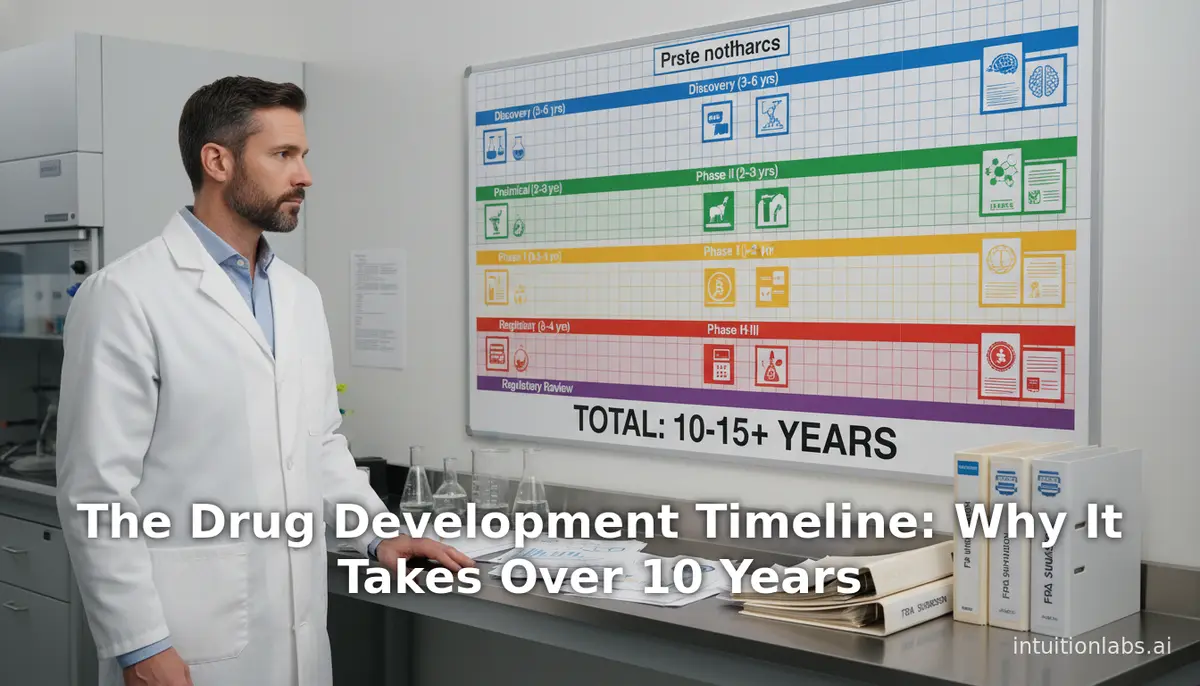
The Drug Development Timeline: Why It Takes Over 10 Years
Learn why the drug development timeline averages 10-15 years. Updated for 2026 with AI drug discovery milestones, ICH E6(R3), FDA AI guidance, and latest cost and success rate data. Covers every stage from discovery through approval.
Find Clinical Drug Pipelines: A Complete Guide to Resources
Updated 2026 guide to finding drugs in the clinical pipeline (Phase I-III). Learn to use ClinicalTrials.gov (550K+ studies), CTIS, commercial databases, and AI-powered tools like Pharmaprojects+ and TuneLab.
Software Applications in the Drug Development Lifecycle
Learn about the specialized software tools used across the drug development lifecycle, from discovery and preclinical research to manufacturing and commercialization. Updated for 2026 with ICH E6(R3), DSCSA compliance deadlines, IDMP/PMS timelines, and the latest in AI-driven drug design.
