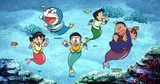
Doraemon: Nobita’s Great Battle of the Mermaid King 映画ドラえもん のび太の人魚大海戦について

Hello, everyone!
We're Doraemon Club of the Jikei University School of Medicine which places in Minato, Tokyo.
Today I’d like to talk honestly about both the charms and the questions I had while watching the 2010 film Doraemon: Nobita’s Great Battle of the Mermaid King. To be frank, the movie didn’t receive very high praise in Japan. One big reason is that it came out right after the voice actor change—from the long-loved “Ōyama-Dora” era to the new “Wasa-Dora” era with Wasabi Mizuta. That early period naturally drew harsher criticism, and this film was caught right in the middle of that transition. But precisely because of that, when you look at it calmly, its strengths and its weak points stand out clearly—and honestly, talking about both sides is part of the fun.
So now, I’d like to walk you through the plot of Nobita’s Great Battle of the Mermaid King in a gentle, easy-to-follow way—nothing too heavy, just like I’m chatting with you.
One day, Suneo cone to the park bragging—again—this time about how he went diving in Palau. And Nobita, frustrated and teary-eyed, sobs, “I want to dive too…”
Seeing this, Doraemon pulls out a secret gadget: the Fictional Water Surface Simulator Pump—a machine that creates virtual seawater that only appears when you wear special goggles. With it, he transforms the entire town into an underwater world!
But he doesn’t stop there. Using the Indoor Fishing Pond Kit and the Fictional Seawater Splash Gas—a gas that temporarily opens a path connecting real ocean creatures to this virtual sea—he brings actual fish from the Pacific into town. Nobita and the others swim joyfully among schools of fish, completely losing their minds with excitement.
Meanwhile, people without goggles only see fish bizarrely floating through the air. A kid doing stargazing faints after spotting a shark through his telescope. Realizing he’s causing chaos, Doraemon sends the fish back to the ocean.
The next day, Nobita steps into his backyard—and finds an unconscious girl lying on the ground. They take care of her, and when she wakes up, she introduces herself as Sophia. Nobita immediately brings her to meet Gian and Suneo, and the group happily shows her around town. But suddenly, Sophia collapses, whispering, “I need… water…”
Panicked, they rush her into the bath, and she instantly recovers. But when Shizuka tries to wash Sophia’s shirt and casually grabs her belt buckle, Sophia’s legs transform into a sparkling tail. She’s a mermaid!
Sophia herself is shocked, not realizing her transformation, but she finally confesses: she is the princess of the Mermaid Tribe.
She explains that her people were originally aliens called Aquarians, who fled their polluted home planet 5,000 years ago and built magnificent underwater cities on Earth. She lives in a palace deep beneath the sea—and she wants to go home.
Doraemon and the gang immediately decide: “Let’s help her return!”
To prepare, Doraemon uses another gadget to replicate Sophia’s outfit so everyone can wear mermaid-style suits. With the Adaptation Light, they can breathe underwater, too. Fully equipped, the group—Nobita, Doraemon, Gian, Suneo, Shizuka, and Sophia—dives into the ocean toward the palace.
As night falls, they build a tiny underwater house and rest. Inside, Sophia begins telling them about the legendary Mermaid Sword, a sacred artifact passed down in her tribe… and the story moves toward its most dramatic turning point.
The next morning, Shizuka admires Sophia’s tiara, and Sophia lets her borrow it for a while. But just as they resume their journey, a giant moray eel attacks! As they scramble to escape, a submarine appears and blasts the eel away.
From it emerges Haribō, captain of the Mermaid Tribe’s royal guards. Believing Sophia was illegally taken outside the sea, he tries to arrest Doraemon and the others. In the confusion, Shizuka runs off—only to mysteriously vanish. All that remains is a strange weapon… proof that someone kidnapped her.
The culprits reveal themselves: the Monster Fish Tribe, led by a tyrant named Buikin. Long ago on the Aquarians’ home planet, the Monster Fish Tribe coexisted with the mermaids—until they stole the planet’s resources, destroyed it, and pursued the mermaids to Earth, intending to eliminate them.
They kidnapped Shizuka only because she was wearing Sophia’s tiara… mistaking her for the princess. The Monster Fish Tribe wants Sophia to reveal the location of the Mermaid Sword.
Just then, Buikin contacts them:
“Bring me the legendary sword… and I’ll return the princess.”
Doraemon prepares a perfect fake sword, and he and Nobita go to the exchange. The trick works, and Shizuka is safely released.
But the celebration doesn’t last. The Monster Fish Tribe discovers the fake and launches a massive attack on the mermaid cities. Sophia and Doraemon’s team fight back, and a great ocean war erupts.
In the chaos, Sophia prays desperately to the Mermaid God—and miraculously, the true Mermaid Sword appears before her, glowing fiercely.
But Buikin snatches it and escapes, unleashing the sword’s power to create a colossal whirlpool. Doraemon and the others are completely overwhelmed.
They regroup and devise a strategy:
“The sword’s power only works underwater. So we lure Buikin onto land.”
Doraemon sprays him with the Fictional Seawater Splash Gas, which links the virtual sea to the real world. He had secretly kept the Fictional Water Surface Pump running this whole time, expanding the virtual ocean across town. Wearing their goggles, Doraemon’s team guides Buikin toward land.
And the moment Buikin steps onto solid ground—
Doraemon slams the emergency stop button.
The pump instantly reverses, sucking all the virtual seawater back in—dragging Buikin with it.
Doraemon and Nobita escape by bamboo-copter in the nick of time as the gigantic whirlpool disappears.
The battle finally ends. When Sophia touches the Mermaid Sword, the sea sparkles once more, restoring the ocean’s beauty. The Monster Fish Tribe is captured, and peace returns.
In the end, Doraemon’s group uses the Time Machine to return to the moment they originally left, acting like nothing ever happened. And just like that, their grand underwater adventure comes to a close, with Nobita and his friends safely back home.
Sounds interesting, right? However, the film is also heavily criticized for its astronomical inconsistencies and several forced explanations. Let me dive into that.
One of the most confusing moments in the scene where the characters search for Sophia’s home star lies in their assumption that a “pentagonal constellation” must refer to Auriga, and that if it cannot be seen from Japan in summer, they can simply travel to the Southern Hemisphere to see it in winter. This idea is problematic from the very beginning. Auriga is a constellation located high in the northern celestial hemisphere, northeast of Orion, and it is indeed well known as a winter constellation in Japan. However, that visibility depends entirely on the viewpoint of northern observers. Because Auriga is positioned so far north in the sky, it is not something that becomes visible just because one moves to the Southern Hemisphere during its winter. In reality, the farther south you travel, the lower northern-hemisphere constellations sink toward the horizon, many eventually disappearing from view altogether. In short, Shizuka’s suggestion—“Japan can’t see it because it’s summer, but the Southern Hemisphere is entering winter, so let’s go there”—is astronomically incorrect.
It is understandable that a young elementary school student like Shizuka might misunderstand the relationship between seasons and celestial visibility. However, what makes the scene feel especially strange is that Doraemon, who is usually portrayed as scientifically knowledgeable, immediately agrees with her mistaken assumption, exclaiming, “That’s it!” instead of correcting it. While this could be interpreted as Doraemon choosing to encourage the children’s enthusiasm rather than shutting down their idea, the scene ends up prioritizing narrative momentum over astronomical accuracy, which weakens its internal consistency.
The problems deepen once they actually arrive in the Southern Hemisphere. Suneo is unable to locate Auriga and is immediately scolded by the entire group. This criticism is unfair on multiple levels. Suneo, although boastful and occasionally overconfident, is not truly an expert in astronomy, and not knowing the exact position of Auriga is hardly a blameworthy failure. More importantly, there was no realistic possibility of finding it in the first place: Auriga is almost entirely invisible from many southern latitudes, and even when technically above the horizon, it is so low and faint that picking it out among a dense star field would be nearly impossible. In other words, Suneo’s failure is not personal incompetence—it is a direct consequence of the group’s flawed premise.
That makes the group’s reaction feel unusually harsh. Even Doraemon, who often mediates rather than accuses, joins in the blame, creating a moment that feels more like collective bullying than the usual dynamic in the series. This stands in contrast to Suneo’s typical characterization; although selfish and sometimes cowardly, he is also the one who frequently voices the “realistic” perspective in impossible situations, acting almost as a surrogate for the audience’s common sense. In this film, however, he is portrayed as a character who shirks responsibility and “runs away” at the first sign of difficulty, undermining his usual role and making him feel like a narrative sacrifice to force group unity.
Another missed opportunity lies in how the film treats the idea of the “five guiding lights” or the “pentagonal star.” These concepts are introduced as if they exist solely to set up a pun involving the constellation Auriga, and yet they are never meaningfully woven into the larger narrative. Ideally, the motif of “five lights” could have been developed into something much richer—perhaps symbolizing the five members of Doraemon’s group, or functioning as a deeper clue that reveals the forgotten history of Aqua. In most adventure-mystery structures, such a recurring visual motif would play a vital role in thematic development or world-building. But here, the entire star-search sequence is used only to generate a momentary bit of drama, and afterward it contributes almost nothing to understanding Aqua or locating Sofia’s home.
The result is that the pentagonal-star premise feels strangely ornamental. It does not inform later plot twists, nor does it shed light on the origins of Aqua, despite being introduced with the weight of an important clue. Instead, the only payoff we are given is a small comedic gag: the Japanese constellation name “Gyosha-za” (Auriga) sounds similar to “gyoza,” the dumpling dish, leading Gian to confuse the two. While the joke is amusing on its own, its relevance to the story is minimal, and the scene ends up highlighting how disconnected the entire “five lights” setup is from the narrative’s core mystery.
All these inconsistencies compound one another: the flawed assumption about hemispheric visibility, the misidentification of a planetary system as a constellation, and the misguided decision to hold Suneo responsible for not finding something that cannot be seen. As a result, the audience is left with the impression that the storytelling moment forced a conflict at Suneo’s expense. Sophia’s desire to “see her home star again” is thematically meaningful and poignant, but the astronomical logic beneath the scene is too shaky to support the emotional weight the story assigns to it.
Ultimately, the handling of Auriga introduces logical contradictions that ripple outward, leading directly to the unfair criticism of Suneo and weakening the overall coherence of the scene. It is not the intention of the story, but the combination of scientific inaccuracy and forced emotional framing makes viewers understandably feel that “something is off.”
But that doesn’t mean the movie has no value. Nobita’s kindness, Sophia’s awakening to her mission, and the purification of the ocean are moving and beautifully animated. The idea of saving the world not through force but through prayer and healing is a soft, very “Wasa-Dora-era” kind of message.
In that sense, Nobita’s Great Battle of the Mermaid King is a movie where beauty and inconsistency coexist. That’s why people’s evaluations vary so widely—but that’s also what makes discussing it so interesting. Looking back on it like this reveals so many layers hidden beneath the surface.
★★☆☆☆☆☆☆☆☆ 2/10