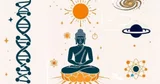
A Scientific Model of a Cosmic Cycle Connecting God, Buddha, and Human

Introduction: The Overlooked Mahayana Cosmology
In contemporary monotheistic societies, the profound cosmology of Mahayana Buddhism remains largely unfamiliar. In the West, for instance, Buddhism is often reduced to a form of psychological wellness, most commonly associated with the origins of “mindfulness.”
However, true Buddhism teaches a path of awakening through practice, where human becomes "Buddha" (the Awakened One) by discovering the truth. And what is particularly noteworthy is that, with the exception of the Big Bang concept, the cosmology depicted in Mahayana Buddhism shows intriguing parallels with observations in modern astronomy.
• Trichiliocosm (hierarchical universe): Galaxies, galaxy clusters, and the bubble structure of the universe.
• Karma: The deterministic law of causality in physics.
• Beginningless and Endless: The eternal nature of the universe, existing without beginning or end.
• Ten Directions of Dust World: Countless stars omnipresent everywhere.
• The Pure Lands of the Ten Directions: Civilized planets existing in every direction of the universe.
• One is Many, Many is One: A concept resembling a nested multiverse.
This article presents a new perspective that re-examinesMahayana Buddhism and monotheism not as a conflict, but as a "cycle of life on a cosmic scale."
Monotheism and Buddhism need not be seen as competing frameworks.
Monotheism and Buddhism shed light on the existence of human beings from different angles.
• Monotheism: Human is God's "creation."
• Buddhism: Human can become "Buddha" (the Awakened One who has realized the truth).
Monotheism addresses the “origin” of humanity, whereas Buddhism describes its “culmination.” In this sense, the two perspectives complement rather than contradict each other. They do not represent the two ends of a single straight line, but rather are located on the left and right sides of a single circle.
To connect these two perspectives, I propose a cyclical model that integrates monotheistic creation with Buddhist enlightenment.

The Lotus Sutra and the "Eternal Buddha"
In the Lotus Sutra, considered the pinnacle of Mahayana Buddhism, Shakyamuni Buddha confesses that he is the "Eternal Buddha," who attained enlightenment long ago.
The Eternal Buddha appears as a Buddha in the necessary time and place to preach the Dharma. On our Earth, he appeared as Shakyamuni Buddha. This symbolizes the infinity of the universe and the continuity of life. In the Lotus Sutra, Shakyamuni Buddha states that all the teachings he had preached up to that point were merely means to lead people to the "One Vehicle" (the one true vehicle). While the specific content of this "One Vehicle" is said to be wisdom shared only between Buddhas, I superimpose the "truth of life" revealed by modern science onto this.
The Cosmic Cycle of Life and Enlightenment
Here, based on the idea that the essence of life lies in DNA, I propose the following cyclical model.
The Cycle of God → Human → Buddha → God
1.Creation: God creates Human in His own image.
2.Awakening: Human attains enlightenment to become a "Buddha," awakening to the ultimate truth.
3.Wisdom: As a Buddha, one gains the wisdom to manipulate and synthesize the essence of life—encoded in DNA.
4.Re-creation: Utilizing this wisdom, the Buddha synthesizes DNA, leading to the emergence of Human.
5.Deification: In this stage of creation, Buddha functions as "God."
Thus, the cycle of God → Human → Buddha → God → … repeats eternally in the infinite universe. This cycle is driven by two things: "compassion," which is tenderness towards life, and "wisdom," which is advanced life science. Perhaps the "One Vehicle" of the Lotus Sutra refers to the existence of an infinite cycle of life in the infinite universe. And the Eternal Buddha transcends time and place, preaching the importance of compassion and wisdom.

A New Form of God-Buddha Syncretism in the 21st Century
In Japan, there is the "Honji Suijaku" theory, which posits that Indian Buddhas manifested themselves in the form of Japanese gods. This allows Shinto gods and Buddhist deities to coexist. Let's apply this flexible, integrated intelligence to the fusion of modern science, monotheism, and Buddhism.
• The Universe and Earth: In monotheism, "creation" refers to the creation of the sky, ground, and life on Earth. The infinite universe itself, to borrow a phrase from the Bible, is "I AM THAT I AM," meaning the universe has existed since the infinite past.
• Intelligence Derived from the Heavens: The Buddhist universe view aligns with modern science because it contains intelligence derived from the "heavens (universe)." The anecdote of Brahma's involvement in Shakyamuni Buddha's enlightenment can be seen as symbolic of this.
• The True Nature of "Spirit & Soul": In times without science, people referred to genes and DNA using the metaphors "spirit" or "soul."
From these perspectives, the home place of the Buddha transcends India and becomes the universe itself. It is the same as the home place of God in monotheistic religions. The land to which they manifested transcends Japan and becomes the Earth itself.
Conclusion: Beyond Mysticism to the Universe
In this cyclical model, even God and Buddha can be understood as expedient means guiding us toward the truth.
We no longer need to be bound by mysticism that fears the unknown, or by the defilements (fear, ignorance) caused by ignorance. Knowing the truth that the essence of life is information inscribed in DNA, and that this is passed down through wisdom and compassion, is the very awakening of humanity.
Our cultivation of intellect and our passing on of the baton of life with compassionate hearts is the path that pleases the will of "God", who is watching over the intelligence given to us by the Creator. We too are part of this magnificent cosmic cycle, beings who weave the next life with our own hands.
In this spirit of unity across traditions—Gassho (=putting one’s hands together in prayer), Amen, and “南無妙法蓮華経(Namu Myoho Renge Kyo).”