Why Were There So Many Italians in This Town?@mx016

Why Were There So Many Italians in This Town?
Even after Rastaman left, I stayed in Puerto Escondido.
I went to the beach, walked through the market, and sometimes stopped by the Galleria for an espresso.
As that routine continued, I began to notice something more clearly.
There were a lot of Italians in this town.
The owners of the Galleria were Italian too.
The husband was a painter and looked to be somewhere in his forties or fifties. His wife seemed younger, perhaps in her late thirties.
There were always Italians gathered inside.
Some came to eat. Others sat over espresso and talked for hours. There were newcomers, people who had already settled in town, and others preparing to leave for somewhere else.
To me, the Galleria seemed like the center of the Italian community in Puerto Escondido.
Who was living where.
Where work might be found.
Which town to go to next.
I could not understand Italian, but it felt as though information from travelers passed from one table to another.
The Galleria was a restaurant and an art gallery.
But it also seemed to be a small meeting point for Italians who had drifted into this part of Mexico.
Why were there so many of them in a coastal town so far from Italy?
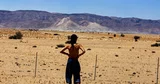
One reason may have been the Italian film Puerto Escondido.
I had seen the film too.
The story begins with a man leaving Italy and traveling through Mexico.
One of the places shown early in the journey is Real de Catorce, an old silver-mining town surrounded by desert.
The wider region is also connected to the Wixárika people, often called the Huichol, and to sacred lands they have visited on pilgrimage for generations.
In the film, peyote appears.
Peyote is a hallucinogenic cactus traditionally used by the Wixárika in ceremony.
It is not presented simply as a drug. It belongs to the land, to ritual, and to a very different way of understanding the world.
From there, the journey continues toward Puerto Escondido.
The Mexico shown in the film was not a polished tourist destination.
It was a place of desert roads, strangers, uncertainty, and the possibility of leaving one life behind to begin another.
Perhaps that was what drew people in.
Some Italians may have crossed the ocean because they wanted to see the place they had watched on screen.
Some may have wanted to follow the same route.
And some may simply have arrived and never left.
Italian and Spanish both developed from Latin, and the languages share many sounds and words.
Perhaps that made Mexico easier for Italians to enter.
They could learn the language more quickly, meet others from the same country, and find places like the Galleria where information was always moving.
That may be how a small Italian world formed inside Puerto Escondido.
Further down the coast, in Zipolite, there were many Italians too.
That was where I would later meet Mauro, a friend of Ken-chan.
Perhaps he had also come to Mexico because of the film.
I never knew for certain.
But along the coast of Oaxaca in those years, there really were people who seemed to have stepped out of a movie and continued walking.
I was one of those who had arrived by a different road.
But I too had drifted into Puerto Escondido from far away.
@archive016
#SafariArchive #Mexico #PuertoEscondido #Galleria #ItalianFilm #TravelMemories #LifeAbroad #Backpacker #Zipolite #LifeArchive