A Five-Year-Old Asked for Seconds. That's Where This Started.

Selling at markets is, honestly, physical work.
You're on your feet from morning to night, talking the whole time,
and by the time everything's packed up, you're completely spent.
But something happened at one of those markets that made the exhaustion vanish.
I still think about the girl I met that day — five years old, maybe.
She came past holding her mother's hand,
and something caught her — the foam on the matcha, or the colors of the botanical blends.
"Want to try some?" I asked.
She nodded, hard, so I handed her a cup.
She drank the whole thing and grinned.
"Can I have another one!"
That surprised us.
Her mother was surprised too — "She never asks for seconds," she said,
half laughing, half serious.
It was only later that I learned there were more of them. A family who'd bought one of our sets told me, "She does this every single day," and I was just plainly happy to hear it.

According to a national survey by Japan's Ministry of Internal Affairs, the number of people practicing tea ceremony as a hobby fell from roughly 1.76 million in 2016 to about 920,000 in 2021. Cut in half in five years.
Abroad, it looks different. In cafés in New York and London, matcha isn't exotic anymore — it sits next to coffee as an ordinary choice. And whisking it by hand, that motion itself, has spread online as a new kind of daily ritual.
So it may be that whisking a bowl of matcha now lives closer to everyday life outside Japan than inside it.
That worries us. It also gives us hope.
WACHA was founded to bring tea ceremony closer to people. But "closer" doesn't mean stripping away the formality. It means building a proper first door — one that someday leads to the real thing.
The moment that girl said "another one" —
that was a seed of curiosity taking root in her.
I wanted that seed to survive past the market, to go home with her,
and to grow a little each day. That's why we made
"My First Matcha."
A mini nodate whisk, a bowl that won't break easily,
and three matcha sticks — Green, Blue, and Red.
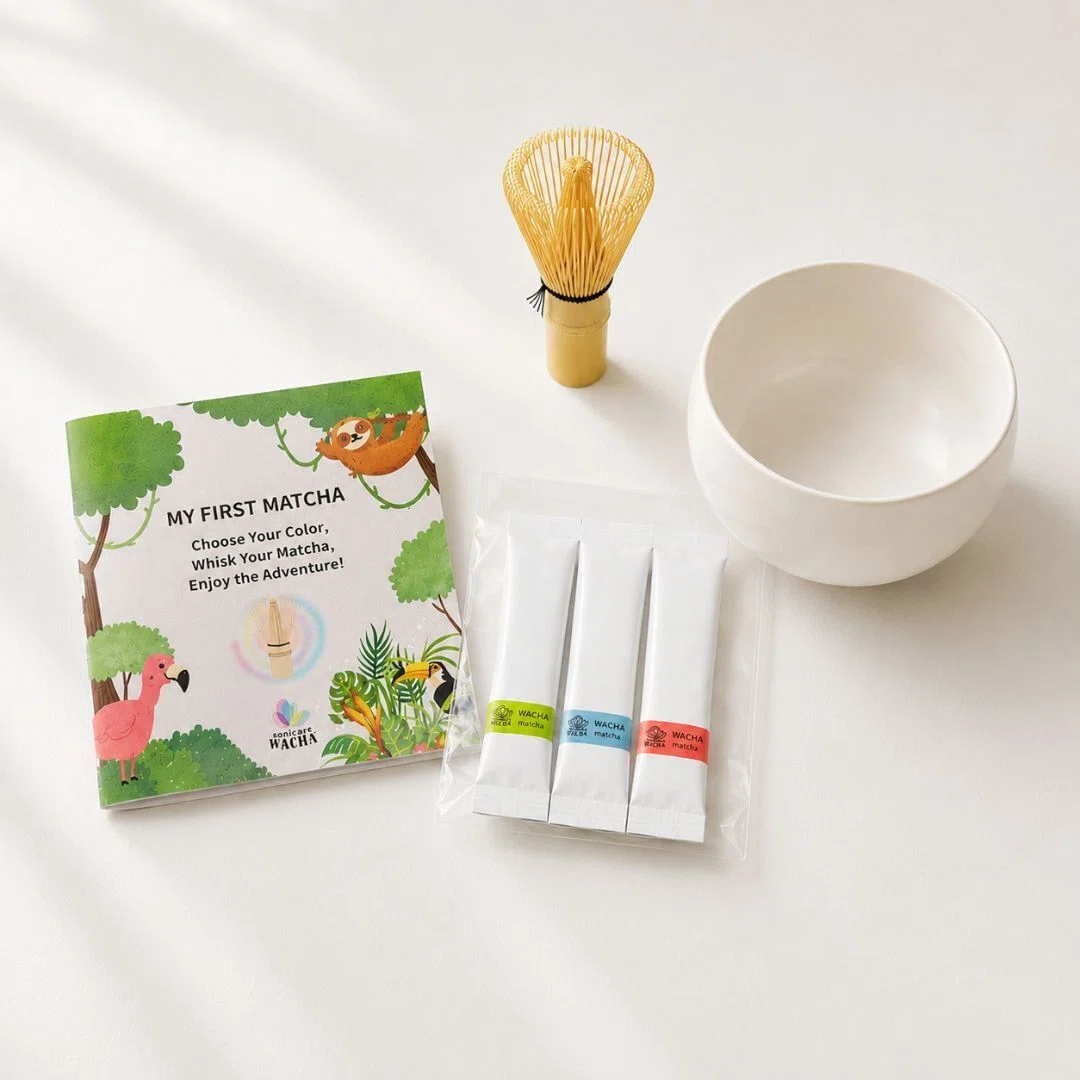
Blue and Red are caffeine-free, so younger children can enjoy them (Green contains peach, so please take note if peach allergies run in your family). No artificial colors or flavorings. So I'd love it if children taste it the way that girl did, and just say it's good.
Once you find a color you like, refill it by the tin next time.
The whisk and the bowl are already yours.
And the bowl stays at the table on days you don't whisk anything at all.
One bowl of matcha can be a child's first door into a culture.
I want to put that door in front of as many families as I can.
That voice at the market — "another one" — is where we started.
▶ My First Matcha — a starter kit for children and their families
▶日本語版記事はこちら / Read this in Japanese