new

Get trending papers in your email inbox!

Subscribe

Trending Papers

byAK and the research community

Trending Papers

TradingAgents: Multi-Agents LLM Financial Trading Framework

A multi-agent framework using large language models for stock trading simulates real-world trading firms, improving performance metrics like cumulative returns and Sharpe ratio.

  • 4 authors
· Dec 28, 2024
Submitted by
unilm

VibeVoice Technical Report

VibeVoice synthesizes long-form multi-speaker speech using next-token diffusion and a highly efficient continuous speech tokenizer, achieving superior performance and fidelity.

MicrosoftResearch Microsoft Research · Aug 26, 2025

Kronos: A Foundation Model for the Language of Financial Markets

Kronos, a specialized pre-training framework for financial K-line data, outperforms existing models in forecasting and synthetic data generation through a unique tokenizer and autoregressive pre-training on a large dataset.

  • 7 authors
· Aug 2, 2025
Submitted by
aaronjli

TokenEconomizer: Experience-Driven Black-Box Cost Control for Coding Agents

TokenEconomizer reduces recurring token costs of coding agents across sequential real-world tasks by pruning irrelevant tools, injecting micro-skills, and interrupting failure loops.

MicrosoftResearch Microsoft Research · Oct 15, 2026
Submitted by
ruiyaox

Harness^2: Recursive Agent Harnessing for an Open World

Harness² improves agent execution harnesses through recursive task-level refinement and continual harness-level learning, boosting performance across benchmarks without ground-truth verifiers.

google Google · Oct 9, 2026
Submitted by
andy-yang

FreeToken: Efficient Edge-Native MoE Serving with Bandwidth-Adaptive Execution

FreeToken is an edge-native Mixture-of-Experts serving system that dynamically maps computation and model state onto heterogeneous local hardware to run large open-weight models on personal machines.

Submitted by
taesiri

Unlimited OCR Works

Unlimited OCR introduces Reference Sliding Window Attention to eliminate growing memory consumption during long-sequence OCR tasks, enabling efficient transcription of multiple pages in a single forward pass.

baidu BAIDU · Jun 22, 2026
Submitted by
zx-Wu

VisSearch-Bench: Evaluating Long Horizon Visual Search in Multimodal Agents

VisSearch-Bench evaluates multimodal agents on visually intensive search tasks that require integrating visual context with external information, showing that even the best system fully solves only 26.47% of tasks.

antgroup Ant Group · Nov 3, 2026
Submitted by
yuxinzuo

Democratizing Robot-Use Agents: A Unified Harness with Open Models

Uni-robot-agent enables open-weight robot-use agents to surpass proprietary models in zero-shot manipulation and suggests joint development of four core capabilities for future training.

  • 28 authors
· Nov 1, 2026
Submitted by
liangtm

WeVisOne-VL: Unified Visual Perception from Objects to Pixels

WeVisOne-VL unifies object-level and pixel-level visual perception via structured token prediction, supporting detection, localization, counting, OCR, segmentation, and matting with a lightweight pixel decoder and multi-stage training.

tencent Tencent · Oct 22, 2026
Submitted by
akhaliq

Very Large-Scale Multi-Agent Simulation in AgentScope

Enhancements to the AgentScope platform improve scalability, efficiency, and ease of use for large-scale multi-agent simulations through distributed mechanisms, flexible environments, and user-friendly tools.

  • 8 authors
· Jul 25, 2024
Submitted by
akhaliq

Efficient Memory Management for Large Language Model Serving with PagedAttention

PagedAttention algorithm and vLLM system enhance the throughput of large language models by efficiently managing memory and reducing waste in the key-value cache.

  • 9 authors
· Sep 12, 2023
Submitted by
taesiri

AgentScope 1.0: A Developer-Centric Framework for Building Agentic Applications

AgentScope enhances agentic applications by providing flexible tool-based interactions, unified interfaces, and advanced infrastructure based on the ReAct paradigm, supporting efficient and safe development and deployment.

  • 23 authors
· Aug 22, 2025
Submitted by
akhaliq

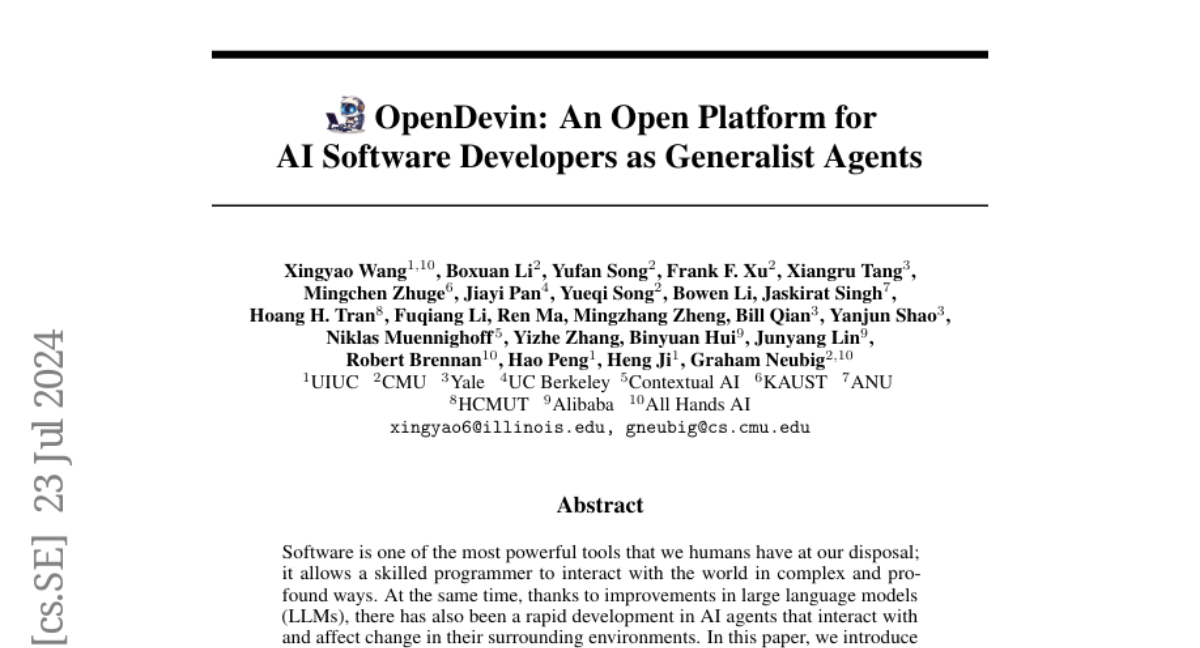
OpenDevin: An Open Platform for AI Software Developers as Generalist Agents

OpenDevin is a platform for developing AI agents that interact with the world by writing code, using command lines, and browsing the web, with support for multiple agents and evaluation benchmarks.

  • 24 authors
· Jul 23, 2024
Submitted by
bupalinyu

The Other Half of the Memory Wall: Serving 35B MoEs from SSD with Trained Routing Prediction

Edge0 enables efficient mixture-of-experts inference on consumer hardware by predicting expert routing ahead of time and using recovery adapters to maintain quality with minimal active memory.

Edge0 Edge0 · Sep 16, 2026
Submitted by
stargazerx0

SpecPilot: Autonomous Algorithm Discovery and Systems Optimization for Speculative Decoding

SpecPilot autonomously discovers deployment-specific algorithms and system optimizations to maximize speculative decoding speedups across diverse models, drafters, and serving regimes without quality loss.

Differentiable Data Augmentation with Kornia

This paper reviews the Kornia differentiable data augmentation module for both 2D and 3D tensors, integrating with PyTorch's autograd and optim, and benchmarks it against other frameworks.

  • 5 authors
· Nov 19, 2020
Submitted by
Lyricccco

TailSteer: Trajectory-Tail Steering for Drift-Resistant Multi-turn Image Editing

TailSteer, a final-stage training framework, reduces cumulative visual drift in multi-turn editing by keeping early denoising dynamics close to the base model and learning tail-focused preservation corrections from on-policy rollouts, preserving pretrained generative and editing abilities.

MMLab-CUHK MMLab-CUHK · Nov 4, 2026
Submitted by
RuofengYang

ARIS: Autonomous Research via Adversarial Multi-Agent Collaboration

ARIS is an open-source research harness that uses cross-model adversarial collaboration to ensure reliable long-term research outcomes through coordinated execution, orchestration, and assurance layers.

Submitted by
zhangkangning

Harness-S: Learning from Sibling Harnesses for Generalizable Agent Training

A selective harness-rescue training method uses specialized sibling harnesses to replace failed reinforcement learning rollouts and transfer their benefits into a single policy that performs better under the original base harness.

Xiaomi-OCR-0 Technical Report

Xiaomi-OCR-0 is a compact vision-language model that unifies document parsing and OCR understanding through automated data synthesis, progressive training with text anchoring and reinforcement learning, and achieves state-of-the-art results on multiple benchmarks.

  • 10 authors
· Sep 28, 2026
Submitted by
hyz317

HairDeck: Animation-Ready Stylized Hair Cards from a Single Image

HairDeck generates stylized hair cards and spring-bone animations as unordered token sets using a diffusion transformer, improving accuracy and speed over prior methods.

Tsinghua Tsinghua University · Oct 29, 2026
Submitted by
billhuang2001

Persistent Recursive Worlds Enable Autonomous Software Evolution

Genesis organizes long-horizon software development around a persistent project rather than persistent agents, enabling multi-day compiler construction and numerical module reimplementation with low cost and high performance.

Submitted by
akhaliq

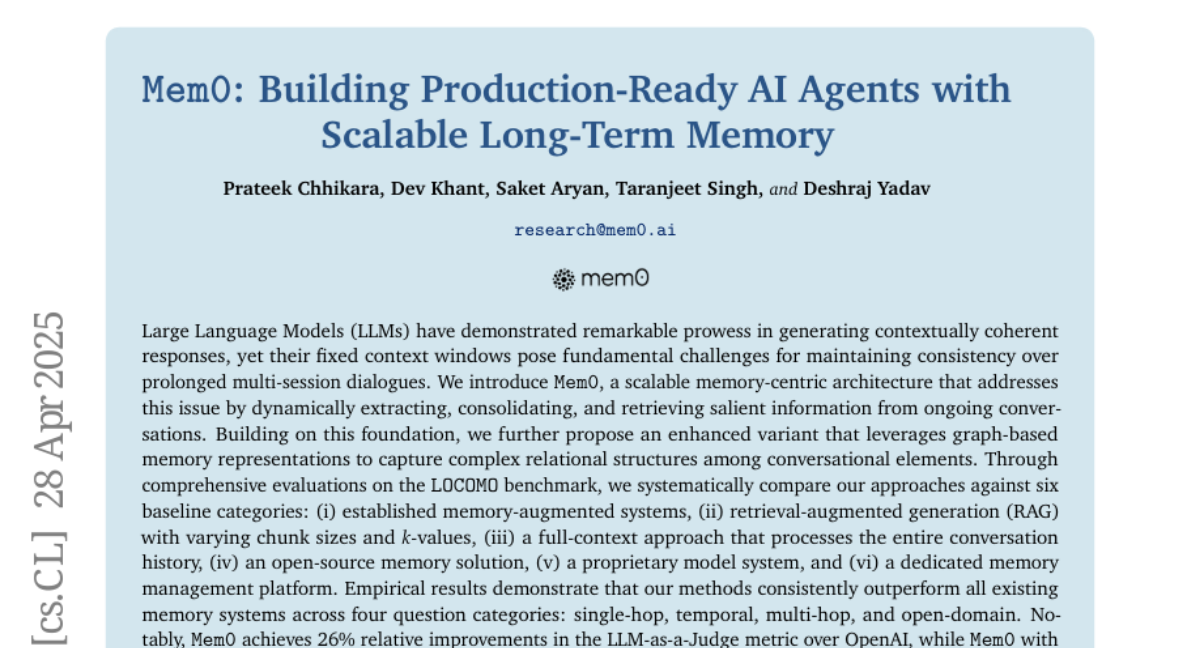
Mem0: Building Production-Ready AI Agents with Scalable Long-Term Memory

Mem0, a memory-centric architecture with graph-based memory, enhances long-term conversational coherence in LLMs by efficiently extracting, consolidating, and retrieving information, outperforming existing memory systems in terms of accuracy and computational efficiency.

  • 5 authors
· Apr 28, 2025
Submitted by
Phospheneser

MOSS-Image Technical Report

MOSS-Image is an open diffusion transformer that combines high-fidelity synthesis with intent-aware prompt enhancement to generate text-rich, layout-coherent images, achieving state-of-the-art open-weight results on long-form text and layout benchmarks.

OpenMOSS-Team OpenMOSS · Oct 16, 2026
Submitted by
ChengCui

PaddleOCR-VL-1.6: Expanding the Frontier of Document Parsing with Under-Optimized Region Refinement and Progressive Post-Training

PaddleOCR-VL-1.6 enhances document parsing performance through targeted data optimization and progressive post-training techniques, achieving state-of-the-art results on OmniDocBench v1.6.

PaddlePaddle PaddlePaddle · Jun 2, 2026
Submitted by
taesiri

MinerU2.5: A Decoupled Vision-Language Model for Efficient High-Resolution Document Parsing

MinerU2.5, a 1.2B-parameter document parsing vision-language model, achieves state-of-the-art recognition accuracy with computational efficiency through a coarse-to-fine parsing strategy.

  • 61 authors
· Sep 26, 2025
Submitted by
andito

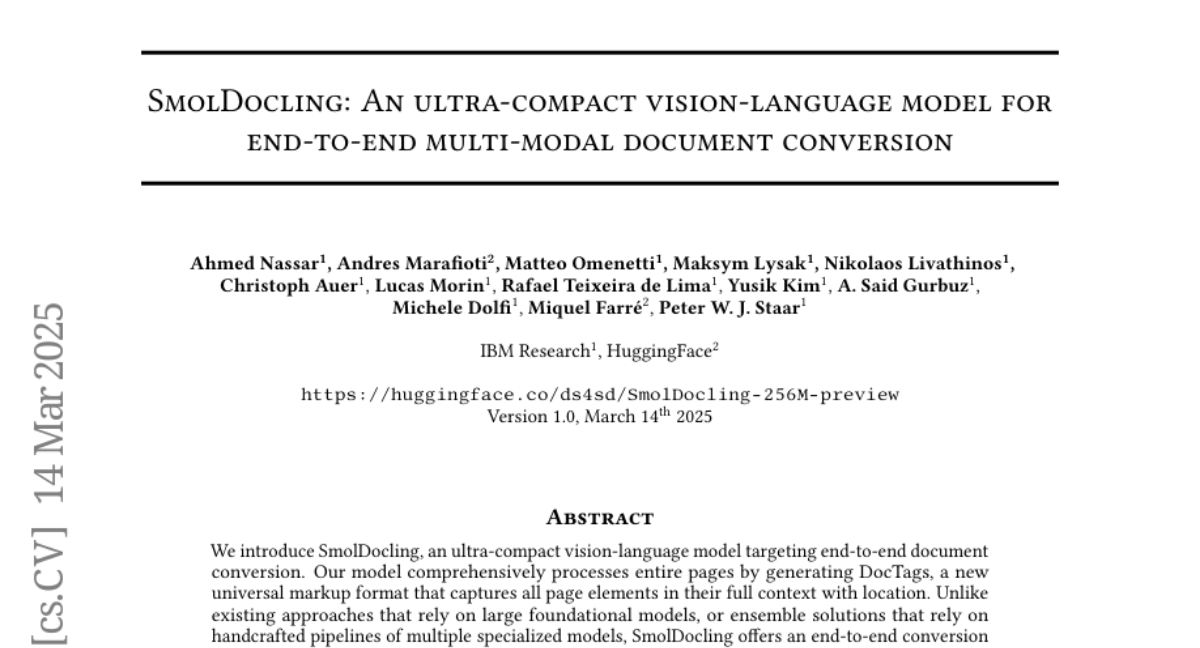
SmolDocling: An ultra-compact vision-language model for end-to-end multi-modal document conversion

SmolDocling is a compact vision-language model that performs end-to-end document conversion with robust performance across various document types using 256M parameters and a new markup format.

ibm-granite IBM Granite · Mar 14, 2025
Submitted by
lgy0404

nanoMuse: An Open-Source Personal Agent for Every Device You Own

Assistants from 2011 answered and waited, and agents from 2023 did a task and stopped. In September 2026 Meta's Muse showed an agent for one person, with accounts, devices, memory and a conversation that lasts, closed, in a vendor's cloud, in one country. Such an agent is expected to act on a person's accounts and devices, remember them across weeks, speak first when it is worth it, and answer for what it did. It is a kind of software, not a model, and until now had no open counterpart. This report defines the personal agent in five questions and three horizons. It reads how Muse is built from Meta's public record and a copy of its production prompt, each statement marked by its source. It then presents nanoMuse, the open-source counterpart under the GPL-3.0, one agent on every device a person owns, with hands on the phone's screen and the computer's. They share one conversation over a relay anyone can run; every action goes through a Sentinel, memory is files the person can read, and the model is their choice. Its size and cost are given as estimates. What is open, memory with provenance, an evaluation suite for the hands and an open model for them, is set out as a roadmap.

zju Zhejiang University · Oct 6, 2026

A decoder-only foundation model for time-series forecasting

A large language model adapted for time-series forecasting achieves near-optimal zero-shot performance on diverse datasets across different time scales and granularities.

  • 4 authors

· Oct 14, 2023
Submitted by
yxl66666

CUA-Master: Scaling Computer-use Agents through Open-World Recursive Improvements

CUA-Master uses nested recursive loops with open-world data and feedback-driven retries to continuously improve computer-use agents across diverse benchmarks.

  • 18 authors

· Nov 2, 2026
Submitted by
Dunge0nMaster

EmoReward: Self-Evolving Reward Calibration for Emotional Video Generation RL

Group Relative Policy Optimization (GRPO) has advanced generative model post-training in verifiable domains such as code and mathematics, but evaluating video quality, especially emotional expression, often depends on subjective aesthetics and has no uniquely correct target. Existing approaches typically rely on fixed rewards for visual quality, motion quality, and text alignment that poorly capture emotional intent and can invite reward hacking, while RLHF is difficult to scale and subject to individual aesthetic differences that complicate the calibration of facial, body motion, and chromatic cues across narrative contexts. We introduce EmoReward, a new self-evolving training mechanism that distills evidence reliability from reward traces collected during an actual training run to adaptively guide multi-reward weight allocation in subsequent training by determining which emotional evidence to trust and how much to weight it. EmoReward first plans specific grounding cues from the emotional prompt to guide evaluation, then uses heterogeneous signal primitives to score the generated video during the act stage. Reflective Reward Gating calibrates their contributions through instance-level gates for phase, face confidence, conflict, and subtlety, then renormalizes weights over the active set to produce the sample's fused reward. RewardMemory then estimates each primitive's reliability from rollout scores and outcomes within each emotional regime in the finished training run, then fixes bounded multipliers that calibrate fusion weights in the next training run without updating reward models. Experiments on HunyuanVideo 1.5 show improvements across multiple RL algorithms and compare EmoReward with other agentic reward methods under SAGE-GRPO. Ablations and transfer experiments on SD 3.5 and FLUX further support adaptive reward calibration for visual generation.

Tencent-Hunyuan Tencent Hunyuan · Nov 4, 2026

Zep: A Temporal Knowledge Graph Architecture for Agent Memory

Zep, a memory layer service, outperforms MemGPT in the DMR benchmark and LongMemEval by excelling in dynamic knowledge integration and temporal reasoning, critical for enterprise use cases.

  • 5 authors
· Jan 20, 2025
Submitted by
lhpku20010120

OmniEdu: Open Foundation Models for Learning and Teaching

OmniEdu is a family of instruction-tuned educational foundation models that improve K-12 problem solving, curriculum understanding, and tutoring through capability-balanced training data.

PekingUniversity Peking University · Sep 19, 2026
Submitted by
dongguanting

CoworkOS:Scaling Agent Coworkers for Real-world Automation

CoworkOS is a long-horizon agent harness that separates strategy from execution, supports human-in-the-loop collaboration via shared artifacts, and improves model performance through sustained automated post-training.

Submitted by
vyokky

NorthCUA Technical Report: Turbocharging Computer-Use Agents through Experience at Scale

NorthCUA scales computer-use agents via an experience flywheel, recursive self-improvement, staged learning, and reinforcement learning to achieve state-of-the-art open-source GUI and web interaction results.

beipo-ai beipo-ai · Nov 1, 2026

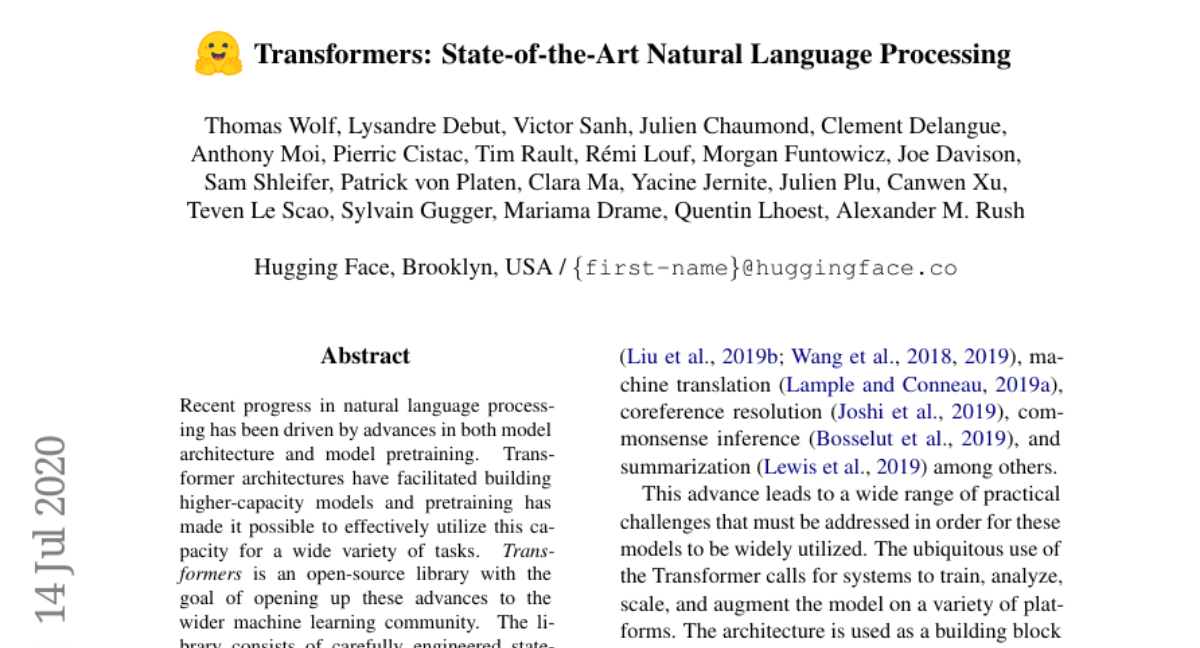
HuggingFace's Transformers: State-of-the-art Natural Language Processing

Transformers library provides state-of-the-art Transformer architectures and pretrained models for natural language processing tasks with a unified API and emphasis on extensibility and robust deployment.

huggingface Hugging Face · Oct 9, 2019
Submitted by
a43992899

YuE2: Unifying Symbolic and Audio Music Generation at Frontier Quality

YuE2 unifies symbolic and audio music generation via symbolic planning, producing readable scores and full-song audio with state-of-the-art quality and agentic editing capabilities.

OmniFlatten: An End-to-end GPT Model for Seamless Voice Conversation

A novel GPT-based model, OmniFlatten, enables real-time natural full-duplex spoken dialogue through a multi-stage post-training technique that integrates speech and text without altering the original model's architecture.

  • 9 authors
· Oct 23, 2024
Submitted by
supra3d

SUPRA-TEX: 3D Generation with Super-Aligned Texture

SUPRA-Tex decouples visible-material estimation, surface alignment, and 3D completion to generate relightable 3D materials that preserve reference image details and complete unobserved surfaces.

  • 8 authors
· Oct 15, 2026
Submitted by
Linzhan

UniMate: One Unified Model to Animate Diverse Skeletons

UniMate is a unified diffusion transformer that generates articulated motion for arbitrary skeletons from text and rigged 3D assets without per-skeleton retraining, using topology-aware attention and a large curated motion dataset.

princetonu Princeton University · Sep 4, 2026

PDFMathTranslate: Scientific Document Translation Preserving Layouts

PDFMathTranslate enables layout-preserving scientific document translation using large language models and precise layout detection, offering improved precision, flexibility, and efficiency.

  • 4 authors

· Jul 2, 2025
Submitted by
jgkwak

Solv3R: 3D Looped Transformer as a Multi-view Solver

Solv3R is a looped transformer that iteratively refines multi-view geometry from its current state, supporting incremental updates, caching, and multiple reconstruction tasks without specialized modules.

  • 5 authors
· Nov 2, 2026

PyTorch Distributed: Experiences on Accelerating Data Parallel Training

The PyTorch distributed data parallel module optimizes large-scale model training using techniques like gradient bucketing, computation-communication overlap, and selective synchronization to achieve near-linear scalability.

  • 11 authors
· Jun 28, 2020
Submitted by
eric-xiang

EvoMemState: Evolving Memory State for Personal Agents

Long-term memory enables large language model (LLM) agents to provide continuous personalized assistance by retaining user information across interactions. Existing systems support this process through fact extraction, organization, updating, and retrieval, but largely maintain memories as independent facts. This fact-centric paradigm may overlook how new facts update, constrain, or conflict with earlier ones, while leaving their applicability, role, and priority for the current request implicit. In this paper, we introduce EvoMemState, a state-centric framework that augments persistent facts with two complementary states: Relational States that capture how facts remain valid and relate to one another as memory evolves, and a Reasoning State that determines how these facts should be applied to the current request. Specifically, EvoMemState consists of three key components: (i) Ontology-Guided Memory State Induction extracts Persistent Facts and constructs Relational States that maintain their validity, scope, and evolving relations. (ii) RL-Based State Evolution internalizes memory-use experience into a policy through reinforcement learning to generate a request-specific Reasoning State. (iii) State-Aware Reasoning then combines the relevant facts with their Relational States and the generated Reasoning State to guide the personal agent. Extensive experiments on long-term dialogue and memory-use benchmarks demonstrate consistent improvements over existing memory systems in retrieval completeness and memory-grounded response accuracy. Our code and implementation details are available at https://github.com/XMUDeepLIT/EvoMemState.git.

  • 10 authors

· Nov 2, 2026
Submitted by
jasonrqh

COLLEAGUE.SKILL: Automated AI Skill Generation via Expert Knowledge Distillation

Person-grounded AI skills are automatically distilled from heterogeneous traces into inspectable, correctable packages that capture both capabilities and behavioral patterns.

ShanghaiAiLab shanghai ailab · May 29, 2026
Submitted by
nielsr

Ultralytics YOLO26: Unified Real-Time End-to-End Vision Models

YOLO26 addresses real-time vision challenges through a unified model family with NMS-free inference, improved training strategies, and multi-task capabilities spanning detection, segmentation, and pose estimation.

Ultralytics Ultralytics · Jun 2, 2026

One Model to Rig Them All: Diverse Skeleton Rigging with UniRig

UniRig is a framework using autoregressive models and cross-attention for automated skeletal rigging, achieving high accuracy across diverse 3D models.

  • 5 authors
· Apr 16, 2025
Submitted by
DrewJin0827

Wave Forcing: Towards Speed-of-Light Streaming Video Generation

Wave Forcing enables efficient continuous long-video generation with consistent appearance and natural motion through co-designed generation, training, and execution, achieving high throughput and quality.

SJTU-DENG-Lab DENG Lab @ SJTU · Oct 31, 2026
Submitted by
YINBO0927

FrameMorrow: Future-guided Frame Selection with Prospective Tokens for Long-Horizon Video Generation

FrameMorrow improves long-horizon video generation by selecting historical frames based on predicted future information needs rather than current content.