

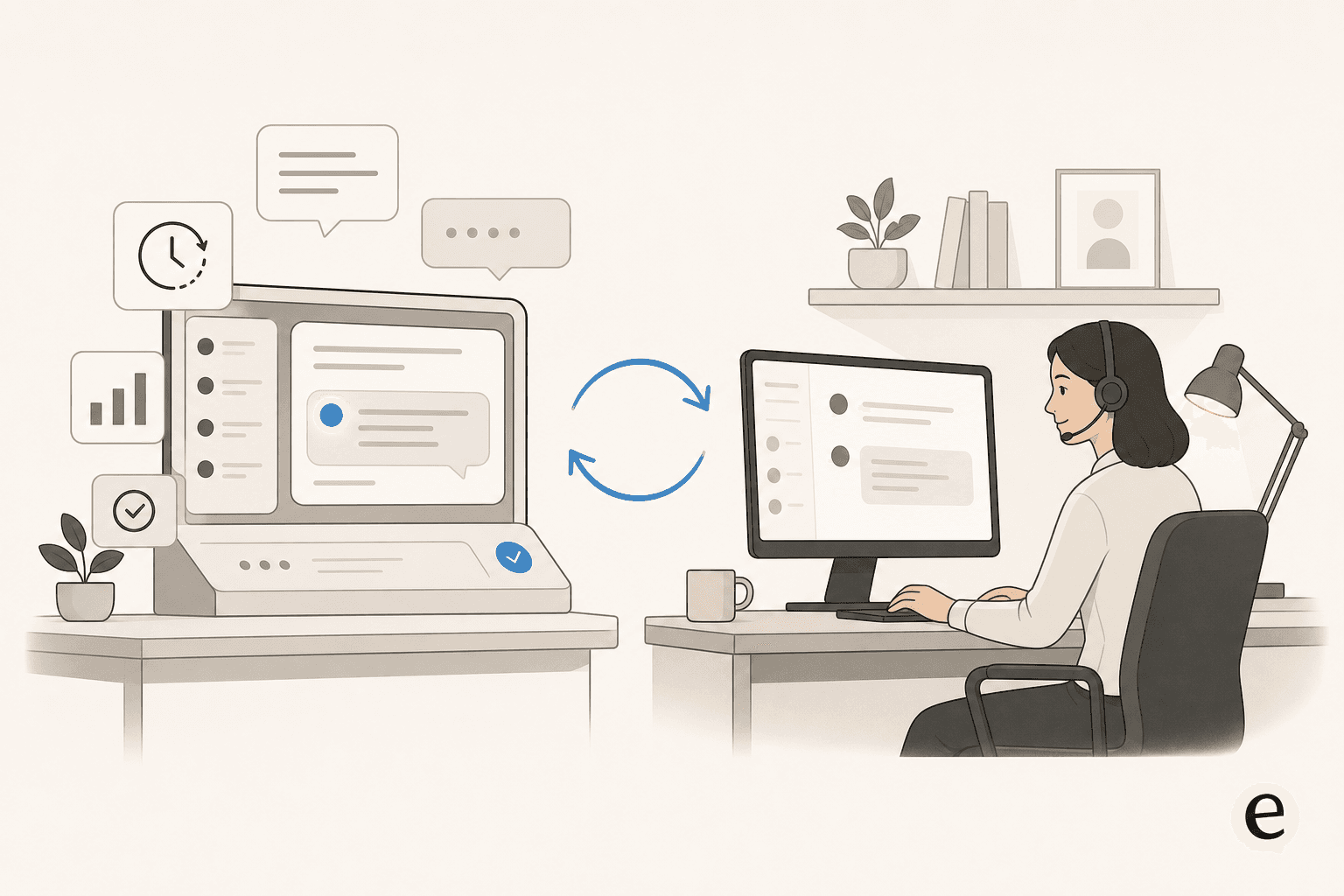
Let AI handle the support questions that have one right answer it can look up (order status, return and shipping policy, stock, account how-tos) and keep people on anything that needs a judgment call, money moving outside policy, or a customer who is already upset. Customers will accept that split only if the way out stays open: in Gartner's 2026 survey of 3,566 customers, 50% said AI makes their service interactions easier, and 87% said a way to reach a human agent is essential.
So AI hasn't replaced human support, and Gartner's own count says few teams are trying: only 21% of service leaders have cut agent headcount because of AI, and 7% have already rehired after a cut. What AI has done is take the repetitive middle of the queue and push people toward the work they win at: angry customers, edge cases, exceptions.
A real split looks like Rúngne's, a climbing apparel brand on Gorgias. eesel answers shipping and return policy, order status, stock, pre-orders and sizing on its own, which came to about one ticket in seven in a month of 2,100. It left about 580 drafts for the team to check and send, and cancellations, damaged items, lost parcels and complaints never reach its public replies at all.
You don't need a long onboarding call to set that up. An AI coding agent you already use can connect eesel through the eesel CLI, load your help center and past tickets, and test drafts on real tickets before anything goes to a customer; connecting the helpdesk still needs an admin's approval.
What should AI handle in customer support?
AI should handle the questions where the answer is a lookup or a written policy, at any hour, in the customer's language. That is most of what lands in a queue on a normal day, and it is where AI is plainly better than a person.
Speed. A person works a queue; AI doesn't wait in one. Klarna's launch numbers are the cleanest public example: in its first month its AI assistant had 2.3 million conversations, two-thirds of Klarna's customer service chats, and customers resolved their errands in under 2 minutes compared with 11 minutes before. Fast answers at that volume are the plain case for AI customer service.
Coverage. 24/7 with no shift premium, no holiday pay and no night-shift attrition. Customers now expect it: in Zendesk's CX Trends 2026 research, 74% of consumers said they expect 24/7 service because of AI.
Pattern matching at scale. A human agent learns the playbook from the tickets they personally worked. An AI agent can read every ticket your team has closed since you turned the helpdesk on. That asymmetry is invisible until you watch an AI find the obscure macro from 18 months ago that solves a ticket nobody on the current team remembers writing.
Doing the lookup, not just the answer. The useful jump isn't the chat window, it's the action behind it. In the same Gartner survey, 58% of customers who use GenAI have used it to complete a task on their behalf, rising to 74% in B2B. "Where is my order?" answered with the tracking link from Shopify is a resolution; "check your confirmation email" is a deflection. The same holds for FAQ deflection: an answer that ends the question beats one that points somewhere else.
The public proof points come from the vendors themselves. Klarna's assistant did the equivalent work of 700 full-time agents, with customer satisfaction on par with human agents and a 25% drop in repeat inquiries. Grammarly reports 87% deflection and a 4.2 out of 5 CSAT with Forethought, which Forethought credits to a well-maintained knowledge base and API integrations that let the AI act inside Grammarly's systems.
Notice the line in Klarna's own announcement that most retellings drop: "customers can still choose to interact with live agents if they'd prefer." Even the most-quoted automation story kept the door to a person open.
What should human agents handle?
People should own the tickets where the right answer isn't written down: exceptions, anything high-risk, and customers who need to feel heard before they need an answer. Gartner's Kathy Ross puts the line in the same place:
"While AI excels at handling routine and well-defined problems, it often struggles with exceptions and high-risk scenarios."
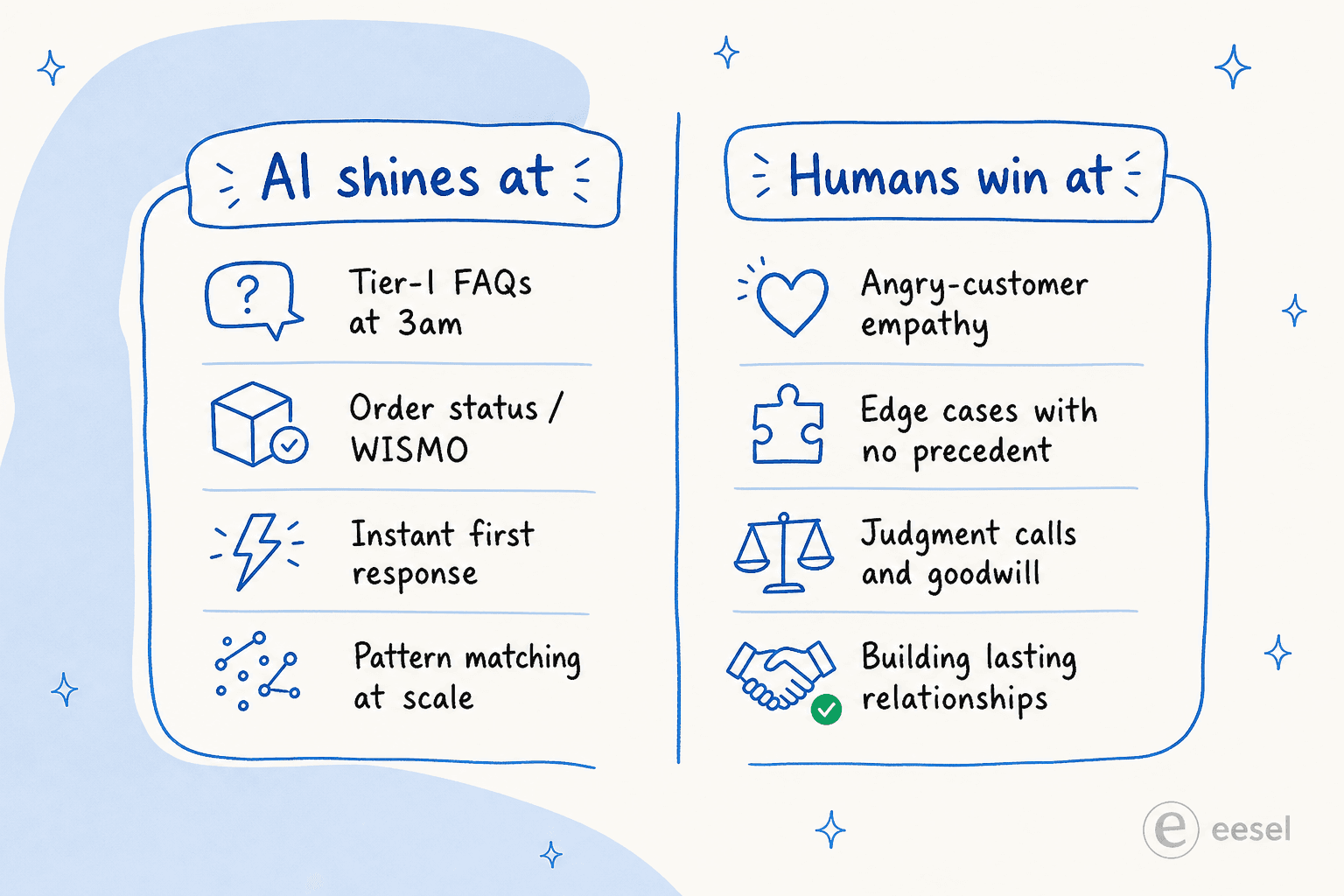
Three kinds of ticket belong with a person:
- Exceptions and goodwill. When a long-standing customer asks for something that isn't in the playbook, a person can decide to make goodwill happen. An AI agent told to follow the knowledge base will follow the knowledge base, confidently, every time, and exactly wrong for that moment.
- Money and risk. Cancellations past a cut-off, refunds outside policy, damaged or lost parcels, disputes. These need someone who can weigh the cost of saying yes against the customer in front of them, and own the call. If an AI touches refunds at all, it needs refund guardrails set in its permissions, not just in its prompt.
- Advice and trust. In a separate Gartner survey of US customers of 5,801 people, 54% said they trust human agents more than AI for product or service recommendations, against 32% who trust AI more.
Upset customers sit across all three. The AI can still help on those tickets, by gathering the order, the history and the facts into a draft, but a person should read it and press send. That's the human-in-the-loop pattern, and sentiment analysis is how the AI spots those tickets early.
What do customers actually think of AI support?
Customers are split, and their answer depends on whether the AI is in their way. Gartner asked the same 3,566 customers several questions in early 2026, and read together they describe exactly where the line sits.
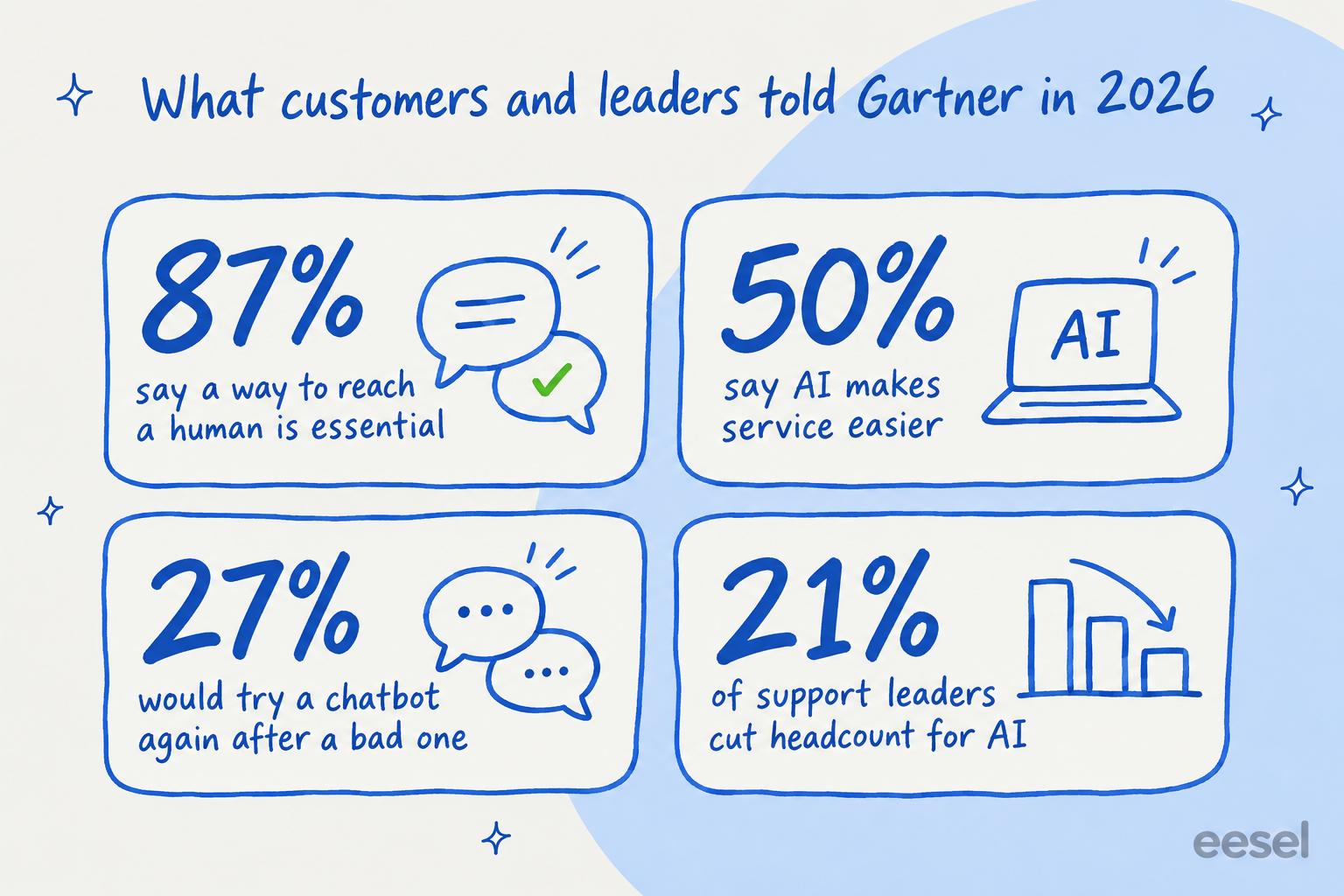
- They'll use it if it works: 50% said their interactions are easier when companies use GenAI.
- They won't be trapped by it: 87% said it is essential to have an option to reach a human agent. Asked what would change the mind of customers unwilling to use AI, the most common answer was the ability to switch to a person.
- They give it one chance: only 27% would try a chatbot again after a negative experience, per a later Gartner release. 49% said they would have used a chatbot if offered one, yet only 7% actually used one in their most recent service interaction.
- They hate repeating themselves: in Zendesk's CX Trends 2026, 81% of consumers want agents to continue the conversation without backtracking, and 74% are frustrated when they have to repeat information. Giving agents full customer context on every ticket is the fix.
The older baseline is harsher. In a December 2023 Gartner survey of 5,728 customers, 64% would prefer companies didn't use AI for customer service, and their top worry was that it would get harder to reach a person. The 2026 numbers read as that worry, answered: customers warmed to AI that helps and kept the veto on AI that blocks.
The containment trap
The fastest way to lose a customer with AI is to measure it on how many conversations it keeps away from people. Containment looks great on a dashboard and quietly counts the customers who gave up.
Gartner's Eric Keller, on the 27% finding:
"Chatbots should serve as seamless connectors to human support, not containment traps. If the chatbot cannot resolve an issue with high confidence, it should provide a visible path to a human agent and pass along the information and context already collected."
The mechanism is easy to picture. The bot loops, the contact button gets buried, and the AI answers an out-of-scope question with a confident wrong answer. A customer who can't reach a person closes the window, and the containment rate goes up. The customer comes back by email two days later, angrier, or doesn't come back at all, which is how silent churn starts.
So measure the thing the customer feels: first contact resolution and CSAT, not containment. Track whether the same customer writes in again about the same issue within a few days, not raw ticket deflection. It's the number Klarna led with too: its 25% drop in repeat inquiries says more than its two-thirds share of chats. A "resolved" ticket that comes back through another channel isn't a resolution, it's debt.
Gartner's advice for getting there is narrower than most rollouts: start with issue types that have a proven high rate of successful resolution, tell customers plainly what the AI can do, and widen its scope only after it performs. Or, in Keller's words, "prioritize reliability over reach."
How does a hybrid AI and human setup work?
AI takes the first pass on every ticket, decides whether it can resolve it with confidence, and either answers or hands it to a person with everything it already collected. Gartner's line for it is "digital first, but not digital only": in its March 2025 poll of 163 service leaders, 95% planned to keep human agents.
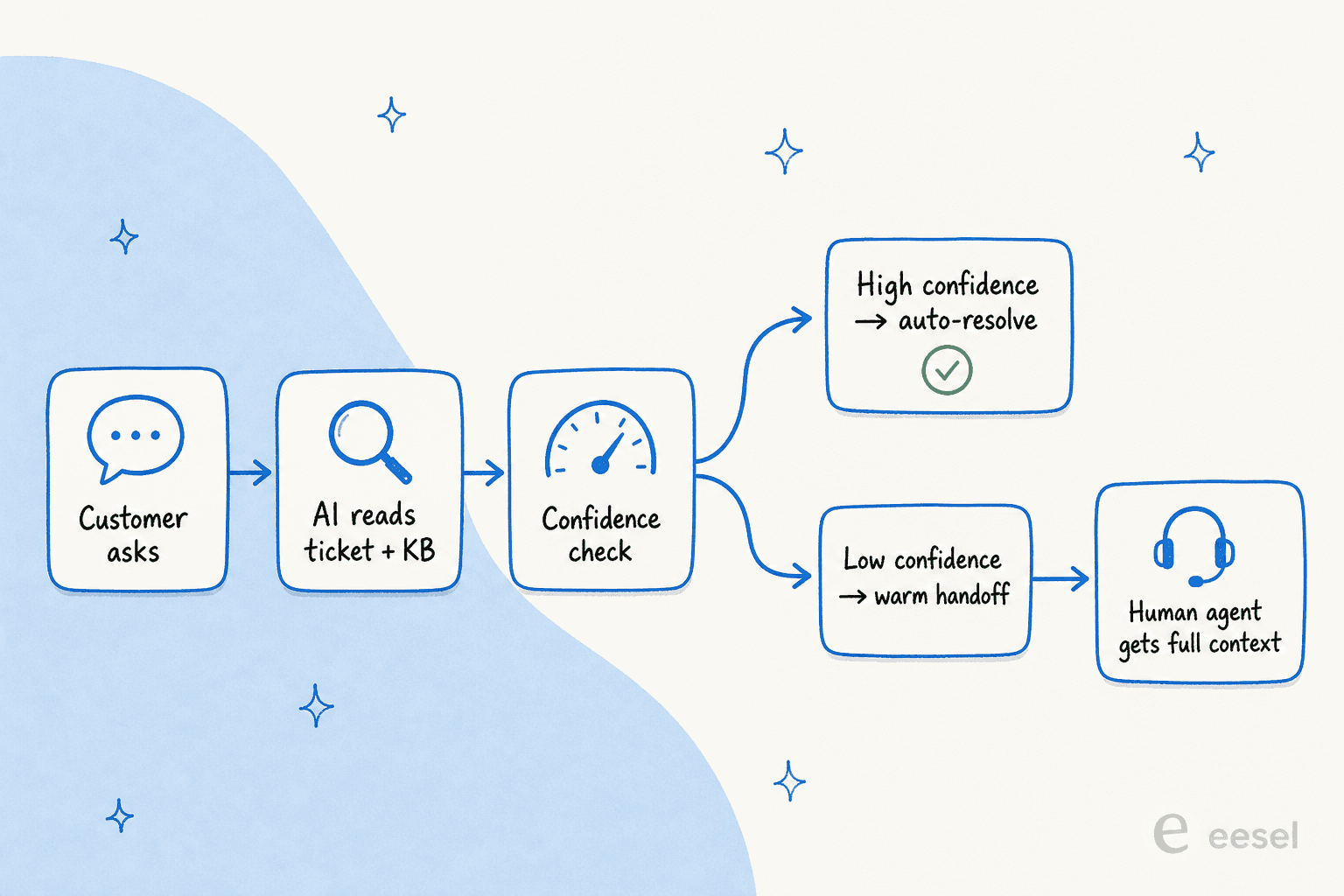
What separates a good hybrid setup from a bad one is the handoff. When an AI agent passes a ticket on, the person picking it up needs four things:
- A short summary of the conversation, on the ticket.
- The full history, not just the last message.
- A flag if the customer is frustrated.
- The reason for the handoff, so the person knows whether they're solving the problem or resetting expectations.
Drop any of those and the customer explains everything again, which is the exact thing 74% of them say frustrates them, and the customer effort you saved with the AI comes straight back.
The other half is deciding when to hand off. Four triggers are the floor: the customer asks for a person, the AI isn't confident in its answer, the same question has failed twice, or the customer's tone turns. Then add the topics you never want the AI answering publicly at all. Rúngne's handover is a good model of the first trigger: when a customer asks for a person, the agent sends one line saying the team will take over, asks for an email address on a live chat that doesn't have one, and stops.
For the deeper version of each piece, see the guides on human handoff in chat, AI escalation and the escalation rate worth tracking.
Is AI support cheaper than human agents?
Per ticket, yes, but most teams haven't banked the saving. A Gartner survey of 275 leaders in mid-2026 found just 4% had achieved the ROI they expected from their AI initiatives.
The same survey shows why the saving doesn't arrive as layoffs. Of the 21% of leaders who cut human agent headcount because of AI, the average cut was 16.7% of the workforce over 18 months. 7% have already rehired after a cut and 11% plan to within 18 months. Gartner calls it the "cut fast, rehire later" trap: cutting people for AI value you expect rather than value you've seen. The more common pattern is quieter. In another Gartner survey, 63% of leaders were shrinking frontline headcount slowly through attrition, and 85% were adding new responsibilities to agents' roles.
The cost case that holds up is simple: the AI takes the lookups, your team stops hiring for volume, and the people you have spend their hours on the tickets in the "human" column. To do the sum for your own team, the AI agent cost breakdown walks through payroll, AI pricing and a hybrid example.
Pricing models matter here too. A per-resolution price charges you more as the AI gets better. eesel's pricing is a fixed monthly batch of credits, where a ticket or chat is 1 credit: 2,000 credits are $849 a month, and extra credits are $0.80 each up to a cap you set. Tickets you tell the agent to stay out of, such as the ones you've kept for people, don't use credits.
How to decide what AI should handle (and what to leave to humans)
Sort each ticket type by two questions: is the right answer written down or looked up, and what happens if the AI gets it wrong? A ticket that's a lookup with a cheap mistake goes to the AI. A ticket with no written answer, or an expensive mistake, goes to a person, with the AI's draft attached.
The rubric I'd hand a support lead:
- AI answers high-volume, well-defined intents: order status, shipping and return policy, stock and pre-orders, sizing, password and account how-tos. Start with the few where its answers are reliably right, then widen.
- AI drafts, a person sends the middle, the agent assist zone: account-specific billing questions, troubleshooting, returns that need a check. The AI gathers the order, the history and the policy, and a person reads it before it goes out.
- A person owns disputes, cancellations past a cut-off, damaged or lost orders, complaints, anything involving a goodwill exception, and any customer who asked for a human.
- The AI never makes the goodwill call. An AI deciding when to give an extra month free will give too many or too few, and either way you'll regret it.
Rúngne runs close to this rubric. One eesel agent sorts and tags incoming Gorgias tickets and another leaves drafts for the team, but the agent that replies publicly only sees the topics on a list the team keeps: policy questions, tracking, stock, pre-orders, sizing, change-of-mind returns and requests for a human. Cancellations, damaged or missing items, lost parcels, complaints, customs disputes and B2B partners never reach it. In a month that came to about 440 public replies, 580 drafts left for the team, and about one ticket in seven answered by eesel alone. Moving a topic from one side to the other is a list edit, not a project.
Pick a ticket to see which side of the line it goes to, and what the AI still does when a person owns it.
What this looks like in your existing helpdesk
You don't need to rip out your helpdesk for a chatbot vendor to run this split. The simpler move is an AI teammate that works inside the helpdesk you already use, Zendesk, Freshdesk or Gorgias, so your team keeps its workflow and the handoff is just a ticket changing hands.
That's how eesel works: it reads tickets, answers the ones you've given it, drafts the rest as internal notes, and leaves anything you've kept for people to the same people who'd see it today. smava, an online loan comparison company in Berlin, runs it on about 27,000 Zendesk tickets a month, sorted and drafted in German. Rúngne runs three agents on Gorgias, each with one job.
When the AI lives in the same queue as your team, the handoff isn't a transfer. It's one ticket that started with the AI and ended with a person, in the same place, with the full history visible. No context drop, and no "I already explained this."
Try eesel next to your support team
If you want this split without a six-month vendor process, Try eesel. It joins your helpdesk, learns from your past tickets and help center, and you tell it in plain language what it may do on its own and what waits for a yes: "answer order status and returns inside policy, draft cancellations for the team, and never offer a refund." What it may do can differ by who's asking, so the same teammate can act for your support lead and only ask first, or stay out, when a customer writes in. The actions and approvals docs show how.
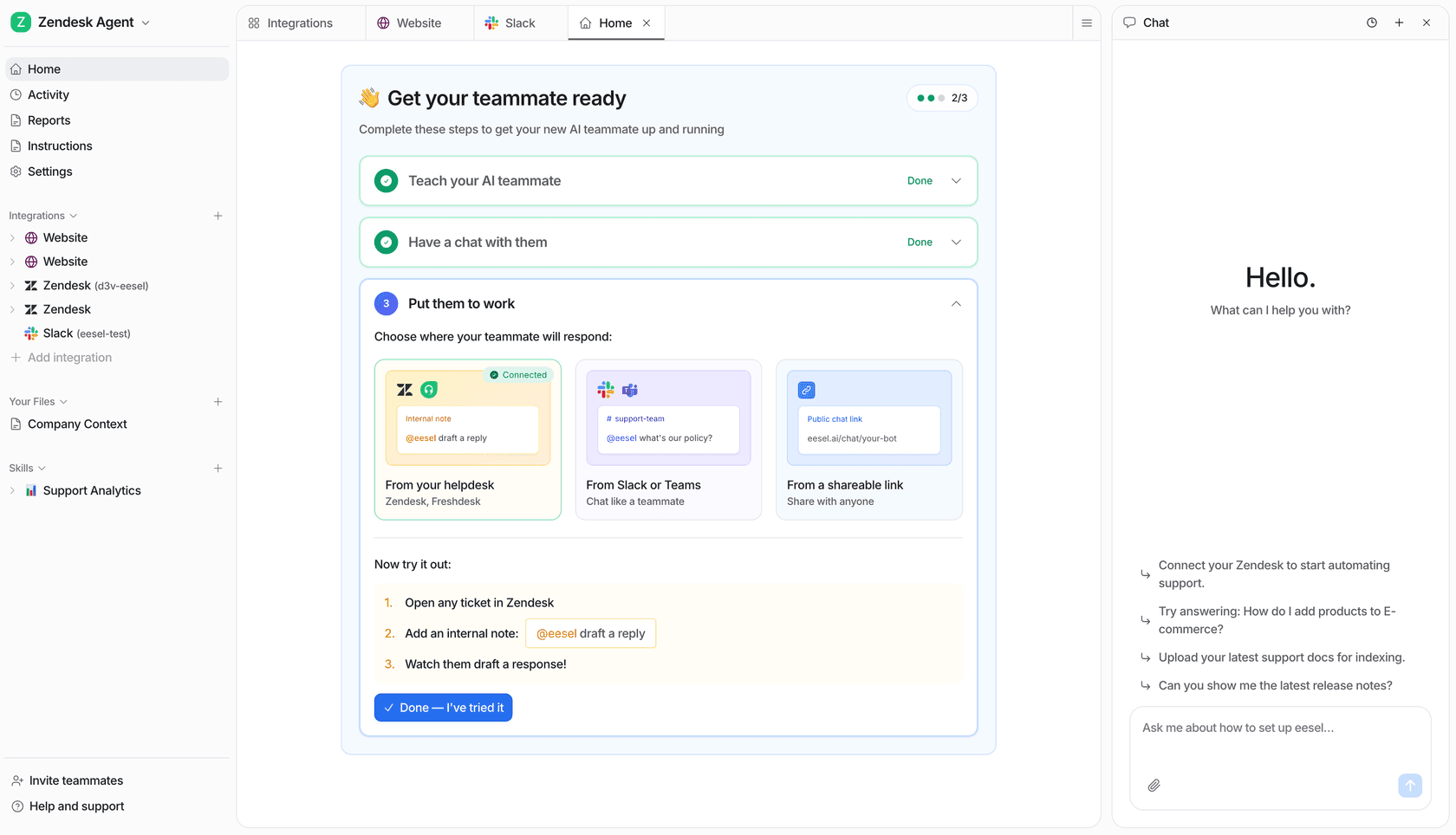
The free trial gives you 100 credits for 7 days with no card, enough to connect your helpdesk and read real drafts on your own tickets before you pay. After that, plans start at $299 a month for 500 credits.
