


ChatGPT for Work has two paid plans: ChatGPT Business at $20 per user per month billed annually (or $25 billed monthly, 2-seat minimum), and ChatGPT Enterprise on custom, quote-only pricing. The ChatGPT Work agent that OpenAI keeps advertising isn't a separate SKU; it's bundled into both plans, so "how much does ChatGPT Work cost" really means "how much does a Business or Enterprise seat cost."
Here's the part the pricing page won't tell you: Business and Enterprise share almost the entire feature set. The extra money on Enterprise buys governance (SCIM, encryption key management, ISO 27001, data residency, 24/7 SLAs), not smarter output. And the sticker price hides a few real costs, seat creep from open invites, annual lock-in, and enterprise renewals quietly moving to metered API pricing.
One thing to settle up front: a per-seat work assistant and an AI teammate for the whole team are different purchases. ChatGPT works for whoever is typing; if your actual goal is shared work getting done across the team, a seat license isn't the tool for that job, and I'll show where the line is. eesel is an AI teammate with unlimited seats on every plan, billed by usage instead of headcount.
I spend most of my time on the search side of this, watching what buyers actually type before they commit budget, and "chatgpt for work pricing" is one of those queries where OpenAI's own page is oddly unhelpful. The business numbers render fine; the consumer ones load via JavaScript and half the comparison table is asterisks. So I pulled the Business and Enterprise pricing page apart line by line. Here's what a seat really costs in 2026.
ChatGPT for Work pricing at a glance
Two plans carry the "for work" branding. Everything below the consumer tiers (Free, Go, Plus, Pro) is aimed at individuals; Business and Enterprise are the ones built for a team with an admin, SSO, and a no-training guarantee.
| Plan | Price | Seat minimum | Billing | Best for |
|---|---|---|---|---|
| Business (formerly Team) | $20 / user / mo billed annually · $25 / user / mo billed monthly | 2+ users | Monthly or annual | Growing companies and teams that want governed access |
| Enterprise | Custom (contact sales) | Not published, volume-based | Annual only | Large orgs that need compliance, residency, and SLAs |
A couple of facts worth pinning down straight away, because they're the ones people get wrong:
- The $20 figure is the annual rate. Billed monthly, it's $25 per user. OpenAI leads with the lower number, as everyone does.
- Enterprise is annual-only. Per OpenAI's own FAQ, monthly plans exist for Go, Plus, and Business; annual is the only option for Business's discount tier and for Enterprise.
- There's a 75% nonprofit discount on both Business and Enterprise through OpenAI for Nonprofits, which is a large break if you qualify.
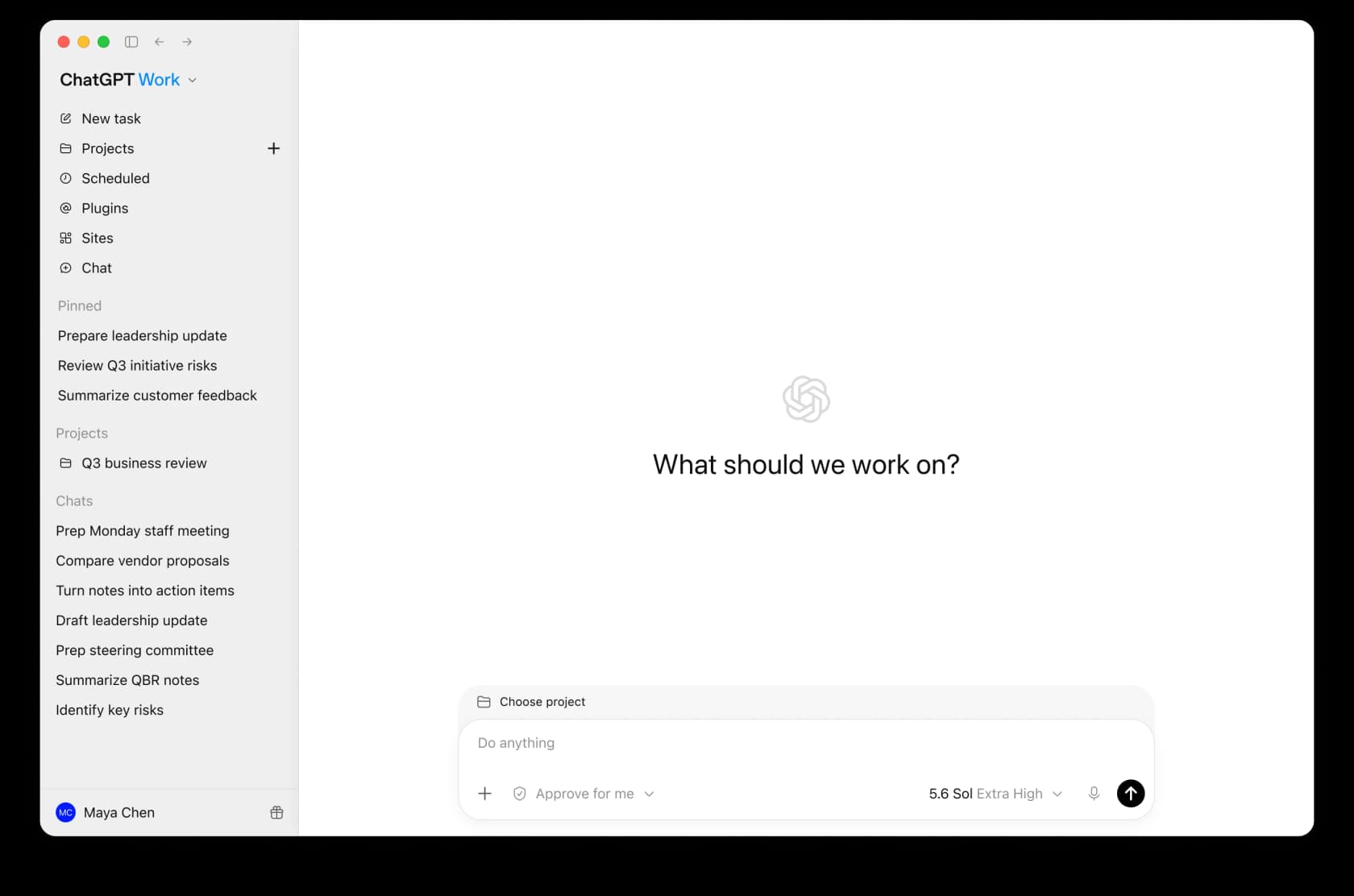
That's the whole "for work" agent OpenAI has been demoing, the one that builds docs, decks, and spreadsheets and runs tasks in the background. It ships inside both paid plans rather than as an upsell.
What ChatGPT Business costs
Business is the plan most teams actually land on, and it's the interesting one, because it used to be called Team and it quietly removed the barrier that kept smaller companies out.
The old story was: you either bought individual Plus seats with no admin controls, or you jumped to Enterprise with its 150-seat minimum and a sales call. Business collapsed that gap. It's $20 per user per month annually, $25 monthly, at a 2-seat minimum, with SAML SSO and MFA, a secure workspace, usage analytics, spend controls, and the no-training-on-your-data guarantee baked in. Admins on r/sysadmin noticed the moment it landed:
"PSA: ChatGPT now has a $25/user/mo Business Plan with SSO, without the 150-seat minimum requirement with Enterprise"

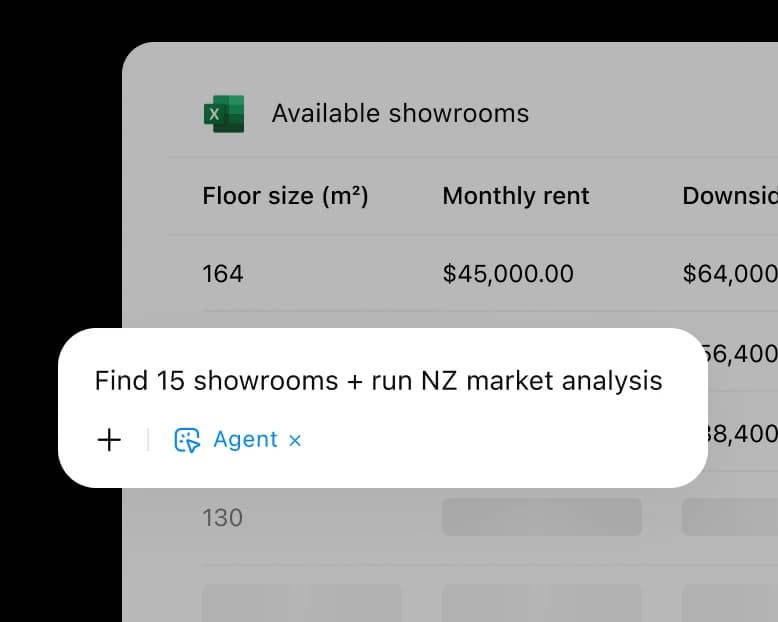
What you get for that seat: ChatGPT and Codex across desktop and mobile, the full ChatGPT Work agent, connectors for Microsoft 365, Google Drive, Slack, GitHub, Linear, and Figma, custom team agent plugins built on your company knowledge, centralized billing, and the whole GPT ecosystem of custom AI agents and shared GPTs. In practice the agent can reach into a spreadsheet and run a real task against it, not just talk about one.
The one real limit to know about: the Business plan doesn't unlock model choice the way power users expect. One Team subscriber on Hacker News put it plainly:
"I have a ChatGPT Team plan, but the only model available is GPT-5. I'm not seeing an option to enable legacy models anywhere. The only way to get access to other models right now (for me at least) is via the iPhone app, for now."

What ChatGPT Enterprise costs
Enterprise is where the pricing goes quiet. There's no number, just "Custom pricing, contact our sales team," plus a line about invoicing and volume discounts. That opacity is a running complaint, the kind of thing buyers vent about on r/ChatGPT ("does anyone have any pricing details on what Enterprise costs?") because they can't sanity-check a quote against anything public.
From what surfaces in real deployments, Enterprise is priced per seat, annually, and negotiated by volume, the same shape as Business but with a floor high enough that OpenAI would rather talk than post it. And the model underneath is shifting. One Hacker News commenter reported that the seat-based sub is starting to give way to consumption pricing:
"All new/renewing enterprise contracts with Claude Enterprise and ChatGPT Enterprise no longer offer usage-based subscriptions, but instead will charge API pricing for all tokens consumed, and... the subs are better deals than raw API pricing."
So the honest read on Enterprise cost in 2026: budget for a per-seat annual commitment, but expect the renewal conversation to include metered tokens. If your usage is spiky, that's a very different bill from a flat seat count.
Business vs Enterprise: what the extra money buys
This is the question that actually decides the invoice, and the answer surprises people. Both plans include the entire productivity feature set, the ChatGPT Work agent, Codex, plugins, deep research, company knowledge, custom GPTs, SSO, the admin console, SOC 2, and the no-training default. You do not get a smarter model or a better agent by paying more.
What Enterprise adds is almost entirely governance and scale: SCIM, Enterprise Key Management, role-based access controls, ISO 27001 certification, IP allowlisting, data residency across ten regions, a compliance/logs API, and 24/7 priority support with SLAs. There's also a bigger GPT Instant context window (128K vs Business's 54K) and "Fastest" rather than "Fast" response priority. Useful if you're a regulated enterprise; irrelevant if you're a 30-person startup that just wants the agent.
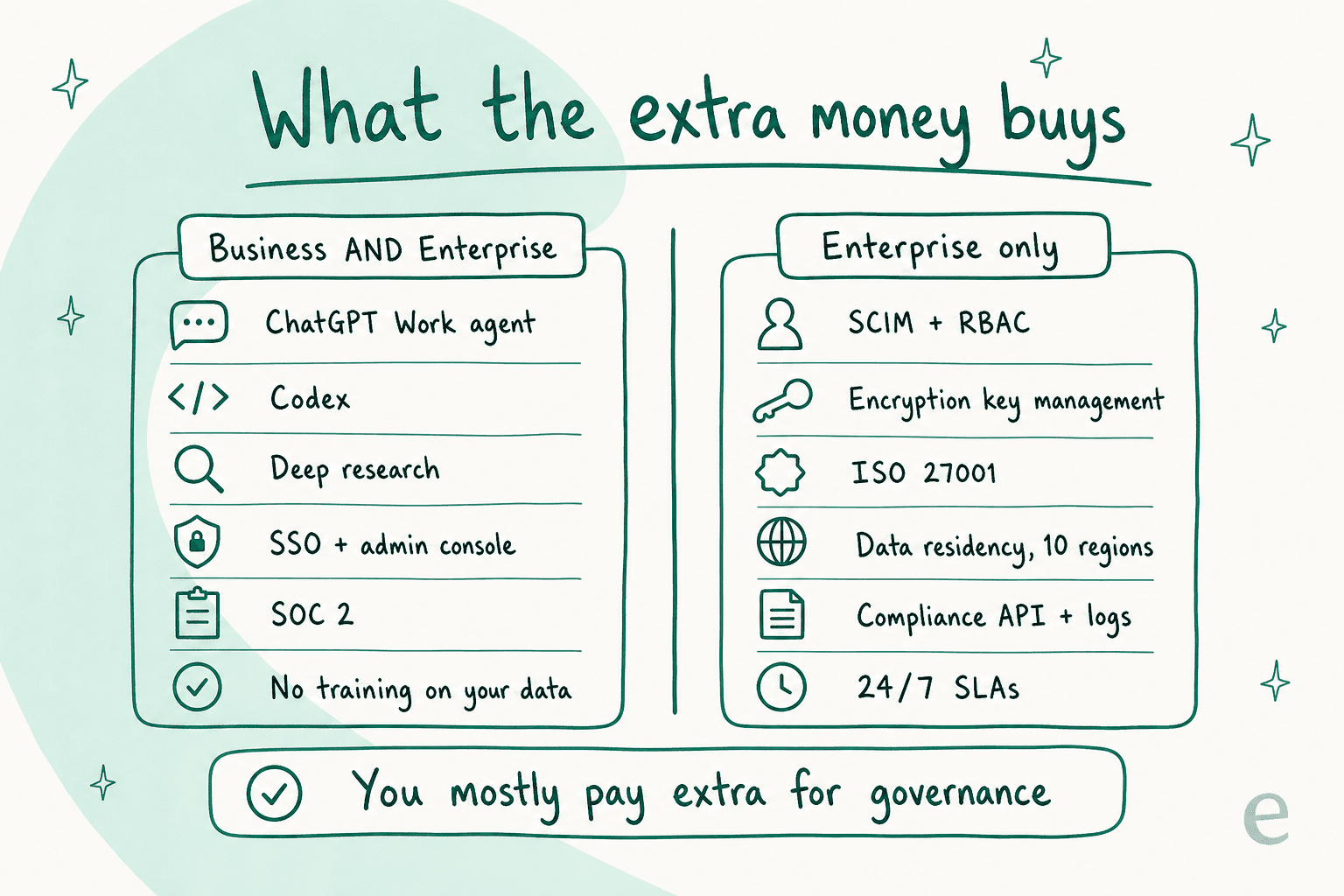
If your reason for wanting Enterprise is "we need the better AI," stay on Business and save the money. If it's "our security team requires EKM and data residency," that's a real requirement Business can't meet, and the jump is justified. That's the whole decision.
The price you don't see on the pricing page
Here's where I'd slow a buyer down. The seat number is the start of the cost, not the end of it. Three things quietly stack on top.
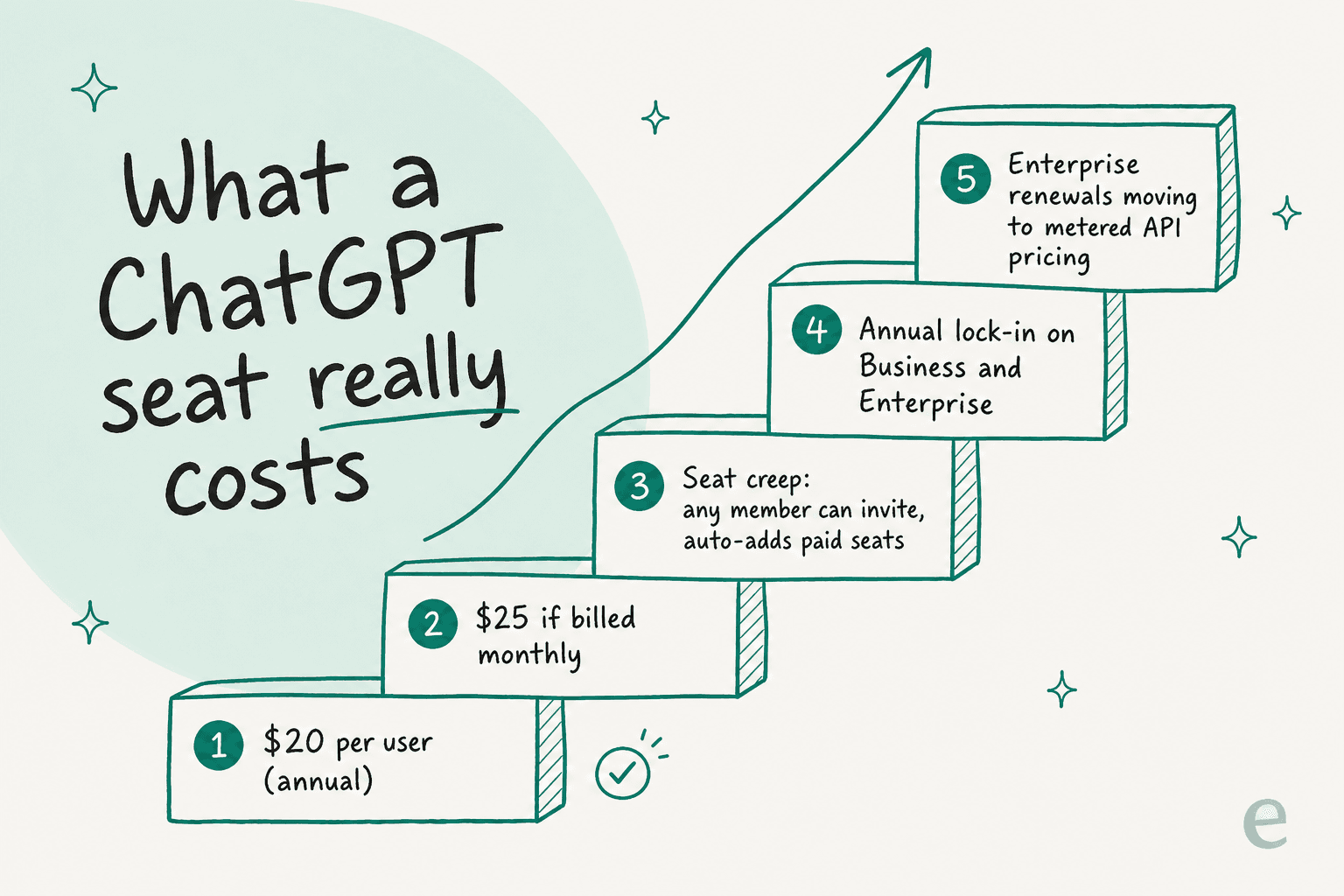
Seat creep. On Business, any member, not just an admin, can invite new users, and every invite auto-adds a paid seat with no approval gate. A growing workspace can quietly inflate the monthly bill, and nobody notices until finance asks why the ChatGPT line doubled.
Idle seats you're still paying for. This is the one that actually burns money. Companies roll out AI with all-hands enthusiasm, then discover half the licenses go unused. The clearest version I've seen, verbatim from Hacker News:
"My company was trying to get people to use AI, we had whole meetings about it. Flash forward a few months and they sent out an email saying they discontinued the Enterprise ChatGPT accounts of anybody not using it often enough as a way to save money."
Another engineer described a company paying for company-wide ChatGPT Enterprise, Copilot, and Windsurf while everyone quietly routed around them to a different tool. Per-seat pricing means you pay for the license, not the usage, and the gap between the two is where the money leaks.
A worked example. Take a 40-person company on Business, annual. Sticker cost is 40 × $20 × 12 = $9,600 a year. Add the three people who invited a contractor each without telling anyone (seat creep), and you're at 43 seats, $10,320. Now assume the usual pattern where maybe 60% log in regularly: you're paying roughly $4,000 a year for seats nobody touches. None of that shows up on the pricing page, but all of it shows up on the invoice.
Is a ChatGPT work plan worth it over Plus?
For a lot of people the honest answer is: the work plans mostly buy you privacy and higher usage limits, not exclusive features. That's the single most-asked question in the community, and it's usually where the disappointment lives, people expect a Business seat to unlock something Plus doesn't, and it largely doesn't.
"worth upgrading to business as a single user only for the higher usage limits?"
The real reason to buy a work plan is the no-training-on-your-data guarantee, which is the concrete thing companies are actually paying for:
"OpenAI says: 'By default, we do not train on any inputs or outputs from our products for business users, including ChatGPT Team, ChatGPT Enterprise, and the API.'"
Just know that guarantee isn't a differentiator so much as table stakes, the same protection ships on the paid tiers of Microsoft Copilot and other rivals too. So the "worth it" math comes down to: do you need governed, no-training access with an admin console for more than one person? If yes, Business is a fair deal. If you're a solo user chasing exclusive capability, you'll feel short-changed.
Where a per-seat AI plan stops making sense
Now the part I care about most: the moment your goal stops being "give each person a smart assistant" and becomes "get this work done for the team," the per-seat model quietly stops fitting.
A work agent like ChatGPT Work is built to help a person finish a task, draft the deck, summarize the thread, analyze the sheet. It's very good at that, and it works for whoever is typing. But a lot of company work isn't one person's task list. It's requests from across the team, customer emails, weekly reports and follow-ups that have to happen whether or not anyone is logged in. Paying $20 a seat so each person does their own slice faster is a productivity boost. It is not the same thing as a teammate that sits in your shared channels and takes the work on, and it's billed on exactly the wrong axis for it, headcount instead of work done.
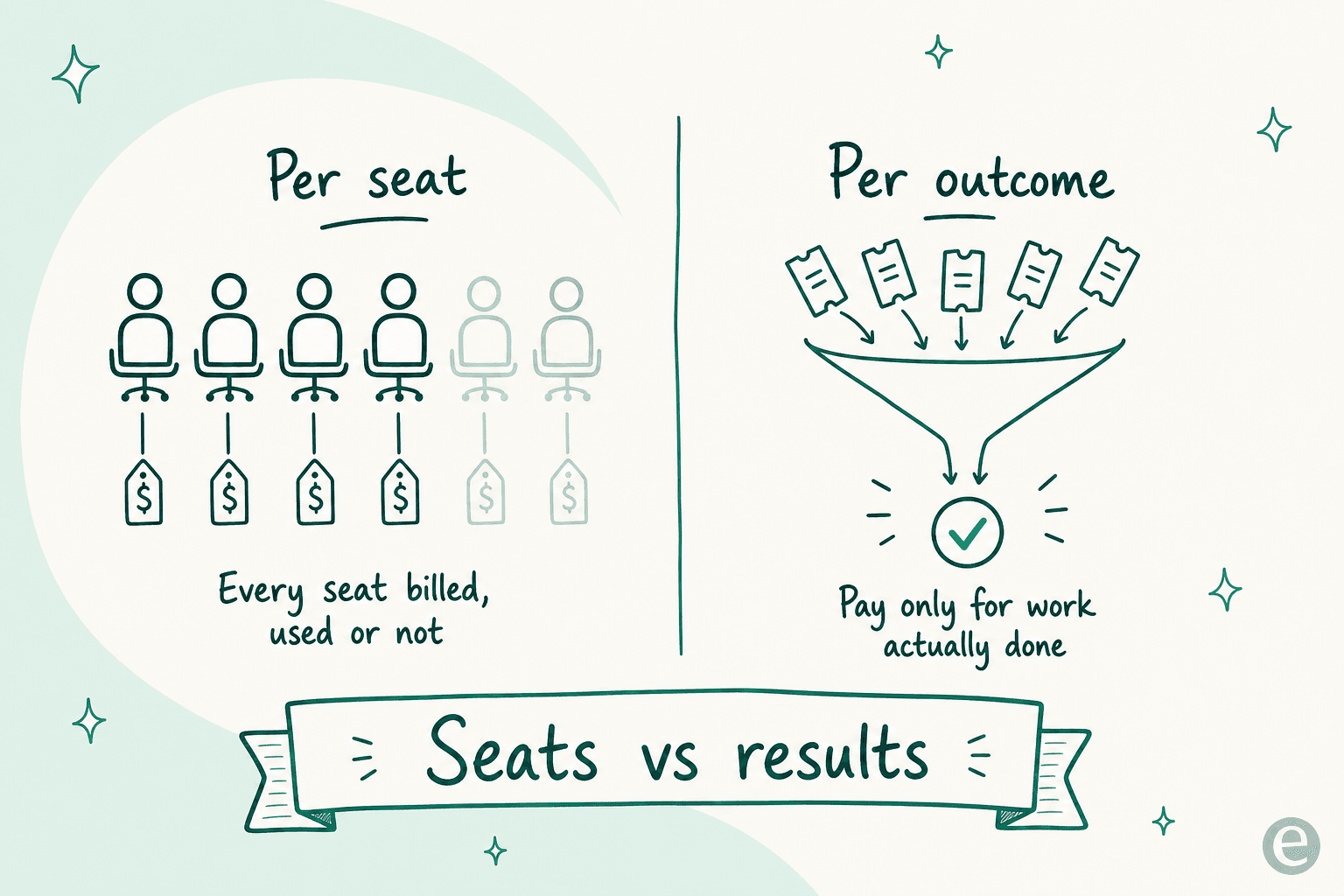
That mismatch is why AI teammates are a different purchase from seat-licensed assistants. The distinction matters more the more people need the same help, precisely because the per-seat bill and the actual work stop tracking each other.
Try eesel for the work your whole team shares
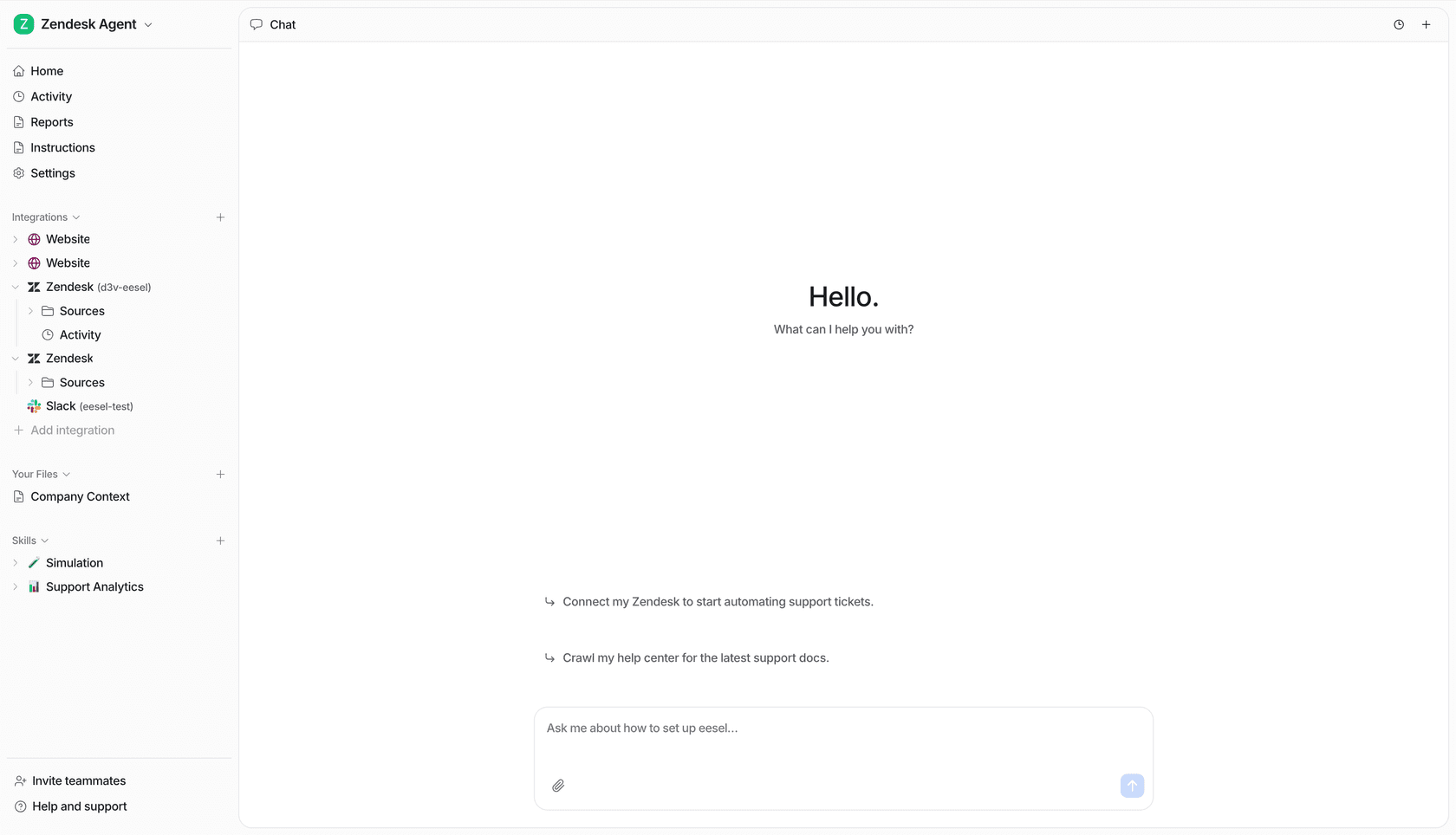
If you got here comparing ChatGPT for Work prices because you want AI doing real work for the team, not just for each person, here's the honest pitch: that's a different tool than a per-seat work assistant. eesel is an AI teammate that joins the apps you already use, Slack, Microsoft Teams, Google Chat, email, your helpdesk, Jira, Google Drive and 3,000+ more, takes requests from anyone who talks to it there, and does the work inside those tools: answering customers, drafting content, pulling reports and running scheduled jobs.
The difference from a ChatGPT seat is who it works for. ChatGPT's permissions follow the person running the session; eesel works for the company, and it tells apart a teammate, a verified customer and an anonymous visitor by itself, with every tool set to act on its own, ask first or stay off. Every plan has unlimited seats, so the bill follows usage, not headcount, starting at $299 a month for 500 credits, with a free 7-day trial and no card.
ChatGPT for Work is a strong general assistant, and if a governed, no-training seat for each person is what you're after, Business at $20 is a fair price. Just be clear-eyed about which purchase you're making, and don't pay per seat for work that belongs to the whole team. Try eesel when you want the second kind.
