

Plain is one of the better-looking support platforms I have used this year. It is API-first, keyboard-driven, and built squarely for software teams that live in Slack, Linear, and Jira. Its customer-facing AI agent, Ari, is genuinely well thought out (it answers only from your docs, cites its sources, and hands off cleanly), and it costs 100 credits only for the threads it resolves on its own.
The catch is the pricing. Plain now charges per user ($45 to $99 a user a month, billed yearly), and AI work runs on a credit meter on top: 100 credits per Customer Agent resolution, and a variable amount per Sidekick task that you only learn by running it. For a developer-facing B2B team that wants a beautiful, opinionated inbox, that trade is easy to make. For a high-volume or non-technical support team that needs a predictable AI bill, it is worth a harder look.
If you are choosing Plain mainly for the AI, the thing to weigh is billing model and knowledge: an AI helpdesk teammate like eesel plugs into the helpdesk you already run, learns from your past tickets, and charges one credit per ticket or chat it handles, with no per-seat fee on top.
I build integrations at eesel, so when I test a support tool I am really looking at the plumbing: how the AI is trained, how it is tested before it touches a customer, and how the bill is calculated. My team has spent the last few years putting AI on live support queues, and we have watched confident-sounding bots give wrong answers, which is why we now simulate every rollout against a customer's real past tickets first. I read Plain through that lens. Here is what I found after going through its product docs, pricing, and the Ari and Sidekick pages in detail.
What Plain is, and who it is really for
Plain (legal entity Not Just Tickets Ltd) is a B2B support platform founded in London in 2020 by Simon Rohrbach and Matt Vagni, both of whom helped scale Deliveroo. It has raised about $21M, including a $15M Series A led by Battery Ventures in February 2025, which the team used to open a San Francisco office and invest in product.
The positioning is not subtle, and I mean that as a compliment. Plain calls itself "support infrastructure" and pitches itself at teams that ship software. Its customer wall is a who's-who of dev tools: Vercel, Raycast, Sourcegraph, n8n, Resend, Sanity, Clerk, Tinybird, and Laravel. The whole product reflects that audience. It is keyboard-first, it unifies Slack, Microsoft Teams, Discord, email, live chat, and in-app forms into one thread-based queue, and it treats Linear and Jira as first-class citizens rather than afterthoughts.
That focus is the single most important thing to understand about Plain. If your support happens in Slack and spills into your issue tracker, Plain was built for you. If you are running a 500-ticket-a-day ecommerce queue or a non-technical team, you are not the target user, and it will feel like it. This is the opposite of a generic AI helpdesk, and that is the point.
One note on security: Plain's trust center lists SOC 2 Type II, GDPR, and a 2025 penetration test, and its pricing page now lists HIPAA on the custom Frontier plan only. If you are in healthcare or a regulated vertical that needs a signed BAA, that means a Frontier contract, so ask Plain about it early.
Ari: the customer-facing AI agent
Ari is Plain's autonomous support agent, and it is the part of the product I liked most. The design philosophy is refreshingly restrained: Ari answers what it can from your knowledge, cites where the answer came from, and hands off to a human the moment it is unsure. There is no flow builder and no decision tree to configure. In Plain's words, you turn Ari on, point it at your knowledge, and it starts answering.
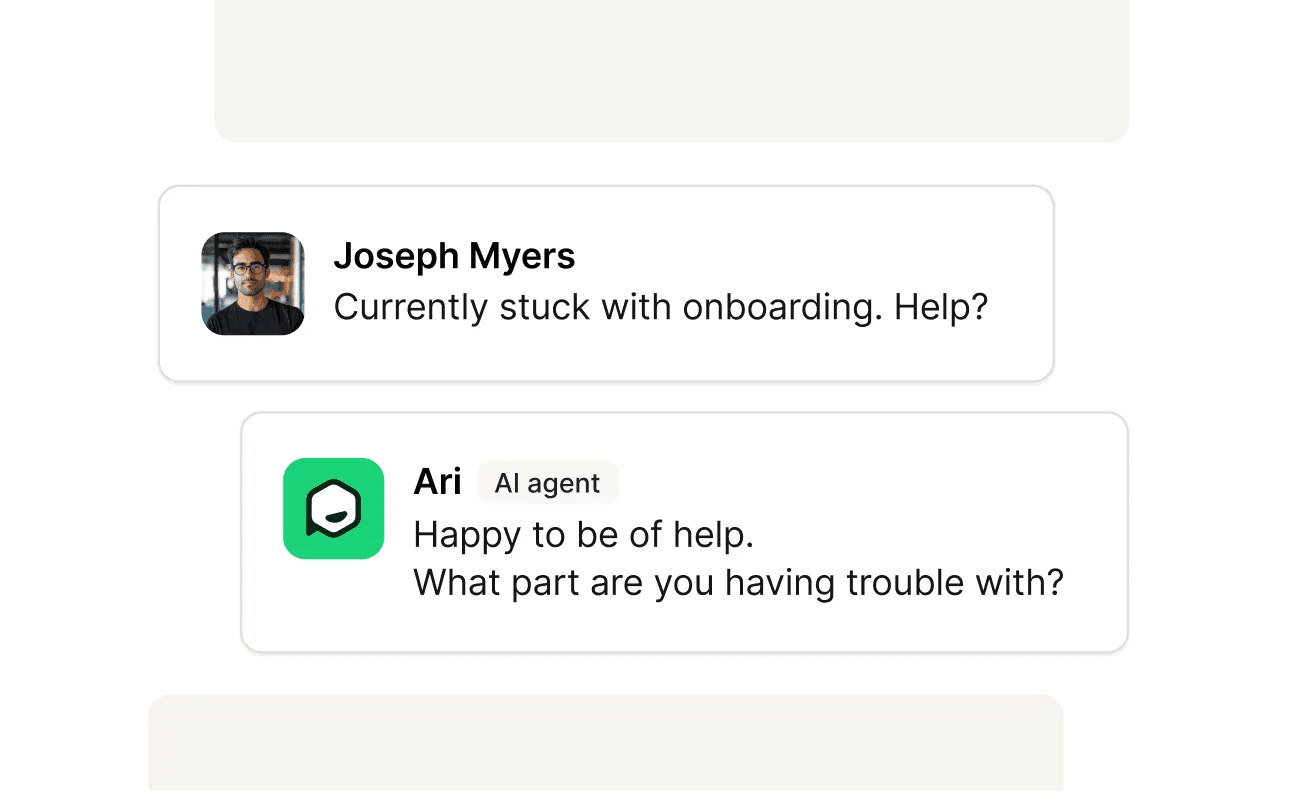
Where Ari gets its knowledge is the detail most reviews skip, and it is the one I care about most. Ari answers only from your Knowledge Sources: it reads your customer-facing help center automatically, and you can add a sitemap or individual URLs that it reindexes every Monday morning. Per thread, it also reads that thread's own recent history. What it does not do is learn from a corpus of your past resolved tickets. That is a deliberate guardrail against hallucination, and it keeps answers grounded, but it also means Ari is only ever as good as your written docs. Plain is upfront about this: without solid knowledge sources, it warns, Ari "will have a high deflection rate," meaning it hands off rather than guessing.
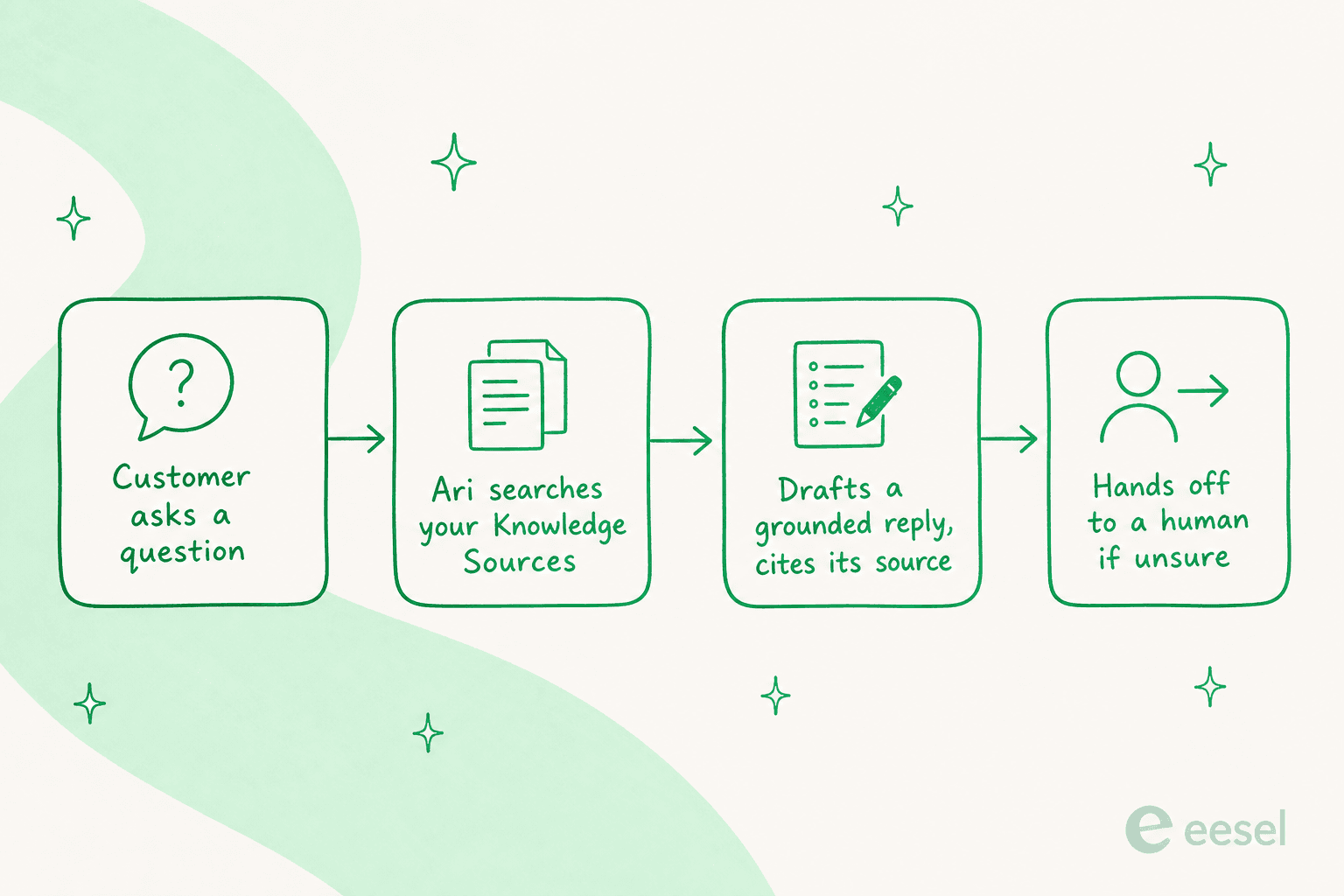
Ari adapts to the channel too, writing fuller replies over email, shorter ones in chat, and staying under Discord's character limit, all in the customer's language. It records a knowledge gap whenever it cannot answer, ranked by how many threads asked, so your team knows exactly which doc to write next. The headline marketing claim is that B2B teams trust Ari to handle 40%+ of volume, which is a "handle" figure rather than a guaranteed resolution rate, so treat it as a directional promise rather than an SLA.
Testing Ari before it goes live
This is a real strength, and I want to give it full credit. Plain ships two testing modes. Test mode (earlier called Shadow Mode) runs Ari on your real, live threads without permission to message customers: it adds private notes showing what it would have replied, what it would have handed off, or where no response was needed. There is also a Playground, an ephemeral chat to poke at Ari against your real knowledge without touching a live thread.
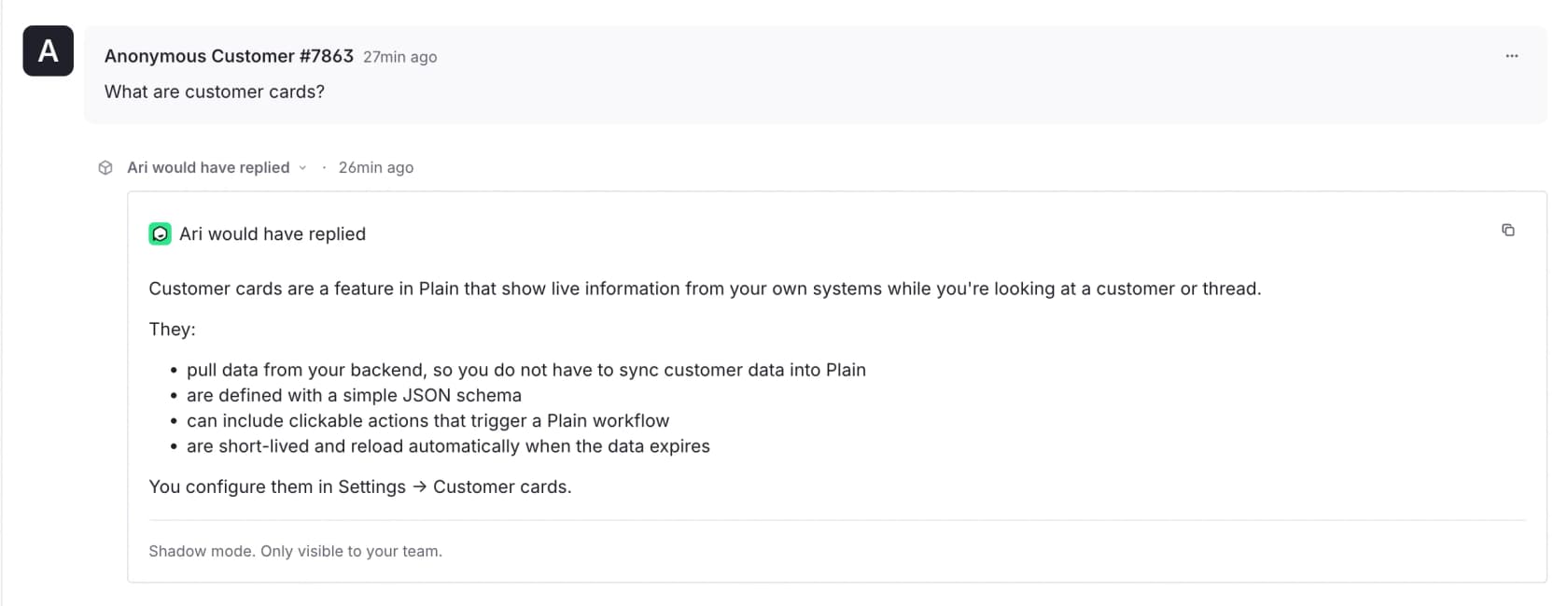
Here is the nuance I would want a buyer to catch. Test mode is a dry run over new, incoming traffic going forward. It is not a bulk simulation over your historical ticket archive that hands you a projected resolution rate before you commit. That distinction is exactly the thing my team obsesses over, because "watch it on the next few live threads" and "replay it against the last 5,000 tickets and show me the number" answer very different questions when a VP asks whether the agent is ready. Plain's approach is good and safe; it is just forward-looking, not a backtest.
Sidekick and the credit question
Sidekick is Plain's other AI, and it is aimed at your team rather than your customers. It researches, drafts, and executes: it reads the full thread, reaches into tools like Linear, Jira, Sentry, Datadog, and GitHub, and can run on a schedule for recurring jobs. Crucially, Sidekick cannot message customers on its own. It drafts, and irreversible actions wait for a human to approve them. There is also a neat developer touch called "Lookup with Cursor" that lets Sidekick query your own GitHub codebase from inside a thread.
Sidekick and Ari both spend credits, and this is where I want any buyer to slow down. Plain's credits page prices each kind of AI work separately: the Customer Agent (Ari) uses a fixed 100 credits for each thread it resolves on its own, a Sidekick discussion or workflow step uses anywhere from 1 to 300+ depending on how much work it takes, and a connected third-party agent uses 15 per thread assignment. Extra credits cost $10 per 1,000, so a resolution beyond your allowance costs about $1.
The resolution rule is fairer than most. A thread is charged only when Ari replied, no teammate stepped in, and the thread stayed in Done for 7 days; if the customer writes back, the clock starts over, and a thread your team had to finish costs nothing. Sidekick is the part you can't price up front, because its cost depends on how much each task reads and does. Foundation includes 1,000 credits a month and Horizon 2,500. They reset monthly and don't roll over, top-up credits never expire, and when you run out, the features that use credits stop until you add more. Everything else in Plain keeps working.
To make that concrete, here is a rough estimator. Plug in your own volumes and it shows how many credits a month you would use and what the top-ups cost past each plan's allowance.
None of this makes Plain expensive, exactly. It makes Plain's AI cost variable in a way you have to actively manage, mostly through Sidekick. If you are the kind of team that likes to model spend to the dollar before you commit, that is the friction point.
Plain pricing in plain terms
Here is the full breakdown. Plain now charges per user. All prices are the annual (billed-yearly) rate; Foundation is $55 a user billed monthly.
| Plan | Price (billed yearly) | Member seats | Credits/mo | Key features |
|---|---|---|---|---|
| Foundation | $45/user/mo | Up to 5 | 1,000 | Slack (25 channels), email (2), in-app, live chat, Ari (Customer Agent), Sidekick, AI workflows, Linear + Jira, 1 Help Center |
| Horizon | $99/user/mo | 3 to 10 | 2,500 | Everything in Foundation, plus Microsoft Teams, SLAs and business hours, escalation paths, CRM integrations, AI suggested responses, unlimited channels |
| Frontier | Custom | Custom | Custom | Everything in Horizon, plus multiple workspaces, SSO and SCIM, advanced security, HIPAA, white-glove onboarding, dedicated CSM |
A few things worth flagging. Viewer seats are free and unlimited on every plan, which is a genuinely nice touch for looping in engineers who only occasionally jump into a thread. There is a 7-day free trial with no credit card, and an early-stage startup program offering up to 50% off. But note the seat caps: Foundation tops out at 5 users and Horizon at 10, so a growing team will hit a custom Frontier contract sooner than the per-user price suggests. Every plan also prices AI agents the same way, and a connected agent such as Decagon or Sierra costs 15 credits per thread assignment on top of that vendor's own bill. And the enterprise essentials, SSO and SCIM, sit only on Frontier, which is standard for the category but worth budgeting for.
For a small startup team, a worked example: three support engineers on Horizon is $297 a month (3 x $99). If Ari resolves 300 threads a month, that is 30,000 credits against 2,500 included, so about $280 in top-ups before Sidekick uses anything. That is still reasonable for the polish you get, but the number that moves is the AI meter, not the seats.
What real users say about Plain
Plain is still an early-stage, developer-audience product, so third-party sentiment is thin but consistent. On G2 it holds 4.5 out of 5 across 27 reviews, with 77% five-star. The praise clusters hard around the same things: the UI, the Slack and Linear integrations, and how responsive Plain's own team is.
"It has a clear, modern, nice designed UI. I use Plain every day for customer tickets. [...] Plain is really self-explanatory, on my first day as a support engineer I didn't need an onboarding to Plain - I simply just used it!"

That "no onboarding needed" note came up more than once, and it matches my read of the product. It is genuinely intuitive. An unprompted recommendation on Hacker News echoed the same core value:
"Not a founder but our support org is a huge fan of Plain (plain.com) which has some AI features but is mostly a great way to manage both Slack and Email support in one place."

The complaints are worth hearing too, because they are specific and they come from otherwise-happy reviewers. The one I would weigh most heavily, given how Ari works, is search:
"The search functionality is a little limited in its ability to search the contents of past threads."
Others flagged buggy rich-text formatting for code blocks and bullet lists (a real irritation for a tool aimed at engineers) and that internal notes are not editable and there is no Notion integration yet. None of these are dealbreakers, but they are the rough edges of a young product still filling in its knowledge base and search story.
Where Plain fits, and where I would look elsewhere
After all of it, my verdict is clear and mostly positive. Plain is a beautifully built, opinionated support tool for software teams, and Ari is one of the more sensible customer-facing agents I have seen this year. The reservations are about audience and billing model, not quality.
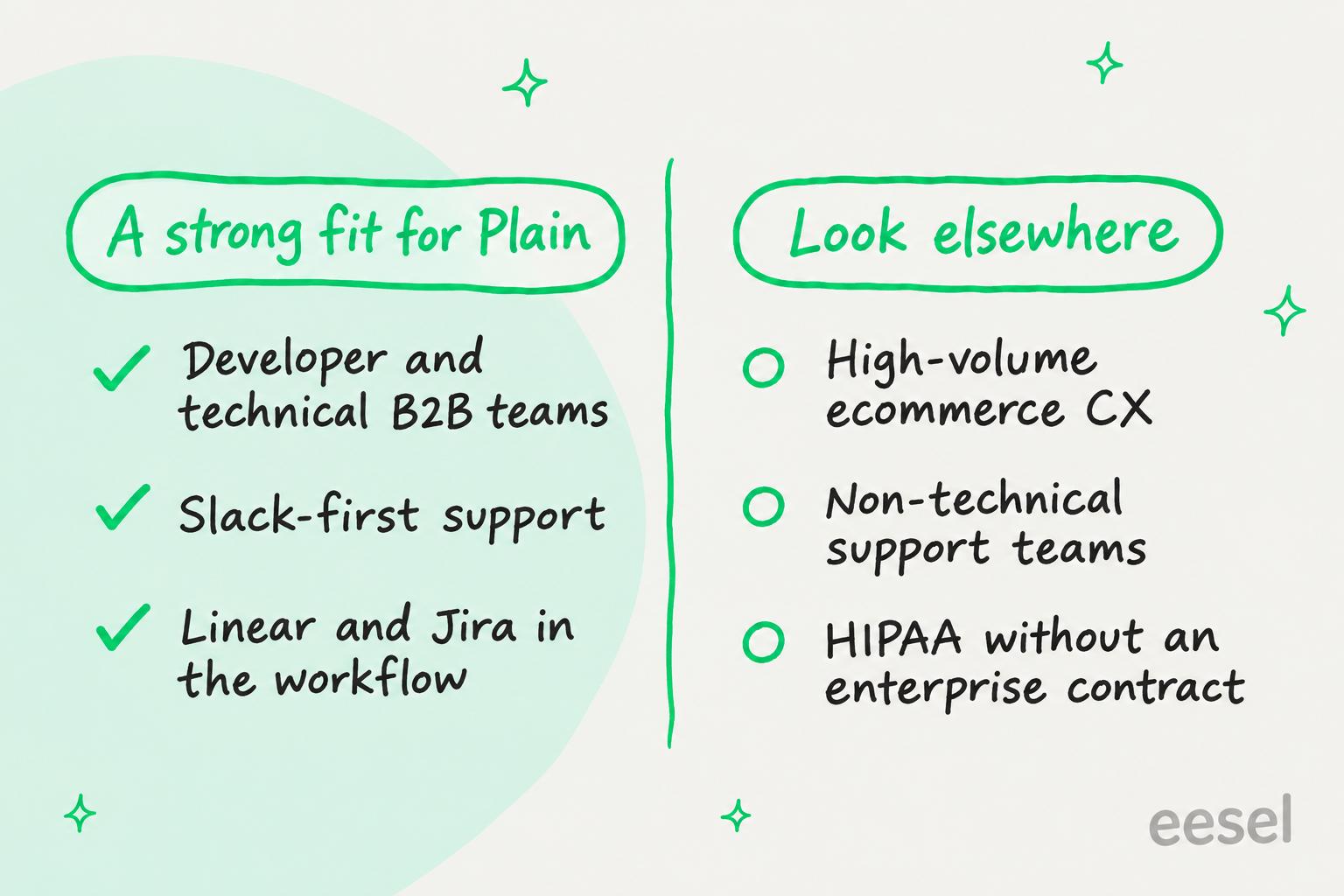
Pick Plain if you are a developer-facing B2B team, you run support out of Slack, and you want your issue tracker wired in from day one. Look elsewhere if you need HIPAA coverage without an enterprise contract, you are a high-volume ecommerce or non-technical team, or you need to know your AI bill to the dollar before you sign. Those are not knocks on Plain; they are just honest statements of what it is optimized for.
Try eesel for AI support that plugs into your existing helpdesk
If what pulled you toward Plain was the AI (an agent that resolves tickets, drafts replies, and works alongside your team) but you do not want to move your whole support stack onto a new platform, that is exactly the gap eesel fills. eesel is an AI helpdesk teammate that plugs into the helpdesk you already run, whether that is Zendesk, Freshdesk, Gorgias, or a Slack-and-Jira setup much like Plain's, and starts resolving tickets from day one.
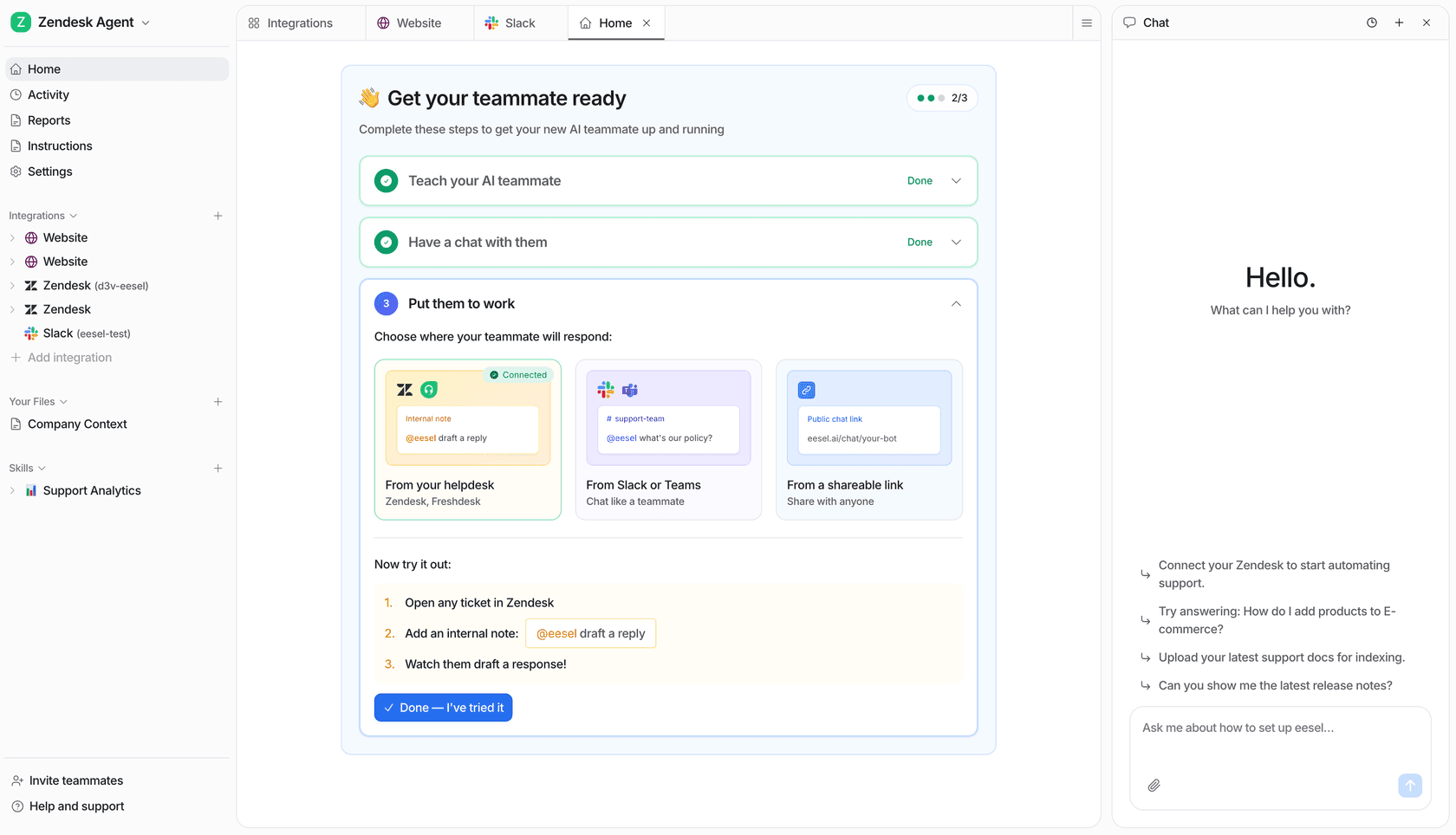
Two differences map directly onto the reservations above. First, knowledge and testing: eesel learns from your past tickets, not just your docs, and it lets you simulate a rollout over thousands of your real historical tickets so you see a projected resolution rate before a single customer is touched. Second, pricing: eesel charges one credit per ticket or chat it handles, with no per-seat fee and no variable per-task meter to reconcile.
And because Plain's audience is developers, the last piece will feel familiar: eesel exposes the same teammate through a proper CLI and MCP server. A person can drive it from a terminal, scripts can automate it, and coding agents like Claude Code, Codex, and Cursor can operate the same workspace programmatically, so the AI is not locked inside a dashboard. It is free to try, and you can have it running against your own tickets in minutes.
