


Qwen is a seriously strong open-source model, but it isn't the only game in town - and depending on what you're building, it might not be the right one.
The short version: DeepSeek wins for coding and technical reasoning, Llama 4 is the best general-purpose open-source foundation, Claude Opus 5.5 leads for long-context writing and analysis, Gemini 3 owns multimodal work, and GPT-5.2 is still the safest do-everything default. Mistral is the pick if you need EU data sovereignty and lower inference costs.
But here's the thing most of these comparisons miss: a raw model is an ingredient, not a solution. If what you actually want is work done in your team's apps, the model is the part you'd still have to build an agent around. That's the gap eesel fills, and I cover it after the list.
Let's be real: the AI world moves at a dizzying pace. One minute you think you've found the perfect model, and the next, three new ones pop up claiming to be faster, smarter, or cheaper. It's a lot to keep up with.
Qwen, from Alibaba Cloud, is a great example of this. It's a seriously impressive open-source model, especially for multilingual tasks or heavy-duty coding. But is it the only option? Absolutely not. I've spent the last few years at eesel putting AI to work inside real teams' tools, watching what holds up on live work and what only demos well, and I've tested everything from raw open-source models to polished business platforms. This is my shortlist of the best Qwen alternatives for 2026.
Why even look for Qwen alternatives?
Qwen is a fantastic tool. It's powerful, it's open-source, and its coding skills are top-notch. But the "best" AI model isn't a universal title. What works for a solo developer building a coding assistant is probably a terrible choice for a support team trying to get through their ticket backlog faster.
Sometimes you just need something that's easier to set up, writes with more creative flair, or is built to solve a specific business problem without needing a team of engineers. This guide is all about those other options. I'm going to dig into the top contenders that offer a different approach, whether you're prioritizing raw power, cost, or just plain simplicity.
What are AI language models?
Before we jump in, let's make sure we're on the same page. A Large Language Model (LLM) is an AI that's been trained on a mind-boggling amount of text and code. This training lets it understand and generate text that feels surprisingly human. You can ask it to draft an email, explain a tricky concept, or even help you debug some code.
They typically come in two main flavors:
-
Open-source models: Think of these as the DIY kits of the AI world. Models like Qwen can be downloaded, modified, and run on your own servers. This gives you an incredible amount of control and privacy, but it also means you're on the hook for all the setup and maintenance.
-
Proprietary models: These are the ready-made services, like OpenAI's GPT-5. You use them through an API (a simple way for different apps to communicate). They're incredibly easy to get started with and are often at the bleeding edge of AI tech, but you have less control and are building on someone else's platform.
There's also a third, increasingly popular path: a managed platform built on top of these models, which gives you the simplicity of an API with the customization of self-hosting.
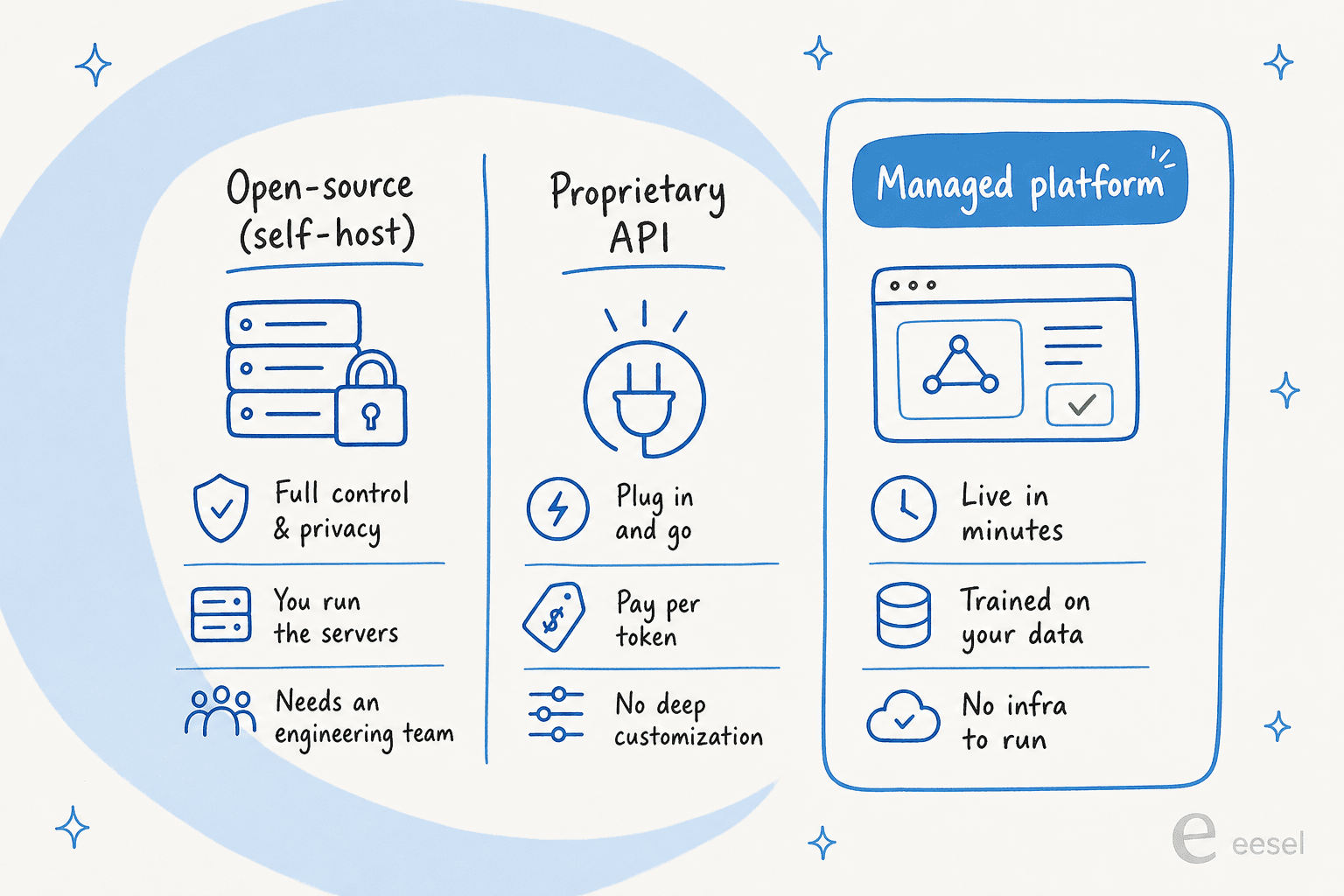
This list sticks to the models themselves, open-source and proprietary, because that's the choice you're making when you replace Qwen. I come back to the third path at the end.
How I chose the best Qwen alternatives
To cut through the marketing hype, I focused on a few things that actually matter when you're choosing a tool. This isn't about which model scores highest on an abstract benchmark; it's about what's practical for real-world use.
-
Performance & specialization: How well does it handle core tasks like coding, writing, and logical reasoning? Is it a jack-of-all-trades or a specialist that's brilliant at one specific thing?
-
Deployment model: Is it open-source like Qwen, where you manage the hosting? Or is it a managed API where you just plug it in and it works? This is a massive factor in your final cost and effort.
-
Ease of use & integration: How quickly can you get a working solution up and running? Are we talking minutes or months? Does it take an entire engineering team or can one person handle it?
-
Cost & total cost of ownership (TCO): I'm looking beyond the initial price tag. An open-source model might be "free," but servers and developer time are expensive. A paid platform might have a higher monthly fee but deliver value much faster.
-
Business-readiness: Is it just a raw model waiting for you to build something on top of it, or is it a complete platform designed to solve a specific business problem right out of the box?
Quick comparison of the top Qwen alternatives for 2026
| Tool | Developer | Best For | Model | Key Feature |
|---|---|---|---|---|
| DeepSeek | DeepSeek AI | Coding & Technical Reasoning | Open-Source | Top-tier performance on coding benchmarks |
| Claude Opus 5.5 | Anthropic | Complex Reasoning & Writing | Proprietary | Industry-leading context window & safety |
| Llama 4 | Meta | General-Purpose Development | Open-Source | Strong all-around performance, huge community |
| Mistral Large | Mistral AI | Efficiency & EU Data Residency | Open-Source | Mixture-of-Experts for faster, cheaper inference |
| GPT-5.2 | OpenAI | Versatility & Ecosystem | Proprietary | The industry benchmark for general intelligence |
| Gemini 3 | Multimodal Applications | Proprietary | Native understanding of text, image, and video |
A detailed look at the 6 best Qwen alternatives
Here's a closer look at each contender, what makes them unique, and who they're actually for.
1. DeepSeek
If Qwen's coding abilities caught your eye, then DeepSeek is the Qwen alternative you need to check out. It's an open-source model that has been consistently topping the leaderboards for code generation and math, often outperforming much larger and more expensive models. Its latest V3.2 release pushed efficiency even further.
Why it's a great alternative: It's an absolute beast for technical work. If you're building developer tools, an internal code assistant, or anything that needs a deep understanding of programming logic, DeepSeek is arguably the best open-source option out there right now.
Pros:
-
Exceptional performance on code generation, debugging, and math problems.
-
Fully open-source and free for commercial use, giving you complete freedom.
-
It uses an efficient architecture that makes it cheaper to run than many other models of its size.
Cons:
-
You'll need serious technical skills and powerful hardware to host and maintain it. This is not a plug-and-play solution.
-
Its creative writing and general conversation skills aren't as strong as some other models on this list, and its data is stored on servers in China - a real concern for privacy-sensitive teams.
Pricing:
The model itself is free. Your costs will come from the servers and computing power needed to run it, which can be significant. API access is also available on a pay-per-use basis, starting around $0.28 per million tokens for its latest model.
2. Claude Opus 5.5
Developed by Anthropic, Claude is the go-to Qwen alternative for tasks that require nuance, creativity, and deep thinking. If you've ever found other models to be a bit robotic, Claude often feels like you're talking to a sharp, careful person. Claude Opus 5.5 is built for long, multi-step work, with the Mythos-class Fable 5.2 above it as the flagship.
Why it's a great alternative: It shines at sophisticated writing and analysis. Its standout feature is a massive context window, which lets it "remember" and analyze huge documents (think entire books or long financial reports) in a single pass. This is perfect for tasks where context is everything.
Pros:
-
Top-tier performance for creative writing, in-depth analysis, and complex problem-solving.
-
An industry-leading context window for digesting long documents in one go.
-
A strong, built-in focus on AI safety and producing honest, helpful responses.
Cons:
-
It's a proprietary, closed-source model, so you can't customize it as deeply as an open-source one.
-
Its top-performing model can be more expensive than other API options.
Pricing:
Claude is available through a pay-per-use API, priced by model tier:
-
Haiku: The fastest and cheapest model, good for simple, high-volume tasks.
-
Sonnet (Claude Sonnet 5.5): The balanced option, offering great performance for the price.
-
Opus (Claude Opus 5.5): The most capable standard model, priced higher for tasks that need maximum intelligence.
There's also a free web chat and a Claude Pro plan for individuals at around $17-20/month.
3. Llama 4
When people talk about open-source AI, Llama from Meta is usually the first name that pops up, and for good reason. The Llama 4 family is the most popular, well-supported, and versatile open-source model lineage available.
Why it's a great alternative: It strikes a fantastic balance between performance, flexibility, and community support. While Qwen and DeepSeek are specialists in coding, Llama 4 is a powerful generalist. It's a solid, reliable foundation for almost any project, from building a chatbot to helping with research.
Pros:
-
Excellent all-around performance across a wide range of tasks.
-
A massive and active developer community, which means tons of tools, tutorials, and help are available.
-
Comes in different sizes, so you can pick a version that fits your hardware and needs.
Cons:
-
Like any open-source model, it requires technical expertise to deploy, fine-tune, and manage.
-
Its commercial license has some restrictions for very large companies.
Pricing:
Llama 4 is free to download and use. Your only costs are for the hardware to host it yourself or for using a third-party cloud service that offers it.
4. Mistral Large
Mistral AI, a company out of France, quickly became a major player by building models that deliver incredible performance without needing massive resources.
Why it's a great alternative: It's all about getting more bang for your buck. Mistral often uses a clever technique (Mixture-of-Experts) that only activates the parts of its "brain" needed for a specific task. The result is a model that's much faster and cheaper to run than others of similar capability - and because it's EU-based and GDPR-friendly, it's a strong pick for privacy-conscious teams. There's a fuller breakdown in my Mistral review.
Pros:
-
Top-tier performance with significantly lower computing costs.
-
Excellent reasoning and multilingual capabilities, fluently handling English, French, Spanish, German, and Italian.
-
Offers a range of options, from fully open-source models to a paid API for their most powerful versions.
Cons:
-
Their very best model, Mistral Large, is proprietary, not open-source.
-
As a newer company, its ecosystem is still growing compared to giants like Meta's Llama.
Pricing:
Mistral provides both free open-source models and a pay-per-use API for its advanced models. Their web interface, "Le Chat," has a free tier, a Pro plan for $14.99/month, and a Team plan for $24.99/user/month.
5. GPT-5.2
You can't really talk about AI models without mentioning OpenAI's GPT series. GPT-5.2 is the latest and greatest, and it remains the benchmark that all other models are measured against.
Why it's a great alternative: It's the safe, reliable, and incredibly capable choice. For teams that want top-tier AI without the headache of hosting an open-source model, GPT-5.2 is the default. It just works, and it works exceptionally well for almost anything you can think of. If you're weighing the API specifically, I broke down GPT-5 Pro in the API separately.
Pros:
-
Consistently high performance across nearly every task.
-
A mature, easy-to-use API with fantastic documentation and a massive community.
-
A huge ecosystem of tools and services is built around the OpenAI platform.
Cons:
-
Completely closed-source. You have no visibility into how it works and limited ability to customize it.
-
Can be one of the more expensive API options, especially for high-volume use.
Pricing:
ChatGPT has multiple tiers for its web app, including a surprisingly capable free version.
-
Free: Access to GPT models with some limits.
-
Go: Around $8 per month for higher limits.
-
Plus: $20 per month for more access and features.
-
Pro: $100+ per month for the full context window and heaviest usage.
API access is priced separately on a pay-per-use basis.
6. Gemini 3
While some versions of Qwen can understand images (Qwen-VL), Google's Gemini was built from the ground up to be "multimodal." That just means it can understand and reason about text, images, audio, and video all at once - and Gemini 3 is the strongest version of that yet.
Why it's a great alternative: If your project involves more than just text, Gemini is a natural fit. It's designed to interpret the world more holistically, making it perfect for things like analyzing visual data, transcribing meetings, or creating content based on images. (For a head-to-head, see Gemini vs Claude.)
Pros:
-
Natively built for multimodality, so it handles different kinds of information in one pass.
-
Some versions have an enormous context window, enabling massive data analysis.
-
Deep integration with the entire Google ecosystem, like Search, Workspace, and Google Cloud.
Cons:
-
Its performance can be a bit inconsistent; it's amazing at some tasks but can lag behind competitors in others.
-
Being so tied to the Google ecosystem can be a drawback if you're not already using their platform.
Pricing:
Gemini has a generous free tier through its web app, and a Google AI Plus plan around $7.99/month. For developers, API access is available through the Google Cloud Vertex AI platform, which has a detailed pay-per-use pricing structure.
From models to solutions: Choosing your path
Picking a model from a list is one thing, but making the right choice for your actual project requires thinking a bit differently.
API vs. self-hosting: What's right for you?
This is the classic debate. Using a proprietary model via an API is fast and simple, but you give up control. Self-hosting an open-source model like Qwen gives you total power and privacy, but it's complicated, expensive, and slow to get started.
But there's a third option: skip the model choice and buy something already built on top of one. You give up control over which model runs. In return you skip the work around it: the integrations, the prompts, and deciding what the AI may do on its own.
Don't forget the TCO
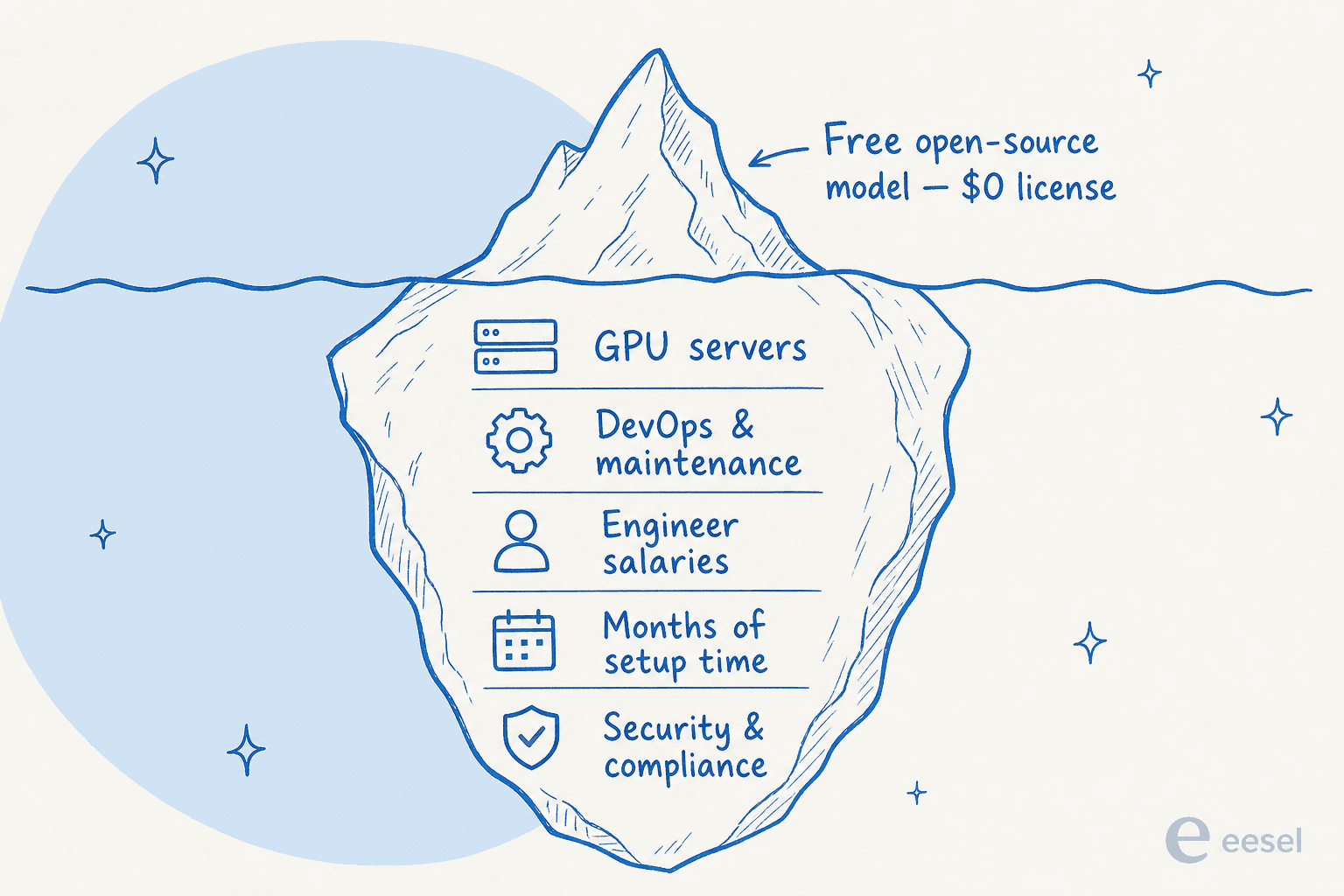
"Free" open-source models are never actually free. You have to account for the cost of powerful servers, the salaries of the engineers needed to maintain them, and the time you lose spending months on setup instead of solving your actual business problem. Put those costs next to the API bill or a ready-made product's monthly price before you call self-hosting the cheap option.
Start with your problem
The biggest mistake I see people make is falling in love with a specific model before they've clearly defined the problem they're trying to solve. Don't get bogged down in endless benchmark comparisons. Instead, ask yourself: what am I trying to achieve?
If your goal is "build a coding assistant" or "run inference in our own EU cloud," a model from this list is the right starting point. If your goal is a job done in your team's apps, a general model like Qwen is one ingredient in a recipe you'd still have to build yourself.
What's the best among the Qwen alternatives?
After all that, what's the final call?
Qwen is an excellent open-source model, but the best Qwen alternative for you depends entirely on what you need to get done.
-
For developers needing a powerful, self-hosted model for coding, DeepSeek is a phenomenal choice.
-
If you're looking for a flexible, all-around open-source foundation for a custom project, Llama 4 is still king.
-
For long-context writing and analysis, Claude Opus 5.5 is hard to beat; for multimodal work, reach for Gemini 3.
-
For the safest do-everything default through an API, GPT-5.2; for EU data residency and cheaper inference, Mistral.
At the end of the day, choosing a raw model is just the first step on a long road. What you build on it is the rest of the trip.
Where eesel fits if you'd rather not build the agent
Every model above is infrastructure. Pick DeepSeek or Llama 4 and you still build the agent around it: the tools it calls, the connections to your team's apps, what it may do on its own and who approves the rest. For a coding assistant or a product feature, that build is the job, and a model from this list is the right buy.
For work your team needs done, eesel is that agent already built. It's an AI teammate that joins Slack, email, the helpdesk, Shopify, Google Drive and the other apps your team uses, takes requests from anyone there, starts work from events and schedules, and does the work inside those tools. What it may do depends on who is asking: you set it for a teammate, named people, a verified customer and an anonymous visitor, and each tool runs on its own, asks a person first or stays off (actions and approvals). Answering customers is the job most teams give it first. It's one fixed monthly price with no per-seat charge, from $299 for 500 credits, and you can try eesel free with 100 credits for 7 days, no card.
Frequently asked questions
Why should I consider Qwen alternatives when Qwen is already a powerful model?
Qwen is excellent, especially for coding and multilingual tasks, but the "best" AI depends entirely on your specific job. The right Qwen alternative might offer an easier setup, stronger creative writing, or come already built into a product that does the job for you, like an AI teammate, with no engineering at all.
What are the main types of Qwen alternatives, open-source versus proprietary?
Qwen alternatives fall into two buckets: open-source models (like DeepSeek or Llama 4) that you host and customize, and proprietary models (like Claude Opus 5.5 or GPT-5.2) you use through an API. There's also a third path: a product built on top of these models that does the work for you, such as a ready-made AI agent. You skip picking and hosting a model, and you get less control over which one runs.
For coding and development, which Qwen alternative is best?
For coding and technical reasoning, DeepSeek stands out as the strongest open-source Qwen alternative in 2026. It consistently tops code-generation benchmarks and is a powerful base for building developer tools or an internal AI assistant.
Do I have to build an agent on a Qwen alternative, or is there something ready-made?
You only build it if building is the job you want. A model still needs tools, connections to your apps, permissions and an approval step around it before it can do work for a team. eesel is an AI teammate with that already built: it works in Slack, email, the helpdesk and other apps your team uses, and you set what it may do for each person who asks.
How should I think about total cost of ownership for open-source Qwen alternatives?
"Free" open-source Qwen alternatives still carry real costs: GPU servers, maintenance, security work, and developer time. API-based or managed platform options have a monthly or per-task fee, but they often work out cheaper because you skip months of setup. eesel, for instance, charges one fixed monthly price, from $299 for 500 credits, with no platform fee and no per-seat charge.
Which Qwen alternatives are best for general-purpose work?
Llama 4 is the strongest all-around open-source Qwen alternative, suitable for almost any project. For proprietary options, GPT-5.2 remains the most versatile general-purpose model, while Claude Opus 5.5 leads for long-context reasoning and writing.
Do any Qwen alternatives offer native multimodal understanding?
Yes. Gemini 3 is built from the ground up for multimodality - it processes text, images, audio, and video together, making it a great Qwen alternative for projects that mix data types.
