













Key Takeaways
- What FinOps is: FinOps is an operational framework and cultural practice that maximizes the business value of technology through collaboration between engineering, finance, and business teams.
- Why it matters now: The practice now covers AI, SaaS, licensing, private cloud, and data center spend, not only public cloud.
- How it runs: Teams cycle through Inform, Optimize, and Operate continuously, guided by six FinOps Foundation principles.
- Where to start: If your teams don’t trust the allocation data yet, start there, because showback, unit economics, and forecasting all depend on it.
- What good looks like: Every dollar of technology spend has an owner, a unit metric, and a business decision attached to it.
What Is FinOps?
FinOps is a portmanteau of “Finance” and “DevOps,” a name that reflects the collaboration between engineering, finance, and business teams the practice depends on. The FinOps Foundation’s FinOps Framework defines FinOps as an operational frameworkand cultural practice that maximizes the business value of technology, enables timely data-driven decisionmaking, and creates financial accountability through collaboration between engineering, finance, and business teams. The FinOps Foundation’s introduction to FinOps now places FinOps inside Technology Value Management, alongside AI Tokenomics and IT Asset Management (ITAM). FinOps and tokenomics aren’t interchangeable: FinOps optimizes how technology spend is allocated, governed, and tied to value, while tokenomics optimizes the outcome of each token across its full life.
The goal of FinOps is not simply to reduce cloud spend. It’s to make every technology dollar a deliberate business decision, as measurable and visible as uptime or latency. Cloud infrastructure is variable, fast-moving, and distributed across dozens of teams. Without a structured practice, costs become invisible until the invoice arrives, and by then the window to act has closed.
Core Principles of FinOps
The FinOps Foundation’s six principles are listed in no particular order. They aren’t procedural checklists. They’re cultural and organizational commitments that determine whether FinOps takes root or stays a dashboard no one reads.
- Teams need to collaborate. FinOps only works when engineering, finance, and product share cost decisions. Siloed cost management creates blind spots at budget cycles and misaligned incentives across teams.
- Business value drives technology decisions. Spending more on cloud can be the right decision if the business value it produces is proportionally higher. FinOps evaluates spend through unit economics, not absolute cost reduction.
- Everyone takes ownership for their technology usage. Cost accountability is distributed across all teams that provision and consume resources, not centralized in a single finance function that issues edicts from above.
- FinOps data should be accessible, timely, and accurate. Cost data that arrives weeks after spend occurs is history, not intelligence. Engineers and product managers need near-real-time data they can act on in the same sprint where the spend happened.
- FinOps should be enabled centrally. Even with distributed ownership, a centralized FinOps function enables best practices in a shared accountability model: governance, tooling standards, education, and the shared taxonomy that makes cross-team comparison possible. Most practices work this way. In the FinOps Foundation’s State of FinOps 2026, 60% of respondents operate with centralized enablement and another 21% with a hub-and-spoke model.
- Take advantage of the variable cost model of the cloud. The cloud’s elasticity is a financial feature, not just an engineering one. FinOps programs build processes to exploit variable pricing, including reserved capacity, spot instances, and auto-scaling governance, rather than defaulting to over-provisioning for safety.
The Three Phases of FinOps
In the FinOps Foundation’s model, the FinOps Framework’s three phases, Inform, Optimize, and Operate, are iterative. Organizations don’t graduate from one to the next permanently. They cycle through all three continuously, and different team members can work on different phases at different cadences.
Inform
Inform is the foundation: examining technology cost, usage, and efficiency data through data ingestion, allocation, reporting and analytics, forecasting, and unit economics. Without accurate allocation, everything downstream, from optimization to accountability, is guesswork.
Optimize
Optimize is where you identify opportunities: rightsizing over-provisioned resources, eliminating idle waste, using reserved instances and savings plans, and reducing the unit cost of delivering each product or feature. It covers both usage optimization (using fewer resources) and rate optimization (paying less for the resources you need).Optimization without visibility is just guessing where to cut.
Operate
Operate is where teams implement the changes identified in Optimize and build continuous improvement into engineering sprints and finance cycles, instead of treating it as a separate quarterly project.Each round of action loops back into Inform to measure the result.
Mature FinOps programs run all three phases simultaneously for different parts of their infrastructure. A team may have mature cost visibility for their cloud compute while still in the Inform phase for their AI spend or SaaS stack.
How Is the FinOps Framework Structured?
Principles and phases are only part of the model. The FinOps Foundation’s 2026 FinOps Framework organizes the practice into these building blocks:
- Domains: Four outcome areas: Understand Usage & Cost, Quantify Business Value, Optimize Usage & Cost, and Manage the FinOps Practice.
- Capabilities: 22 functional activities across those domains (four under Understand Usage & Cost, five under Quantify Business Value, five under Optimize Usage & Cost, and eight under Manage the FinOps Practice), from Data Ingestion and Allocation to Unit Economics, Rate Optimization, and Invoicing & Chargeback. The 2026 Framework update added Executive Strategy Alignment, which connects technology value to business strategy and helps leaders compare options, make tradeoffs, and govern investment.
- Personas: Six core personas (FinOps Practitioner, Engineering, Finance, Leadership, Procurement, and Product), plus allied personas such as ITAM, ITFM, ITSM, Security, and Sustainability.
- Scopes: Segments of technology spend tied to a business construct, such as a product, cost center, or environment, that set the decision context for which personas and capabilities apply.
- Maturity: A Crawl, Walk, Run model applied capability by capability.
The FinOps Foundation’s maturity model offers sample community KPIs for allocation: at least 70% of cost allocated to a known owner at Crawl, at least 85% at Walk, and more than 90% at Run. The same model cautions that the goal should never be simply to reach Run in every capability. If a Walk-stage capability already supports the decisions you need to make, your time is better spent maturing a different one.
FinOps Best Practices
1. Tag Everything and Enforce It at the Policy Level
Consistent resource tagging by team, product, environment, and cost center is the prerequisite for all meaningful cost allocation. Without it, attribution is guesswork and accountability is impossible. Enforce tagging at the infrastructure layer, not retroactively in a FinOps teamspreadsheet.AWS Organizations tag policies can block resources with non-compliant tag values, but required tag keys need service control policies or infrastructure-as-code checks. In Azure, Azure Policy definitions such as Require a tag on resources enforce that a tag exists.
Tagging is never fully clean, though. Resources provisioned before your standards existed, and costs that can’t be tagged at the provider level, still need an owner, and that’s the gap the other cloud cost allocation methods have to close.
2. Build Unit Economics, Not Just Cost Dashboards
Cost dashboards tell you what you spent. Unit economics tell you whether that spending is producing value, or as the FinOps Foundation’s Unit Economics capability puts it, they bring together what you spend on technology and the value that spending creates. Define cost-per-unit metrics that matter to your business (cost per active user, cost per API call, cost per transaction) and review them on a regular cadence. These metrics connect cloud investment to product outcomes and give engineering teams a meaningful optimization target beyond “spend less.”
3. Run Showback Everywhere, and Add Chargeback When Your Accounting Model Calls for It
Showback, reporting costs to teams without billing them, builds the habit of cost awareness without moving money between budgets, and every FinOps practice needs it. Chargeback,actually transferring costs to team budgets, depends on how your organization accounts for technology spend. The FinOps Foundation’s Invoicing & Chargeback capability puts it plainly: showback is always required, while chargeback depends on organizational accounting policies. It only works when teams have stable, trusted allocation data and the tools to control what they spend. If you switch on chargeback before that foundation is in place, you’ll spend the next quarter defending numbers instead of acting on them.
4. Embed Optimization in Engineering Sprints, Not Quarterly Reviews
Infrastructure usage patterns change faster than quarterly review cycles. Set up automated alerts for over-provisioned instances, idle resources, and underutilized commitments, and build a process for acting on them within sprint planning, not as a separate FinOps project. Optimization that isn’t tied to a sprint action item doesn’t get done.
5. Forecast at the Team Level, Not Just the Organization Level
Org-level forecasts hide which teams are driving variance. Build driver-based forecasts at the level of the teams and applications that own the spend, using historical spend plus planned changes such as new features or architecture changes. The FinOps Foundation’s Forecasting capability describes the same pattern at Run maturity: granular forecasts by team, product, or service, built from rolling, trend-based, and driver-based models. This surfaces budget risk before it becomes a month-end surprise and creates shared accountability for variance between what was planned and what was spent.
6. Shift Left: Govern Costs Before Deployment, Not After
Shift-left practices bring cost into design and architecture decisions instead of waiting until resources are already running. The FinOps Foundation’s Architecting & Workload Placement capability says value and cost efficiency are best achieved by architecting them into a system’s design, or as early in its life as possible. Cost estimates in CI/CD pipelines carry that into every change, and IDC says vendors need to provide cost estimates within the CI/CD pipeline before workloads reach production. That way teams make cost-aware decisions before commitments are made, instead of optimizing reactively once spend is already on the invoice. The FinOps Foundation’s principles point the same way, calling for a shift to proactive system architecture and design over infrequent reactive cleanups.
FinOps for AI & SaaS in 2026
The scope of FinOps has shifted fast. According to the FinOps Foundation’sState of FinOps 2026report, 98% of respondents now manage AI spend, up from 63% in 2025 and 31% in 2024. SaaS is following the same path: 90% of respondents manage SaaS or plan to within the next 12 months. Respondents also manage, or expect to manage within a year, licensing (64%), private cloud (57%), and data center spend (48%).
Why AI Costs Break Traditional FinOps
Traditional cloud cost management was designed for predictable, infrastructure-shaped spend: VMs, storage, egress. AI workloads run on different economics. Inference runs continuously and consumes GPU capacity long after training ends, as IDC notes. For token-billed APIs, consumption follows user behavior rather than provisioned capacity, and a FinOps Foundation working group paper on token economics warns that it can jump with prompt changes or bugs. Token prices vary by model tier and token type: the Foundation’s guide to token pricing notes that output tokens often cost three to five times more than input tokens, and context length drives how many input tokens each call carries. And tokens are only the most visible part of the bill. Orchestration, agent loops, retrieval, evaluations, and the people running them sit outside the token line, and the same working group paper says surrounding infrastructure often represents 40 to 60 percent of total feature spend in production RAG and agentic systems. That’s why AI cost and token cost are never the same number.
Managing AI costs requires per-model, per-endpoint visibility tied to business metrics, not just cloud line items. It requires anomaly detection that operates at the model and workload level, not the account level. And it requires unit economics framing: cost per inference, cost per query, cost per successful automation, not just cost per GPU-hour. Without that framing, AI spend is hard to defend. In the Tokenomics Foundation’s State of Tokenomics report, a September 2026 survey of 472 respondents, 39% of respondents said they weren’t confident they could connect AI spend to a measurable business outcome their CFO would accept. IDC’s FutureScape 2027 predictions raise the stakes: IDC predicts that by 2029, 40% of G2000 CIOs will be measured on AI unit economics, and that by the end of 2027, 55% of enterprises will see agentic bills rise with no published price change, up from 20% today.
Why SaaS Spend Needs the Same Discipline
SaaS spend has the same accountability problems as cloud: it’s distributed, fast-growing, and, as the FinOps Foundation’s Licensing & SaaS capability notes for early-maturity practices, often reviewed only at renewal, after the commitment is already in place. Unused seats and duplicate subscriptions are the SaaS equivalent of idle cloud instances, and the FinOps Foundation’s SaaS guidance lists underutilized licenses and duplicate subscriptions among the optimization opportunities to report. The same FinOps practices that work for cloud (visibility, ownership, unit economics, regular optimization cycles) apply directly to SaaS, but require tooling that can ingest SaaS billing data alongside cloud billing data.
What to Look For in FinOps Tools
Choosing the wrong tool at the wrong maturity stage wastes time, budget, and credibility. Here’s what to evaluate, and the ceiling most teams eventually hit.
Native cloud billing tools (AWS Cost Explorer, Azure Cost Management, Google Cloud Billing reports) are the right starting point if you’re early in your FinOps journey. They’re built into each provider’s console, connected to that provider’s billing data, and sufficient for basic single-cloud visibility. You’ll outgrow them once your footprint spreads across multiple accounts, providers, or services those tools don’t surface.
As complexity grows, native tools break down. Multi-cloud environments, Kubernetes clusters, shared services, AI workloads, and SaaS spend all introduce cost attribution problems that basic billing consoles weren’t designed to solve. At that point, teams either build a fragile DIY setup in a BI tool or invest in a purpose-built FinOps platform, and the DIY path tends to turn into a standing reconciliation job.
What a mature FinOps platform needs to do:
- Unify cost data across every provider and service into a single allocation model.
- Apply ownership logic that adapts as fast as the org changes, without infrastructure code changes.
- Surface unit economics alongside raw spend.
- Produce reports that engineering and finance both trust without a week of month-end reconciliation.
- Normalize billing data to a common standard. FOCUS, the FinOps Open Cost and Usage Specification, normalizes billing data across technology vendors, from cloud providers to SaaS and AI tools, and the FinOps Foundation’s FOCUS 1.4 announcement confirms version 1.4 was ratified on June 4, 2026.
What Does FinOps Mean in Practice?
FinOps in 2026 is no longer just a cloud cost management practice. It’s the organizational capability that governs how technology investment across cloud, AI, SaaS, Kubernetes, and shared infrastructure gets allocated, optimized, and tied to business outcomes. The teams that build it well don’t just spend less. They spend more intentionally and scale cost decisions without scaling headcount.
Where you start depends on the decision your leadership is trying to make:
- If leadership asks “what are we spending on AI?”, find the decision behind the question first, such as which product teams should get more AI investment, and build your first Scope around that outcome before you build reports.
- If teams don’t trust the allocation data, prioritize allocation and showback ahead of chargeback or optimization targets, because every downstream number inherits the gaps.
- If your spend spans more than one provider, prioritize a single allocation model across all of them, because per-console views can’t assign shared costs to owners consistently.
- If allocation is already solid, move to unit economics and team-level forecasts, because those connect spend to the business outcomes you’re accountable for.
Strong FinOps programs share three foundations: a single system of record that engineering and finance both trust, allocation logic that adapts as fast as the org ships, and unit economics that connect every dollar of technology spend to a measurable business outcome.
How Finout Helps You Run FinOps Across Cloud and AI Spend
Finout is an enterprise-grade FinOps platform for cloud and AI spend, built for teams that have outgrown native consoles and spreadsheet-based allocation. Finout’s MegaBill brings AWS, Azure, GCP, OCI, Kubernetes, Snowflake, Datadog, SaaS, and AI costs into one unified bill, putting AI spend in the same view as the rest of your infrastructure costs.
- Allocation: Finout’s Virtual Tags apply approved allocation rules retroactively, without code changes, covering resources provisioned before your tagging standards existed and costs that can’t be tagged at the provider level. Ownership stays current as org structures change. Shared Cost reallocates shared and platform spend to the teams that consume it, and fully allocated outputs feed the showback reporting that grounds chargeback.
- Planning: Financial Plans lets you track budgets by team, feature, or segment, forecast from historical data, and compare actual spend against plan throughout the year.
- Optimization: CostGuard unifies cloud recommendations, prioritizes them by impact, and assigns each one an owner, while Anomaly Detection flags unexpected spend.
- AI spend: FinOps for AI brings AI cost into the same model across four layers: cloud AI services, direct provider contracts, token-based developer tools, and AI inside your existing SaaS stack. The first layer usually shows up in the cloud bill. The other three often don’t, and that’s where untracked AI spend tends to sit.
- AI assistance: Billy answers natural-language cost questions from your live Finout data. FinOps Agents handles the follow-through: Detection Agent continuously scans cloud, Kubernetes, AI, and SaaS spend for waste, drift, and anomalies, Investigation Agent traces each finding to its root cause, owner, and blast radius, and Orchestration Agent routes approved actions through Jira, Slack, or ServiceNow. The Finout MCP server lets your own agents and copilots query the same governed data.
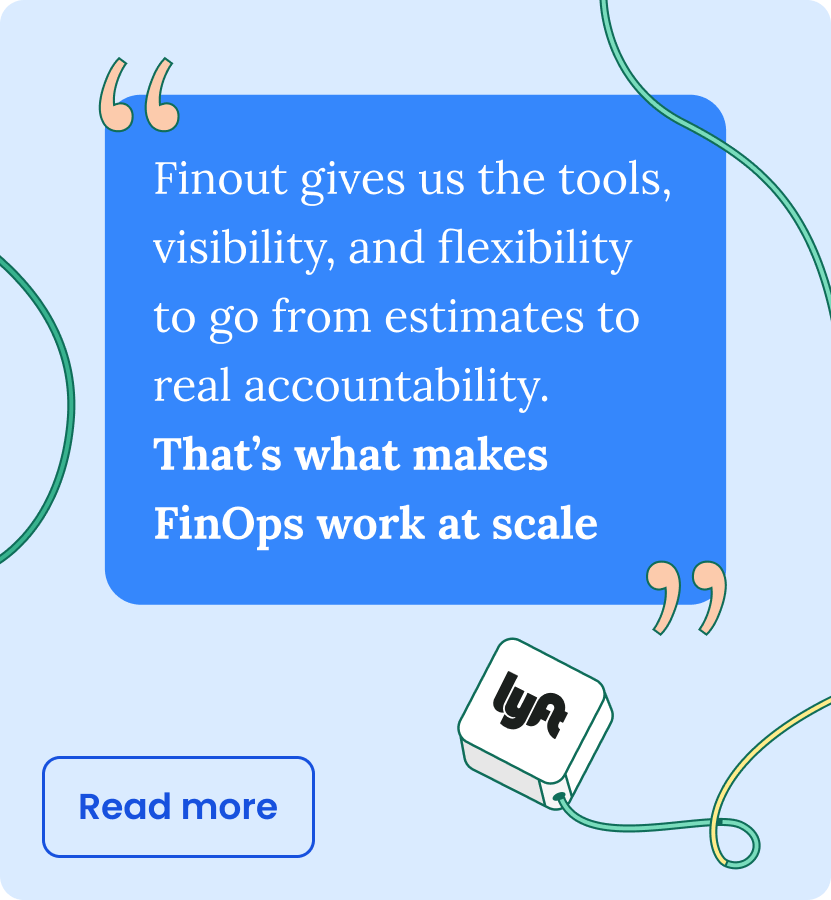
With Finout, Lyft improved cost attribution from 80% to more than 96% and moved anomaly detection from weeks to days, according to the Lyft case study. That’s above the more-than-90% allocation level the FinOps Foundation’s maturity model uses as a sample Run-stage KPI.
Book a demo to see how Finout maps your cloud and AI spend to owners.
cloud & AI spend