













Key Takeaways
- Definition: FinOps is an operational framework and cultural practice that brings financial accountability to technology spend, from public cloud to SaaS, data platforms, and AI.
- Collaboration: It breaks down silos between engineering, finance, and business teams to optimize cloud value.
- The Lifecycle: The process follows a continuous three-phase cycle: Inform, Optimize, and Operate.
- Ownership: Individual teams take responsibility for their own cloud usage and costs through visibility and real-time reporting.
- Business Value: The goal is not just cost-cutting, but making data-driven decisions that accelerate business outcomes.
What Is FinOps?
The FinOps Foundation, which notes that the name blends “Finance” and “DevOps,” defines FinOps as an operational framework and cultural practice that maximizes the business value of technology, enables timely data-driven decisions, and creates financial accountability through collaboration between engineering, finance, and business teams.
In practice, FinOps gives your engineering, finance, product, and executive stakeholders a shared language and set of processes for managing technology spendacross public cloud, SaaS, data platforms, AI infrastructure, and beyond. The goal isn't just to cut costs. It's to make smarter trade-offs between cost, quality, and speed, helping your organization deliver business outcomes faster.
FinOps has also moved well beyond public cloud. The FinOps Framework's Technology Categories now cover public cloud, SaaS, data cloud platforms, data center, and AI. In the FinOps Foundation's State of FinOps 2026 report, 98% of respondents said they now manage AI spend, up from 31% two years earlier, and 90% manage SaaS or plan to in the coming year. The Framework also defines FinOps Scopes: segments of technology spending aligned to business constructs such as products, cost centers, or environments, which set the decision context for each part of a FinOps practice.
Unlike on-premises environments where infrastructure procurement was centralized and predictable, cloud and AI spending is decentralized by design. Development teams provision their own resources, often without visibility into the financial impact. That's exactly the gap FinOps closes: it brings shared accountability and governance to a model where anyone with an API key can spin up costs.
In this article, we'll break down the six core FinOps principles, walk through the three lifecycle phases (Inform, Optimize, Operate), and cover what it actually takes to adopt FinOps successfully, whether you're managing cloud, AI, or SaaS spend. For a broader primer, see our complete guide to FinOps.
FinOps Principles
The FinOps Foundation defines six core principles that act as a north star for any FinOps practice. These principles are in no particular order, and each one is important to FinOps success. Here's what they are and how to put them into practice:
Teams Need to Collaborate
FinOps requires a cultural shift. Teams can no longer work in silos. Finance, engineering, product, and leadership all need to work together to manage technology spend at the speed and granularity each category requires. That means:
- Finance defines cost metrics, sets budgets, and provides centralized governance.
- Engineering treats cost as a first-class efficiency metric alongside performance and uptime.
- Product weighs cost trade-offs when prioritizing features and roadmap decisions.
- Leadership coordinates strategic alignment from executives to individual contributors.
The goal isn't a one-time alignment exercise. Teams work together to continuously improve for efficiency and innovation, iterating on processes, sharing learnings, and refining cost practices over time.
Business Value Drives Technology Decisions
FinOps isn't just about tracking cloud costs. It's about making decisions that increase the business value of your technology spend. The cloud provides clear advantages: on-demand scaling, no upfront investment, and access to managed services. But those benefits only compound when you tie spending to outcomes.
That means:
- Using unit economic and value-based metrics (e.g., cost per transaction, cost per customer, cost per inference) to demonstrate business impact, rather than relying on aggregate spend alone.
- Making conscious trade-off decisions among cost, quality, and speed. Sometimes spending more is the right call if it accelerates time-to-market or improves reliability.
- Leveraging the strengths of each technology category (public cloud, SaaS, data platforms, AI) to derive maximum value and support innovation.
FinOps Should Be Enabled Centrally
A centralized FinOps function doesn't dictate decisions. It encourages, evangelizes, and enables best practices across a shared accountability model. Your FinOps team should:
- Set cost-efficiency expectations and educate engineering teams on standards and best practices.
- Establish cost-control guardrails including tagging standards, budget policies, and governance frameworks.
- Centralize rate, commitment, and discount optimization to take advantage of economies of scale, which lets engineers stay focused on optimizing their usage rather than negotiating pricing.
- Align business and technology strategies by enabling executive-level communication around cloud and AI spend.
- Develop tools and dashboards (or adopt a platform like Finout, an enterprise-grade FinOps platform for cloud and AI spend) to create budgets, forecasts, and real-time cost visibility across the organization.
That centralized enablement model is now the norm. In the FinOps Foundation's State of FinOps 2026 survey, 60% of practices operate with centralized enablement and another 21% use a hub-and-spoke model, and 78% of FinOps teams report into the CTO or CIO organization.
Everyone Takes Ownership for Their Technology Usage
Accountability for usage and cost should be pushed to the edge. Each team in your organization should own the cloud costs of the products and resources it manages, from architecture design through ongoing operations.
This means:
- Empowering individual feature and product teams to manage their own technology usage against budgets they help control.
- Decentralizing decision-making around cost-effective architecture, resource usage, and optimization.
- Treating cost as a first-class metric from the beginning of the software development lifecycle, not something teams address after deployment.
With Finout's and AI-Powered VTags, you can reach 100% cost allocation across teams without relabeling resources, making ownership practical at scale. Engineers can perform rightsizing, decommission unused resources, and track their costs in real time, without waiting on finance to generate reports.
FinOps Data Should Be Accessible, Timely, and Accurate
FinOps data should be accessible, timely, and accurate. Cost data needs to be processed and shared as soon as it becomes available. Real-time visibility autonomously drives better technology utilization, and fast feedback loops result in more efficient behavior.
Here's what that looks like in practice:
- Consistent visibility into technology spend is provided to all levels of the organization, from engineers to executives.
- Real-time financial forecasting and planning is continuously monitored and improved.
- Trending and variance analysis helps explain cost movements, letting teams act on root causes, not just symptoms.
- Internal benchmarking across teams drives best practices and celebrates wins.
- Anomaly detection notifies teams immediately when abnormal spending occurs.
- Normalized data across technology categories, using FOCUS (the FinOps Open Cost and Usage Specification) and other methods to keep cost data consistent.
Tools like Finout's FinOps Dashboards centralize all of this into customizable views by team, department, or application. And with Billy, Finout's AI FinOps assistant, any stakeholder can ask cost questions in plain English and get instant, chart-backed answers from live Finout data, without building a query.
Take Advantage of the Variable Cost Model of the Cloud
In the cloud, it is easy to provision new resources. There is no upfront cost, and you only pay for the resources you use. However, you need to be cost-conscious and ensure that you use your current resources optimally. Do this by continuously monitoring resource spend to ensure that your actual costs align with your budget forecast.
The principle now reaches past cloud. More of every technology category, including SaaS, licenses, and data cloud platforms, is becoming consumption-based and variable, which favors just-in-time planning and purchasing, iterative planning over static annual plans, and continuous architecture adjustments over occasional cleanups.
To further minimize your cloud costs, follow these optimization practices:
- Rightsizing: Adjusting resources to the optimal size for their workload.
- Reserved Instances: Committing to long-term usage for significant discounts.
- Resource Scheduling: Turning off resources when not in use (e.g., development or sandbox environments).
The FinOps Lifecycle: Inform, Optimize, and Operate
Now that we have discussed the main FinOps principles, let’s explore how to implement them efficiently. To do this, cycle continuously through three phases: Inform, Optimize, and Operate.
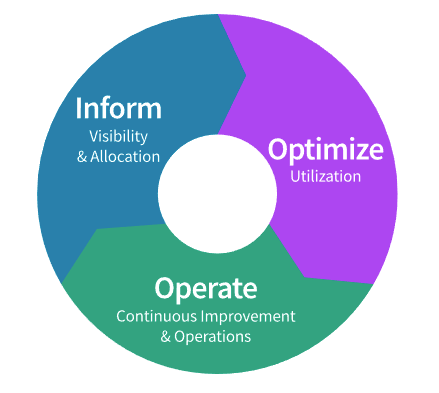
FinOps phases (Source: FinOps Foundation)
Inform
In the Inform phase, teams examine technology cost, usage, and efficiency data and understand it at a granular level. The FinOps Foundation frames this phase around data ingestion, allocation, reporting and analytics, forecasting, and unit economics. Costs need to be mapped to applications, teams, and business units, which lets them be analyzed, rolled up, and reported accurately. This is where your FinOps team generates budgets and forecasts.
Key activities in the Inform phase include:
- Standardized Tagging: Implementing a strategy to provide granular visibility into usage.
- Cost Allocation: Identifying untagged resources to ensure proper chargeback and transparency.
- Reporting: Creating dashboards and scorecards to keep teams informed of spending trends.
Optimize
Once you understand your cloud spending and cost drivers, it's time to create optimization measures and set realistic goals. Native cloud tools like AWS Cost Explorer or GCP Recommender are useful starting points, but each one covers only its own provider, which leaves Kubernetes, SaaS, AI, and other clouds to be reconciled somewhere else.
Key optimization activities include:
- Identifying underutilized resources and eliminating waste: idle EC2 instances, unattached EBS volumes, oversized VMs, and unused Kubernetes capacity.
- Setting up cost anomaly alerts to catch unusual usage patterns and cost spikes before they become budget overruns. Finout's Anomaly Detection uses ML to surface these automatically via Slack and email.
- Analyzing commitment opportunities across your fleet (reserved instances, savings plans, and long-term commitments) to lower steady-state costs.
- Evaluating AI and SaaS spend alongside cloud, since inference costs (OpenAI, Anthropic) and data platform usage (Snowflake, Databricks) can scale just as fast.
Finout's CostGuard consolidates recommendations from native cloud tools, Kubernetes, Snowflake, and third-party optimizers into a single workspace, where your FinOps team can cut noise, assign ownership, and track realized savings.
Operate
In the Operate phase, your organization implements the cost optimization plan and builds the automation to sustain it. The goal is to make cost optimization repeatable and continuous, not a quarterly exercise.
Key activities in this phase include:
- Automating cost reports and distributing them regularly to stakeholders via Slack, email, or Teams, keeping decisions close to realtime.
- Routing optimization tasks to the right owners. Finout's CostGuard assigns recommendations to owners using tags and Virtual Tags.
- Training engineering teams on cost optimization measures and empowering them to implement changes: rightsizing, decommissioning, and commitment purchases.
- Closing the loop on every recommendation by tracking potential vs. realized savings in dashboards, ensuring provable financial impact.
The Operate phase is also where agentic automation fits. Within Finout's FinOps Agents, Detection Agent continuously scans cloud, Kubernetes, AI, and SaaS spend for waste and anomalies, while Investigation Agent performs root-cause analysis on each finding and maps it to its owner and blast radius. Approved follow-up is routed through Jira, Slack, or ServiceNow under the policies you configure, with human approval required for destructive actions. Finout's MCP server lets teams connect their own agents and internal platforms to the same governed cost data.
Continuous improvement, automation, and building an effective cost-governance strategy remain the foundation of this phase.
How to Successfully Adopt FinOps
Now that you understand FinOps principles and the lifecycle, the first step is gaining visibility into your cloud, AI, and SaaS environments. The FinOps journey requires cultural change and constant iteration through the Inform, Optimize, and Operate phases. The FinOps Foundation's maturity model uses a Crawl, Walk, Run approach: start small, then grow in scale, scope, and complexity as business value warrants. The FinOps Foundation is clear that the goal is not to reach Run in every Capability; mature the Capabilities that deliver the most business value first.
Remember: your centralized FinOps team provides guidance, governance, and visibility. Engineering teams use that information to make infrastructure changes and optimize spending. The key is giving both sides the tools and data they need to act fast.
Related FinOps content:
- Guide to Choosing the Right FinOps Tools
- Guide to FinOps Azure
How Finout Helps You Run FinOps at Scale
Finout is an enterprise-grade FinOps platform for cloud and AI spend, built for any scale. Finout brings cloud, Kubernetes, SaaS, and AI costs into one governed data layer and maps them to teams, products, and business units with Virtual Tags and AI-Powered VTags, delivering 100% cost allocation.
- FinOps for AI brings OpenAI, Anthropic, and Cursor costs alongside cloud spend, showing cost per token and the ROI of AI features.
- Billy answers plain-English cost questions from live Finout data.
- FinOps Agents pairs Detection Agent, which detects waste and anomalies, with Investigation Agent, which traces each finding to its root cause and owner.
- MCP server lets you run your own agents on governed Finout data.
- Anomaly Detection, Financial Plans, and CostGuard cover alerts, budgets and forecasts, and optimization tracking.
Book a demo to see how Finout can help your organization adopt the FinOps standard for cloud and AI spend.