

The Total Assets to Debt Ratio is a solvency ratio that measures the relationship between a company's total assets and its long-term debt. It indicates the extent to which the firm's assets can cover its long-term financial obligations and serves as a variation of the Debt–Equity Ratio, providing a similar assessment of financial stability and solvency. Total assets include all fixed and current assets owned by the company, but exclude fictitious assets such as share issue expenses, preliminary expenses, underwriting commission, discount on issue of shares, and any negative balance in the Profit and Loss Account. Long-term debt consists of liabilities that are repayable after more than one year, including mortgage loans, debentures, bank loans, public deposits, and other long-term borrowings. A higher Total Assets to Debt Ratio generally indicates a stronger financial position, as it shows that the company has sufficient assets to meet its long-term debt obligations. Thus, this ratio helps investors, creditors, and management evaluate the long-term solvency and financial strength of an organization.
The Total Assets to Debt Ratio is usually expressed as a pure ratio; i.e., 1:1 or 2:1.
Formula
Or
Where,
Total Assets = Non-Current Assets (Tangible Assets + Intangible Assets + Non-Current Investments + Long Term Loans & Advances) +Current Assets
Debt = Long-Term Borrowings + Long-Term Provisions
Significance
The Total Assets to Debt Ratio establishes a relationship between total assets and long-term loans. It also indicates the safety margin available to the firm's long-term loans. In simple terms, it shows the extent to which the long-term loans of a company are covered by its total assets. A higher total assets to debt ratio represents more security to the lenders of long-term loans. However, lower total assets to debt ratio represent less security to the lenders of long-term loans, which indicates more dependence of the firm on long-term borrowed funds.
Illustration 1:
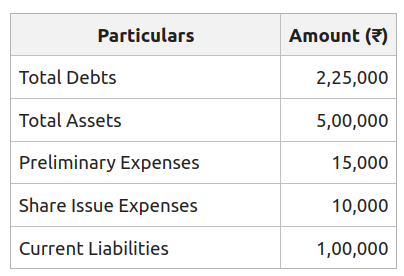
Compute Total Assets to Debt Ratio from the following information:
Solution:
Or
Total Assets = Non-Current Assets (Tangible Assets + Intangible Assets + Non-Current Investments + Long Term Loans & Advances) +Current Assets
Debt = Long Term Borrowings + Long Term Provisions
In the given question,
Net Total Assets = Total Assets - Fictitious Assets (Preliminary Expenses + Share Issue Expenses)
= ₹5,00,000 - (₹15,000 + ₹10,000)
= ₹5,00,000 - ₹25,000
= ₹4,75,000
Long-term Loans = Total Debts - Current Liabilities
= ₹2,25,000 - ₹1,00,000
= ₹1,25,000
Total Assets to Debt Ratio =
= 3.8:1
Comment:
Total Asset to Debt Ratio of 3.8:1 means that the company's total assets are 3.8 times of its long-term loans. It indicates that the assets are sufficiently large and provides an adequate safety margin to the providers of long-term loan.
Illustration 2:
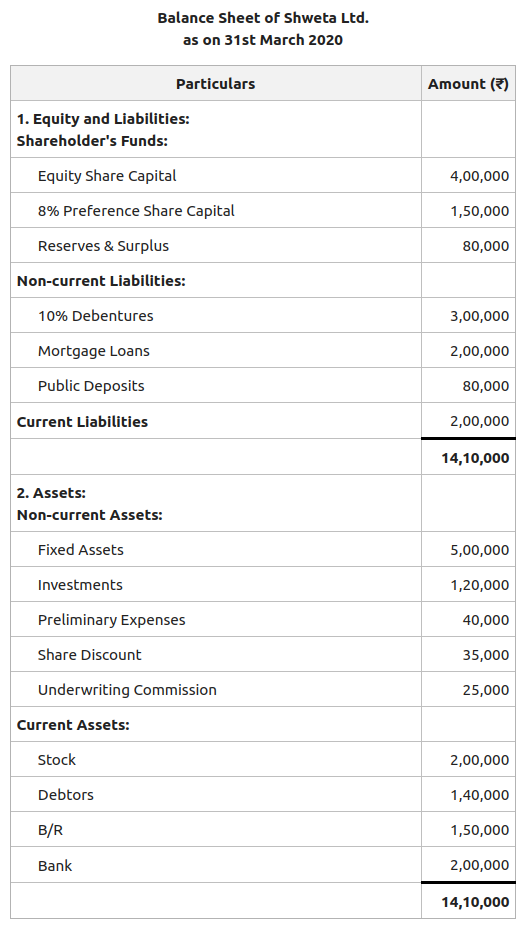
Compute Total Assets to Debt Ratio from the following Balance Sheet of Shweta Ltd. as on 31st March 2020:
Solution:
Total Assets = Non-Current Assets (Tangible Assets + Intangible Assets + Non-Current Investments + Long Term Loans & Advances) +Current Assets
Debt = Long-Term Borrowings + Long-Term Provisions
In the given question,
Total Assets = Fixed Assets + Investments + Stock + Debtors + B/R + Bank
= ₹5,00,000 + ₹1,20,000 + ₹2,00,000 + ₹1,40,000 + ₹1,50,000 + ₹2,00,000
= ₹13,10,000
Or,
Total Assets = Total Assets - (Preliminary Expenses + Share Discount + Underwriting Commission)
= ₹14,10,000 - (₹40,000 + ₹35,000 + ₹25,000)
= ₹14,10,000 - ₹1,00,000
= ₹13,10,000
Debt = Mortgage Loans + 10% Debentures + Public Deposits
= ₹2,00,000 + ₹3,00,000 + ₹80,000
=₹5,80,000
Total Assets to Debt Ratio =
= 2.25:1
Comment:
Total Asset to Debt Ratio of 2.25:1 means that the company's total assets are 2.25 times of its long-term loans. It indicates that the assets of Shweta Ltd. are sufficiently large and provides an adequate safety margin to the providers of long-term loan.
