

Earthworms are elongated, cylindrical, segmented invertebrate animals belonging to the phylum Annelida. They are commonly known as the “farmer’s friend” because they improve soil fertility, aeration, and decomposition of organic matter through their burrowing activities. Earthworms are mainly found in moist and fertile soils where they feed on decaying organic substances and help maintain ecological balance.
Their body is divided into numerous segments, and they possess well-developed organ systems for digestion, circulation, excretion, respiration, and reproduction.
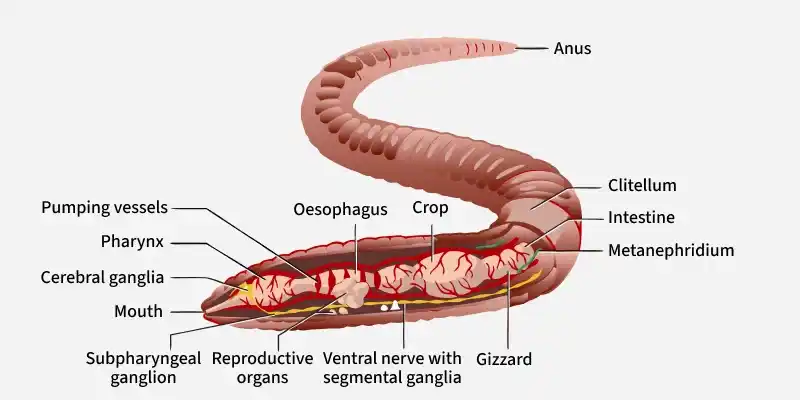
Classification of Earthworm
The systematic classification of earthworms is as follows:
| Taxonomic Category | Classification |
|---|---|
| Kingdom | Animalia |
| Phylum | Annelida |
| Class | Clitellata |
| Order | Haplotaxida |
| Family | Megascolecidae |
| Genus | Pheretima |
| Species | Pheretima posthuma |
Habitat and Habit
- Earthworms are terrestrial animals that prefer moist, cool, and fertile soil rich in humus and decaying organic matter. Since respiration occurs through the moist body surface, they cannot survive in dry environments.
- Earthworms usually remain inside self-made burrows in the soil and come out mainly during the night or after rainfall.
- Earthworms feed on dead and decaying leaves, microorganisms, decomposed organic matter, and soil particles. They are detritivores because they consume decomposing organic substances.
- Their feeding and burrowing habits help mix soil layers and improve soil fertility.
- Earthworms are also called natural ploughmen because their movement through soil loosens compact soil particles and increases aeration and water infiltration.
Morphology of Earthworm
Morphology refers to the study of the external structure, appearance, and physical features of an organism. The morphology of the earthworm includes its shape, size, colour, segmentation, body divisions, and external openings.

- Shape and Size: The body of the earthworm is elongated, cylindrical, narrow, and tapering at both ends. The anterior end is slightly pointed, while the posterior end is comparatively blunt. The body is soft, flexible, and smooth due to the presence of a thin, moist cuticle covering the outer surface.
- Colouration: Earthworms are usually reddish-brown or rosy brown in colour. The dorsal surface appears darker than the ventral surface because the dorsal blood vessel is visible through the thin body wall. The colour of earthworms is mainly due to the presence of haemoglobin dissolved in blood plasma.
- Bilateral Symmetry: Earthworms exhibit bilateral symmetry, which means the body can be divided into two equal and similar halves only through one longitudinal plane.
- Segmentation: The body of the earthworm is divided into many ring-like segments called metameres. These segments are externally visible as circular grooves surrounding the body. A mature earthworm usually possesses about 100–120 segments.
- Body Surface: The body surface of the earthworm is moist and slimy due to the secretion of mucus by epidermal glands. Moisture is necessary for gaseous exchange during respiration.
- Dorsal and Ventral Surfaces: The body of the earthworm can be differentiated into dorsal and ventral surfaces. The dorsal surface is darker and contains the dorsal blood vessel. The ventral surface is comparatively lighter and contains genital openings.
- Clitellum: The clitellum is a thick, glandular, and saddle-shaped band present around segments 14–16 in sexually mature earthworms. It appears swollen and lighter in colour than the rest of the body.
External Features of Earthworm
- Prostomium: The prostomium is a small fleshy lobe located in front of the mouth. It overhangs the mouth like a hood. The prostomium helps in burrowing, acts as a sensory organ, and assists in food collection.
- Mouth: The mouth is situated ventrally in the first segment below the prostomium. It is crescent-shaped and serves as the opening for the ingestion of food.
- Anus: The anus is located in the terminal segment at the posterior end of the body and serves as the opening for the ejection of undigested food materials.
- Setae: Setae are minute, S-shaped, chitinous bristles embedded in the body wall. They are present in all segments except the first, last, and clitellar segments. It assist in locomotion, provide grip during movement, and help in burrowing.
- Dorsal Pores: Dorsal pores are minute openings present along the dorsal midline from the 12th segment onwards. Release coelomic fluid to maintain body moisture.
- Nephridiopores: These are small openings of nephridia on the body surface through which nitrogenous wastes are excreted.
- Male Genital Pores: A pair of male genital pores is located ventrally on the 18th segment and release sperms during copulation.
- Female Genital Pore: A single female genital pore is located mid-ventrally on the 14th segment and release ova.
- Spermathecal Pores: Four pairs of spermathecal pores are present between segments 5–9 and stores sperm received during copulation.
- Genital Papillae: Genital papillae are small conical structures present near the male genital pores and assist in attachment during mating.
Anatomy of Earthworm
Anatomy refers to the study of internal structure and organisation of body systems. Earthworms possess highly developed organ systems despite being invertebrates.
- Body wall: The body wall of the earthworm consists of several layers arranged from outside to inside.
- Cuticle: The cuticle is a thin, transparent, non-cellular protective layer covering the body surface.
- Epidermis: The epidermis contains gland cells, sensory cells, and supporting cells.
- Circular Muscles: These muscles help elongate the body during movement.
- Longitudinal Muscles: These muscles shorten the body during locomotion.
- Coelomic Epithelium: The innermost lining surrounding the coelom.
- Coelom: The coelom is a fluid-filled body cavity located between the body wall and alimentary canal.
Digestive System of Earthworm
The digestive system consists of a straight alimentary canal extending from mouth to the anus.
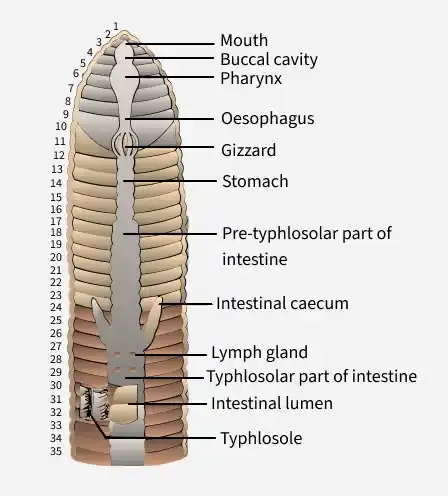
- Mouth: The mouth is the first opening of the alimentary canal and is situated ventrally in the first body segment below the prostomium. It is crescent-shaped and serves as the entry point for food into the body.
- Buccal Cavity: The buccal cavity is a short, thin-walled chamber extending from the first to the third segment. It lies immediately behind the mouth.
- Pharynx: The pharynx is a thick-walled, muscular chamber located behind the buccal cavity, generally extending through the fourth segment. It contains pharyngeal glands that secrete mucus and digestive enzymes.
- Oesophagus: The oesophagus is a narrow tubular structure extending through segments 5–7. It serves mainly as a passage for transporting food from the pharynx to the gizzard.
- Gizzard: The gizzard is a thick-walled, muscular, and hard structure located in segments 8–9. It is one of the most important parts of the digestive system because it mechanically grinds and crushes food particles.
- Stomach: The stomach is a thin-walled tubular structure located approximately in segments 9–14. In this region, food undergoes further chemical processing.
- Intestine: The intestine is the longest part of the alimentary canal and extends from the 15th segment up to the last segment except the anus. It is the main site for the digestion and absorption of nutrients.
- Typhlosole: A special internal fold called the typhlosole is present in the intestine begins around the 26th segment and extends through a major part of the intestine, increasing the absorptive surface area.
- Anus: The anus is the terminal opening of the alimentary canal located in the last body segment. Undigested food materials and waste products are expelled through the anus in the form of castings.
Circulatory System of Earthworm
Earthworms possess a closed circulatory system in which blood remains confined within blood vessels.
- Blood: The blood of the earthworm is red in colour because it contains haemoglobin dissolved directly in the plasma. Unlike vertebrates, haemoglobin in earthworms is not enclosed within red blood cells but remains freely dissolved in the blood plasma.
- Blood Vessels: The blood vessels form a network of tubes through which blood circulates throughout the body. The major blood vessels present in the earthworm include dorsal, ventral, and lateral blood vessels.
- Hearts of Earthworm: Earthworms possess several muscular pumping organs called hearts or aortic arches. These hearts are modified lateral blood vessels that help pump blood from the dorsal blood vessel into the ventral blood vessel.
- Blood Glands: Blood glands are specialised structures located above the pharynx in segments 4th, 5th, and 6th. These glands are responsible for the formation of blood corpuscles and haemoglobin.
Respiratory System of Earthworm
- Earthworms do not possess specialised respiratory organs such as lungs or gills. Respiration occurs through the moist body surface by diffusion.
- The respiratory system of the earthworm is comparatively simple because earthworms do not possess specialised respiratory organs such as lungs, gills, or tracheae that are commonly found in many higher animals.
- Respiration in earthworms takes place directly through the moist body surface by the process of diffusion.
- This type of respiration is known as cutaneous respiration because gaseous exchange occurs through the skin.
- The body surface of the earthworm remains continuously moist due to the secretion of mucus by gland cells present in the epidermis and also because of the coelomic fluid released through dorsal pores.
- Moisture is extremely important because oxygen can dissolve only in a thin film of water before diffusing through the skin. Therefore, earthworms always prefer moist habitats and cannot survive in dry conditions for long periods.
Excretory System of Earthworm
The excretory system of the earthworm is responsible for removing nitrogenous metabolic wastes from the body and maintaining water and salt balance. Excretion is extremely important because accumulation of toxic substances inside the body may damage tissues and interfere with normal physiological activities. Based on their location, nephridia are of three main types:
- Septal Nephridia: Septal nephridia are present on both sides of intersegmental septa from the 15th segment to the last segment. These nephridia open into the intestine and are therefore called enteronephric nephridia.
- Integumentary Nephridia: Integumentary nephridia are small nephridia present in the body wall from the third segment onwards. These nephridia open directly outside through nephridiopores and are therefore called exonephric nephridia.
- Pharyngeal Nephridia: Pharyngeal nephridia are present in clusters in segments 4, 5, and 6 around the pharynx. These nephridia also discharge wastes into the alimentary canal.
Nervous System of Earthworm
The nervous system of the earthworm is well developed and controls all body activities such as movement, feeding, burrowing, reproduction, and response to external stimuli. The nervous system coordinates the activities of different organs and maintains communication between body parts. The nervous system of the earthworm includes:
- Cerebral Ganglia: The cerebral ganglia are paired masses of nerve cells located dorsally in segments 3 and 4 above the pharynx. These ganglia together function as the brain of the earthworm.
- Circumpharyngeal Connectives: The circumpharyngeal connectives are nerve cords that arise from the cerebral ganglia and pass around the pharynx to join the ventral nerve cord.
- Ventral Nerve Cord: The ventral nerve cord is a long, double nerve cord extending along the ventral side of the body from the anterior to the posterior end.
Reproductive System of Earthworm
The reproductive system of the earthworm is highly specialised for sexual reproduction. Earthworms are hermaphrodites or bisexual organisms because both male and female reproductive organs are present in the same individual. However, despite possessing both sets of reproductive organs, self-fertilisation does not usually occur.
Hermaphroditism in Earthworm
Earthworms possess both male and female reproductive organs in the same body and are therefore called hermaphrodites or bisexual organisms. Even though both reproductive systems are present together, self-fertilisation is prevented because the maturation of sperm and ova generally occurs at different times.
Male Reproductive System of Earthworm
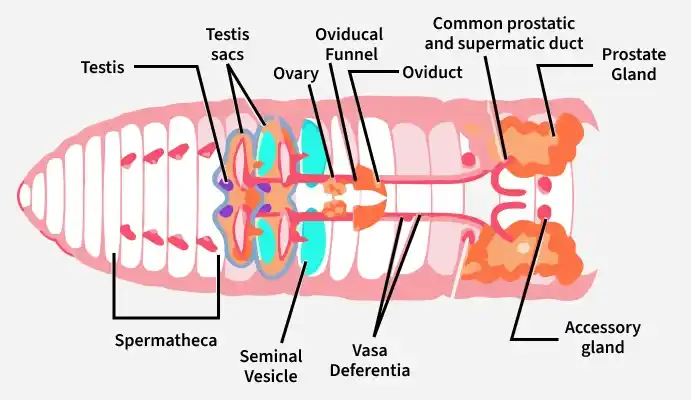
The male reproductive system is responsible for the production, storage, maturation, and transfer of sperm. The male reproductive organs are mainly situated in the anterior region of the body. The male reproductive system consists of:
- Testes: Earthworms possess two pairs of testes situated in the 10th and 11th body segments. The testes are small, whitish structures responsible for the production of sperm. The sperm produced by the testes are initially immature and require further maturation before fertilisation.
- Testis Sacs: The testes are enclosed within fluid-filled structures called testis sacs located in the 10th and 11th segments. These sacs provide protection and suitable conditions for sperm development.
- Seminal Vesicles: Earthworms possess two pairs of seminal vesicles situated in the 11th and 12th segments. These are large sac-like structures connected with the testes. Immature sperms produced in the testes pass into the seminal vesicles, where they undergo maturation and temporary storage.
- Spermiducal Funnels: A pair of ciliated funnels called spermiducal funnels is present in segments 10 and 11. These funnels collect mature sperm from the seminal vesicles. The cilia help move sperm into the vas deferens.
- Vas Deferens: The vas deferens are long, slender tubes extending posteriorly up to the 18th segment. They carry sperm from the spermiducal funnels towards the male genital pores.
- Prostate Glands: The prostate glands are large, whitish, lobulated glands extending approximately from the 16th to the 20th segment. These glands secrete a fluid that helps nourish sperm and facilitates their transfer during copulation.
- Male Genital Pores: A pair of male genital pores is located ventrally on the 18th segment. These openings serve as the exit points for sperm during mating.
Female Reproductive System of Earthworm
The female reproductive system is comparatively simpler than the male reproductive system. It is responsible for the production, storage, and release of ova or eggs. The female reproductive system includes:
- Ovaries: Earthworms possess one pair of ovaries located in the 13th segment. The ovaries are small, whitish, lobulated structures attached to the septum. The ovaries produce ova or female gametes.
- Oviducts: The oviducts are short tubes that collect ova from the ovaries and transport them to the exterior. The two oviducts join together and open outside through a single female genital pore.
- Female Genital Pore: A single female genital pore is situated ventrally on the 14th segment. It serves as the opening through which ova are released during cocoon formation.
- Spermathecae: Earthworms possess four pairs of spermathecae located between segments 5–9. These are flask-shaped sacs that store sperm received from another earthworm during copulation. The stored sperm remain viable until fertilisation occurs.
Importance of Earthworms
- Earthworms are highly beneficial organisms with immense ecological and agricultural importance.
- Earthworms convert organic matter into humus and enrich the soil.
- Burrowing activities increase aeration and water penetration.
- Earthworms are used for preparing nutrient-rich organic manure called vermicompost.
- Earthworms serve as food for fish, frogs, birds, and reptiles.
- They are used in biological and ecological studies.
