

Photorespiration is a metabolic process that occurs mainly in the green cells of plant leaves. It is considered a wasteful pathway because it competes with photosynthesis, reducing the efficiency of food production in plants. Photorespiration occurs when the concentration of carbon dioxide (CO₂) inside the leaf becomes low, and the concentration of oxygen (O₂) becomes high. Under these conditions, the enzyme RuBisCO binds with oxygen instead of carbon dioxide, leading to the process of photorespiration.
Mechanism of Photorespiration
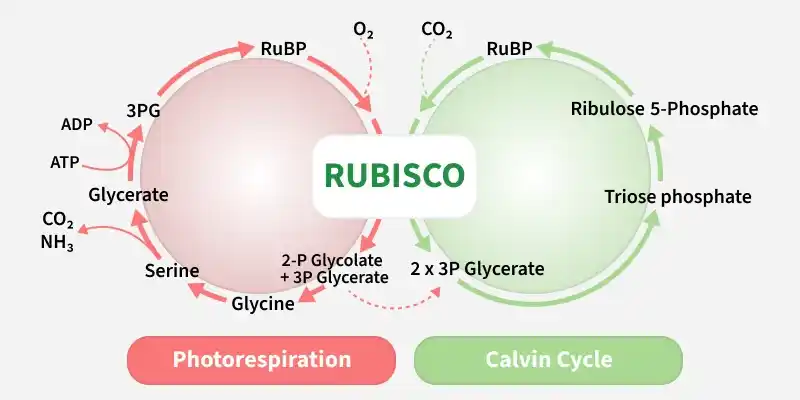
- Photorespiration begins in the chloroplast when RuBisCO binds with oxygen instead of carbon dioxide.
- Normally, RuBisCO catalyses the fixation of carbon dioxide with ribulose-1,5-bisphosphate (RuBP) during the Calvin cycle. However, under low carbon dioxide and high oxygen conditions, RuBisCO exhibits oxygenase activity.
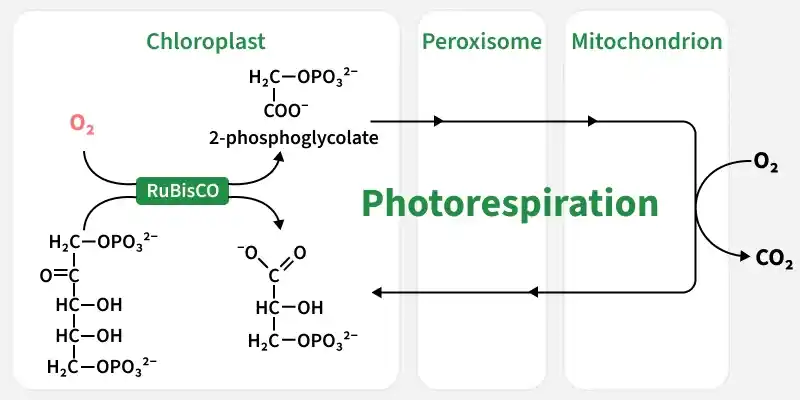
- During this reaction, oxygen combines with RuBP and produces one molecule of 3-phosphoglycerate (3-PGA) and one molecule of phosphoglycolate.
- The 3-phosphoglycerate can directly enter the Calvin cycle, but phosphoglycolate cannot participate in carbohydrate synthesis and therefore enters the photorespiratory pathway.
- The phosphoglycolate formed inside the chloroplast is converted into glycolate, which is then transported to the peroxisome. Inside the peroxisome, glycolate undergoes a series of reactions and forms glycine.
- Glycine is then transported into the mitochondria, where two molecules of glycine combine to form one molecule of serine. During this reaction, carbon dioxide and ammonia are released.
- The serine formed in the mitochondria is again transferred to the peroxisome, where it is converted into glycerate.
- Finally, glycerate returns to the chloroplast and is converted into 3-phosphoglycerate using ATP. This molecule then re-enters the Calvin cycle.

Organelles involved in Photorespiration
Three cell organelles are involved in photorespiration, those are:
- Chloroplast – The chloroplast is the site where photorespiration begins. Oxygenation of ribulose-1,5-bisphosphate by RuBisCO occurs inside the chloroplast. Glycolate is also produced here before being transported to the peroxisome.
- Peroxisome – The peroxisome plays a major role in processing glycolate and converting it into glycine through a series of enzymatic reactions.
- Mitochondria – The mitochondria participate in the conversion of glycine into serine. During this step, carbon dioxide is released, which contributes to the loss of previously fixed carbon.
Why Photorespiration is Considered a Wasteful Process
Photorespiration is generally regarded as an inefficient and wasteful process because:
- It consumes oxygen and releases carbon dioxide.
- It uses ATP during the recycling of compounds.
- It does not produce glucose or ATP.
- Previously fixed carbon dioxide is lost.
- It reduces the efficiency of photosynthesis.
- During photorespiration, a considerable amount of energy is consumed in recycling phosphoglycolate into useful intermediates.
- This energy expenditure decreases the net productivity of plants. In many crop plants, excessive photorespiration may significantly reduce growth and yield.
Factors influencing Photorespiration
- High temperature increases the oxygenase activity of RuBisCO and promotes photorespiration. Therefore, photorespiration is more common in hot climatic conditions.
- When carbon dioxide concentration inside the leaf decreases, RuBisCO becomes more likely to bind with oxygen instead of carbon dioxide.
- An increase in oxygen concentration enhances the oxygenation reaction and increases the rate of photorespiration.
- High light intensity may indirectly increase photorespiration because more oxygen is produced during photosynthesis.
- During water deficiency, stomata close to prevent water loss. This reduces the entry of carbon dioxide and favours photorespiration.
