

The nervous system is responsible for controlling and coordinating all activities of the body. It enables the body to respond quickly to internal and external stimuli. The basic functional unit of the nervous system is the neuron or nerve cell. Neurons communicate with one another through electrical and chemical signals known as nerve impulses. The process by which these impulses travel along neurons and pass from one neuron to another is called the transmission of nerve impulses.

Structure of a Neuron
A neuron consists of three main parts:
- Cell body (Cyton): The cell body, also known as the cyton or soma, contains the nucleus and cytoplasm. It controls all metabolic activities of the neuron and serves as the main centre for cellular functions. The cytoplasm contains various cell organelles such as mitochondria, ribosomes, endoplasmic reticulum, and Nissl granules, which help in protein synthesis.
- Dendrites: Dendrites are short, branched cytoplasmic extensions arising from the cell body. Their primary function is to receive nerve impulses or stimuli from receptors or neighbouring neurons and transmit them toward the cell body
- Axon: The axon is a long, slender fibre-like projection that carries nerve impulses away from the cell body toward another neuron, muscle, or gland. Some axons are covered by a fatty insulating layer known as the myelin sheath, which is formed by Schwann cells. The myelin sheath protects the axon and increases the speed of impulse conduction. Gaps present between adjacent myelin sheath segments are called Nodes of Ranvier.
Resting Membrane Potential
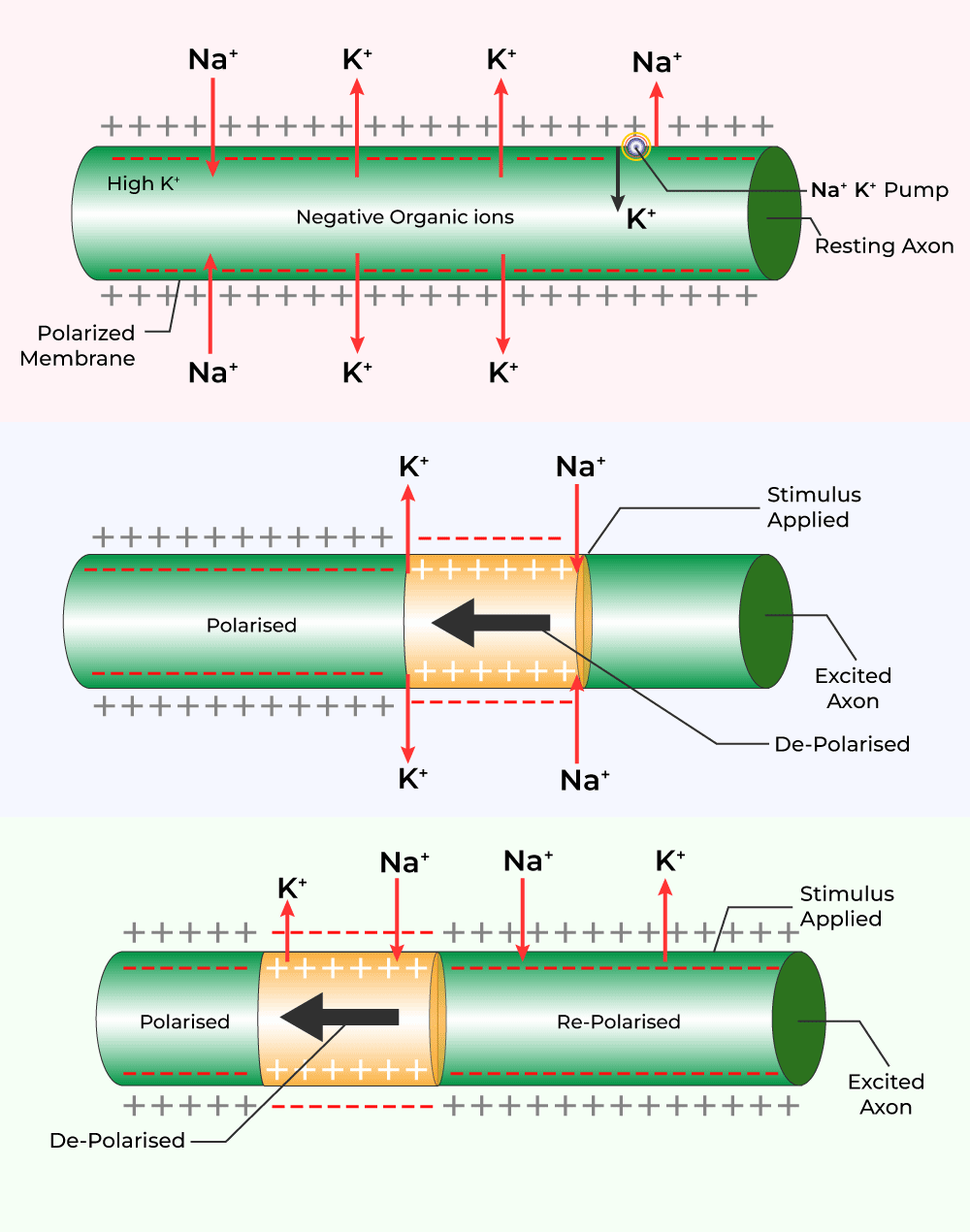
When a neuron is not transmitting an impulse, it is said to be resting. In this state, the outer surface of the neuron membrane is positively charged, while the inner surface is negatively charged. This difference in electrical charge across the membrane is called the resting membrane potential.
The resting membrane potential of a neuron is approximately −70 mV. The resting potential is maintained by:
- unequal distribution of sodium (Na⁺) and potassium (K⁺) ions,
- selective permeability of the membrane,
- sodium-potassium pumps that actively transport ions.
Generation of Nerve Impulse
When a stimulus is applied to a neuron, changes occur in the permeability of the membrane.
1. Depolarization
During stimulation:
- Sodium ion channels open.
- Na⁺ ions rapidly enter the neuron.
- The inside of the membrane becomes positively charged.
This change in polarity is called depolarisation and produces an action potential. The action potential of a neuron is approximately +30 mV. If the stimulus reaches the threshold level, the impulse is generated and travels along the axon.
2. Repolarization
After depolarisation:
- Potassium ion channels open.
- K⁺ ions move out of the neuron.
- The inside of the membrane becomes negative again.
This process is called repolarisation and restores the resting membrane potential.
3. Hyperpolarization
Sometimes, more potassium ions leave the neuron than necessary during repolarization. This makes the inside of the membrane temporarily more negative than the normal resting potential. This condition is known as hyperpolarization. After a short period, the sodium-potassium pump restores the normal resting membrane potential.
Transmission Across a Synapse
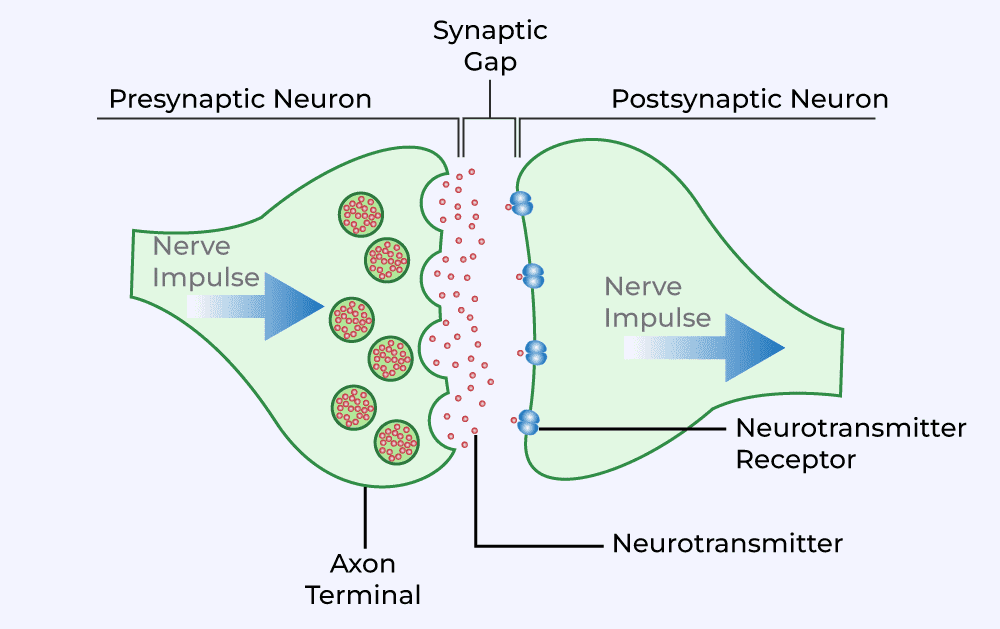
The junction between two neurons is called a synapse. The transmission of impulses across a synapse is usually chemical in nature.
Steps in Synaptic Transmission
- Arrival of Impulse: When the nerve impulse reaches the axon terminal, it stimulates synaptic vesicles.
- Release of Neurotransmitters: Synaptic vesicles release chemical substances called neurotransmitters into the synaptic cleft. Common neurotransmitters include acetylcholine and dopamine.
- Binding to Receptors: The neurotransmitters bind to specific receptors on the membrane of the next neuron.
- Generation of New Impulse: This binding opens ion channels and may generate a new nerve impulse in the receiving neuron.
- Removal of Neurotransmitters: Neurotransmitters are quickly broken down or reabsorbed to stop continuous stimulation.
Importance of Nerve Impulse Transmission
- Transmission of nerve impulses is essential for the proper functioning and coordination of the body.
- It helps in sensory perception by carrying signals from sensory organs to the brain, allowing the body to detect stimuli such as light, sound, touch, pain, and temperature.
- It also controls muscle contraction by transmitting impulses from the brain and spinal cord to muscles, enabling movement and physical activities.
- Nerve impulse transmission plays an important role in reflex actions, which provide quick and automatic responses to harmful stimuli and protect the body from injury.
- It also helps maintain coordination, balance, posture, learning, memory, and thinking by ensuring proper communication between different parts of the nervous system.
- In addition, nerve impulses regulate important body functions such as heartbeat, breathing, digestion, and glandular secretion, thereby helping maintain normal physiological activities and homeostasis.
