

Leadership style refers to the pattern of behaviour adopted by a leader while directing, motivating and supervising subordinates. It determines how decisions are made, how authority is exercised and how employees are involved in organisational activities. Different leadership styles suit different organisational situations, employee capabilities and environmental conditions. Among the various styles of leadership, Authoritative, Democratic and Laissez Faire are widely discussed in management studies.
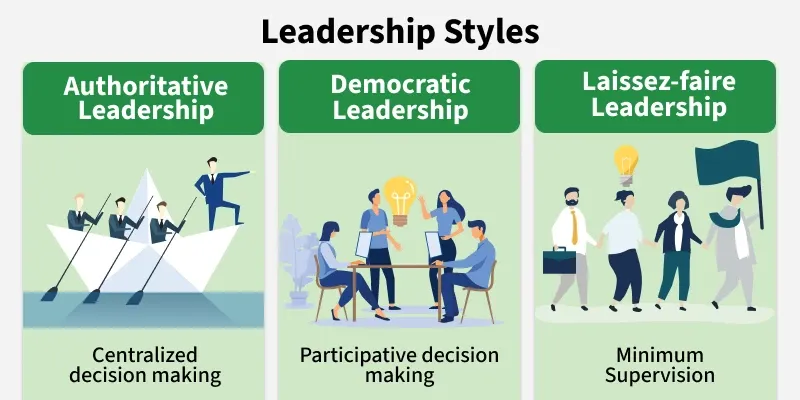
Authoritative Style
The authoritative style of leadership, also known as autocratic leadership, is marked by complete control and centralised decision making in the hands of the leader. In this style, the leader takes all decisions independently and expects subordinates to follow instructions without questioning. The leader exercises complete control over the group and maintains strict supervision. This style is useful in emergency situations where quick decisions are required, but it may lower employee morale and creativity.
Key characteristics:
- Centralised authority and decision making
- Clear instructions and strict supervision
- One way communication
- Emphasis on discipline and control
However, the excessive or prolonged use of this style may lead to negative outcomes. Since employees have little or no participation in decision making, their initiative and creativity may be suppressed. Over time, this can result in low morale, dissatisfaction and reduced motivation. Therefore, while authoritative leadership is effective in specific situations, it should be applied carefully and balanced with other leadership styles to maintain employee engagement and long term organisational effectiveness.
Democratic Style
The democratic style of leadership is based on participation, consultation and shared decision making. The leader encourages employees to share their ideas and opinions before taking important decisions. Although the final decision is taken by the leader, employees actively participate in the process, creating a sense of involvement and belonging.
This style is effective in organisations where teamwork, creativity and innovation are important. Employees feel valued, which improves motivation, morale and job satisfaction.
Key characteristics:
- Participative decision making
- Open communication
- Teamwork and cooperation
- Encourages creativity and initiative
However, this style may be time consuming and less effective when quick decisions are needed or when employees lack experience.
Laissez-Faire Style
The laissez-faire style of leadership involves minimum supervision and maximum freedom for employees. The leader provides guidance and resources but allows employees to work independently and make decisions on their own.
This style works best when employees are skilled, experienced and self motivated. It promotes creativity, innovation and independent thinking.
Key characteristics:
- Minimum supervision
- Employee autonomy
- Delegation of authority
- Encourages independence and creativity
However, lack of proper guidance may lead to confusion, poor coordination and low productivity if employees are not responsible or experienced.
Authoritative V/S Democratic V/S Laissez Faire Style of Leadership
| Basis | Authoritative Leadership | Democratic Leadership | Laissez Faire Leadership |
|---|---|---|---|
| Decision making | Centralised with the leader | Shared with employees | Delegated to employees |
| Control | High level of control | Moderate control | Very little control |
| Employee participation | Very low | High | Very high |
| Communication | One way, top to bottom | Two way communication | Minimal communication |
| Supervision | Strict supervision | Balanced supervision | Little or no supervision |
| Suitable for | Emergencies, unskilled workers | Skilled and cooperative teams | Highly skilled and self motivated employees |
| Impact on morale | Often low | Generally high | Depends on employee capability |
