

Robert J. House developed the Path–Goal Theory of Leadership, which explains that leaders motivate employees by clearly showing the path to achieving goals and rewards. The theory states that employees perform better when they understand their tasks, believe their efforts will lead to good performance, and expect valuable rewards in return. Leaders must adapt their behaviour to the needs of employees and work situations by providing guidance, support, motivation, and removing obstacles. In simple terms, the theory views the leader as a facilitator who helps employees achieve goals more easily, leading to higher motivation, satisfaction, and organisational performance.
Originator of the Theory
House’s Path–Goal Theory of Leadership was proposed by Robert J. House, an American leadership scholar, in the early 1970s. He developed this theory to explain how leadership behaviour influences employee motivation, satisfaction, and performance. House aimed to bridge the gap between leadership theories and motivation theories by showing how leaders can directly affect the effort and goal attainment of subordinates.
The theory is strongly influenced by Expectancy Theory of motivation, which suggests that individuals are motivated when they believe that their effort will lead to good performance and that performance will result in valued rewards. House applied this concept to leadership by emphasizing the role of leaders in clarifying expectations, reducing obstacles, and linking rewards to performance.
Through this contribution, Robert J. House highlighted that effective leadership is situational and dynamic. His work shifted the focus from fixed leadership traits to flexible leadership behaviours that adapt to the needs of employees and the work environment.
Core Assumptions of Path–Goal Theory
The Path–Goal Theory is based on the assumption that employees are motivated when leaders help them understand the connection between their efforts, performance, and rewards. It assumes that leaders can positively influence employee behaviour by selecting leadership styles that suit the needs of subordinates and the work situation.
The main assumptions of Path–Goal Theory are as follows:
- Employees are motivated when they clearly know what is expected from them
- Performance improves when goals are well defined and achievable
- Motivation increases when rewards are directly linked to performance
- Leaders can enhance employee satisfaction by removing obstacles in the work path
- No single leadership style is effective in all situations
- Leadership effectiveness depends on subordinate characteristics and task environment
Thus, the theory assumes that leaders act as facilitators who guide employees toward goal achievement by providing direction, support, and motivation according to situational requirements.
Leadership Styles under Path–Goal Theory
Path–Goal Theory identifies four distinct leadership styles that leaders can adopt depending on the needs of subordinates and the work situation. The effectiveness of each style depends on how well it helps employees achieve their goals. The leadership styles are explained below:
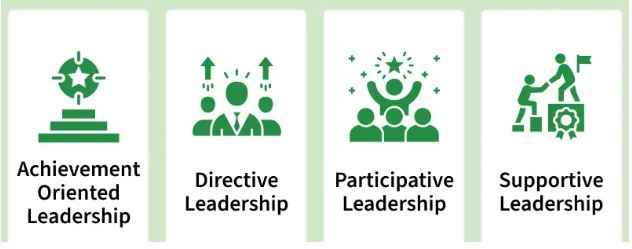
Achievement-Oriented Leadership: Achievement-oriented leadership focuses on setting challenging goals and maintaining high performance standards. Leaders encourage excellence, show confidence in employees’ abilities, and motivate them to achieve difficult objectives. This style is most effective when employees are skilled, motivated, and willing to take responsibility. It promotes continuous improvement, personal growth, higher productivity, and strong performance, especially in competitive and dynamic work environments.
Directive Leadership: Directive leadership is a style in which the leader gives clear instructions, defines roles, and explains what tasks must be done, how they should be completed, and the standards to be followed. This approach is most effective when tasks are complex or unclear and when employees lack experience or guidance. By providing structured directions and procedures, directive leadership reduces confusion, improves efficiency, and helps employees achieve organisational goals. However, overuse of this style may limit creativity and initiative among highly skilled employees.
Supportive Leadership: Supportive leadership focuses on employees’ well-being, satisfaction, and positive work relationships. The leader is friendly, approachable, and considerate, providing emotional support and showing concern for employees’ needs and problems. This style is most effective in stressful or repetitive work environments, as it helps reduce tension, improve morale and motivation, and build trust between leaders and subordinates, leading to higher job satisfaction and lower absenteeism.
Participative Leadership: Participative leadership is a style in which leaders involve employees in decision making and encourage them to share ideas, opinions, and suggestions. The leader consults subordinates before making important decisions and values their contributions, while retaining final authority. This style works best when employees are experienced and capable of contributing effectively. Participative leadership increases involvement, motivation, commitment, and acceptance of decisions, while also improving decision quality through collective thinking.
Evaluation of House's Path-goal Theory
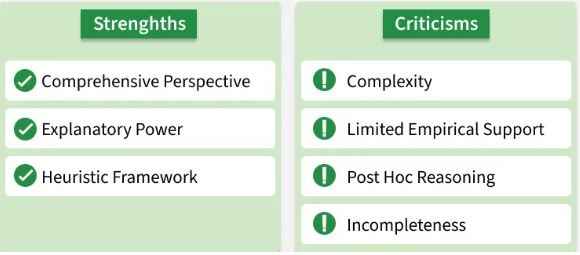
The path-goal model of leadership offers several strengths but has also faced criticisms:
Strengths:
Comprehensive Perspective: Unlike Fiedler's contingency model, the path-goal model considers both the personality characteristics of subordinates and situational variables. This holistic approach provides a more thorough understanding of leadership effectiveness and explains the reasons behind the effectiveness of different leadership styles in specific situations.
Explanatory Power: The model not only suggests which leadership styles may be effective in certain circumstances but also offers insights into the mechanisms through which leaders influence subordinates' perceptions and motivations. It provides a framework for understanding how leaders can enhance performance and goal attainment through their behaviours.
Heuristic Framework: For researchers new to the field of leadership effectiveness, the path-goal model serves as a valuable starting point. It provides a structured framework that guides investigations into the interactions between leader behaviours, situational variables, and subordinate characteristics.
Criticisms:
Complexity: The path-goal model is intricate, making empirical testing challenging due to its methodological complexities. Researchers need to carefully design and implement studies to address the multifaceted nature of the model, which can be demanding.
Limited Empirical Support: Although the path-goal model has potential, it is still in the early stages of development. There is a scarcity of research supporting its propositions, and some studies even present findings that contradict its predictions. This indicates the need for further refinement and more extensive investigation.
Post hoc Reasoning: Critics argue that the path-goal model exhibits post hoc reasoning, as some of the research evidence used to support it was also used in its construction. This raises concerns about circular reasoning and potential biases in interpreting findings.
Incompleteness: The path-goal theory provides only a tentative explanation of leadership styles and has been criticized for neglecting the effects of personal traits that may constrain leader behaviour selection. It also lacks a comprehensive explanation of how leader behaviours impact subordinate satisfaction. Additionally, the model assumes that leaders can adapt their behaviours to suit various situations without fully considering other factors such as subordinate expectations and behaviour.
