

Business is an economic activity that involves the production, purchase, sale, or exchange of goods and services with the primary objective of earning profit while satisfying the needs and wants of society. Business activities are carried out regularly and involve an element of risk.
Broadly, business activities are classified into two categories: industry and commerce.
Economic and Non-Economic Activities
Every individual has different needs and wants. To satisfy these needs, people perform various activities.
These activities are broadly classified into
Economic Activities: Activities undertaken with the primary objective of earning income, profit, or livelihood. They involve the production, purchase, sale, or exchange of goods and services and are measured in monetary terms. Examples include running a business, working for a salary, or providing professional services.
Non-Economic Activities: Activities performed without the intention of earning money. They are carried out for personal satisfaction, love, affection, social service, or religious purposes. These activities are not measured in monetary terms. Examples include helping a friend, caring for family members, donating to charity, and volunteering for social causes.
Characteristics of Business
1. Economic Activity: Business is an economic activity because it is carried out to earn income or profit. It involves producing, buying, selling, or exchanging goods and services for monetary gain.
2. Production or Exchange of Goods and Services: Every business involves the production, purchase, sale, or exchange of goods and services. These activities are performed to satisfy the needs and wants of customers.
3. Profit Motive: The main objective of every business is to earn profit. Profit ensures the survival, growth, and expansion of the business.
4. Risk and Uncertainty: Business involves risk and uncertainty because future profits cannot be guaranteed. Losses may occur due to changes in market conditions, competition, or other unforeseen factors.
5. Regular Activity: Business is a continuous and regular activity carried out repeatedly over time. A one-time sale or purchase is not considered a business.
6. Customer Satisfaction: A business aims to satisfy customers by providing quality goods and services at reasonable prices. Customer satisfaction helps build loyalty and ensures long-term success
Objectives of Business
1.Profit Earning: Profit is the excess of revenue over expenditure and is the primary objective of every business. It ensures the survival, growth, and expansion of the business and provides a reward for the risks undertaken.
2. Innovation: Innovation means introducing new products, improving existing products, or adopting better production and distribution methods. It helps a business remain competitive and meet changing customer needs.
3. Market Standing: Market standing refers to the position and reputation of a business in the market. It can be achieved by providing quality goods and services, ensuring customer satisfaction, and building goodwill.
4. Productivity or Optimum Utilisation of Resources: A business should use its resources, such as labour, capital, machinery, and raw materials, efficiently to achieve maximum output with minimum waste. This increases productivity and reduces costs.
5. Physical and Financial Resources: A business aims to acquire and use adequate physical resources (land, buildings, machinery, equipment) and financial resources (capital and funds) for smooth and efficient operations
6.Quality Goods and Services at Fair Prices: A business should provide safe, high-quality goods and services at reasonable prices to ensure customer satisfaction and protect consumer interests.
7. Social Responsibility: A business has a responsibility towards society and the environment. It should operate ethically, protect the environment, generate employment, and contribute to the welfare of the community.
8. Workers' Development: Employees are valuable assets of a business. Therefore, businesses should provide fair wages, equal opportunities, training, safe working conditions, and welfare facilities to promote their development
Classification of Business Activities
Business activities are broadly classified into two categories: Industry and Commerce.
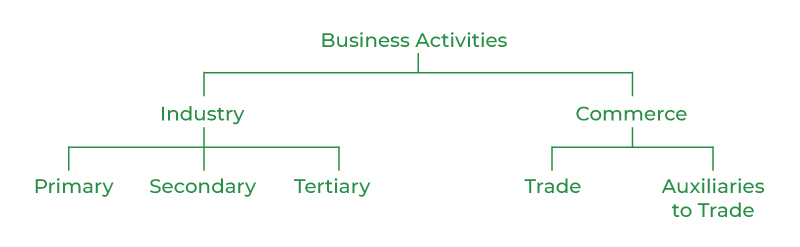
1. Industry
It refers to the economic activity involved in the production, processing, extraction, or construction of goods. It converts raw materials into finished goods and creates utility by making products available for use.
Types of Industry
(a) Primary Industry: Primary industries are engaged in the extraction and collection of natural resources directly from nature.
Examples: Agriculture, fishing, mining, forestry.
(b) Secondary Industry: Secondary industries process raw materials into finished or semi-finished goods.
It is further divided into:
- Manufacturing Industry: Converts raw materials into finished products (e.g., textile, automobile, cement industries).
- Construction Industry: Involves the construction of buildings, roads, bridges, dams, etc.
(c) Tertiary Industry: Tertiary industries provide services that support primary and secondary industries and help consumers.
Examples: Banking, insurance, transportation, communication, warehousing.
2. Commerce
Commerce includes all activities involved in the distribution of goods and services from producers to consumers. It removes the barriers of trade and facilitates smooth exchange.
Commerce consists of Trade and Auxiliaries to Trade.
(a) Trade: Trade refers to the buying and selling of goods and services.
Types of Trade:
- Internal (Home) Trade: Buying and selling within the same country.
- External (Foreign) Trade: Buying and selling between different countries (Import, Export, and Entrepot Trade).
(b) Auxiliaries to Trade: Auxiliaries to trade are services that assist and support trade by removing obstacles in the distribution process.
