Nomenclature of coordination compounds refers to the systematic naming of coordination compounds according to the rules recommended by IUPAC (International Union of Pure and Applied Chemistry). Since coordination compounds contain different types of ligands, metal ions and coordination spheres, a proper naming system is necessary to avoid confusion and represent their composition clearly.
Basic Terms Used in Nomenclature of Coordination Compounds
Before naming coordination compounds, it is important to understand some basic terms used in coordination chemistry.
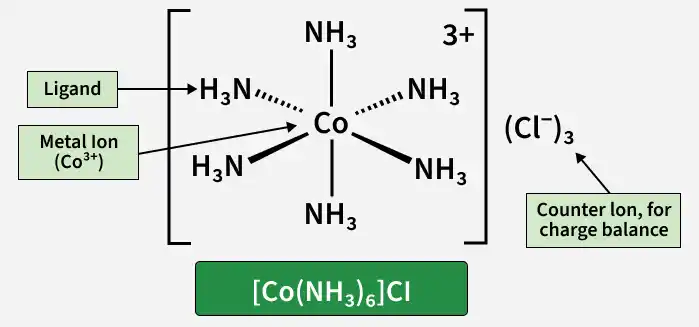
1. Ligand: A ligand is an ion or molecule that donates one or more pairs of electrons to the central metal atom or ion and forms coordinate bonds. Ligands may be neutral molecules or negatively charged ions.
Examples: NH3 (ammine), H2O (aqua), Cl - (chloro), CN - (cyano)
2. Central Metal Atom: The central metal atom or ion is the metal present at the centre of the coordination compound to which ligands are attached through coordinate bonds.
Examples: Co in [Co(NH3)6]Cl3 , Fe in K4[Fe(CN)6]
3. Coordination Sphere: The coordination sphere includes the central metal atom or ion along with the ligands directly attached to it. It is written inside square brackets.
Example: [Co(NH3)6]3+
4. Coordination Number: The coordination number is the total number of ligand donor atoms directly bonded to the central metal atom or ion.
Example: [Co(NH3)6]Cl3
Coordination number of cobalt = 6
5. Oxidation Number: The oxidation number of the central metal atom is the charge present on the metal ion after considering the charges of ligands and the overall charge of the complex.
Example: [Fe(CN)6] 4−
Oxidation number of Fe = +2
Rules for Naming Coordination Compounds
The nomenclature of coordination compounds is based on the rules recommended by IUPAC. The names of ligands, central metal atom and oxidation state are written in a systematic order.
1. Name the Cation First
In a coordination compound, the positive ion (cation) is named first, followed by the negative ion (anion).
Example: K3[Fe(CN)6]
Name: Potassium hexacyanoferrate(III)
2. Name Ligands Before the Metal
The names of ligands are written before the name of the central metal atom or ion.
Example: [Co(NH3)6]Cl3
Here, ammine is written before cobalt.
3. Naming of Negative Ligands
Negative ligands usually end with the letter “o”.
| Ligand | Name |
|---|---|
| Cl⁻ | chloro |
| CN⁻ | cyano |
| OH⁻ | hydroxo |
| NO2⁻ | nitro |
4. Naming of Neutral Ligands
Neutral ligands are generally named as the molecule itself, except for a few special names.
| Ligand | Name |
|---|---|
| NH3 | ammine |
| H2O | aqua |
| CO | carbonyl |
| NO | nitrosyl |
5. Prefixes for Number of Ligands
Prefixes are used to indicate the number of ligands attached to the central metal atom. For complex ligands, prefixes such as bis, tris and tetrakis are used.
| Number | Prefix |
|---|---|
| 2 | di |
| 3 | tri |
| 4 | tetra |
| 5 | penta |
| 6 | hexa |
6. Naming the Metal Atom
- If the complex ion is positively charged or neutral, the metal name remains unchanged.
Examples: cobalt, nickel, platinum
- If the complex ion is negatively charged, the metal name ends with “-ate”.
Examples: (Fe) ferrate, (Cu) cuprate
7. Oxidation State of the Metal
The oxidation state of the central metal atom is written in Roman numerals within brackets after the metal name.
Example: [Fe(CN)6] 4−
Name: Hexacyanoferrate(II)
8. Arrangement of Ligand Names
Ligand names are written in alphabetical order before the name of the metal atom, irrespective of their charge.
Example: [Co(NH3 )4Cl2]+
Name: Tetraamminedichlorocobalt(III)
Examples of Coordination Compounds
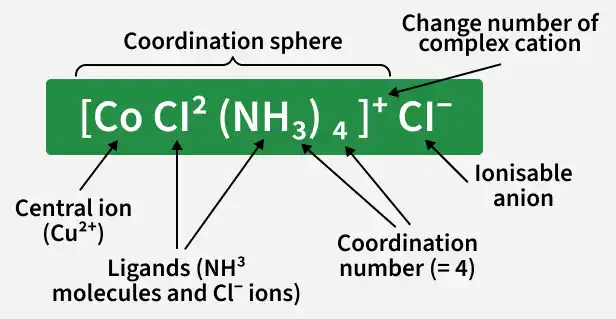
The labelled coordination compound below shows the central metal ion, ligands, coordination sphere, coordination number and ionisable ions involved in the nomenclature of coordination compounds.
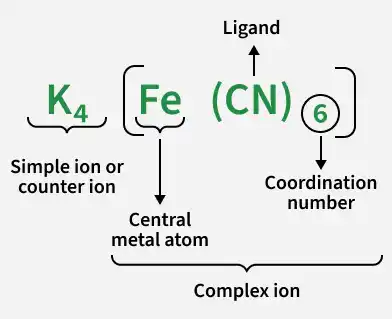
1. Potassium Hexacyanoferrate(II)
- In potassium hexacyanoferrate(II), Fe²⁺ acts as the central metal ion and six cyanide ligands form the coordination sphere around the metal atom.
- The complex ion carries a negative charge and four potassium ions act as counter ions.
2. Tetraaquadichlorochromium(III) Chloride
In tetraaquadichlorochromium(III) chloride, chromium acts as the central metal ion and is surrounded by four aqua ligands and two chloro ligands inside the coordination sphere, while one chloride ion remains outside as the ionisable anion.