

Computer memory is used to store data and instructions required for a computer to function. RAM and ROM are two important types of primary memory, each serving a different purpose in data storage and system operation.
- RAM (Random Access Memory) is temporary memory used to store data currently being processed by the CPU.
- ROM (Read Only Memory) is permanent memory that stores firmware and system instructions even when the power is turned off.
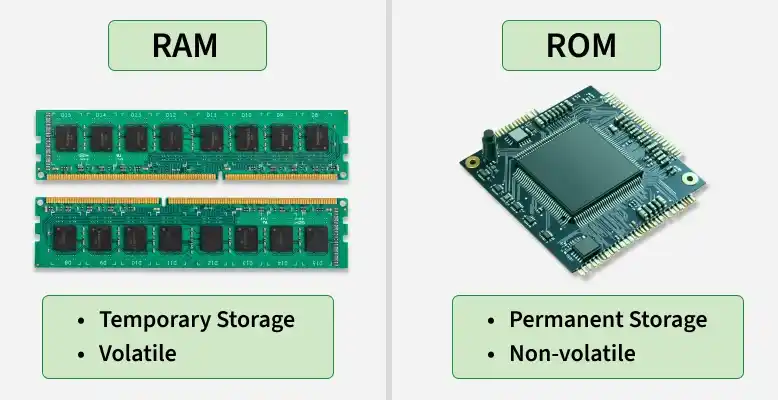
The table below shows the major differences between RAM and ROM:
| RAM | ROM |
|---|---|
| Data is lost when the power is turned off. | Data is retained when the power is turned off. |
| Supports both read and write operations. | Primarily used for reading stored data. |
| Provides faster access to data. | Generally provides slower access than RAM. |
| Stores programs and data currently being used or processed by the CPU. | Stores firmware and boot instructions. |
| Common types include SRAM and DRAM. | Common types include PROM, EPROM, EEPROM, and Mask ROM. |
| Used as the main working memory of a computer. | Used to store essential system instructions. |
| Examples: SRAM, DRAM, DDR4, DDR5 | Examples: PROM, EPROM, EEPROM, Mask ROM |
Choosing Between RAM and ROM
RAM and ROM serve different purposes in a computer system:
RAM is preferred when:
- Temporary storage of data and instructions is required.
- Fast read and write operations are needed.
- Applications need working memory during execution.
- Improving system performance and multitasking is important.
ROM is preferred when:
- Permanent storage of instructions is required.
- Data must be retained after the system is powered off.
- Firmware or boot instructions need to be stored.
- Essential instructions are required to initialize and operate hardware.
