

Region Proposal Network (RPN) is a deep learning component used in object detection models to identify potential object locations within an image. It generates candidate regions and shares features with the detection network, improving the efficiency of the detection process.
- Generates Regions of Interest (RoIs) by proposing candidate bounding boxes for possible objects.
- Replaces traditional region proposal methods like Selective Search with a faster and more efficient learning-based approach.
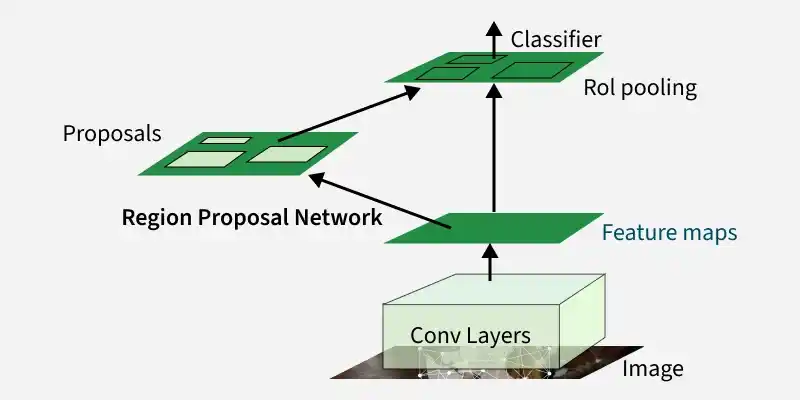
Working
1. Feature Map Extraction: The input image is passed through convolutional layers to generate a feature map. These feature maps contain high-level visual information that is used for region proposal generation.
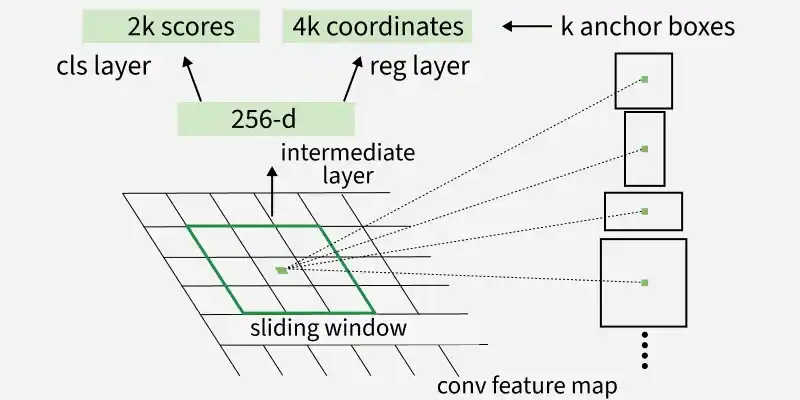
2. Anchor Box Generation: At each location of the feature map, multiple anchor boxes with different scales and aspect ratios are placed.
- Each anchor acts as a candidate object region.
- Multiple anchors allow detection of objects of different sizes and shapes.
- Every anchor is classified as either foreground (object) or background.
3. Anchor Classification using IoU: The overlap between an anchor box and the ground-truth box is measured using Intersection over Union (IoU).
- Anchors with high IoU are labeled as foreground.
- Anchors with low IoU are labeled as background.
4. Bounding Box Regression: For anchors classified as foreground, RPN predicts offsets to refine the anchor position and size, producing more accurate bounding boxes.
5. Region Proposal Generation: The refined foreground anchors are selected as Regions of Interest (RoIs) and passed to the object detection network for final classification and localization.
Implementation
Step 1: Load the Pre-trained Backbone Network
Load the pre-trained model and clone the required convolutional and fully connected layers.
base_model = load_model(cfg['BASE_MODEL_PATH'])

conv_layers = clone_conv_layers(base_model, cfg)

fc_layers = clone_model(
    base_model,
    [cfg["MODEL"].POOL_NODE_NAME],
    [cfg["MODEL"].LAST_HIDDEN_NODE_NAME],
    clone_method=CloneMethod.clone
)
Step 2: Extract Feature Maps
Normalize the input image and generate feature maps using the convolutional layers.
feat_norm = features - Constant(
    [[[v]] for v in cfg["MODEL"].IMG_PAD_COLOR]
)

conv_out = conv_layers(feat_norm)
Step 3: Generate Region Proposals Using RPN
Use the feature maps to generate Region of Interests (RoIs) and compute RPN losses.
rpn_rois, rpn_losses = create_rpn(
    conv_out,
    scaled_gt_boxes,
    dims_input,
    cfg
)
Step 4: Create Proposal Targets
Generate training targets for object classification and bounding box regression.
rois, label_targets, \
bbox_targets, bbox_inside_weights = \
create_proposal_target_layer(
    rpn_rois,
    scaled_gt_boxes,
    cfg
)
Step 5: Perform Object Detection
Pass the proposed regions through the Fast R-CNN detection head.
cls_score, bbox_pred = create_fast_rcnn_predictor(
    conv_out,
    rois,
    fc_layers,
    cfg
)
Step 6: Compute Loss and Prediction Error
Calculate the final training loss and classification error.
detection_losses = create_detection_losses(...)

loss = rpn_losses + detection_losses

pred_error = classification_error(
    cls_score,
    label_targets,
    axis=1
)
Intersection-Over-Union (IoU)
Intersection over Union (IoU) is a metric used by the Region Proposal Network (RPN) to measure how closely an anchor box matches a ground-truth bounding box. It is widely used to evaluate the quality of region proposals and assign training labels to anchors.
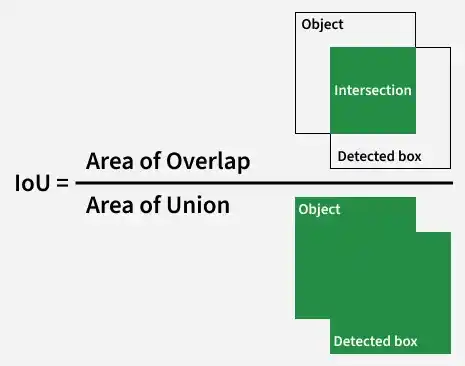
- Computed as the ratio of the overlapping area to the combined area of the two bounding boxes.
- Anchors with IoU greater than 0.7 are typically treated as foreground samples during training.
- Helps the RPN identify proposals that are most likely to contain objects.
Note: The RPN classifier only predicts whether a region is foreground or background. Object categories are determined later by the detection network.
Bounding Box Regression
Bounding box regression refines the position and size of anchor boxes by predicting adjustments to their center coordinates, width, and height. These adjustments help the proposed regions align more accurately with the objects in the image.
- Predicts offsets for anchor box coordinates to improve localization accuracy.
- Works together with classification to generate high-quality region proposals.
Where:
i is the index of an anchor.p_i is the predicted probability of an anchor containing an object.p_i^{*} is the ground-truth label.t_i represents the predicted bounding box coordinates.t_i^{*} represents the target bounding box coordinates.N_{cls} andN_{reg} are normalization factors.
The predicted offsets are applied to foreground anchors to obtain refined Regions of Interest (RoIs), which are then passed to the object detection stage for final classification and localization.
Advantages
- Generates region proposals significantly faster than traditional methods such as Selective Search.
- Shares convolutional features with the detection network, reducing computational overhead.
- Produces high-quality proposals that improve overall object detection accuracy.
Limitations
- Performance depends on the quality and configuration of anchor boxes.
- May struggle to accurately detect extremely small or densely packed objects.
- Requires substantial computational resources and training data for optimal performance.
