

Cybersecurity incident management is a structured process used to identify, analyze, contain, eradicate, and recover from security incidents while minimizing business impact. A mature incident management strategy helps organizations protect sensitive data, maintain operations, reduce downtime, and meet compliance requirements.
- Detecting suspicious activities.
- Investigating security alerts.
- Containing malicious actions.
- Removing threats from the environment.
- Restoring affected systems.
- Documenting lessons learned.
Incident Management Process in Cyber Security
Incident management follows a structured methodology. Each phase contributes to effective handling of security events.
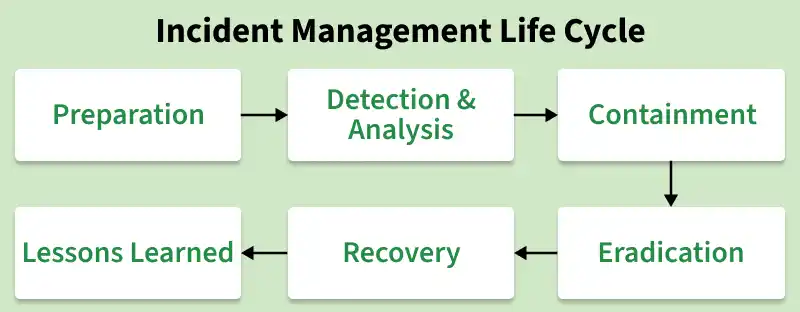
1. Preparation
Preparation is the foundation of successful incident management. Poor preparation often results in delayed response and confusion during an actual attack. Organizations should establish Incident response policies, Security procedures, Communication plans, Response playbooks, Backup strategies, Monitoring capabilities. Preparation also includes:
- Employee security awareness training.
- Tabletop exercises.
- Incident simulation drills.
- Team readiness assessments.
2. Detection and Analysis
The detection phase focuses on recognizing suspicious behavior or security anomalies. Common detection sources include SIEM alerts, Endpoint Detection and Response tools, Intrusion Detection Systems, Firewall logs, Threat intelligence feeds, User reports. Security teams analyze indicators to determine whether an event qualifies as a genuine incident. Accurate identification prevents false positives and ensures resources are used efficiently. Typical indicators include:
- Failed login spikes.
- Unusual outbound traffic.
- Privilege escalation.
- Unauthorized file changes.
- Malware execution alerts.
3. Containment
Once an incident is confirmed, organizations must limit its spread. Containment strategies vary depending on the attack type. Containment generally occurs in two stages:
- Short-Term Containment: Immediate actions taken to stop ongoing damage.
- Long-Term Containment: Temporary fixes implemented while eradication activities continue. Rapid containment significantly reduces business impact.
- Examples: Disconnect compromised hosts, Block malicious, IP addresses, Disable affected accounts, Restrict network communication, Isolate infected systems.
4. Eradication
Eradication focuses on removing the root cause of the incident. The goal is complete elimination of malicious components from the environment. Incomplete eradication may allow attackers to regain access. Security teams may:
- Delete malware.
- Remove unauthorized accounts.
- Patch exploited vulnerabilities.
- Close exposed ports.
- Reconfigure security settings.
5. Recovery
Recovery restores systems to normal operation. Organizations should verify that systems operate securely before returning them to production. Continuous monitoring after recovery helps detect residual compromise. Recovery activities include:
- Rebuilding affected servers.
- Restoring backups.
- Reconnecting systems.
- Validating functionality.
- Monitoring for recurring threats.
6. Lessons Learned
The final stage examines the incident to improve future response capability. Lessons learned transform incidents into opportunities for security improvement. Post-incident analysis typically covers Timeline reconstruction, Root cause analysis, Response effectiveness, Control failures. Organizations often update:
- Security policies.
- Playbooks.
- Detection rules.
- Training programs.
Types of Security Incidents
Cybersecurity incidents can appear in multiple forms.
- Malware Infection: Malicious software infiltrates systems and performs unauthorized actions.
- Phishing Attacks: Attackers trick users into revealing credentials, financial details, or sensitive information through deceptive emails or fake websites.
- Denial-of-Service (DoS) Attacks: Attackers overwhelm systems or services, making them unavailable to legitimate users.
- Data Breaches: Sensitive information is exposed, stolen, or leaked.
- Insider Threats: Employees, contractors, or trusted users intentionally or accidentally compromise organizational security.
Roles and Responsibilities in Incident Management
Effective incident management requires collaboration across multiple teams.
- Incident Response Team: Responsible for Investigation, Containment, Threat analysis, Technical remediation
- Security Analysts: Monitor alerts and analyze suspicious activity.
- IT Operations Team: Supports system restoration and infrastructure management.
- Management Leadership: Makes business decisions during major incidents. Responsibilities may include Risk assessment, Communication approval, Resource allocation.
- Legal and Compliance Teams: Handle regulatory reporting, contractual obligations, and legal considerations.
- Public Relations Team: Manages external communication and reputation during public incidents.
Tools Used in Incident Management
Organizations rely on specialized security technologies.
- SIEM Solutions: Security Information and Event Management platforms collect and correlate logs. Popular functions include Event monitoring, Threat detection, Alert generation, Incident investigation.
- EDR Tools: Endpoint Detection and Response solutions monitor endpoint behavior and support rapid containment.
- IDS and IPS: Intrusion Detection and Prevention Systems identify malicious network activity.
- Threat Intelligence Platforms: Provide indicators of compromise and attacker intelligence.
- Ticketing and Case Management Systems: Help teams track investigation workflows, evidence, and response tasks.
Importance of Incident Management in Cyber Security
Modern cyber threats evolve rapidly. Attackers continuously develop new techniques to bypass traditional defenses. A firewall or antivirus alone cannot guarantee security. Effective incident management provides several benefits.
- Reduces Security Impact: Quick detection and response reduce the amount of damage caused by an attack. For example, isolating an infected device early can stop malware from spreading across an enterprise network.
- Minimizes Downtime: Business continuity depends on system availability. Structured incident handling helps organizations restore services faster and maintain operational stability.
- Protects Sensitive Data: Rapid incident response lowers the risk of data exposure. Organizations store valuable information including Customer records, Financial data, Intellectual property, Employee information.
- Supports Regulatory Compliance: Many security frameworks require formal incident management procedures. Failure to manage incidents properly may lead to compliance violations. Examples include ISO 27001, PCI DSS, HIPAA, GDPR, NIST Cybersecurity Framework
- Improves Security Posture: Each incident investigation provides insights into security weaknesses, helping organizations strengthen defenses.
Real-World Incident Example: WannaCry Ransomware Attack
One of the most significant cybersecurity incidents was the WannaCry ransomware outbreak in 2017. WannaCry exploited a vulnerability in Microsoft Windows systems. The malware rapidly spread across global networks. The incident highlighted several lessons related to incident management. Organizations affected included: Healthcare institutions, Telecommunications providers Government entities, Private enterprises. Consequences included:
- System encryption.
- Service disruption.
- Operational downtime.
- Financial losses
Challenges in Cyber Security Incident Management
Even mature organizations face incident management difficulties.
- Alert Fatigue: Security teams often process thousands of alerts daily. Excessive noise increases analyst workload.
- Limited Visibility: Incomplete logging or monitoring creates investigation blind spots.
- Skill Shortages: Cybersecurity talent shortages affect incident response capability.
- Advanced Threat Actors: Sophisticated attackers use stealth techniques to evade detection.
- Complex Infrastructure: Cloud, hybrid, remote work, and distributed systems increase response complexity.
Best Practices for Effective Incident Management
Organizations can improve response readiness through proven practices.
- Develop an Incident Response Plan: Documented procedures ensure consistent handling during security events.
- Conduct Regular Training: Train employees and response teams continuously.
- Use Automation Wisely: Automated workflows can accelerate detection and containment.
- Maintain Updated Backups: Reliable backups support recovery during ransomware incidents.
- Perform Threat Hunting: Proactive investigations uncover hidden threats before they escalate.
- Review and Improve Continuously: Incident management should evolve alongside emerging threats.
