Given three arrays height[], width[], and length[] of size n, where height[i], width[i], and length[i] represent the dimensions of the ith box, find the maximum possible height of a stack formed using these boxes.
A box can be rotated so that any of its dimensions becomes its height.
A box can be placed on top of another only if both dimensions of its base are strictly smaller than those of the box below.
Multiple instances of the same box can be used.
Example:
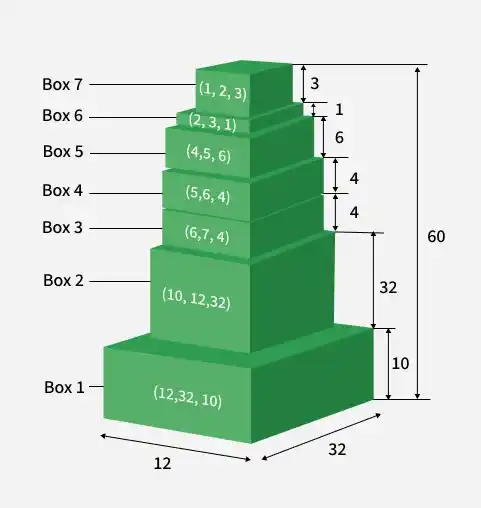
Input: height[] = [4, 1, 4, 10], width[] = [6, 2, 5, 12], length[] = [7, 3, 6, 32] Output: 60 Explanation: Note that there can be multiple instances of boxes.One possible arrangement of the boxes from bottom to top is shown below:
Hence, the total height of this stack is 10 + 32 + 4 + 4 + 6 + 1 + 3 = 60. No other combination of boxes produces a height greater than this.
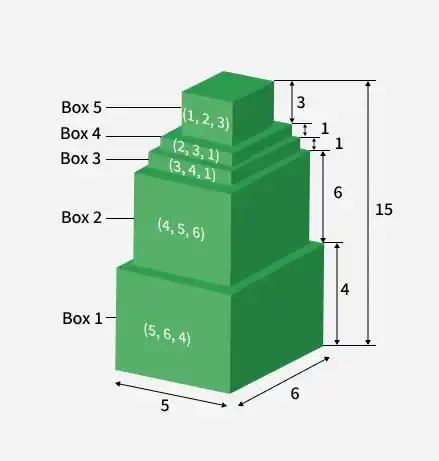
Input: height[] = [1, 4, 3], width[] = [2, 5, 4], length[] = [3, 6, 1] Output: 15 Explanation: One possible arrangement of the boxes from bottom to top is shown below:
Hence, the total height of this stack is 4 + 6 + 1 + 1 + 3 = 15. No other combination of boxes produces a height greater than this.
[Naive Approach] Recursion - Exponential Time and O(n) Auxiliary Space
This problem can be viewed as a 2D Weighted Longest Increasing Subsequence. The length and width of the base determine whether two orientations can form a valid sequence, similar to LIS. However, instead of maximizing the length of the sequence, we maximize the sum of heights, where the height of each orientation acts as its weight.
The idea is to generate all six orientations of each box, store each as (length, width, height), and sort them in descending order of their base dimensions.
For a given box orientation i, the recursive relation is based on two conditions:
We check if i can be placed on top of any previously considered j, meaning the base of box i must be strictly smaller than the base of box j.
We compute the maximum stack height by choosing the best possible prior box to place under box i.
The recurrence relationfor maximum height with base as i is.
maxHeight(i) = max(height-of-i + maxHeight(j)) for all boxes j where base of i > base of j)
For orientation i, orientation j can be placed above it if: boxes[i][0] > boxes[j][0] && boxes[i][1] > boxes[j][1]
Since the orientations are sorted in descending order, we only consider j > i.
For every valid j, recursively calculate the maximum stack height and add it to the height of orientation i.
The recurrence is: maxHeight(i) = max(boxes[i][2], boxes[i][2] + maxHeight(j))
C++
#include<iostream>#include<vector>#include<array>#include<algorithm>usingnamespacestd;// Function to find the maximum height // with box i as base.intmaxHeightRecur(inti,vector<array<int,3>>&boxes){intans=boxes[i][2];// Check all the boxes that can be placed above box i for(intj=i+1;j<boxes.size();j++){// If dimensions of box j are less // than that size of box iif(boxes[i][0]>boxes[j][0]&&boxes[i][1]>boxes[j][1]){ans=max(ans,boxes[i][2]+maxHeightRecur(j,boxes));}}returnans;}intmaxHeight(vector<int>&height,vector<int>&width,vector<int>&length){intn=height.size();vector<array<int,3>>boxes(n*6);intindex=0;for(inti=0;i<n;i++){inta=height[i],b=width[i],c=length[i];boxes[index++]={a,b,c};boxes[index++]={a,c,b};boxes[index++]={b,a,c};boxes[index++]={b,c,a};boxes[index++]={c,a,b};boxes[index++]={c,b,a};}// Sort the boxes in descending // order of length and width.sort(boxes.begin(),boxes.end(),[](auto&box1,auto&box2){if(box1[0]==box2[0]){if(box1[1]==box2[1])returnbox1[2]>box2[2];elsereturnbox1[1]>box2[1];}returnbox1[0]>box2[0];});intans=0;// Check for all boxes starting as base.for(inti=0;i<boxes.size();i++){ans=max(ans,maxHeightRecur(i,boxes));}returnans;}intmain(){vector<int>height={4,1,4,10};vector<int>width={6,2,5,12};vector<int>length={7,3,6,32};cout<<maxHeight(height,width,length);}
Java
importjava.util.Arrays;classGFG{// Function to find the maximum height // with box i as base.staticintmaxHeightRecur(inti,int[][]boxes){intans=boxes[i][2];// Check all the boxes that can be placed above box i for(intj=i+1;j<boxes.length;j++){// If dimensions of box j are less // than that size of box iif(boxes[i][0]>boxes[j][0]&&boxes[i][1]>boxes[j][1]){ans=Math.max(ans,boxes[i][2]+maxHeightRecur(j,boxes));}}returnans;}staticintmaxHeight(int[]height,int[]width,int[]length){intn=height.length;// Create a 2d array to store all // orientations of boxes in (l, b, h)// manner.int[][]boxes=newint[n*6][3];intindex=0;for(inti=0;i<n;i++){inta=height[i],b=width[i],c=length[i];boxes[index++]=newint[]{a,b,c};boxes[index++]=newint[]{a,c,b};boxes[index++]=newint[]{b,a,c};boxes[index++]=newint[]{b,c,a};boxes[index++]=newint[]{c,a,b};boxes[index++]=newint[]{c,b,a};}// Sort the boxes in descending // order of length and width.Arrays.sort(boxes,(box1,box2)->{if(box1[0]==box2[0]){if(box1[1]==box2[1])returnInteger.compare(box1[2],box2[2]);elsereturnInteger.compare(box2[1],box1[1]);}returnInteger.compare(box2[0],box1[0]);});intans=0;// Check for all boxes starting as base.for(inti=0;i<boxes.length;i++){ans=Math.max(ans,maxHeightRecur(i,boxes));}returnans;}publicstaticvoidmain(String[]args){int[]height={4,1,4,10};int[]width={6,2,5,12};int[]length={7,3,6,32};System.out.println(maxHeight(height,width,length));}}
Python
# Function to find the maximum height # with box i as base.defmaxHeightRecur(i,boxes):ans=boxes[i][2]# Check all the boxes that can be placed above box i forjinrange(i+1,len(boxes)):# If dimensions of box j are less # than that size of box iifboxes[i][0]>boxes[j][0]andboxes[i][1]>boxes[j][1]:ans=max(ans,boxes[i][2]+maxHeightRecur(j,boxes))returnansdefmaxHeight(height,width,length):n=len(height)boxes=[]foriinrange(n):a,b,c=height[i],width[i],length[i]boxes+=[[a,b,c],[a,c,b],[b,a,c],[b,c,a],[c,a,b],[c,b,a]]# Sort the boxes in descending # order of length and width.boxes.sort(key=lambdabox:(-box[0],-box[1],-box[2]))ans=0# Check for all boxes starting as base.foriinrange(len(boxes)):ans=max(ans,maxHeightRecur(i,boxes))returnansif__name__=="__main__":height=[4,1,4,10]width=[6,2,5,12]length=[7,3,6,32]print(maxHeight(height,width,length))
C#
usingSystem;classGFG{// Function to find the maximum height // with box i as base.staticintmaxHeightRecur(inti,int[][]boxes){intans=boxes[i][2];// Check all the boxes that can be placed above box i for(intj=i+1;j<boxes.Length;j++){// If dimensions of box j are less // than that size of box i if(boxes[i][0]>boxes[j][0]&&boxes[i][1]>boxes[j][1]){ans=Math.Max(ans,boxes[i][2]+maxHeightRecur(j,boxes));}}returnans;}staticintmaxHeight(int[]height,int[]width,int[]length){intn=height.Length;int[][]boxes=newint[n*6][];intindex=0;for(inti=0;i<n;i++){inta=height[i],b=width[i],c=length[i];boxes[index++]=newint[]{a,b,c};boxes[index++]=newint[]{a,c,b};boxes[index++]=newint[]{b,a,c};boxes[index++]=newint[]{b,c,a};boxes[index++]=newint[]{c,a,b};boxes[index++]=newint[]{c,b,a};}// Sort the boxes in descending // order of length and width.Array.Sort(boxes,(box1,box2)=>{if(box1[0]==box2[0]){if(box1[1]==box2[1])returnbox1[2].CompareTo(box2[2]);elsereturnbox2[1].CompareTo(box1[1]);}returnbox2[0].CompareTo(box1[0]);});intans=0;// Check for all boxes starting as base.for(inti=0;i<boxes.Length;i++){ans=Math.Max(ans,maxHeightRecur(i,boxes));}returnans;}publicstaticvoidMain(){int[]height={4,1,4,10};int[]width={6,2,5,12};int[]length={7,3,6,32};Console.WriteLine(maxHeight(height,width,length));}}
JavaScript
// Function to find the maximum height // with box i as base.functionmaxHeightRecur(i,boxes){letans=boxes[i][2];// Check all the boxes that can be placed above box i for(letj=i+1;j<boxes.length;j++){// If dimensions of box j are less // than that size of box iif(boxes[i][0]>boxes[j][0]&&boxes[i][1]>boxes[j][1]){ans=Math.max(ans,boxes[i][2]+maxHeightRecur(j,boxes));}}returnans;}functionmaxHeight(height,width,length){constn=height.length;constboxes=newArray(n*6);letindex=0;for(leti=0;i<n;i++){consta=height[i],b=width[i],c=length[i];boxes[index++]=[a,b,c];boxes[index++]=[a,c,b];boxes[index++]=[b,a,c];boxes[index++]=[b,c,a];boxes[index++]=[c,a,b];boxes[index++]=[c,b,a];}// Sort the boxes in descending // order of length and width.boxes.sort((box1,box2)=>{if(box1[0]===box2[0]){if(box1[1]===box2[1])returnbox1[2]-box2[2];elsereturnbox2[1]-box1[1];}returnbox2[0]-box1[0];});letans=0;// Check for all boxes starting as base.for(leti=0;i<boxes.length;i++){ans=Math.max(ans,maxHeightRecur(i,boxes));}returnans;}// Driver codeconstheight=[4,1,4,10];constwidth=[6,2,5,12];constlength=[7,3,6,32];console.log(maxHeight(height,width,length));
Output
60
[Better Approach] Top-Down DP (Memoization) - O(n^2) Time and O(n) Auxiliary Space
The idea is to use memoization to avoid calculating the maximum stack height for the same box orientation multiple times.
In the recursive approach, the same orientation can be reached through different stacking paths. We store its result in a dp array so that it can be reused.
For each orientation i, dp[i] represents the maximum height of the stack with orientation i as the bottom box.
Initially: dp = [-1, -1, -1, ...]
For each orientation i:
If dp[i] is already calculated, return it.
Start with the height of the current box.
Check all orientations that can be placed above it.
Recursively find the maximum height for each valid orientation.
Store the maximum result in dp[i].
The recurrence is: dp[i] = max( boxes[i][2], boxes[i][2] + dp[j] ) where j is an orientation that can be placed above i.
C++
#include<vector>#include<algorithm>#include<iostream>usingnamespacestd;// Function to find the maximum height // with box i as base.intmaxHeightRecur(inti,vector<vector<int>>&boxes,vector<int>&dp){// If value is stored in dp arrayif(dp[i]!=-1)returndp[i];intans=boxes[i][2];// Check all the boxes that can be placed above box i for(intj=i+1;j<boxes.size();j++){// If dimensions of box j are less // than that size of box iif(boxes[i][0]>boxes[j][0]&&boxes[i][1]>boxes[j][1]){ans=max(ans,boxes[i][2]+maxHeightRecur(j,boxes,dp));}}returndp[i]=ans;}intmaxHeight(vector<int>&height,vector<int>&width,vector<int>&length){intn=height.size();// Create a 2d array to store all // orientations of boxes in (l, b, h)// manner.vector<vector<int>>boxes(n*6,vector<int>(3));intidx=0;for(inti=0;i<n;i++){inta=height[i],b=width[i],c=length[i];boxes[idx++]={a,b,c};boxes[idx++]={a,c,b};boxes[idx++]={b,a,c};boxes[idx++]={b,c,a};boxes[idx++]={c,a,b};boxes[idx++]={c,b,a};}// Sort the boxes in descending // order of length and width.sort(boxes.begin(),boxes.end(),[](auto&box1,auto&box2){if(box1[0]==box2[0]){if(box1[1]==box2[1])returnbox1[2]>box2[2];elsereturnbox1[1]>box2[1];}returnbox1[0]>box2[0];});vector<int>dp(boxes.size(),-1);intans=0;// Check for all boxes starting as base.for(inti=0;i<boxes.size();i++){ans=max(ans,maxHeightRecur(i,boxes,dp));}returnans;}intmain(){vector<int>height={4,1,4,10};vector<int>width={6,2,5,12};vector<int>length={7,3,6,32};cout<<maxHeight(height,width,length);}
Java
importjava.util.Arrays;classGFG{// Function to find the maximum height // with box i as base.staticintmaxHeightRecur(inti,int[][]boxes,int[]dp){// If value is stored in dp arrayif(dp[i]!=-1)returndp[i];intans=boxes[i][2];// Check all the boxes that can be placed above box i for(intj=i+1;j<boxes.length;j++){// If dimensions of box j are less // than that size of box iif(boxes[i][0]>boxes[j][0]&&boxes[i][1]>boxes[j][1]){ans=Math.max(ans,boxes[i][2]+maxHeightRecur(j,boxes,dp));}}returndp[i]=ans;}staticintmaxHeight(int[]height,int[]width,int[]length){intn=height.length;// Create a 2d array to store all // orientations of boxes in (l, b, h)// manner.int[][]boxes=newint[n*6][3];intidx=0;for(inti=0;i<n;i++){inta=height[i],b=width[i],c=length[i];boxes[idx++]=newint[]{a,b,c};boxes[idx++]=newint[]{a,c,b};boxes[idx++]=newint[]{b,a,c};boxes[idx++]=newint[]{b,c,a};boxes[idx++]=newint[]{c,a,b};boxes[idx++]=newint[]{c,b,a};}// Sort the boxes in descending // order of length and width.Arrays.sort(boxes,(box1,box2)->{if(box1[0]==box2[0]){if(box1[1]==box2[1])returnInteger.compare(box1[2],box1[2]);elsereturnInteger.compare(box2[1],box1[1]);}returnInteger.compare(box2[0],box1[0]);});int[]dp=newint[boxes.length];Arrays.fill(dp,-1);intans=0;// Check for all boxes starting as base.for(inti=0;i<boxes.length;i++){ans=Math.max(ans,maxHeightRecur(i,boxes,dp));}returnans;}publicstaticvoidmain(String[]args){int[]height={4,1,4,10};int[]width={6,2,5,12};int[]length={7,3,6,32};System.out.println(maxHeight(height,width,length));}}
Python
# Function to find the maximum height # with box i as base.defmaxHeightRecur(i,boxes,dp):# If value is stored in dp arrayifdp[i]!=-1:returndp[i]ans=boxes[i][2]# Check all the boxes that can be placed above box i forjinrange(i+1,len(boxes)):# If dimensions of box j are less # than that size of box iifboxes[i][0]>boxes[j][0]andboxes[i][1]>boxes[j][1]:ans=max(ans,boxes[i][2]+maxHeightRecur(j,boxes,dp))dp[i]=ansreturnansdefmaxHeight(height,width,length):n=len(height)# Create a 2d array to store all # orientations of boxes in (l, b, h)# manner.boxes=[]foriinrange(n):a,b,c=height[i],width[i],length[i]boxes.append([a,b,c])boxes.append([a,c,b])boxes.append([b,a,c])boxes.append([b,c,a])boxes.append([c,a,b])boxes.append([c,b,a])# Sort the boxes in descending # order of length and width.boxes.sort(key=lambdabox:(-box[0],-box[1],-box[2]))dp=[-1]*len(boxes)ans=0# Check for all boxes starting as base.foriinrange(len(boxes)):ans=max(ans,maxHeightRecur(i,boxes,dp))returnansif__name__=="__main__":height=[4,1,4,10]width=[6,2,5,12]length=[7,3,6,32]print(maxHeight(height,width,length))
C#
usingSystem;classGFG{// Function to find the maximum height // with box i as base.staticintmaxHeightRecur(inti,int[][]boxes,int[]dp){// If value is stored in dp arrayif(dp[i]!=-1)returndp[i];intans=boxes[i][2];// Check all the boxes that can be placed above box i for(intj=i+1;j<boxes.Length;j++){// If dimensions of box j are less // than that size of box iif(boxes[i][0]>boxes[j][0]&&boxes[i][1]>boxes[j][1]){ans=Math.Max(ans,boxes[i][2]+maxHeightRecur(j,boxes,dp));}}returndp[i]=ans;}staticintmaxHeight(int[]height,int[]width,int[]length){intn=height.Length;// Create a 2d array to store all // orientations of boxes in (l, b, h)// manner.int[][]boxes=newint[n*6][];intidx=0;for(inti=0;i<n;i++){inta=height[i],b=width[i],c=length[i];boxes[idx++]=newint[]{a,b,c};boxes[idx++]=newint[]{a,c,b};boxes[idx++]=newint[]{b,a,c};boxes[idx++]=newint[]{b,c,a};boxes[idx++]=newint[]{c,a,b};boxes[idx++]=newint[]{c,b,a};}// Sort the boxes in descending // order of length and width.Array.Sort(boxes,(box1,box2)=>{if(box1[0]==box2[0]){if(box1[1]==box2[1])returnbox1[2].CompareTo(box2[2]);elsereturnbox2[1].CompareTo(box1[1]);}returnbox2[0].CompareTo(box1[0]);});int[]dp=newint[boxes.Length];Array.Fill(dp,-1);intans=0;// Check for all boxes starting as base.for(inti=0;i<boxes.Length;i++){ans=Math.Max(ans,maxHeightRecur(i,boxes,dp));}returnans;}publicstaticvoidMain(){int[]height={4,1,4,10};int[]width={6,2,5,12};int[]length={7,3,6,32};Console.WriteLine(maxHeight(height,width,length));}}
JavaScript
// Function to find the maximum height // with box i as base.functionmaxHeightRecur(i,boxes,dp){// If value is stored in dp arrayif(dp[i]!==-1)returndp[i];letans=boxes[i][2];// Check all the boxes that can be placed above box i for(letj=i+1;j<boxes.length;j++){// If dimensions of box j are less // than that size of box iif(boxes[i][0]>boxes[j][0]&&boxes[i][1]>boxes[j][1]){ans=Math.max(ans,boxes[i][2]+maxHeightRecur(j,boxes,dp));}}returndp[i]=ans;}functionmaxHeight(height,width,length){constn=height.length;// Create a 2d array to store all // orientations of boxes in (l, b, h)// manner.constboxes=newArray(n*6);letidx=0;for(leti=0;i<n;i++){consta=height[i],b=width[i],c=length[i];boxes[idx++]=[a,b,c];boxes[idx++]=[a,c,b];boxes[idx++]=[b,a,c];boxes[idx++]=[b,c,a];boxes[idx++]=[c,a,b];boxes[idx++]=[c,b,a];}// Sort the boxes in descending // order of length and width.boxes.sort((box1,box2)=>{if(box1[0]===box2[0]){if(box1[1]===box2[1])returnbox1[2]-box2[2];elsereturnbox2[1]-box1[1];}returnbox2[0]-box1[0];});constdp=newArray(boxes.length).fill(-1);letans=0;// Check for all boxes starting as base.for(leti=0;i<boxes.length;i++){ans=Math.max(ans,maxHeightRecur(i,boxes,dp));}returnans;}// Driver codeconstheight=[4,1,4,10];constwidth=[6,2,5,12];constlength=[7,3,6,32];console.log(maxHeight(height,width,length));
Output
60
[Expected Approach] Using Bottom-Up DP (Tabulation) - O(n^2) Time and O(n) Space
The idea is to fill the DP table from bottom to up. The table is filled in an iterative manner from i = n-1 to i = 0.
For each box i, the dynamic programming relation is as follows:
set dp[i] = height-of-i
For j > i and base of j is smaller than base of i, set dp[i] = max(dp[i], height(-of-i + dp[j]).
For an orientation i, let dp[i] represent the maximum stack height when orientation i is the bottom box.
Initialize dp[i] with the height of the current box.
Check every orientation j that comes after i.
If both base dimensions of j are strictly smaller than those of i, it can be placed above i.
#include<vector>#include<algorithm>#include<iostream>usingnamespacestd;// Function to find the maximum height // with box i as base.intmaxHeight(vector<int>&height,vector<int>&width,vector<int>&length){intn=height.size();// Create a 2d array to store all // orientations of boxes in (l, b, h)// manner.vector<vector<int>>boxes;boxes.reserve(n*6);for(inti=0;i<n;i++){inta=height[i],b=width[i],c=length[i];boxes.push_back({a,b,c});boxes.push_back({a,c,b});boxes.push_back({b,a,c});boxes.push_back({b,c,a});boxes.push_back({c,a,b});boxes.push_back({c,b,a});}// Sort the boxes in descending // order of length and width.sort(boxes.begin(),boxes.end(),[](auto&box1,auto&box2){if(box1[0]==box2[0]){if(box1[1]==box2[1])returnbox1[2]>box2[2];elsereturnbox1[1]>box2[1];}returnbox1[0]>box2[0];});vector<int>dp(boxes.size());intans=0;// Check for all boxes starting as base.for(inti=boxes.size()-1;i>=0;i--){dp[i]=boxes[i][2];// Check all the boxes that can be placed above box i for(intj=i+1;j<boxes.size();j++){// If dimensions of box j are less // than that size of box iif(boxes[i][0]>boxes[j][0]&&boxes[i][1]>boxes[j][1]){dp[i]=max(dp[i],boxes[i][2]+dp[j]);}}ans=max(ans,dp[i]);}returnans;}intmain(){vector<int>height={4,1,4,10};vector<int>width={6,2,5,12};vector<int>length={7,3,6,32};cout<<maxHeight(height,width,length);}
Java
importjava.util.Arrays;classGFG{// Function to find the maximum height // with box i as base.staticintmaxHeight(int[]height,int[]width,int[]length){intn=height.length;// Create a 2d array to store all // orientations of boxes in (l, b, h)// manner.int[][]boxes=newint[n*6][3];intidx=0;for(inti=0;i<n;i++){inta=height[i],b=width[i],c=length[i];boxes[idx++]=newint[]{a,b,c};boxes[idx++]=newint[]{a,c,b};boxes[idx++]=newint[]{b,a,c};boxes[idx++]=newint[]{b,c,a};boxes[idx++]=newint[]{c,a,b};boxes[idx++]=newint[]{c,b,a};}// Sort the boxes in descending // order of length and width.Arrays.sort(boxes,(box1,box2)->{if(box1[0]==box2[0]){if(box1[1]==box2[1])returnInteger.compare(box1[2],box2[2]);elsereturnInteger.compare(box2[1],box1[1]);}returnInteger.compare(box2[0],box1[0]);});int[]dp=newint[boxes.length];intans=0;// Check for all boxes starting as base.for(inti=boxes.length-1;i>=0;i--){dp[i]=boxes[i][2];// Check all the boxes that can be placed above box i for(intj=i+1;j<boxes.length;j++){// If dimensions of box j are less // than that size of box iif(boxes[i][0]>boxes[j][0]&&boxes[i][1]>boxes[j][1]){dp[i]=Math.max(dp[i],boxes[i][2]+dp[j]);}}ans=Math.max(ans,dp[i]);}returnans;}publicstaticvoidmain(String[]args){int[]height={4,1,4,10};int[]width={6,2,5,12};int[]length={7,3,6,32};System.out.println(maxHeight(height,width,length));}}
Python
# Function to find the maximum height # with box i as base.defmaxHeight(height,width,length):n=len(height)# Create a 2d array to store all # orientations of boxes in (l, b, h)# manner.boxes=[]foriinrange(n):a,b,c=height[i],width[i],length[i]boxes.append([a,b,c])boxes.append([a,c,b])boxes.append([b,a,c])boxes.append([b,c,a])boxes.append([c,a,b])boxes.append([c,b,a])# Sort the boxes in descending # order of length and width.boxes.sort(key=lambdabox:(-box[0],-box[1],-box[2]))dp=[0]*len(boxes)ans=0# Check for all boxes starting as base.foriinrange(len(boxes)-1,-1,-1):dp[i]=boxes[i][2]# Check all the boxes that can be placed above box i forjinrange(i+1,len(boxes)):# If dimensions of box j are less # than that size of box iifboxes[i][0]>boxes[j][0]andboxes[i][1]>boxes[j][1]:dp[i]=max(dp[i],boxes[i][2]+dp[j])ans=max(ans,dp[i])returnansif__name__=="__main__":height=[4,1,4,10]width=[6,2,5,12]length=[7,3,6,32]print(maxHeight(height,width,length))
C#
usingSystem;// Function to find the maximum height // with box i as base.classGFG{staticintmaxHeight(int[]height,int[]width,int[]length){intn=height.Length;// Create a 2d array to store all // orientations of boxes in (l, b, h)// manner.int[][]boxes=newint[n*6][];intidx=0;for(inti=0;i<n;i++){inta=height[i],b=width[i],c=length[i];boxes[idx++]=newint[]{a,b,c};boxes[idx++]=newint[]{a,c,b};boxes[idx++]=newint[]{b,a,c};boxes[idx++]=newint[]{b,c,a};boxes[idx++]=newint[]{c,a,b};boxes[idx++]=newint[]{c,b,a};}// Sort the boxes in descending // order of length and width.Array.Sort(boxes,(box1,box2)=>{if(box1[0]==box2[0]){if(box1[1]==box2[1])returnbox1[2].CompareTo(box2[2]);elsereturnbox2[1].CompareTo(box1[1]);}returnbox2[0].CompareTo(box1[0]);});int[]dp=newint[boxes.Length];intans=0;// Check for all boxes starting as base.for(inti=boxes.Length-1;i>=0;i--){dp[i]=boxes[i][2];// Check all the boxes that can be placed above box i for(intj=i+1;j<boxes.Length;j++){// If dimensions of box j are less // than that size of box iif(boxes[i][0]>boxes[j][0]&&boxes[i][1]>boxes[j][1]){dp[i]=Math.Max(dp[i],boxes[i][2]+dp[j]);}}ans=Math.Max(ans,dp[i]);}returnans;}publicstaticvoidMain(){int[]height={4,1,4,10};int[]width={6,2,5,12};int[]length={7,3,6,32};Console.WriteLine(maxHeight(height,width,length));}}
JavaScript
// Function to find the maximum height // with box i as base.functionmaxHeight(height,width,length){constn=height.length;// Create a 2d array to store all // orientations of boxes in (l, b, h)// manner.constboxes=[];for(leti=0;i<n;i++){consta=height[i],b=width[i],c=length[i];boxes.push([a,b,c]);boxes.push([a,c,b]);boxes.push([b,a,c]);boxes.push([b,c,a]);boxes.push([c,a,b]);boxes.push([c,b,a]);}// Sort the boxes in descending // order of length and width.boxes.sort((box1,box2)=>{if(box1[0]===box2[0]){if(box1[1]===box2[1])returnbox1[2]-box2[2];elsereturnbox2[1]-box1[1];}returnbox2[0]-box1[0];});constdp=newArray(boxes.length).fill(0);letans=0;// Check for all boxes starting as base.for(leti=boxes.length-1;i>=0;i--){dp[i]=boxes[i][2];// Check all the boxes that can be placed above box i for(letj=i+1;j<boxes.length;j++){// If dimensions of box j are less // than that size of box iif(boxes[i][0]>boxes[j][0]&&boxes[i][1]>boxes[j][1]){dp[i]=Math.max(dp[i],boxes[i][2]+dp[j]);}}ans=Math.max(ans,dp[i]);}returnans;}// Driver codeconstheight=[4,1,4,10];constwidth=[6,2,5,12];constlength=[7,3,6,32];console.log(maxHeight(height,width,length));