

Given two integers l and r, find the count of numbers x such that:
- l ≤ x ≤ r
- The binary representation of x contains exactly 3 set bits.
Return the total count of such numbers in the given range.
Examples:
Input: l = 11, r = 19
Output: 4
Explanation: There are 4 such numbers with 3 set bits in range 11 to 19. 11 -> 1011, 13 -> 1101, 14 -> 1110, 19 -> 10011. So answer for this test case is 4.Input: l = 25, r = 29
Output: 3
Explanation: There are 3 such numbers with 3 set bits in range 25 to 29. 25 -> 11001, 26 -> 11010, 28 -> 11100. So answer for this test case is 3

Table of Content
[Naive Approach] Using Bit Counting – O((r − l + 1) × log n) Time and O(1) Space
The idea is to traverse every number in the range
[l, r]and count the number of set bits in its binary representation. If a number contains exactly3set bits, it is counted in the final answer.The set bits are counted by repeatedly checking the last bit using
(n & 1)and then right-shifting the number.
- Traverse all numbers from
ltor - For each number, count set bits in binary representation and If the count equals
3, increment the result
#include <bits/stdc++.h>
using namespace std;

// count set bits in binary
int countSetBits(int n)
{

    int count = 0;

    while (n)
    {

        // check last bit
        if (n & 1)
        {
            count++;
        }

        // right shift
        n = n >> 1;
    }

    return count;
}

// count numbers having exactly 3 set bits
int solve(int l, int r)
{

    int ans = 0;

    // check every number in range
    for (int i = l; i <= r; i++)
    {

        // count set bits
        int bits = countSetBits(i);

        // if exactly 3 set bits
        if (bits == 3)
        {
            ans++;
        }
    }

    return ans;
}

int main()
{
    int l = 1;
    int r = 20;
    cout << solve(l, r);
    return 0;
}
import java.util.*;

class GFG {

    // count set bits in binary
    static int countSetBits(int n)
    {

        int count = 0;

        while (n > 0) {

            // check last bit
            if ((n & 1) == 1) {
                count++;
            }

            // right shift
            n = n >> 1;
        }

        return count;
    }

    // count numbers having exactly 3 set bits
    public static int solve(int l, int r)
    {

        int ans = 0;

        // check every number in range
        for (int i = l; i <= r; i++) {

            // count set bits
            int bits = countSetBits(i);

            // if exactly 3 set bits
            if (bits == 3) {
                ans++;
            }
        }

        return ans;
    }

    public static void main(String[] args)
    {

        int l = 1;
        int r = 20;

        System.out.println(solve(l, r));
    }
}
# precompute function

# count set bits in binary
def countSetBits(n):

    count = 0

    while n:

        # check last bit
        if n & 1:
            count += 1

        # right shift
        n = n >> 1

    return count

# count numbers having exactly 3 set bits
def solve(l, r):

    ans = 0

    # check every number in range
    for i in range(l, r + 1):

        # count set bits
        bits = countSetBits(i)

        # if exactly 3 set bits
        if bits == 3:
            ans += 1

    return ans


l = 1
r = 20

print(solve(l, r))
using System;

class GFG {

    // count set bits in binary
    private static int countSetBits(int n)
    {

        int count = 0;

        while (n > 0) {

            // check last bit
            if ((n & 1) == 1) {
                count++;
            }

            // right shift
            n = n >> 1;
        }

        return count;
    }

    // count numbers having exactly 3 set bits
    public static int solve(int l, int r)
    {

        int ans = 0;

        // check every number in range
        for (int i = l; i <= r; i++) {

            // count set bits
            int bits = countSetBits(i);

            // if exactly 3 set bits
            if (bits == 3) {
                ans++;
            }
        }

        return ans;
    }

    static void Main()
    {

        int l = 1;
        int r = 20;

        Console.WriteLine(solve(l, r));
    }
}
// count set bits in binary
function countSetBits(n)
{

    let count = 0;

    while (n) {

        // check last bit
        if (n & 1) {
            count++;
        }

        // right shift
        n = n >> 1;
    }

    return count;
}

// count numbers having exactly 3 set bits
function solve(l, r)
{

    let ans = 0;

    // check every number in range
    for (let i = l; i <= r; i++) {

        // count set bits
        let bits = countSetBits(i);

        // if exactly 3 set bits
        if (bits === 3) {
            ans++;
        }
    }

    return ans;
}

let l = 1;
let r = 20;

console.log(solve(l, r));
Output
5
[Efficient Approach] Using Precomputation + Binary Search – O(1) Query Time
A number having exactly
3set bits can be formed by choosing any3distinct bit positions. Since along longinteger has at most63usable bit positions, all such numbers can be generated beforehand using three nested loops.After generating all valid numbers:
- Sort them
- Use binary search to count how many lie in the range
[l, r]The count is: upperBound(r)−lowerBound(l)
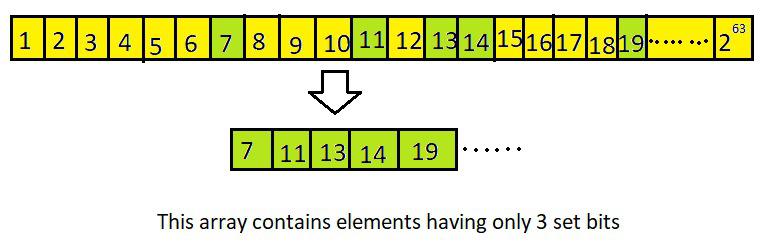
- Generate all numbers with exactly
3set bits using:(1LL<<i) ∣ (1LL<<j) ∣ (1LL<<k)(1LL << i) - Store all generated numbers in a array and sort the array
- Use:
lowerBound()for first index having value>= l and upperBound()for first index having value> r - Their difference gives the required count
#include <bits/stdc++.h>
using namespace std;

vector<long long> nums;

// precompute all numbers
void precompute(vector<long long> &nums)
{

    // choose 3 different bit positions
    for (int i = 0; i < 63; i++)
    {

        for (int j = i + 1; j < 63; j++)
        {

            for (int k = j + 1; k < 63; k++)
            {

                // make number using 3 set bits
                long long val = (1LL << i) | (1LL << j) | (1LL << k);

                nums.push_back(val);
            }
        }
    }

    // sort for binary search
    sort(nums.begin(), nums.end());
}

// count numbers in range [l,r]
int solve(int l, int r)
{
    auto low = lower_bound(nums.begin(), nums.end(), l);
    auto high = upper_bound(nums.begin(), nums.end(), r);
    return (int)(high - low);
}

int main()
{
    vector<long long> nums;
    precompute(nums);

    int l = 1;
    int r = 20;
    cout << solve(l, r);

    return 0;
}
import java.util.*;

class GFG{

    //precompute all numbers
    static void precompute(ArrayList<Long> nums){

        //choose 3 different bit positions
        for(int i=0;i<63;i++){

            for(int j=i+1;j<63;j++){

                for(int k=j+1;k<63;k++){

                    //make number using 3 set bits
                    long val=(1L<<i)|(1L<<j)|(1L<<k);

                    nums.add(val);
                }
            }
        }

        //sort for binary search
        Collections.sort(nums);
    }

    //first index having value >= target
    static int lowerBound(ArrayList<Long> nums,long target){

        int low=0;
        int high=nums.size()-1;

        int ans=nums.size();

        while(low<=high){

            int mid=low+(high-low)/2;

            if(nums.get(mid)>=target){

                ans=mid;
                high=mid-1;
            }
            else{

                low=mid+1;
            }
        }

        return ans;
    }

    //first index having value > target
    static int upperBound(ArrayList<Long> nums,long target){

        int low=0;
        int high=nums.size()-1;

        int ans=nums.size();

        while(low<=high){

            int mid=low+(high-low)/2;

            if(nums.get(mid)>target){

                ans=mid;
                high=mid-1;
            }
            else{

                low=mid+1;
            }
        }

        return ans;
    }

    //count numbers in range [l,r]
    static int solve(int l,int r){

        //store all numbers having exactly 3 set bits
        ArrayList<Long> nums=new ArrayList<>();

        //generate all valid numbers
        precompute(nums);

        int left=lowerBound(nums,l);

        int right=upperBound(nums,r);

        return right-left;
    }

    public static void main(String[] args){

        int l=1;
        int r=20;

        System.out.println(solve(l,r));
    }
}
#precompute all numbers
def precompute(nums):

    #choose 3 different bit positions
    for i in range(63):

        for j in range(i+1,63):

            for k in range(j+1,63):

                #make number using 3 set bits
                val=(1<<i)|(1<<j)|(1<<k)

                nums.append(val)

    #sort for binary search
    nums.sort()

#first index having value >= target
def lowerBound(nums,target):

    low=0
    high=len(nums)-1

    ans=len(nums)

    while low<=high:

        mid=low+(high-low)//2

        if nums[mid]>=target:

            ans=mid
            high=mid-1

        else:

            low=mid+1

    return ans

#first index having value > target
def upperBound(nums,target):

    low=0
    high=len(nums)-1

    ans=len(nums)

    while low<=high:

        mid=low+(high-low)//2

        if nums[mid]>target:

            ans=mid
            high=mid-1

        else:

            low=mid+1

    return ans

#count numbers in range [l,r]
def solve(l,r):

    #store all numbers having exactly 3 set bits
    nums=[]

    #generate all valid numbers
    precompute(nums)

    left=lowerBound(nums,l)

    right=upperBound(nums,r)

    return right-left

l=1
r=20

print(solve(l,r))
using System;
using System.Collections.Generic;

class GFG{

    //precompute all numbers
    static void precompute(List<long> nums){

        //choose 3 different bit positions
        for(int i=0;i<63;i++){

            for(int j=i+1;j<63;j++){

                for(int k=j+1;k<63;k++){

                    //make number using 3 set bits
                    long val=(1L<<i)|(1L<<j)|(1L<<k);

                    nums.Add(val);
                }
            }
        }

        //sort for binary search
        nums.Sort();
    }

    //first index having value >= target
    static int lowerBound(List<long> nums,long target){

        int low=0;
        int high=nums.Count-1;

        int ans=nums.Count;

        while(low<=high){

            int mid=low+(high-low)/2;

            if(nums[mid]>=target){

                ans=mid;
                high=mid-1;
            }
            else{

                low=mid+1;
            }
        }

        return ans;
    }

    //first index having value > target
    static int upperBound(List<long> nums,long target){

        int low=0;
        int high=nums.Count-1;

        int ans=nums.Count;

        while(low<=high){

            int mid=low+(high-low)/2;

            if(nums[mid]>target){

                ans=mid;
                high=mid-1;
            }
            else{

                low=mid+1;
            }
        }

        return ans;
    }

    //count numbers in range [l,r]
    static int solve(int l,int r){

        //store all numbers having exactly 3 set bits
        List<long> nums=new List<long>();

        //generate all valid numbers
        precompute(nums);

        int left=lowerBound(nums,l);

        int right=upperBound(nums,r);

        return right-left;
    }

    static void Main(){

        int l=1;
        int r=20;

        Console.WriteLine(solve(l,r));
    }
}
//precompute all numbers
function precompute(nums){

    //choose 3 different bit positions
    for(let i=0;i<63;i++){

        for(let j=i+1;j<63;j++){

            for(let k=j+1;k<63;k++){

                //make number using 3 set bits
                let val=(1n<<BigInt(i))|(1n<<BigInt(j))|(1n<<BigInt(k));

                nums.push(val);
            }
        }
    }

    //sort for binary search
    nums.sort((a,b)=>(a<b?-1:1));
}

//first index having value >= target
function lowerBound(nums,target){

    let low=0;
    let high=nums.length-1;

    let ans=nums.length;

    while(low<=high){

        let mid=Math.floor(low+(high-low)/2);

        if(nums[mid]>=target){

            ans=mid;
            high=mid-1;
        }
        else{

            low=mid+1;
        }
    }

    return ans;
}

//first index having value > target
function upperBound(nums,target){

    let low=0;
    let high=nums.length-1;

    let ans=nums.length;

    while(low<=high){

        let mid=Math.floor(low+(high-low)/2);

        if(nums[mid]>target){

            ans=mid;
            high=mid-1;
        }
        else{

            low=mid+1;
        }
    }

    return ans;
}

//count numbers in range [l,r]
function solve(l,r){

    //store all numbers having exactly 3 set bits
    let nums=[];

    //generate all valid numbers
    precompute(nums);

    let left=lowerBound(nums,BigInt(l));

    let right=upperBound(nums,BigInt(r));

    return right-left;
}

let l=1;
let r=20;

console.log(solve(l,r));
Output
5
