

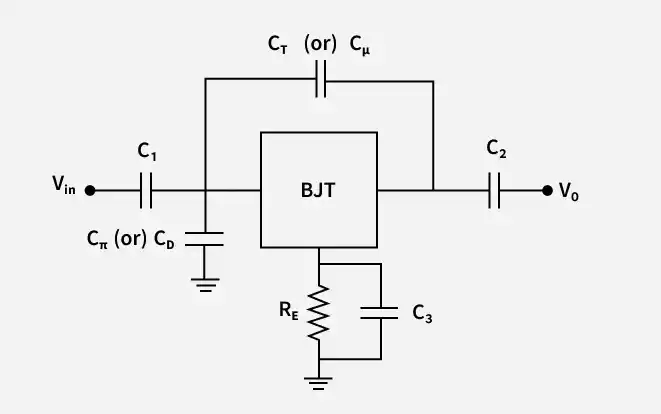
A Bipolar Junction Transistor (BJT) does not function as a fully resistive device in real-world transistor circuits. There are tiny capacitances between the transistor's various terminals because of the physical makeup of the semiconductor junctions.
- These capacitances have an impact on the transistor's behavior, particularly when the amplifier runs at various signal frequencies.
- Because these capacitances alter the circuit is gain and signal flow throughout a range of frequencies, their presence becomes very significant when examining the frequency response of BJT amplifiers.
- In amplifier circuits, external capacitors are utilized for coupling and bypassing in addition to the internal capacitances found within the transistor.
Types
The capacitances associated with a BJT can be broadly classified into two categories:
- Internal (Parasitic) Capacitances
- External Circuit Capacitances
Internal Capacitances
Arise due to the p–n junctions inside the transistor. Because they are a result of the device construction rather than being inserted on purpose, these capacitances are also referred to as parasitic capacitances.
There are two primary internal capacitances:
Diffusion Capacitance (C_D )
When a transistor is operating normally, diffusion capacitance develops across the forward-biased base-emitter junction.
- Diffusion capacitance results from charge storage in the base area when charge carriers are introduced across this junction.
- This capacitance is dependent on the transistor's operating current and is directly correlated with the quantity of stored charge in the base.
Junction Capacitance (C_T )
The base-collector junction, which is often reverse biased in an amplifier circuit, has junction capacitance across it.
- The depletion area between the p-type and n-type semiconductor materials is what creates this capacitance.
- The junction area and the applied reverse bias voltage are two variables that affect the junction capacitance value.
External Capacitances
In addition to internal capacitances, external capacitors are commonly used in BJT amplifier circuits. These capacitors help in signal coupling and bias stabilization.
Coupling Capacitor
Used to connect different stages of an amplifier while preventing the DC bias from one stage from affecting another stage.
Typical coupling capacitors include:
- Input coupling capacitor
- Output coupling capacitor
These capacitors allow AC signals to pass while blocking DC components.
Bypass Capacitor
It is connected across the emitter resistor in many amplifier circuits.
- Its purpose is to provide a low impedance path for AC signals so that the emitter resistor does not reduce the AC gain of the amplifier.
- At higher frequencies, the bypass capacitor behaves like a short circuit and allows the signal to pass easily.
Behavior at Different Frequencies
- Low frequencies: Capacitors have a large effect on the circuit due to their high reactance.
- Mid-band frequencies: Internal capacitances are typically disregarded in basic amplifier analysis because to their extremely low values.
- High frequencies: Internal capacitances may lower the amplifier gain and begin to affect the behavior of the circuit.
- Coupling capacitors: For AC signals, coupling capacitors behave nearly like short circuits at high enough frequencies.
- Bypass capacitors: They facilitate the easy passage of AC signals by acting as short circuits at higher frequencies.
Importance
- Impact circuit behavior: The way signals move through a transistor circuit is influenced by capacitances.
- Impact amplifier performance: They have an impact on the signal response and gain at various frequencies.
- Describe phase effects: Phase shifts in amplified signals can be caused by capacitive devices.
- Crucial for circuit design: When creating amplifiers for optimal performance, engineers take these capacitances into account.
- Assistance with frequency response analysis: Studying how amplifier gain changes with frequency requires an understanding of them.
Factors Affecting Capacitance
The values of internal capacitances in a BJT are not constant and may vary depending on several factors. Some important factors include:
- Junction area: Higher capacitance is produced by larger junction areas.
- Applied voltage: The breadth of the depletion region and, consequently, the capacitance are influenced by the reverse bias across the junction.
- Operating current: Diffusion capacitance depends on the amount of charge stored in the base region.
- Semiconductor material and device structure: The physical design of the transistor influences its capacitance values.
