

A Control System regulates the behaviour of devices or systems to produce a desired output. Control systems operate on the input–process–output principle, where an input signal is processed to generate a controlled output.
- A control system manages and regulates machine or system operation.
- Operation follows the input–process–output cycle to achieve the desired output.
- Sensors, controllers, and actuators work together for proper system functioning.
- Widely used in various applications such as electronics, automation, robotics, and aerospace engineering.
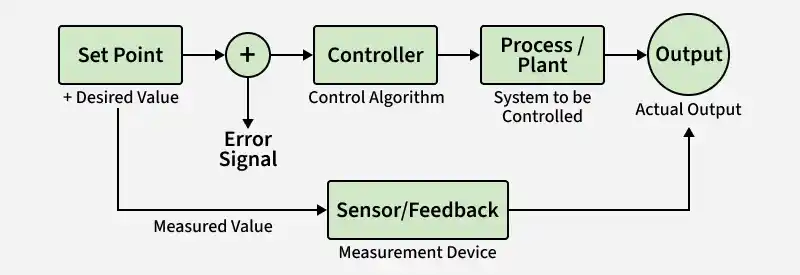
Introduction to Control Systems
A control system operates on the input–process–output principle to produce a desired output based on given input, similar to a human brain or computer, as seen in examples like controlling a fan using a switch.
- What is Control System ?
- What are the main types of control systems
- Basic components of a Control System
- Classification of Control System
- How are control systems used?
- Advantages and Disadvantages of Control Systems
Classification
Control systems operate on the input–process–output (I-P-O) principle and are classified into various types based on parameters such as signal type, nature and number of inputs and outputs, feedback mechanism, linearity, and time characteristics.
- Open Loop Control System
- Closed Loop Control System
- Linear and Non Linear Control Systems
- Time-Invariant and Time-Varying Control Systems
- Continuous-Time and Discrete-Time Control Systems
- SISO and MIMO Control Systems
- Difference Between Feedback and Feed Forward Control Systems
- Difference Between Open Loop and Closed Loop Control System
Feedback
Feedback is the process in which the output is returned to the input to modify system behavior, classified into positive and negative feedback, and it affects gain, stability, sensitivity, and noise in control systems.
Block Diagram in Control System
A block diagram is a pictorial representation of a control system using interconnected blocks that clearly and easily illustrate system components and their relationships for analysis and design.
- Block Diagram Algebra
- Block Diagram Reduction Rules
- Block Diagram Reduction Rules - Method and Solved Problem
- Basic Elements of Signal Flow Graph
- Conversion of Block Diagrams into Signal Flow Graphs
- Mason's Gain Formula in control system
Time Response and Time Domain Analysis
Time response and time domain analysis study system behavior over time, including transient and steady-state responses, standard test signals, and performance measures like rise time, settling time, overshoot, and steady-state error.
Stability Analysis
Stability in a control system refers to whether the output remains bounded and under control, with a stable system producing a controlled output and an unstable system not.
Frequency Domain Analysis
Frequency domain analysis is an important aspect of control systems that evaluates system behavior based on frequency rather than time, serving as a complement to time-domain analysis.
Compensators in Control System
A compensator is an important component of a control system used to improve performance and stability, helping achieve desired output behavior, and is classified into lag, lead, and lead–lag compensators.
Controllers in Control System
A controller is a key component of a control system that improves system performance and helps achieve desired output behavior, with types including proportional, integral, derivative, PD, PI, and PID controllers.
- What is Controllers?
- Proportional Controller
- Proportional Integral (PI) Controller
- Proportional Integral Derivative (PID) Controller
State Space Analysis
State space analysis is an important control system method used to analyze and design dynamic systems using state equations, providing a systematic framework for detailed analysis and achieving desired performance specifications.
