

A type of current mirror circuit used to drive multiple loads using a single reference current. It replicates the reference current into several output branches.
- When identical transistors are used, each output current is approximately equal to the reference current.
- The current repeater is especially useful when the same bias current must be supplied to multiple stages of a circuit.
Need
In practical analog circuits:
- A single bias current is often required in multiple branches.
- Using separate current sources increases circuit complexity.
- Direct connection of multiple loads to a basic mirror reduces accuracy.
To overcome this, a current repeater is used to distribute the same current to multiple outputs efficiently.
Circuit Concept
In a current repeater:
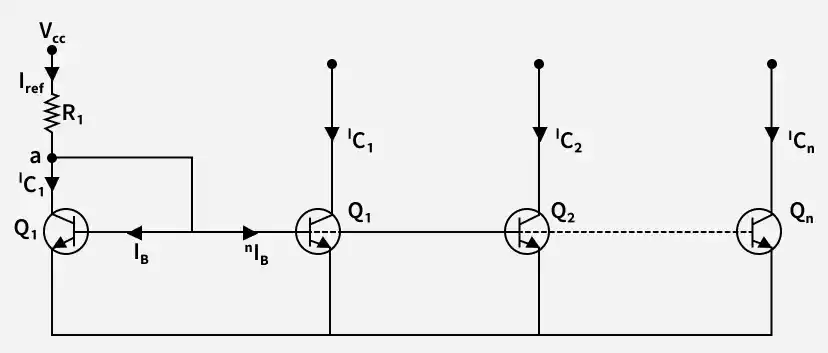
- One transistor acts as the reference transistor.
- Multiple identical transistors act as output transistors.
- All bases are connected together.
If transistors are identical:
Each branch receives approximately the same current.
Mathematical Analysis
Applying KCL at the collector node of the reference transistor:
Assuming identical transistors:
Substituting:
Thus,
For large
This shows that as the number of output branches increases, base current error increases.
Current Scaling
Different output current values can be achieved by:
- Changing transistor emitter area
- Adding emitter resistors (similar to Widlar configuration)
- Thus, unequal but controlled current distribution is possible.
Key Features
- Provides multiple output currents
- Simple extension of basic current mirror
- Useful for bias distribution
- Accuracy depends on
\beta - Suitable for identical current replication
Advantages
- Multiple Outputs from Single Reference : One reference current can drive several loads.
- Simple Design : Only additional matched transistors are required.
- Compact Implementation : Easily fabricated in ICs.
- Uniform Current Distribution : Identical branches receive nearly equal current.
Disadvantages
- Base Current Error Increases with n : More output branches increase error.
- Depends on Transistor Matching : Mismatch causes unequal currents.
- Finite
\beta Reduces Accuracy : Output current slightly less than reference. - Limited Output Resistance : Affected by Early effect.
Applications
1. Bias Distribution Networks : Supplies identical bias currents to multiple amplifier stages.
2. Differential Amplifier Arrays : Provides equal tail currents in multi-stage systems.
3. Operational Amplifiers : Distributes internal bias current to different internal blocks.
4. Analog IC Design : Used where repeated identical currents are required.
5. Current Steering Circuits : Directs controlled current to multiple branches.
