

In real-world amplifier circuits, the amplifier's gain varies throughout all input signal frequencies. The amplifier's frequency response is the change in amplifier gain in relation to the input signal's frequency.
- Electronic circuits frequently employ Bipolar Junction Transistor (BJT) amplifiers for signal augmentation.
- However, when the frequency of the input signal changes, so does their performance.
- The efficiency of the amplifier at various frequencies is influenced by certain circuit elements, such as capacitors and the intrinsic properties of the transistor.
- The range of frequencies at which a BJT amplifier can deliver steady and dependable amplification can be ascertained by examining the amplifier's frequency response.
- Numerous electronic applications, including signal processing circuits, audio electronics, and communication systems, depend on this range.
Frequency Response Curve
A voltage gain vs frequency graph is typically used to depict the frequency response of a BJT amplifier. This graphic illustrates how the amplifier gain varies as the input signal's frequency rises. The gain in a typical frequency response curve diminishes at extremely low or very high frequencies and stays almost constant for a specific range of frequencies.
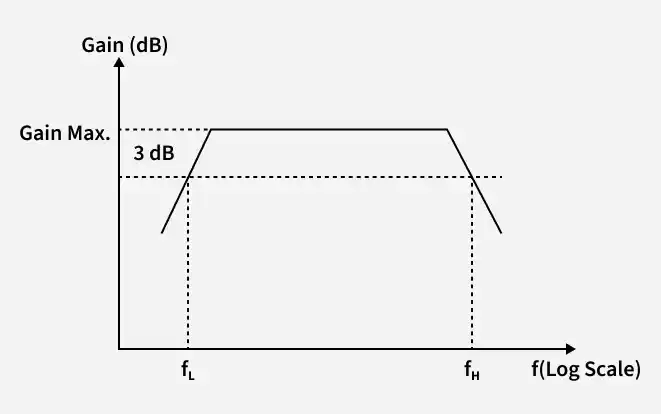
This behavior allows for the division of an amplifier's frequency response into three primary regions:
- Low-frequency region
- Mid-band region
- High-frequency region
These fields support engineers in analyzing and designing amplifiers that meet the required operating frequency range.
Frequency Regions of BJT Amplifier
Low-Frequency Region
The band where the input signal frequency is comparatively low. In this area, the amplifier's gain progressively drops as the frequency drops. The coupling and bypass capacitors in the amplifier circuit are primarily responsible for this behavior.
Mid-Band Region
Frequency range in which an amplifier operates with maximum and nearly constant gain. In this region, reactive components have minimal effect, so the amplifier behaves almost like a resistive circuit.
High-Frequency Region
When the frequency of the input signal increases significantly, the high-frequency zone is reached. As the frequency rises in this area, the amplifier's gain starts to decline.
Cutoff Frequencies
The transition points between the mid-band region and the other two regions. These frequencies mark the limits where the amplifier gain starts to drop significantly.
Lower Cutoff Frequency: Represented as
Upper Cutoff Frequency: Represented as
Bandwidth of the Amplifier
The range of frequencies over which an amplifier may function efficiently with almost constant gain is known as its bandwidth.
It is computed as the difference between the lower and upper cutoff frequencies:
The bandwidth indicates the usable frequency range of the amplifier and plays an important role in determining the overall performance of the circuit.
Gain-Bandwidth Product
A relationship between gain and bandwidth in various amplifier circuits.
- This idea states that for a particular device, the product of the amplifier gain and its bandwidth stays roughly constant.
- This implies that an amplifier's bandwidth often reduces as its gain increases and vice versa.
- When designing amplifiers, engineers can better balance amplification strength and frequency range by being aware of this relationship.
Importance
- Establishes operating range: Assists in determining the frequency range in which the amplifier operates efficiently.
- Verifies appropriate signal amplification: Enables engineers to determine whether signals may be amplified without significant gain loss or distortion.
- Helps in circuit design: Assists designers in selecting suitable circuit components such as resistors and capacitors.
- Improves amplifier performance: Ensures the amplifier operates efficiently within the required bandwidth.
Factors Affecting Frequency Response
Several factors influence the frequency response of a BJT amplifier. These factors determine how the gain of the amplifier varies with frequency.
- Coupling and Bypass Capacitors: These capacitors affect the amplifier performance at low frequencies.
- Internal Transistor Capacitances: Capacitances present inside the transistor influence the amplifier behavior at high frequencies.
- Circuit Resistances: The resistances used in the amplifier circuit interact with capacitive elements and affect the overall response.
- Stray Capacitances: Unwanted capacitances due to wiring, layout, and device packaging also affect high-frequency performance.
