

In a basic current mirror, the output current accuracy depends on the transistor current gain
- To overcome this limitation without changing the transistor current gain
\beta , a Modified Current Mirror is used. - This configuration reduces the error caused by base currents and improves current mirroring accuracy.
Need
In a basic current mirror:
- The reference transistor must supply base currents of all output transistors.
- As the number of output branches increases, total base current increases.
- For lower values of
\beta , the error becomes significant. - The output current reduces from the ideal value.
Therefore, an improved configuration is required to minimize base current error.
Circuit Concept
In the modified current mirror:
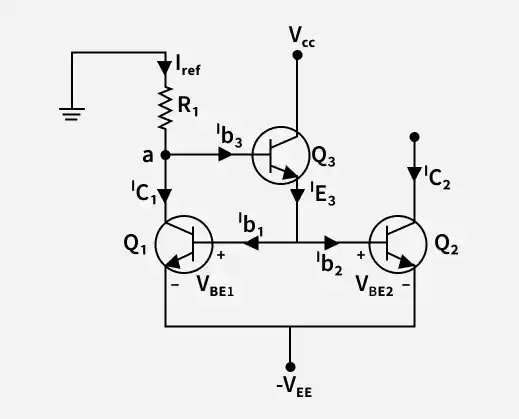
- An additional transistor is introduced.
- This transistor supplies the required base currents.
- The reference branch is relieved from feeding multiple base currents.
- Accuracy improves even when
\beta is moderate.
This configuration works effectively when the number of output transistors (n+1) is greater than 10.
Mathematical Analysis
Applying KCL at the reference node:
Since:
For identical transistors:
Substituting:
In general, for n+1 total transistors:
For large n and practical cases:
Thus, the modified circuit significantly reduces the effect of base current error.
Key Features
- Reduces base current error
- Improves accuracy of mirrored current
- Works better for moderate
\beta - Suitable for multiple output branches
- Does not require changing transistor gain
Advantages
- Improved Accuracy : Output current is closer to reference current.
- Less Dependence on
\beta : Performs well even when current gain is moderate. - Suitable for Multiple Outputs : Effective when many output transistors are used.
- Better Bias Stability : Used in precision bias circuits.
- No Need for Very High
\beta : Practical for real transistors.
Disadvantages
- Increased Circuit Complexity : More transistors compared to basic mirror.
- Higher Chip Area : Slight increase in silicon area in IC fabrication.
- Still Not Ideal : Some dependence on
\beta remains. - Design Complexity : Requires careful transistor matching.
Applications
1. Bias Networks in Analog ICs : Used to generate stable bias currents.
2. Differential Amplifiers : Provides accurate current replication for active loads.
3. Operational Amplifiers : Used in internal current biasing stages.
4. Current Distribution Circuits : Supplies identical current to multiple branches.
5. Analog Integrated Circuits : Used where high-accuracy current mirroring is required.
