

Amplifiers are essential components in electronic circuits used to increase the strength of electrical signals. Depending on the magnitude of the input signal compared to the DC bias value, amplifiers can be classified into different types.
Based on the variation of the input signal, amplifiers are broadly divided into two categories:
- Small Signal Amplifiers
- Large Signal Amplifiers
This classification helps in understanding how the transistor behaves during amplification and what type of application the amplifier is suitable for.
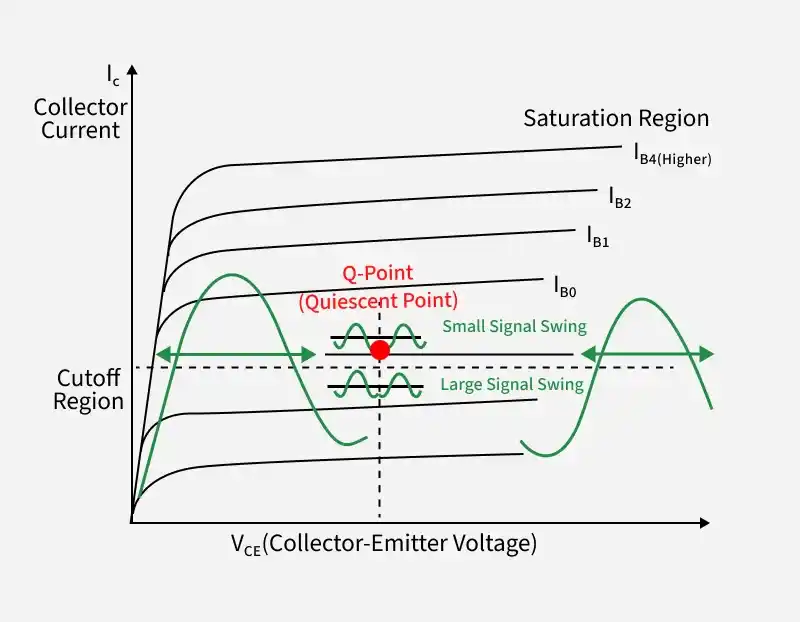
Small Signal Amplifier
A small signal amplifier is an amplifier in which the variation of the input signal is very small compared to the DC bias value applied to the transistor.
- In this type of amplifier, the transistor operates only in a small region around the operating point (Q-point).
- Even though a Bipolar Junction Transistor (BJT) is inherently a nonlinear device, it behaves almost linearly for small variations in the input signal.
- Because of this near-linear behavior, the output signal closely follows the input signal without significant distortion. For this reason, small signal amplifiers are mainly used to amplify weak voltage signals.
Characteristics
- The input signal amplitude is very small.
- The transistor operates near the Q-point in the linear region.
- The output signal is accurate and distortion-free.
- These amplifiers provide high voltage gain.
- They consume relatively low power.
Working Idea
When a small AC signal is applied at the input, it causes a small change in the base current of the transistor. This small change produces a larger change in the collector current, which results in a larger voltage across the load resistor.
Since the variations are small, the transistor remains within the linear operating region, ensuring faithful amplification.
Applications
Small signal amplifiers are used in circuits where weak signals must be amplified before further processing. Some common applications include:
- Microphone amplifiers: Amplify the very weak electrical signal produced by a microphone so it can be processed or recorded.
- Radio receiver circuits: Increase the strength of weak radio frequency signals received by an antenna for proper detection and processing.
- Sensor signal amplification: Boost the low-level signals generated by sensors (such as temperature or pressure sensors) so they can be measured accurately.
- Audio preamplifiers: Amplify low-level audio signals before sending them to a power amplifier.
- Instrumentation systems: Amplify small measurement signals in instruments to improve accuracy and readability.
Large Signal Amplifier
A large signal amplifier is an amplifier in which the variation of the input signal is large compared to the DC bias value.
- In this case, the transistor operates over a large portion of its characteristic curve.
- Because of these large variations, the transistor behaves as a nonlinear device, which may introduce some distortion in the output signal.
- However, the primary objective of a large signal amplifier is not perfect linearity but delivering high power to the load. Therefore, these amplifiers are commonly used as power amplifiers.
Characteristics
- The input signal amplitude is large.
- The transistor operates over a wide region of operation.
- Some signal distortion may occur.
- Designed to deliver high output power.
- Typically used in the final stage of amplification.
Working Idea
In a large signal amplifier, the input signal causes significant changes in transistor current and voltage. These variations allow the amplifier to transfer a large amount of power from the DC supply to the load.
Because the signal swings over a wider range, the transistor may enter nonlinear regions, which can lead to distortion. However, the circuit is designed to maximize power transfer.
Applications
Large signal amplifiers are used in applications where high power output is required. Some examples include:
- Audio power amplifiers: Increase the power of audio signals so they can drive speakers effectively.
- Public address systems: Amplify sound signals to produce loud audio for large audiences in halls or public places.
- Radio transmitters: Boost the power of RF signals so they can be transmitted over long distances through antennas.
- Loudspeaker driving circuits: Provide sufficient power to operate loudspeakers and produce audible sound.
- Power stages in communication systems: Amplify signals at the final stage of communication circuits before transmission.
Small Signal vs Large Signal Amplifiers
| Parameter | Small Signal Amplifier | Large Signal Amplifier |
|---|---|---|
| Input Signal | Very small compared to DC bias | Large compared to DC bias |
| Transistor Operation | Operates in linear region | Operates in nonlinear region |
| Distortion | Very low | May occur |
| Gain Type | Mainly voltage gain | Mainly power gain |
| Power Output | Low | High |
| Applications | Preamplifiers, sensors | Audio power amplifiers |
