

An improved current mirror configuration that uses three transistors to provide highly accurate current replication.
- It significantly reduces base current error and increases output resistance compared to the basic two-transistor current mirror.
- Because of its improved accuracy and high output impedance, the Wilson current mirror is widely used in precision analog integrated circuits.
Need
In a basic current mirror:
- Base current causes output current error.
- Output resistance is limited due to the Early effect.
- Accuracy depends heavily on
\beta
To overcome these limitations, the Wilson current mirror introduces a feedback mechanism using an additional transistor.
Circuit Concept
The Wilson current mirror uses three transistors:
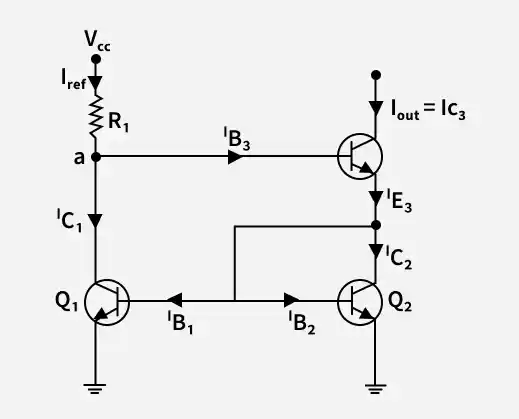
- Q1: Reference transistor
- Q2: Output transistor
- Q3: Feedback transistor
The third transistor provides negative feedback that:
- Compensates base current error
- Increases output resistance
- Improves current matching
Mathematical Analysis
Applying KCL at internal nodes and assuming identical transistors:
After analysis, the output current is obtained as:
For large
The error between
This error is extremely small even for moderate values of
Output Resistance Improvement
The Wilson mirror increases output resistance approximately by a factor of:
This makes it behave much closer to an ideal current source compared to the basic mirror.
Key Features
- Uses three transistors
- Very small static current error
- High output resistance
- Negative feedback improves stability
- Suitable for precision current mirroring
Advantages
- Very High Accuracy : Base current error is greatly reduced.
- High Output Resistance : Improved current source behavior.
- Reduced Dependence on
\beta : Works well even with moderate gain. - Better Stability : Negative feedback enhances performance.
Disadvantages
- Higher Minimum Voltage Requirement : Requires more voltage headroom than basic mirror.
- Increased Circuit Complexity : Uses three transistors.
- Higher Noise Contribution : All three transistors contribute noise.
- Not Suitable for Multiple Independent Outputs : Cannot easily generate many identical outputs from one reference.
Applications
1. Precision Bias Circuits : Used where accurate current matching is required.
2. Operational Amplifiers : Forms high-accuracy internal current mirrors.
3. Active Loads in Amplifiers : Provides high output resistance for higher gain.
4. Analog Integrated Circuits : Used in high-performance analog IC blocks.
5. Low-Error Current Sources : Suitable where minimal input-output error is required.
