

A coset is a subset of a group formed by multiplying every element of a subgroup by a fixed element of the group.
- It helps us understand how a subgroup is positioned within the larger group and is one of the most important concepts in group theory.
- It divides a group into equal-sized, non-overlapping subsets.
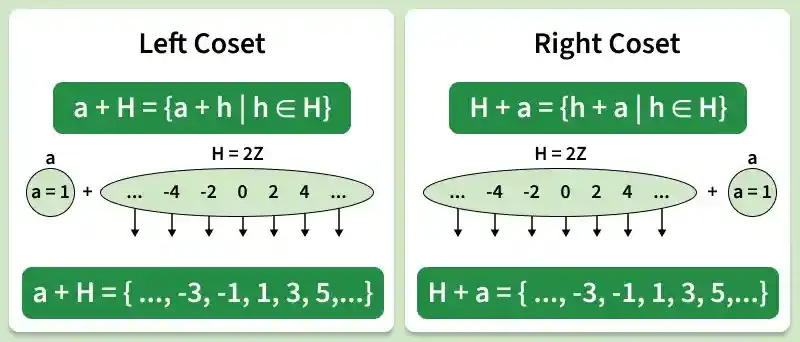
Suppose G is a group and H is a subgroup of G. If a is any element of G, then combining a with every element of H forms a coset.
Example: Let G = (Z,+), H = 2Z
Choose the element 1 ∈ G
Then, 1+H = {…, −3, −1, 1, 3, 5,…}
This set contains all odd integers and is a coset of H.
Since cosets are formed depending on the side on which the fixed element is combined with the subgroup, they are classified into two types.
1. Left Cosets
A left coset of a subgroup H in a group G is obtained by multiplying a fixed element 'a' from the left with every element of the subgroup.
aH = {ah ∣ h ∈ H} , where a ∈ G , H ≤ G
In Left cosets, if two elements g1 and g2 of G belong to the same left coset, then the cosets g1H and g2H are identical.
Example
Consider G = (Z,+), H = {0,3,6,9,…}
Choose a = 1
Then, 1+H = {1,4,7,10,…}
Thus, aH = {1,4,7,10,…} is a left coset.
2. Right Cosets
A right coset of a subgroup H is obtained by multiplying a fixed element from the right with every element of the subgroup.
Ha = { ha ∣ h ∈ H}, where a ∈ G , H ≤ G
Example
Consider G = (Z,+), H = {0,3,6,9,…}
Choose a = 1
Then, H + 1 = {1,4,7,10,…}
Hence, Ha = {1, 4, 7, 10,…}
Since addition is commutative, aH = Ha
Therefore, in an abelian group, left and right cosets are the same.
Properties
The following are the important properties of cosets.
1. Every Coset Has the Same Number of Elements as the Subgroup i.e., if H has n elements, then every left or right coset of H also contains n elements.
2. Cosets Are Either Equal or Disjoint i.e, if aH ∩ bH ≠ ∅, then aH = bH
3. Each element of the group belongs to one and only one coset of a given subgroup.
4. All cosets together divide the group into disjoint subsets.
For example, Z = 2Z ∪ (1 + 2Z), where the two sets have no common elements.
5. The total number of distinct cosets is called the index of the subgroup i.e,
[G:H]=\frac{|G|}{|H|} for finite groups.6. If e is the identity element of the group, then eH = H = He
Steps to find cosets
The following steps can be used to determine all distinct cosets of a subgroup.
Step 1: Identify the Group and the Subgroup
Example: G = Z6 ={0,1,2,3,4,5}, H={0,3}
Step 2: Choose an Element from the Group a∈G
For example, a = 1.
Step 3: Form the Coset i.e multiply (or add, depending on the group operation) the chosen element with every element of the subgroup.
For a left coset, aH = {ah ∣ h ∈ H}
For the example, 1 + H = {1+0, 1+3} = {1,4}
Step 4: Choose another element from the group and repeat the process.
For example, 2 + H = {2,5} and 3+H = {3,0} = {0,3} = H.
Step 5: If a newly obtained coset is identical to an existing one, do not count it again.
For the example, the distinct cosets are {0,3}, {1,4}, {2,5}.
Thus, there are three distinct cosets.
Relation Between Cosets and Lagrange's Theorem
Cosets provide the foundation for Lagrange's Theorem. Since every coset of a subgroup has the same number of elements as the subgroup, and the cosets partition the group without overlapping, the order of the group can be expressed as the product of the order of the subgroup and the number of distinct cosets.
If G is a finite group and H is a subgroup of G, then
∣G∣ = [G : H] × ∣H∣
where:
- ∣ G∣ is the order of the group,
- ∣ H ∣ is the order of the subgroup,
- [ G:H ] is the index of H, i.e., the number of distinct cosets of H in G.
This leads directly to Lagrange's Theorem.
➢Practice: Solved Examples
