

A cyclic group is a group in which every element of the group can be obtained by repeatedly applying the group operation to a single element, known as the generator of the group.
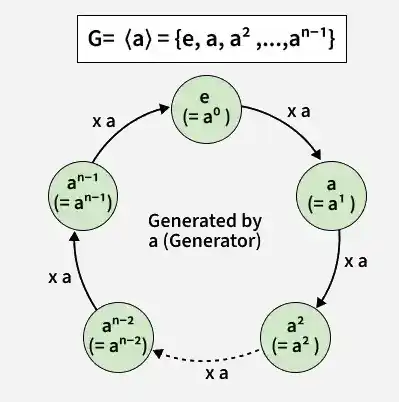
If a group (G) has an element (a) such that every element of (G) can be written as a power (or repeated addition) of (a), then (G) is called a cyclic group.
A cyclic group is represented as
G = \langle a\rangle where (a) is the generator of the group.
For multiplicative groups,
For additive groups,
Types of cyclic groups
Finite Cyclic Groups
- The group of integers modulo n, denoted Zn, is a cyclic group. It consists of the integers {0, 1 , 2, … ,n−1} under addition modulo n. The generator is 1 because every element can be written as 1⋅k (mod n) for some integer k.
Infinite Cyclic Group
- The group of all integers Z under addition is an infinite cyclic group. The generator can be 1 (or −1), because every integer nnn can be written as 1 ⋅ n or (-1) ⋅ (−n).
Properties
Some of the common properties of cyclic group are:
- Every cyclic group is also an Abelian group.
- If G is a cyclic group with generator g and order n. If m < n, then the order of the element gm is given by,
|g^{m}| = \frac{n}{gcd(m, n)} - Every subgroup of a cyclic group is cyclic.
- If G is a finite cyclic group with order n, the order of every element in G divides n.
- If d is a positive divisor of n, the number of elements of order d in a cyclic group of order n is Φ(d), where Φ(d) is Euler Phi function.
- The order of a cyclic group and the order of its generator is same.
Steps to Determine Cyclic Group
A group is cyclic if there exists at least one element that generates every element of the group.
- Choose an element of the group.
- Repeatedly apply the group operation.
- List all distinct elements obtained.
- If every group element appears exactly once before the sequence repeats, then the chosen element is a generator.
- If at least one generator exists, the group is cyclic.
➢Practice: Solved Examples
