

A vector subspace (or simply a subspace) is a subset of a vector space that is itself a vector space under the same operations of vector addition and scalar multiplication. A subspace inherits all the properties of the parent vector space.
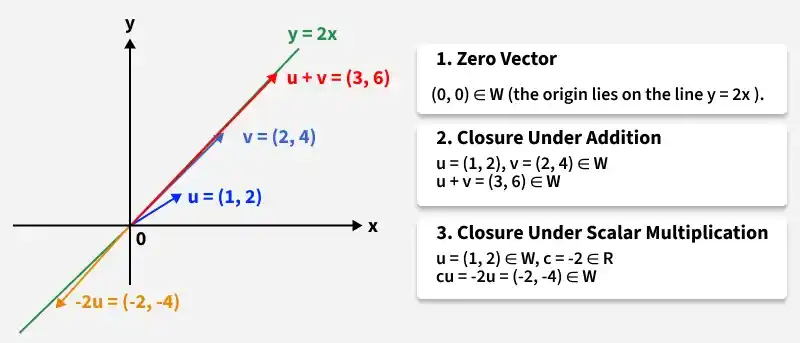
Let V be a vector space over a field F (such as ℝ or ℂ), and let W be a subset of V. Then W is a subspace of V if:
- Zero Vector: The zero vector of V is in W.
- Closure under Addition: For any u, v ∈ W, the sum u + v ∈ W.
- Closure under Scalar Multiplication: For any u ∈ W and any scalar c ∈ F, the product c·u ∈ W.
These conditions ensure that W is a subspace of V.
Subspace Test
A non-empty subset W of a vector space V is a subspace if, for all vectors u,v ∈ W and scalars a,b ∈ F,
au + bv ∈ W
This single condition combines closure under addition and scalar multiplication and is often used to verify whether a set is a subspace.
Examples
1. Trivial Subspace{0}: The set containing only the zero vector is always a subspace of any vector space.
2. Entire Vector Space: V itself is a subspace of V.
3. Lines and Planes through the Origin in ℝ3:
- Any line through the origin in ℝ3 is a one-dimensional subspace.
- Any plane through the origin in ℝ3 is a two-dimensional subspace.
4. Solution Sets to Homogeneous Linear Equations:
Consider the equation Ax = 0, where A is a matrix. The set of all solutions x forms a subspace called the null space or kernel of A.
5. Column Space and Row Space:
The set of all linear combinations of the columns of a matrix A is the column space of A, a subspace of ℝⁿ if A has n rows. Similarly, the row space is the set of all linear combinations of the rows of A.
6. Polynomials of Degree ≤ k:
The set Pk of all polynomials of degree at most k is a subspace of the vector space of all polynomials.
Properties
Some of the common properties of vector subspaces are:
1. Containment of the Zero Vector: Every subspace must include the zero vector .
2. Closure Under Addition and Scalar Multiplication: If you add any two vectors in the subspace, the result is still within the subspace and if you multiply any vector in the subspace by a scalar, the result remains in the subspace.
3. Intersection and Union: The intersection of any collection of subspaces is also a subspace. However, the union of two subspaces is generally not a subspace unless one is contained within the other.
4. Dimension: The dimension of a subspace is the number of vectors in a basis for that subspace. It cannot exceed the dimension of the parent vector space.
