

Java pattern programs are commonly used to practice loops, nested loops, conditional statements, and logical thinking. In these programs, characters, numbers, or symbols are printed in a specific arrangement based on the given number of rows and columns.
- Conditional statements are often used to decide whether to print a character, number, or space.
- Spaces are important for creating aligned and symmetric patterns.
- Pattern programs can contain star, number, character, hollow, and mathematical patterns.
Prerequisite: Before solving pattern programs, you should have a basic understanding of Java syntax and loops such as
for,while, anddo-while.
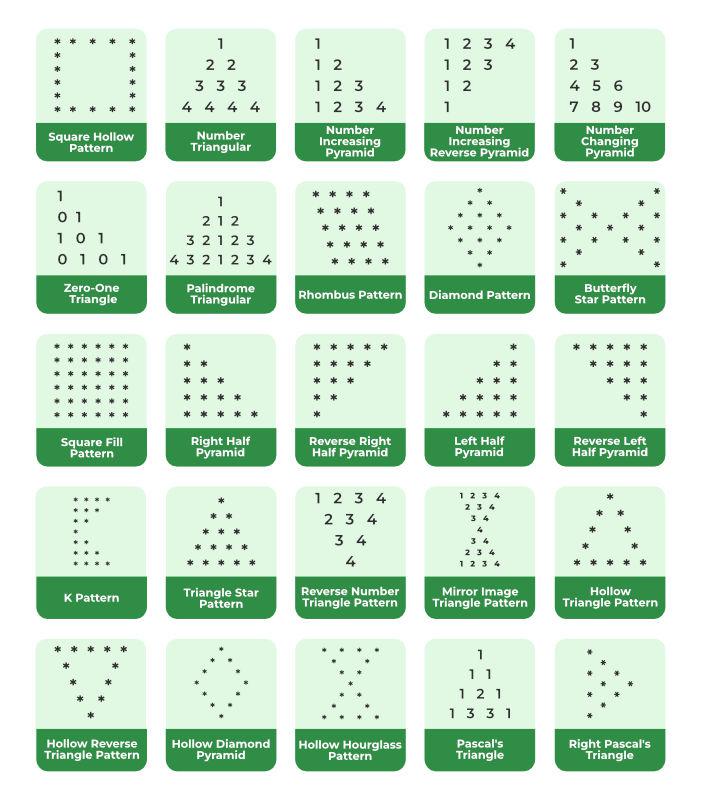
Java Pattern Programs
Some Pattern Programs in Java are mentioned below:
1. Square Hollow Pattern
This program prints a square where the border is filled with stars (*), and the inside is hollow (filled with spaces).
import java.util.*;

public class Geeks {

    public static void printPattern(int n)
    {
        int i, j;

        // outer loop to handle number of rows
        for (i = 0; i < n; i++) {

            //  inner loop to handle number of columns
            for (j = 0; j < n; j++) {

                // star will print only when  it is in first
                // row or last row or first column or last
                // column
                if (i == 0 || j == 0 || i == n - 1
                    || j == n - 1) {
                    System.out.print("*");
                }

                // otherwise print space only
                else {
                    System.out.print(" ");
                }
            }
            System.out.println();
        }
    }

    // Driver Function
    public static void main(String args[])
    {
        int n = 6;
        printPattern(n);
    }
}
Output
******
*    *
*    *
*    *
*    *
******
Explanation: This program prints a square with stars on the boundary and spaces inside. The outer loop controls the rows, while the inner loop controls the columns. A star is printed when the position is in the first or last row or column.
2. Number Triangle Pattern
Prints a right-angled triangle with numbers in increasing row order, aligned to the right.
import java.util.*;

public class Geeks {

    // Function to demonstrate pattern
    public static void printPattern(int n)
    {
        int i, j;

        // outer loop to handle number of rows
        for (i = 1; i <= n; i++) {

            // inner loop to print space
            for (j = 1; j <= n - i; j++) {
                System.out.print(" ");
            }

            // inner loop to print star
            for (j = 1; j <= i; j++) {
                System.out.print(i + " ");
            }

            // print new line for each row
            System.out.println();
        }
    }

    // Driver Function
    public static void main(String args[])
    {
        int n = 6;
        printPattern(n);
    }
}
Output
     1
    2 2
   3 3 3
  4 4 4 4
 5 5 5 5 5
6 6 6 6 6 6
Explanation: This program prints a right-angled triangle where each row contains the same number repeated. The outer loop controls the rows, and the inner loop prints the row number i multiple times.
3. Number-Increasing Pyramid Pattern
Prints a pyramid where each row contains numbers from 1 to the row number.
import java.util.*;

public class Geeks {

    // Function to demonstrate pattern
    public static void printPattern(int n)
    {
        int i, j;

        // outer loop to handle number of rows
        for (i = 1; i <= n; i++) {

            // inner loop to handle number of columns
            for (j = 1; j <= i; j++) {

                // printing column values
                // upto the row value
                System.out.print(j + " ");
            }

            // print new line for each row
            System.out.println();
        }
    }

    // Driver Function
    public static void main(String args[])
    {
        int n = 6;
        printPattern(n);
    }
}
Output
1
1 2
1 2 3
1 2 3 4
1 2 3 4 5
1 2 3 4 5 6
Explanation: This pattern prints numbers from 1 to the row number in each row. The inner loop starts from 1 and continues up to i.
4. Number-Increasing Reverse Pyramid Pattern
This is a reverse pyramid where each row starts from 1 and ends at the row count, in decreasing number of elements.
import java.util.*;

public class Geeks {
        public static void printPattern(int n)
    {
        int i, j;

        // outer loop to handle number of rows
        for (i = n; i >= 1; i--) {

            // inner loop to handle number of columns
            for (j = 1; j <= i; j++) {

                // printing column values
                // upto the row value
                System.out.print(j + " ");
            }

            // print new line for each row
            System.out.println();
        }
    }

    // Driver Function
    public static void main(String args[])
    {
        int n = 6;
        printPattern(n);
    }
}
Output
1 2 3 4 5 6
1 2 3 4 5
1 2 3 4
1 2 3
1 2
1
Explanation: This is the reverse form of the previous pattern. The outer loop starts from n and decreases to 1, while each row prints numbers from 1 to the current row value.
5. Number-Changing Pyramid Pattern
Prints a pyramid where numbers increase continuously from top to bottom.
import java.util.*;

public class Geeks {

    public static void printPattern(int n)
    {
        int i, j;
        int num = 1;

        // outer loop to handle number of rows
        for (i = 1; i <= n; i++) {

            // inner loop to handle number of columns
            for (j = 1; j <= i; j++) {

                // printing value of num in each iteration
                System.out.print(num + " ");

                // increasing the value of num
                num++;
            }

            // printing new line for each row
            System.out.println();
        }
    }

    // Driver Function
    public static void main(String args[])
    {
        int n = 6;
        printPattern(n);
    }
}
Output
1
2 3
4 5 6
7 8 9 10
11 12 13 14 15
16 17 18 19 20 21
Explanation: This program prints numbers that continue increasing across all rows. The variable num starts at 1 and is incremented after every number printed.
6. Zero-One Triangle Pattern
Prints a triangle where each number alternates between 1 and 0 based on the position.
import java.util.*;

public class Geeks {

    public static void printPattern(int n)
    {
        int i, j;

        //outer loop to handle number of rows
        for (i = 1; i <= n; i++) {

            //inner loop to handle number of columns
            for (j = 1; j <= i; j++) {

                // if the sum of (i+j) is even then print 1
                if ((i + j) % 2 == 0) {
                    System.out.print(1 + " ");
                }
                // otherwise print 0
                else {
                    System.out.print(0 + " ");
                }
            }

            //printing new line for each row
            System.out.println();
        }
    }

    // Driver Function
    public static void main(String args[])
    {
        int n = 6;
        printPattern(n);
    }
}
Output
1
0 1
1 0 1
0 1 0 1
1 0 1 0 1
0 1 0 1 0 1
Explanation: This pattern prints 1 and 0 alternately. The program checks whether i + j is even or odd to decide which number to print.
7. Palindrome Triangle Pattern
Prints a triangle with mirrored numbers forming a palindrome on each row.
import java.util.*;

public class Geeks {

    public static void printPattern(int n)
    {
        int i, j;

        // outer loop to handle number of rows
        for (i = 1; i <= n; i++) {

            // inner loop to print the spaces
            for (j = 1; j <= 2 * (n - i); j++) {
                System.out.print(" ");
            }

            // inner loop to print the first part
            for (j = i; j >= 1; j--) {
                System.out.print(j + " ");
            }

            // inner loop to print the second part
            for (j = 2; j <= i; j++) {
                System.out.print(j + " ");
            }

            // printing new line for each row
            System.out.println();
        }
    }

    // Driver Function
    public static void main(String args[])
    {
        int n = 6;
        printPattern(n);
    }
}
Output
          1
        2 1 2
      3 2 1 2 3
    4 3 2 1 2 3 4
  5 4 3 2 1 2 3 4 5
6 5 4 3 2 1 2 3 4 5 6
Explanation: This pattern prints numbers in a palindromic form. Each row first prints numbers in decreasing order and then in increasing order, with spaces used for alignment.
8. Rhombus Pattern
Prints a rhombus (tilted square) made of stars, shifted by spaces.
import java.util.*;

public class Geeks {

    public static void printPattern(int n)
    {
        int i, j;
        int num = 1;

        // outer loop to handle number of rows
        for (i = 1; i <= n; i++) {

            // inner loop to print spaces
            for (j = 1; j <= n - i; j++) {
                System.out.print(" ");
            }

            // inner loop to print stars
            for (j = 1; j <= n; j++) {
                System.out.print("*");
            }

            // printing new line for each row
            System.out.println();
        }
    }

    // Driver Function
    public static void main(String args[])
    {
        int n = 6;
        printPattern(n);
    }
}
Output
     ******
    ******
   ******
  ******
 ******
******
Explanation: This program prints a slanted square (rhombus) using stars. Spaces are printed before the stars in each row to shift the pattern gradually to the right.
9. Diamond Star Pattern
Prints a diamond shape made of stars.
import java.util.*;

public class Geeks {

    public static void printPattern(int n)
    {
        int i, j;
        int num = 1;

        // outer loop to handle upper part
        for (i = 1; i <= n; i++) {

            // inner loop to print spaces
            for (j = 1; j <= n - i; j++) {
                System.out.print(" ");
            }

            // inner loop to print stars
            for (j = 1; j <= 2 * i - 1; j++) {
                System.out.print("*");
            }
            System.out.println();
        }

        // outer loop to handle lower part
        for (i = n-1; i >= 1; i--) {

            // inner loop to print spaces
            for (j = 1; j <= n - i; j++) {
                System.out.print(" ");
            }

            // inner loop to print stars
            for (j = 1; j <= 2 * i - 1; j++) {
                System.out.print("*");
            }
            System.out.println();
        }
    }

    // Driver Function
    public static void main(String args[])
    {
        int n = 6;
        printPattern(n);
    }
}
Output
     *
    ***
   *****
  *******
 *********
***********
 *********
  *******
   *****
    ***
     *
Explanation: This program prints a diamond shape using stars. It has two parts: the upper half increases the number of stars, while the lower half decreases them.
10. Butterfly Star Pattern
Prints a butterfly-shaped pattern using stars (*).
import java.util.*;

public class Geeks {

    public static void printPattern(int n)
    {
        // Outer loop to handle the upper part
        for (int i = 1; i <= n; i++) {
            for (int j = 1; j <= 2 * n; j++) {

                // To print spaces
                if (j > i && j <= 2 * n - i) {
                    System.out.print(" ");
                }

                // To print stars
                else {
                    System.out.print("*");
                }
            }
            System.out.println();
        }

        // Outer loop to handle the lower part
        for (int i = n; i >= 1; i--) {
            for (int j = 1; j <= 2 * n; j++) {

                // To print spaces
                if (j > i && j <= 2 * n - i) {
                    System.out.print(" ");
                }

                // To print stars
                else {
                    System.out.print("*");
                }
            }
            System.out.println();
        }
    }

    // Driver Function
    public static void main(String[] args)
    {
        // Number of rows
        int n = 6;
        printPattern(n);
    }
}
Output
*          *
**        **
***      ***
****    ****
*****  *****
************
************
*****  *****
****    ****
***      ***
**        **
*          *
Explanation: This pattern prints a butterfly shape. Each row contains stars on both sides with spaces in the middle. The pattern is created using separate upper and lower sections.
11. Square Fill Pattern
This program prints a filled square of stars (*) with n+1 rows and columns.
import java.util.*;

public class Geeks {

    public static void printPattern(int n)
    {
        int i, j;

        // outer loop to handle rows
        for (i = 0; i < n; i++) {

            // inner loop to handle columns
            for (j = 0; j < n; j++) {
                System.out.print("*");
            }

            // printing new line for each row
            System.out.println();
        }
    }

    // Driver Function
    public static void main(String args[])
    {
        int n = 6;
        printPattern(n);
    }
}
Output
******
******
******
******
******
******
Explanation: This program prints a filled square of stars. Both the outer and inner loops run n times, so every row contains n stars.
12. Right Half Pyramid Pattern
This creates a right-angled triangle aligned to the left using stars.
import java.util.*;

public class Geeks {

    public static void printPattern(int n)
    {
        int i, j;

        // outer loop to handle rows
        for (i = 1; i <= n; i++) {

            // inner loop to handle columns
            for (j = 1; j <= i; j++) {
                System.out.print("*");
            }

            // printing new line for each row
            System.out.println();
        }
    }

    // Driver Function
    public static void main(String args[])
    {
        int n = 6;
        printPattern(n);
    }
}
Output
*
**
***
****
*****
******
Explanation: This pattern prints a left-aligned right triangle of stars. The number of stars increases by one in each row.
13. Reverse Right Half Pyramid Pattern
This prints a right-aligned triangle but in reverse top to bottom.
import java.util.*;

public class Geeks {

    public static void printPattern(int n)
    {
        int i, j;

        // outer loop to handle rows
        for (i = n; i >= 1; i--) {

            // inner loop to handle columns
            for (j = 1; j <= i; j++) {
                System.out.print("*");
            }

            // printing new line for each row
            System.out.println();
        }
    }

    // Driver Function
    public static void main(String args[])
    {
        int n = 6;
        printPattern(n);
    }
}
Output
******
*****
****
***
**
*
Explanation: This is the reverse of the right half pyramid. It starts with n stars and decreases the number of stars by one in each row.
14. Left Half Pyramid Pattern
This pattern aligns a triangle to the right by adding spaces before stars.
import java.util.*;

public class Geeks {

    public static void printPattern(int n)
    {
        int i, j;

        // outer loop to handle rows
        for (i = n; i >= 1; i--) {

            // inner loop to print spaces.
            for (j = 1; j < i; j++) {
                System.out.print(" ");
            }

            // inner loop to print stars.
            for (j = 0; j <= n - i; j++) {
                System.out.print("*");
            }

            // printing new line for each row
            System.out.println();
        }
    }

    // Driver Function
    public static void main(String args[])
    {
        int n = 6;
        printPattern(n);
    }
}
Output
     *
    **
   ***
  ****
 *****
******
Explanation: This pattern prints a right-aligned triangle. Spaces are printed before the stars to move the stars toward the right side.
15. Reverse Left Half Pyramid Pattern
This prints a left pyramid in reverse, starting from full-width and decreasing.
import java.util.*;

public class Geeks {

    public static void printPattern(int n)
    {
        int i, j;

        // outer loop to handle rows
        for (i = n; i > 0; i--) {

            // inner loop to print spaces.
            for (j = 0; j < n - i; j++) {
                System.out.print(" ");
            }

            // inner loop to print stars.
            for (j = 0; j < i; j++) {
                System.out.print("*");
            }

            // printing new line for each row
            System.out.println();
        }
    }

    // Driver Function
    public static void main(String args[])
    {
        int n = 6;
        printPattern(n);
    }
}
Output
******
 *****
  ****
   ***
    **
     *
Explanation: This pattern prints a right-aligned triangle in decreasing order. The number of stars decreases while the number of leading spaces increases.
16. Triangle Star Pattern
This prints an equilateral triangle where stars are spaced apart.
import java.util.*;

public class Geeks {

    public static void printPattern(int n)
    {
        int i, j;

        // outer loop to handle rows
        for (i = 0; i < n; i++) {

            // inner loop to print spaces.
            for (j = n - i; j > 1; j--) {
                System.out.print(" ");
            }

            // inner loop to print stars.
            for (j = 0; j <= i; j++) {
                System.out.print("* ");
            }

            // printing new line for each row
            System.out.println();
        }
    }

    // Driver Function
    public static void main(String args[])
    {
        int n = 6;
        printPattern(n);
    }
}
Output
     *
    * *
   * * *
  * * * *
 * * * * *
* * * * * *
Explanation: This program prints a center-aligned triangle. Spaces are printed first, followed by stars separated by spaces to form the triangular shape.
17. Reverse Number Triangle Pattern
A reverse right-aligned triangle with ascending numbers from i to n.
import java.util.*;

public class Geeks {

    public static void printPattern(int n)
    {
        int i, j;

        // outer loop to handle rows
        for (i = 1; i <= n; i++) {

            // inner loop to print spaces.
            for (j = 1; j < i; j++) {
                System.out.print(" ");
            }

            // inner loop to print value of j.
            for (j = i; j <= n; j++) {
                System.out.print(j + " ");
            }

            // printing new line for each row
            System.out.println();
        }
    }

    // Driver Function
    public static void main(String args[])
    {
        int n = 6;
        printPattern(n);
    }
}
Output
1 2 3 4 5 6
 2 3 4 5 6
  3 4 5 6
   4 5 6
    5 6
     6
Explanation: This pattern prints numbers from the current row number up to n. Leading spaces increase with each row, creating a right-aligned reverse triangle.
18. Mirror Image Triangle Pattern
This creates a mirrored triangle with numbers, forming a diamond-like shape.
import java.util.*;

public class Geeks {

    public static void printPattern(int n)
    {
        int i, j;

        // Printing the upper part
        for (i = 1; i <= n; i++) {

            // inner loop to print spaces.
            for (j = 1; j < i; j++) {
                System.out.print(" ");
            }
            // inner loop to print value of j.
            for (j = i; j <= n; j++) {
                System.out.print(j + " ");
            }

            // printing new line for each row
            System.out.println();
        }

        // Printing the lower part
        for (i = n - 1; i >= 1; i--) {

            // inner loop to print spaces.
            for (j = 1; j < i; j++) {
                System.out.print(" ");
            }

            // inner loop to print value of j.
            for (j = i; j <= n; j++) {
                System.out.print(j + " ");
            }

            // printing new line for each row
            System.out.println();
        }
    }

    // Driver Function
    public static void main(String args[])
    {
        int n = 6;
        printPattern(n);
    }
}
Output
1 2 3 4 5 6
 2 3 4 5 6
  3 4 5 6
   4 5 6
    5 6
     6
    5 6
   4 5 6
  3 4 5 6
 2 3 4 5 6
1 2 3 4 5 6
Explanation: This program creates a diamond-like mirrored number pattern by combining an upper and lower section. The numbers start from the current row value and continue to n.
19. Hollow Triangle Pattern
This prints a hollow equilateral triangle using stars with only the boundary.
import java.util.*;

public class Geeks {

    public static void printPattern(int n)
    {
        int i, j, k;

        // outer loop to handle rows
        for (i = 1; i <= n; i++) {

            // inner loop to print spaces.
            for (j = i; j < n; j++) {
                System.out.print(" ");
            }

            for (k = 1; k <= (2 * i - 1); k++) {

                // printing stars.
                if (k == 1 || i == n || k == (2 * i - 1)) {
                    System.out.print("*");
                }

                // printing spaces.
                else {
                    System.out.print(" ");
                }
            }

            System.out.println("");
        }
    }

    // Driver Function
    public static void main(String args[])
    {
        int n = 6;
        printPattern(n);
    }
}
Output
     *
    * *
   *   *
  *     *
 *       *
***********
Explanation: This program prints a hollow triangle. Stars are printed only at the left boundary, right boundary, and bottom row; spaces are printed inside.
20. Hollow Reverse Triangle Pattern
Prints an inverted hollow triangle with stars only at boundaries and top row.
import java.util.*;

public class Geeks {

    public static void printPattern(int n)
    {
        int i, j, k;

        // outer loop to handle rows
        for (i = n; i >= 1; i--) {

            // inner loop to print spaces.
            for (j = i; j < n; j++) {
                System.out.print(" ");
            }

            for (k = 1; k <= (2 * i - 1); k++) {

                // printing stars.
                if (k == 1 || i == n || k == (2 * i - 1)) {
                    System.out.print("*");
                }

                // printing spaces.
                else {
                    System.out.print(" ");
                }
            }

            System.out.println("");
        }
    }

    // Driver Function
    public static void main(String args[])
    {
        int n = 6;
        printPattern(n);
    }
}
Output
***********
 *       *
  *     *
   *   *
    * *
     *
Explanation: This is the inverted version of the hollow triangle.Stars form the outer boundary while the inside remains hollow.
21. Hollow Diamond Pyramid
Prints a symmetrical hollow diamond made of stars, with spaces in the middle and stars only at the borders.
import java.util.*;

public class Geeks {

    public static void printPattern(int n)
    {
        int i, j;

        // outer loop to handle upper part
        for (i = 1; i <= n; i++) {

            // inner loop to print spaces
            for (j = 1; j <= n - i; j++) {
                System.out.print(" ");
            }

            // inner loop to print stars
            for (j = 1; j <= 2 * i - 1; j++) {
                if (j == 1 || j == 2*i-1)
                    System.out.print("*");
                else
                    System.out.print(" ");
            }
            System.out.println();
        }

        // outer loop to handle lower part
        for (i = n-1; i >= 1; i--) {

            // inner loop to print spaces
            for (j = 1; j <= n - i; j++) {
                System.out.print(" ");
            }

            // inner loop to print stars
            for (j = 1; j <= 2 * i - 1; j++) {
                if (j == 1 || j == 2*i-1)
                    System.out.print("*");
                else
                    System.out.print(" ");
            }
            System.out.println();
        }
    }

    // Driver Function
    public static void main(String args[])
    {
        int n = 6;
        printPattern(n);
    }
}
Output
     *
    * *
   *   *
  *     *
 *       *
*         *
 *       *
  *     *
   *   *
    * *
     *
Explanation: This pattern creates a hollow diamond using two sections. Only the boundary positions contain stars, while the inside contains spaces.
22. Hollow Hourglass Pattern
Displays a hollow hourglass using stars, where only boundary stars are visible in a symmetric hourglass shape.
import java.util.*;

public class Geeks {

    public static void printPattern(int n)
    {
        int i, j;

        // Printing the upper part
        for (i = 1; i <= n; i++) {

            // inner loop to print spaces.
            for (j = 1; j < i; j++) {
                System.out.print(" ");
            }

            // inner loop to print value of j.
            for (j = i; j <= n; j++) {
                if(j==i||j==n||i==1)
                    System.out.print("* ");
                else
                    System.out.print("  ");
            }

            // printing new line for each row
            System.out.println();
        }

        // Printing the lower part
        for (i = n - 1; i >= 1; i--) {

            // inner loop to print spaces.
            for (j = 1; j < i; j++) {
                System.out.print(" ");
            }

            // inner loop to print value of j.
            for (j = i; j <= n; j++) {
                if(j==i||j==n||i==1)
                    System.out.print("* ");
                else
                    System.out.print("  ");
            }

            // printing new line for each row
            System.out.println();
        }
    }

    // Driver Function
    public static void main(String args[])
    {
        int n = 6;
        printPattern(n);
    }
}
Output
* * * * * *
 *       *
  *     *
   *   *
    * *
     *
    * *
   *   *
  *     *
 *       *
* * * * * *
Explanation: This program prints a hollow hourglass. It uses upper and lower sections, with stars forming the outer boundaries and spaces filling the interior.
23. Pascal's Triangle
Generates Pascal’s Triangle with proper alignment, showing binomial coefficients for each row.
import java.util.*;

class Geeks {

    public static void printPascal(int n)
    {
        for (int i = 1; i <= n; i++) {
            for (int j = 0; j <= n - i; j++) {

                // for left spacing
                System.out.print(" ");
            }

            // used to represent x(i, k)
            int x = 1;
            for (int k = 1; k <= i; k++) {

                // The first value in a line is always 1
                System.out.print(x + " ");
                x = x * (i - k) / k;
            }
            System.out.println();
        }
    }

    // Driver code
    public static void main(String[] args)
    {
        int n = 4;
        printPascal(n);
    }
}
Output
    1
   1 1
  1 2 1
 1 3 3 1
Explanation: This program prints Pascal's Triangle, where each row contains binomial coefficients. The value of each element is calculated using the previous value in the row.
24. Right Pascal’s Triangle
Forms a right-angled triangle pointing upward and downward, creating a right Pascal’s triangle shape.
import java.util.*;

public class Geeks {

    public static void printPattern(int n)
    {
        int i, j;
        int num = 1;

        // outer loop to handle upper part
        for (i = 1; i <= n; i++) {

            // inner loop to print stars
            for (j = 1; j <= i; j++) {
                System.out.print("* ");
            }

            System.out.println();
        }

        // outer loop to handle lower part
        for (i = n-1; i >= 1; i--) {

            // inner loop to print stars
            for (j = 1; j <= i; j++) {
                System.out.print("* ");
            }

            System.out.println();
        }
    }

    // Driver Function
    public static void main(String args[])
    {
        int n = 4;
        printPattern(n);
    }
}
Output
*
* *
* * *
* * * *
* * *
* *
*
Explanation: This pattern forms a right Pascal-like triangle shape using stars. The number of stars increases up to n and then decreases.
25. K Pattern
Prints an inverted and then upright right half pyramid (like K shaped), forming a symmetrical star pattern.
import java.util.*;

public class Geeks {

    public static void printPattern(int n)
    {
        int i, j;

        // outer loop to handle rows
        for (i = n; i >= 1; i--) {

            // inner loop to handle columns
            for (j = 1; j <= i; j++) {
                System.out.print("*");
            }

            // printing new line for each row
            System.out.println();
        }

        // outer loop to handle rows
        for (i = 2; i <= n; i++) {

            // inner loop to handle columns
            for (j = 1; j <= i; j++) {
                System.out.print("*");
            }

            // printing new line for each row
            System.out.println();
        }
    }

    // Driver Function
    public static void main(String args[])
    {
        int n = 6;
        printPattern(n);
    }
}
Output
******
*****
****
***
**
*
**
***
****
*****
******
Explanation: This program creates a K-shaped pattern by printing decreasing rows of stars followed by increasing rows. The two sections together form a symmetric pattern.
