

Bayesian Hierarchical Models (BHMs) are an extension of Bayesian inference that introduce multiple layers of uncertainty. These models are useful in cases where data is structured in a hierarchical manner, such as data collected across different groups, locations or time periods. Hierarchical models allow for the pooling of information across groups while accounting for group-specific variations, making them ideal for complex data scenarios.
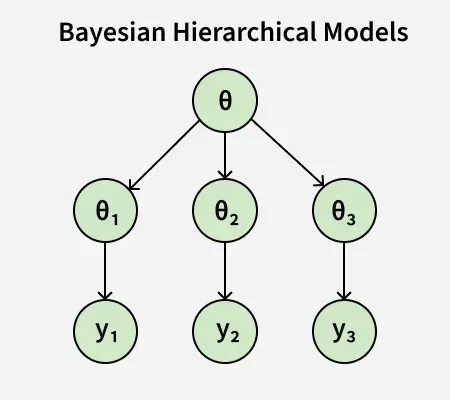
Understanding Hierarchical Structure
A hierarchical model assumes that the observed data yi (where i indexes the data points) depends on some group-level parameters θi , which are in turn drawn from a higher-level (hyperprior) distribution governed by hyperparameters 𝜙.
General Hierarchical Structure
yi ∼ f(yi | θi)
Where:
- f(yi ∣ θi) is the likelihood of the observed data.
- g(θi ∣ ϕ) is the prior distribution for the group-level parameter 𝜃𝑖.
- ℎ(𝜙) is the hyperprior, a distribution for the hyperparameters 𝜙.
Bayesian Framework in Hierarchical Models
Bayesian inference updates prior beliefs based on observed data using Bayes’ theorem:
P(\theta, \phi \mid y) = \frac{P(y \mid \theta) P(\theta \mid \phi) P(\phi)}{P(y)}
For a hierarchical model, this extends to:
P(\theta, \phi \mid y) = \frac{P(y \mid \theta) P(\theta \mid \phi) P(\phi)}{P(y)}
Where:
- P(θ∣ϕ) accounts for the variability across groups.
- P(ϕ) models uncertainty in hyperparameters.
Example: Bayesian Hierarchical Model for School Test Scores
Consider a scenario where we want to model student test scores across multiple schools. The scores follow a normal distribution with mean θi and variance σ2:
y_{ij} \sim N(\theta_i, \sigma^2)
Where:
- yij is the test score of the j-th student in the i-th school.
- θi is the mean score for school i, which varies across schools.
Group-Level Model
The school-specific means θi follow a normal distribution with a global mean μ and variance τ2:
\theta_i \sim N(\mu, \tau^2)
Applications of Bayesian Hierarchical Models
- Medical Trials: BHMs are used to estimate treatment effects across different hospitals or clinics, allowing for the pooling of data while accounting for site-specific variability.
- Marketing Analysis: They help model customer behavior across different regions or demographics, providing insights into how various factors impact sales or customer retention.
- Education: BHMs are used to assess the impact of educational interventions or policies across different schools, accounting for school-level effects such as funding, location or teacher quality.
- Economics: These models are valuable for understanding regional or country-level economic phenomena, such as GDP growth, inflation rates or unemployment.
Advantages of Bayesian Hierarchical Models
- Improved Estimation: By pooling information across groups, BHMs reduce variance and improve estimates, especially when some groups have limited data.
- Handling Complex Data Structures: BHMs are well-suited for handling data with multiple layers or structures, such as longitudinal data, nested data or data with missing values.
- Incorporating Prior Knowledge: BHMs naturally incorporate prior knowledge about the data through the use of priors and hyperpriors, allowing us to make better-informed inferences.
- Flexibility: The hierarchical structure allows for modeling complex relationships between different levels of data, making it ideal for problems in healthcare, education, marketing and social sciences.
Challenges and Limitations
- Computational Complexity: MCMC methods can be slow for large datasets.
- Model Specification: Defining appropriate priors and hyperpriors can be challenging.
- Convergence Issues: Ensuring convergence of MCMC chains requires careful diagnostics.
