

Beam Search is a heuristic search algorithm used in Artificial Intelligence to efficiently explore large search spaces by selecting only the most promising nodes at each level. Instead of expanding every possible path like Breadth-First Search, it keeps a limited number of best nodes based on heuristic values, making the search faster and more memory-efficient.
- Uses a fixed beam width to limit node expansion
- Balances efficiency and solution quality
- Widely used in NLP, speech recognition and pathfinding tasks
Characteristics
- Width of the Beam (W): This parameter defines the number of nodes considered at each level. The beam width W directly influences the number of nodes evaluated and hence the breadth of the search.
- Branching Factor (B): If B is the branching factor, the algorithm evaluates
W \times B nodes at every depth but selects only W for further expansion. - Completeness and Optimality: The restrictive nature of beam search, due to a limited beam width, can compromise its ability to find the best solution as it may prune potentially optimal paths.
- Memory Efficiency: The beam width bounds the memory required for the search, making beam search suitable for resource-constrained environments.
Working
Beam Search works by selecting only a limited number of the best nodes at each level based on heuristic values. Suppose the beam width
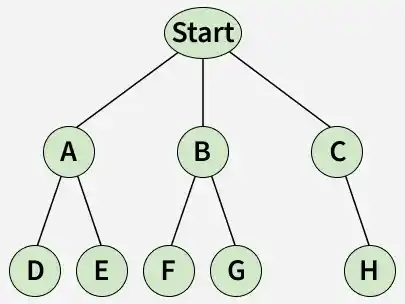
Step 1: Start from the initial node Start.
Step 2: Generate all successor nodes: A, B and C.
Step 3: Evaluate the nodes using heuristic values and select the best
Step 4: Expand the selected nodes:
- A → D, E
- B → F, G
Step 5: Again evaluate the generated nodes (D, E, F, G) and keep only the best 2 nodes for further exploration.
Step 6: Repeat the process until the goal node is reached.
Python Implementation of Beam Search
1. Beam Search Algorithm
The following function implements Beam Search. It maintains a fixed number of the highest-scoring candidates at each stage, determined by the beam_width.
def beam_search(graph, start, goal, beam_width):
    beam = [(start, [start], 0)]

    while beam:
        candidates = []

        for node, path, score in beam:
            if node == goal:
                return path, score

            for neighbor, edge_score in graph.get(node, []):
                new_score = score + edge_score
                candidates.append(
                    (neighbor, path + [neighbor], new_score)
                )

        if not candidates:
            break

        candidates.sort(key=lambda x: x[2], reverse=True)
        beam = candidates[:beam_width]

        for node, path, score in beam:
            if node == goal:
                return path, score

    return None
The algorithm starts with the initial node and generates possible paths. It then scores these paths, sorts them by their scores and retains only the top candidates according to the specified beam_width. This process continues until the goal is reached or no more candidates are available.
2. Example
Now, define a graph and use the beam_search() function to find a path from A to G.
graph = {
    'A': [('B', 8), ('C', 6), ('D', 4)],
    'B': [('E', 7), ('F', 5)],
    'C': [('G', 9), ('H', 3)],
    'D': [('I', 6)],
    'E': [],
    'F': [],
    'G': [],
    'H': [],
    'I': []
}

result = beam_search(graph, 'A', 'G', 2)

print("Best Path:", result[0])
print("Score:", result[1])
Output:
Best Path: ['A', 'C', 'G']
Score: 15
Here, beam_width = 2, so the algorithm keeps only the two highest-scoring candidates at each stage. The resulting path from A to G is A → C → G, with a total score of 15.
you can download the complete code from here.
Applications
- Used in machine translation, text generation and speech recognition to predict the most likely sequence of words.
- Helps robots find efficient paths and navigate through environments.
- Used in strategic games where exploring every possible move is computationally expensive.
Advantages
- Efficient for large search spaces because it expands only limited nodes
- Flexible since beam width and heuristic functions can be adjusted
- Scalable for complex problems with many possible solution paths
- Requires less memory than exhaustive search method
Limitations
- May miss the optimal solution because some paths are discarded early
- Performance depends heavily on the quality of the heuristic function
- Small beam width can remove potentially useful solutions
- Large beam width increases computation time and memory usage
