

The absolute value (also called the modulus) of a complex number z = a + bi is its distance from the origin in the complex plane. The absolute value tells you how far a number is from zero, regardless of its direction (positive or negative).
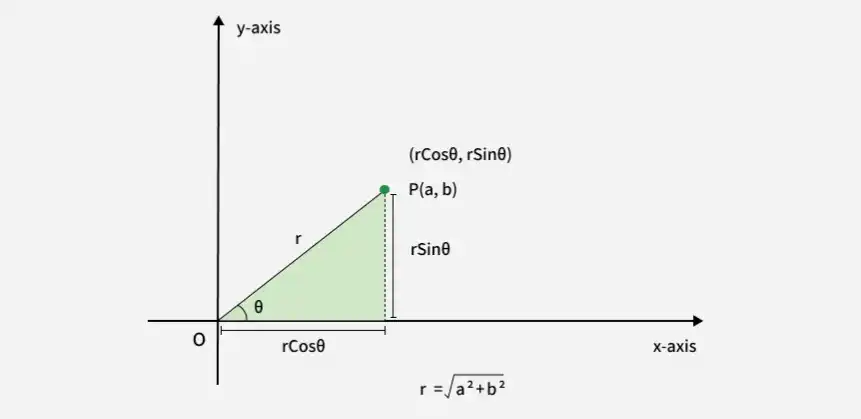
It is denoted as ∣z∣ and is given by the formula:
|z| = \sqrt{ (a^2 + b^2)} Where,
- a is the real part of z
- b is the imaginary part of z
- The square root operation ensures the result is always non-negative.
The absolute value represents the Euclidean distance between the point (a, b) and the origin (0, 0) in a coordinate plane. Using the distance formula:
d = \sqrt{(a-0)^2+ (b-0)^2} = \sqrt{a^2+b^2}
Example: Calculate the absolute value (modulus) of the complex number z = -2 + 3i
Solution:
By the formula z = a + bi
|z| = \sqrt{ (a^2 + b^2)}
Here,
- a = −2 (real part)
- b = 3 (imaginary part)
Now, substitute into the formula:
|z| = \sqrt{ (-2)^2 + (3)^2)} = \sqrt{ 4 + 9} = \sqrt{13} |z| = \sqrt{13}
This represents the distance from the origin to the point (-2, 3) in the complex plane.
Types of Numbers in Complex Plane
- Real Number: A real number is a number that is present in the number system, which can be positive, negative, integer, rational irrational, etc. For example, 23, -3, 3/6.
- Imaginary Number: Imaginary numbers are those numbers that are not real numbers. For example, √3, √11, etc.
- Zero Complex Number: A zero complex number is a number that has its real and imaginary parts both equal to zero. For example, 0 + 0i.
Proof
Let us consider the mode of the complex number z is extended from 0 to z, and the mod of a, b real numbers is extended from a to 0 and b to 0. So these values create a right-angle triangle in which 0 is the vertex of the acute angle
So, using Pythagoras' theorem, we get,
|z|2 = |a|2 + |b|2
|z| = √(a2 + b2)Now, in the sets of complex numbers z1 > z2 or z1 < z2 has no meaning but |z1| > |z2| or |z1| < |z2| has meaning because |z1| and |z2| is a real number.
Properties of Modulus of a Complex Number
Some of the common properties of the modulus of a complex number are:
- |z| = 0 ⇔ z = 0i, i.e., Re(z) = 0 and Im(z) = 0
- |z| = |
\bar{z} | = |-z| - -|z| ≤ Re(z) ≤ |z|, -|z| ≤ Im(z) ≤ |z|
- z.
\bar{z} = |z2| - |z1z2| = |z1||z2|
- |z1 / z2| = |z1|/|z2|
- |z1 + z2|2 = |z1| + |z2| + 2Re(z1
\bar{z}_2 ) - |z1 - z2|2 = |z1| + |z2| - 2Re(z1
\bar{z}_2 ) - |z1 + z2|2 ≤ |z1| + |z2|
- |z1 - z2|2 ≥ |z1| - |z2|
- |az1 - bz2|2 + |bz1 + az2|2 = (a2 + b2)(|z1|2 + |z2|2) Or |z1 - z2|2 + |z1 + z2|2 = 2(|z1|2 + |z2|2)
- |zn| = |z|n
- 1/z = a - ib/a2 + b2 =
\bar{z} /|z|2
Example: Calculate absolute value of
- z = 3 + 4i
- z = 5 + 6i
Solution:
(i) z = 3 + 4i
Thus, |z| = √(32 + 42)
⇒ |z| = √(9 + 16)
⇒ |z| = √25
⇒ |z| = ±5(ii) z = 5 + 6i
|z| = √(52 + 62)
⇒ |z| = √(25 + 36)
⇒ |z| = √61
Argument of Complex numbers
The argument of the complex number is the angle inclined from the real axis in the direction of the complex number that is represented on the complex plane or argand plane.
θ = tan-1(b/a)
OR
arg(Z) = tan-1(b/a)
Here, Z = a + ib
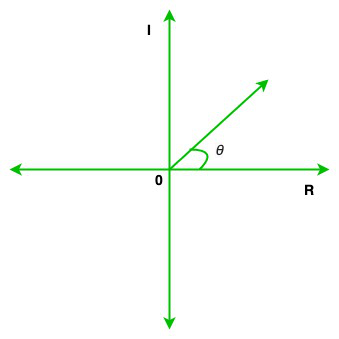
Properties of the plane Argument of Complex Number
Some of the common properties of the argument of complex numbers are:
- arg(Zn) = n arg(Z)
- arg (Z1/ Z2) = arg (Z1) – arg (Z2)
- arg (Z1 Z2) = arg (Z1) + arg (Z2)
Example: Find the argument for
- z = 2 + 2i
- z = -4 + 4i
Solution:
(i) z = 2 + 2i
θ = tan-1(2/2)
⇒ θ = tan-1(1)
⇒ θ= 45°(ii) z = -4 + 4i
θ = tan-1(4/-4)
⇒ θ= tan-1(-1)
⇒ θ = -45°It is important to note here that the angle θ =-45° is in 4th quadrant, while we always measure angle with the positive x-axis.
So, we will have to add 180° to the answer to obtain the real opposite angle.
So, θ = 180° + (-45°)
⇒ θ = 135°So , the above complex number will make an angle of 135° with the positive x-axis.
