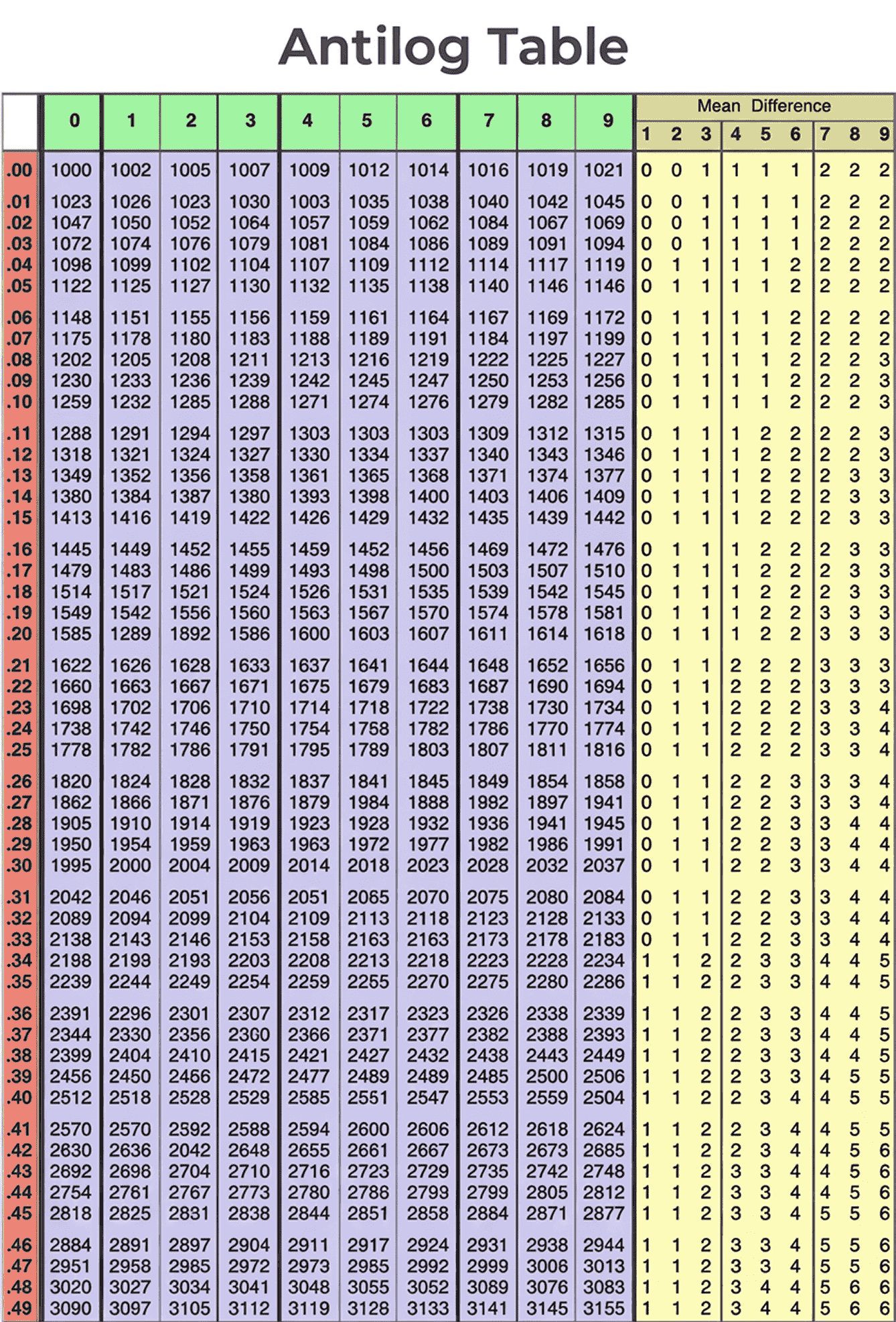
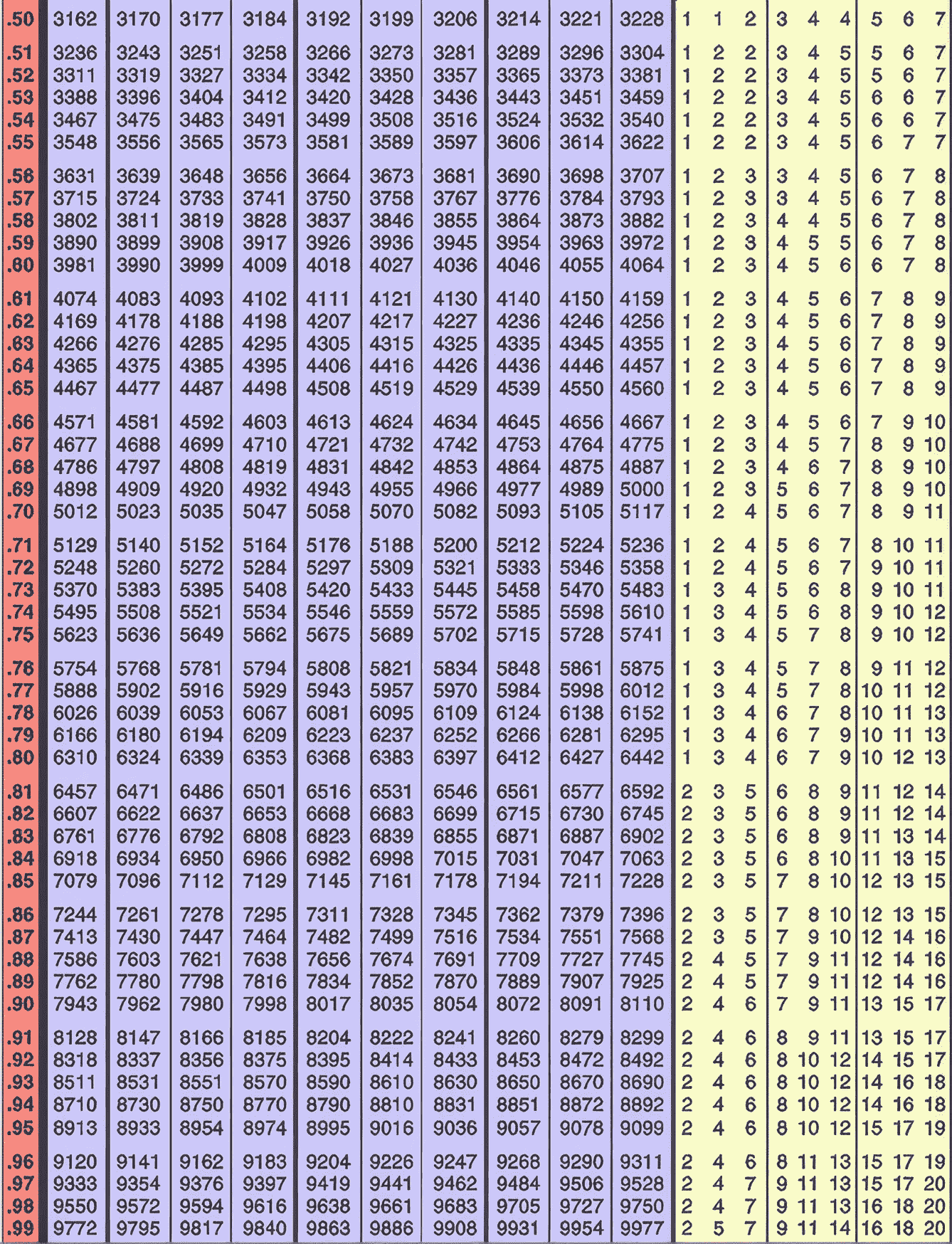
An antilog table is a mathematical table used to find the antilogarithm (antilog) of a number, especially when working with common logarithms (base 10).
It typically provides a pre-computed antilogarithm value for various logarithmic inputs, commonly in base 10 or natural logarithm base (e.g., ≅ 2.71828)
An antilog table allows users to find the number corresponding to a given logarithmic value without performing complex exponential calculations, as the result can be directly read from the table.
Antilog Table for Finding Antilogarithms
Before the widespread use of calculators and computers, antilog tables were frequently used alongside log tables to simplify calculations involving exponentiation, enabling quick conversion from logarithm results back to standard numerical values.
Calculation of Antilog
The logarithm of any number can be divided into two parts: the characteristic and the mantissa. These components help us calculate the value of the antilogarithm for any given logarithmic value.
To calculate the antilogarithm (also known as the inverse logarithm) using the characteristic and mantissa, you need to understand the structure of a logarithmic number. A logarithm can be represented as the following:
Log(x) = Characteristic + Mantissa
Here,
Log(x) is the logarithm of the number you want to find the antilogarithm for.
Characteristic is the integer part of the logarithm, and
Mantissa is the fractional part of the logarithm.
To find the antilogarithm, we need to calculate,
x = 10 Log(x)
Let's consider an example to understand it better.
Example: Find antilog(2.4567).
Solution:
Let's us assume Log(x) = 2.4567, [Where x is the antilog of 2.4567]
x = 102 × 100.4567 [100.4567 ≈ 3.016] ⇒ x = 100 × 3.016 ⇒ x = 301.6
So, the antilog(2.4567) is approximately 301.6.
How to Use the Antilog Table?
Calculating the antilog using an antilog table involves breaking down the given logarithm into its characteristic and mantissa parts.
Step 1: Given logarithm: 1.4317.
Separate the integral part (characteristic) from the fractional part (mantissa):
Characteristic: 1
Mantissa: 0.4317
Step 2: Find the equivalent value of mantissa using the antilog table. Find the row number that equals .43 and then select column number 1 is the matching value.
Step 3: Proceed to the mean difference column. Use the .56 row again and get the appropriate value in column 8. The value in this case is 7.
Step 4: Add the values you discovered in steps 2 and 3. It is 2698 + 7 = 3697 in this case.
Step 5: Insert the decimal point now. The decimal point always goes in the correct position. You must multiply the characteristic value by 1. You now have 3. Then, after 3 digits, add the decimal point to obtain 369.7.
As a result, the antilog value of 2.5678 is 369.7.
Antilog from 1 to 10
The following table represents the value of antilog from 1 to 10.
x
Antilog(x) = 10x
1
10
2
100
3
1,000
4
10,000
5
100,000
6
1,000,000
7
10,000,000
8
100,000,000
9
1,000,000,000
10
10,000,000,000
Important Notes on the Antilog Table:
The Antilog Table gives the value of 10x for the mantissa, with columns for different decimal places.
The Antilog of a number has two parts: Characteristic (Integral Part) and Mantissa ( Decimal Part).
We can split the number into two parts, use the table for the decimal part, and use the whole number part.
The table helps simplify calculations by avoiding the direct computation of powers of 10.