

Question 14. Prove that \frac{(1+cotθ+tanθ)(sinθ-cosθ)}{sec^3θ-cosec^3θ}=sin^2θcos^2θ
Solution:
We have
\frac{(1+cotθ+tanθ)(sinθ-cosθ)}{sec^3θ-cosec^3θ}=sin^2θcos^2θ Taking LHS
=
\frac{(1+cotθ+tanθ)(sinθ-cosθ)}{sec^3θ-cosec^3θ} =
\frac{(1+\frac{cosθ}{sinθ}+\frac{sinθ}{cosθ})(sinθ-cosθ)}{\frac{1}{cos^3θ}-\frac{1}{sin^3θ}} =
\frac{(\frac{cosθsinθ+cos^2θ+sin^2θ}{sinθcosθ})(sinθ-cosθ)}{\frac{sin^3θ-cos^3θ}{sin^3θcos^3θ}} =
\frac{(1+cosθsinθ)(sinθ-cosθ)(sin^2θcos^2θ)}{sin^3θ-cos^3θ} =
\frac{(1+cosθsinθ)(sinθ-cosθ)(sin^2θcos^2θ)}{(sinθ-cosθ)(sin^2θ+cos^2θ+cosθsinθ)} =
\frac{(1+cosθsinθ)(sin^2θcos^2θ)}{(1+cosθsinθ)} = sin2θcos2θ
Hence, LHS = RHS (Proved)
Question 15. Prove that \frac{2sinθcosθ-cosθ}{1-sinθ+sin^2θ-cos^2θ}=cotθ
Solution:
We Have
\frac{2sinθcosθ-cosθ}{1-sinθ+sin^2θ-cos^2θ}=cotθ Taking LHS
=
\frac{2sinθcosθ-cosθ}{1-sinθ+sin^2θ-cos^2θ} =
\frac{cosθ(2sinθ-1)}{1-cos^2θ-sinθ+sin^2θ} =
\frac{cosθ(2sinθ-1)}{sin^2θ-sinθ+sin^2θ} =
\frac{cosθ(2sinθ-1)}{2sin^2θ-sinθ} =
\frac{cosθ(2sinθ-1)}{sinθ(2sinθ-1)} = cosθ/sinθ
= cotθ
Hence, LHS = RHS(Proved)
Question 16. Prove that cosθ(tanθ + 2)(2tanθ + 1) = 2secθ + 5sinθ
Solution:
We have
cosθ(tanθ + 2)(2tanθ + 1) = 2secθ + 5sinθ
Taking LHS
= cosθ(tanθ + 2)(2tanθ + 1)
=
cosθ(\frac{sinθ}{cosθ}+2)(\frac{2sinθ}{cosθ}+1) =
cosθ\frac{(sinθ+2cosθ)(2sinθ+cosθ)}{cos^2θ} =
\frac{(2sin^2θ+sinθcosθ+4sinθcosθ+2cos^2θ)}{cosθ} =
\frac{2(sin^2θ+cos^2θ)+5sinθcosθ}{cosθ} =
\frac{2+5sinθcosθ}{cosθ} =
\frac{2}{cosθ}+\frac{5sinθcosθ}{cosθ} = 2secθ + 5sinθ
Hence, LHS = RHS(Proved)
Question 17. If x = \frac{2sinθ}{1+cosθ+sinθ} , prove that \frac{1-cosθ+sinθ}{1+sinθ} is also equal to x.
Solution:
We have
x =
\frac{2sinθ}{1+cosθ+sinθ} Taking LHS
=
\frac{2sinθ(1-cosθ+sinθ)}{(1+cosθ+sinθ)(1-cosθ+sinθ)} =
\frac{2sinθ(1-cosθ+sinθ)}{(1+sinθ)^2-cos^2θ} =
\frac{2sinθ-2sinθcosθ+2sin^2θ}{1+sin^2θ +2sinθ-cos^2θ} =
\frac{2sinθ(1+cosθ-sinθ)}{2sin^2θ+2sinθ} =
\frac{1+cosθ-sinθ}{1+sinθ}
Question 18. If sin θ=\frac{a^2+b^2}{a^2−b^2} , then find the values of tanθ, secθ, and cosecθ
Solution:
We have
sin θ=\frac{Perpendicular}{Hypotenuse}=\frac{a^2+b^2}{a^2−b^2} As we know that
cosθ = √1 - sin2θ -(1)
Now put the value of sinθ in eq(1)
cosθ =
\sqrt{1-\frac{(a^2-b^2)^2}{(a^2+b^2)^2}} =
\sqrt{\frac{(a^2+b^2)^2-(a^2-b^2)^2}{(a^2+b^2)^2}} =
\sqrt{\frac{(a^4+b^4+2a^2b^2)-(a^4+b^4-2a^2b^2)}{(a^2+b^2)^2}} =
\sqrt{\frac{4a^2b^2}{(a^2+b^2)^2}} =
\frac{2ab}{(a^2+b^2)} So the value of cosθ =
\frac{2ab}{(a^2+b^2)} Now,
tanθ =
\frac{Perpendicular}{Base}=\frac{a^2−b^2}{2ab} secθ =
\frac{Hypotenuse}{Base}=\frac{a^2+b^2}{2ab} cosecθ =
\frac{Hypotenuse}{Perpendicular}=\frac{a^2+b^2}{a^2-b^2} Alternative Method:
We have
sin θ=\frac{Perpendicular}{Hypotenuse}=\frac{a^2+b^2}{a^2−b^2} We draw a △PQR right-angled at Q PR = a2 + b2 and PQ = a2 - b2
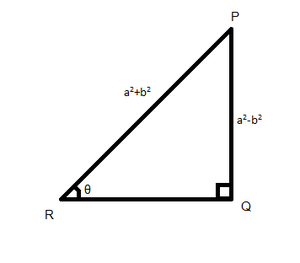
By Pythagoras theorem, we have
PR2 = PQ2 + QR2
QR2 = (a2 + b2)2 - (a2 - b2)2
QR2 = (a4 + b4 + 2a2b2) − (a4 + b4 − 2a2b2)
QR2 = 4a2b2
QR = 2ab
cosθ =
\frac{2ab}{a^2 +b^2} Now,
tanθ =
\frac{Perpendicular}{Base}=\frac{a^2−b^2}{2ab} secθ =
\frac{Hypotenuse}{Base}=\frac{a^2+b^2}{2ab} cosecθ =
\frac{Hypotenuse}{Perpendicular}=\frac{a^2+b^2}{a^2-b^2}
Question 19. If tanθ = a/b, then find the value of \sqrt{\frac{a+b}{a-b}}+ \sqrt{\frac{a-b}{a+b}}
Solution:
We have
=
\sqrt{\frac{a+b}{a-b}}+ \sqrt{\frac{a-b}{a+b}} =
\sqrt{\frac{\frac{a}{b}+1}{\frac{a}{b}-1}}+ \sqrt{\frac{\frac{a}{b}-1}{\frac{a}{b}+1}} Now put tanθ = a/b
=
\sqrt{\frac{tanθ +1}{tanθ-1}}+\sqrt{\frac{tanθ -1}{tanθ+1}} =
\sqrt{\frac{\frac{sinθ}{cosθ}+1}{\frac{sinθ}{cosθ}-1}}+\sqrt{\frac{\frac{sinθ}{cosθ}-1}{\frac{sinθ}{cosθ}+1}} =
\sqrt{\frac{sinθ +cosθ}{sinθ-cosθ}}+\sqrt{\frac{sinθ -cosθ}{sinθ+cosθ}} =
\frac{sinθ+cosθ+sinθ-cosθ}{\sqrt{sin^2θ-cos^2θ}} =
\frac{2sinθ}{\sqrt{sin^2θ-cos^2θ}}
Question 20. If tanθ = a/b, show that \frac{asinθ-bcosθ}{asinθ+bcosθ}=\frac{a^2-b^2}{a^2+b^2} .
Solution:
We have
\frac{asinθ-bcosθ}{asinθ+bcosθ}=\frac{a^2-b^2}{a^2+b^2} Taking LHS
=
\frac{asinθ-bcosθ}{asinθ+bcosθ} Dividing denominator and Numerator by cosθ
=
\frac{\frac{asinθ-bcosθ}{cosθ}}{\frac{asinθ+bcosθ}{cosθ}} =
\frac{\frac{asinθ}{cosθ}-\frac{bcosθ}{cosθ}}{\frac{asinθ}{cosθ}+\frac{bcosθ}{cosθ}} =
\frac{atanθ-b}{atanθ+b} =
\frac{a(\frac{a}{b})-b}{a(\frac{a}{b})+b} =
\frac{\frac{a^2-b^2}{b}}{\frac{a^2+b^2}{b}} =
\frac{a^2-b^2}{a^2+b^2} Hence, LHS = RHS(Proved)
Question 21. If cosecθ - sinθ = a3, secθ - cosθ = b3, then prove that a2b2(a2 + b2) = 1.
Solution:
Given: cosecθ - sinθ = a3
1/sinθ − sinθ = a3
\frac{1-sin^2θ}{sinθ} = a3cos2θ/sinθ = a3
a = (cos2θ/sinθ)1/3
Similarly, b = (sin2θ/cosθ)1/3
Now putting the values of a and b in the following equation
Taking LHS
= a2b2(a2 + b2)
= a4b2 + a2b4
=
(\frac{cos^2θ}{sinθ})^\frac{4}{3}(\frac{sin^2θ}{cosθ})^\frac{2}{3}+ (\frac{cos^2θ}{sinθ})^\frac{2}{3}(\frac{sin^2θ}{cosθ})^\frac{4}{3} = cos6/3θ + sin6/3θ
= cos2θ + sin2θ
= 1
Hence, LHS = RHS (Proved)
Question 22. If cotθ(1 + sinθ) = 4m and cotθ(1 − sinθ) = 4n, prove that (m2 - n2)2 = mn.
Solution:
Given: cotθ(1 + sinθ) = 4m and cotθ(1 − sinθ) = 4n
Multiplying both the equations
16mn = cot2θ(1 - sin2θ)
16mn =
\frac{cos^2θ}{sin^2θ}(cos^2θ) 16mn = cos4θ/sin2θ
mn = cos4θ/16sin2θ -(1)
Now squaring the given equations
16m2 = cot2θ(1 + sinθ)2 and 16n2 = cot2θ(1 - sinθ)2
On subtracting both the equation, we get
16m2 - 16n2 = cot2θ(1 + sinθ)2 - cot2θ(1 - sinθ)2
16(m2 - n2) = cot2θ((1 + sinθ)2 - (1 - sinθ)2)
16(m2 - n2) =
\frac{cos^2θ}{sin^2θ}(4sinθ) (m2 - n2) = cos2θ/4sinθ
On squaring both side, we get
(m2 - n2)2 = cos4θ/16sinθ -(2)
From equation(1) and (2)
(m2 - n2)2 = mn
Hence proved
Question 23. If sinθ + cosθ = m then prove that sin6θ + cos6θ = \frac{4−3(m^2−1)^2}{4} , where m2 ≤ 2.
Solution:
Given: sinθ + cosθ = m
On squaring both side, we get
(sinθ + cosθ)2 = m2
= sin2θ + cos2θ + 2sinθcosθ = m2
= 2sinθcosθ = m2 − 1
Now,
Taking LHS
= sin6θ + cos6θ
Using a3 + b3 = (a + b)(a2 + b2 − ab)
= (sin2θ)3 + (cos2θ)3
= (sin2θ + cos2θ)(sin4θ + cos4θ − sin2θcos2θ)
= (1)((sin2θ)2 + (cos2θ)2 − sin2θcos2θ)
= (sin2θ + cos2θ)2 − 2sin2θcos2θ − sin2θcos2θ
= (1 − 3sin2θcos2θ)
=
1−3(\frac{m^2-1}{2})^2 =
1−3\frac{(m^2-1)^2}{4} =
\frac{4-3(m^2-1)^2}{4} Hence, Proved.
Question 24. If a = secθ - tanθ and b = cosecθ + cotθ, then show that ab + a - b + 1 = 0.
Solution:
We have
a = secθ - tanθ and b = cosecθ + cotθ
and we have to proof that
ab + a - b + 1 = 0
So, taking LHS
ab + a - b + 1
Now put the values of a and b, we get
= (secθ - tanθ)(cosecθ + cotθ) - (secθ - tanθ) + (cosecθ + cotθ) + 1
= (1/cosθ - sinθ/cosθ)(1/sinθ + cosθ/sinθ) - (1/cosθ - sinθ/cosθ) + (1/sinθ + cosθ/sinθ) + 1
= 1/cosθsinθ + 1/cosθ x cosθ/sinθ - sinθ/cosθ x 1/sinθ - (sinθ/cosθ) x (cosθ/sinθ) + 1/cosθ - sinθ/cosθ - 1/sinθ - cosθ/sinθ + 1
= 1/cosθsinθ + 1/sinθ - 1/cosθ - 1 + 1/cosθ - sinθ/cosθ - 1/sinθ - cosθ/sinθ + 1
= 1/cosθsinθ - sinθ/cosθ - cosθ/sinθ
= 1 - sin2θ - cos2θ/sinθcosθ
= 1 - (sin2θ + cos2θ)/sinθcosθ
= 1 - 1/sinθcosθ
= 0
Hence, LHS = RHS (Proved)
Question 25. |\sqrt\frac{1-sinθ}{1+sinθ}+\sqrt\frac{1+sinθ}{1-sinθ}|=\frac{-2}{cosθ} , where π/2 < θ < π.
Solution:
We have
|\sqrt\frac{1-sinθ}{1+sinθ}+\sqrt\frac{1+sinθ}{1-sinθ}|=\frac{-2}{cosθ} Taking LHS
=
|\sqrt\frac{1-sinθ}{1+sinθ}+\sqrt\frac{1+sinθ}{1-sinθ}| =
\sqrt(\frac{1-sinθ}{1+sinθ})(\frac{1-sinθ}{1-sinθ})+\sqrt(\frac{1+sinθ}{1-sinθ})(\frac{1+sinθ}{1+sinθ}) =
\sqrt\frac{(1-sinθ)^2}{(1)^2-(sinθ)^2}+\sqrt\frac{(1+sinθ)^2}{(1)^2-(sinθ)^2} =
\sqrt\frac{(1-sinθ)^2}{1-sin^2θ}+\sqrt\frac{(1+sinθ)^2}{1-sin^2θ} =
\sqrt\frac{(1-sinθ)^2}{cos^2θ}+\sqrt\frac{(1+sinθ)^2}{cos^2θ} =
\frac{(1-sinθ)}{cosθ}+\frac{(1+sinθ)}{cosθ} =
\frac{(1-sinθ+1+sinθ)}{cosθ} = 2/cosθ
Since π/2 < θ < π ,where cosθ is negative
So, -2/cosθ
Hence, LHS = RHS (Proved)
Question 26 (i). If Tn = sinnθ + cosnθ, prove that
\frac{T_3-T_5}{T_1}=\frac{T_5-T_7}{T_5}
Solution:
LHS =
\frac{T_3-T_5}{T_1}=\frac{(sin^3θ+cos^3θ)-(sin^5θ+cos^5θ)}{sinθ+cosθ}
=\frac{sin^3θ-sin^5θ+cos^3θ-cos^5θ}{sinθ+cosθ}
=\frac{sin^3θ(1-sin^2θ)+cos^3θ(1-cos^2θ)}{sinθ+cosθ}
=\frac{sin^3θcos^2θ+cos^3θsin^2θ}{sinθ+cosθ}
=\frac{sin^2θcos^2θ(sinθ+cosθ)}{sinθ+cosθ} = sin2θcos2θ
RHS =
\frac{T_5-T_7}{T_5} =
\frac{(sin^5θ+cos^5θ)-(sin^7θ+cos^7θ)}{sin^3θ+cos^3θ}
=\frac{sin^5θ-sin^7θ+cos^5θ-cos^7θ}{sin^3θ+cos^3θ}
=\frac{sin^5θ(1-sin^2θ)+cos^5θ(1-cos^2θ)}{sin^3θ+cos^3θ}
=\frac{sin^5θcos^2θ+cos^5θsin^2θ}{sin^3θ+cos^3θ}
=\frac{sin^2θcos^2θ(sin^3θ+cos^3θ)}{sin^3θ+cos^3θ} = sin2θcos2θ
Question 26 (ii). If Tn = sinnθ + cosnθ, prove that
2T6 - 3T4 + 1 = 0
Solution:
LHS = 2(sin6θ + cos6θ) - 3(sin4θ + cos4θ) + 1
Using (a3 + b3) = (a + b)(a2 + b2 - ab)
= 2(sin2θ + cos2θ)(sin4θ + cos4θ - sin2θcos2θ) - 3(sin4θ + cos4θ) + 1
= 2(1)(sin4θ + cos4θ - sin2θcos2θ) - 3(sin4θ + cos4θ) + 1
= 2sin4θ + 2cos4θ - 2sin2θcos2θ - 3sin4θ - 3cos4θ + 1
= -sin4θ - cos4θ - 2sin2θcos2θ + 1
= -(sin2θ + cos2θ)2 + 1
= -1 + 1 = 0 = RHS (Hence Proved)
Question 26 (iii). If Tn = sinnθ + cosnθ, prove that
6T10 - 15T8 + 10T6 - 1 = 0
Solution:
T6 = sin6θ + cos6θ
Using a3 + b3 = (a + b)(a2 + b2 − ab)
= (sin2x)3 + (cos2x)3
= (sin2x + cos2x)(sin4x + cos4x − sin2xcos2x)
Using a2 + b2 = (a + b)2 − 2ab
= (1)(sin4x + cos4x − sin2xcos2x)
= (sin2x)2 + (cos2x)2 − sin2xcos2x
= (sin2x + cos2x)2 − 3sin2xcos2
= 1 − 3sin2xcos2x
Similarly, we get the values of T8 & T10
T8 = (sin6x + cos6x)(sin2x + cos2x) − sin2xcos2x(sin4x + cos4x)
= 1 − 3sin2xcos2x − sin2xcos2x(1 − 2sin2xcos2x)
= 1 − 4sin2xcos2x + 2sin4xcos4x
T10 = sin10θ + cos10θ
= (sin6θ + cos6θ)(sin4θ + cos4θ) − sin4θcos4θ(sin2θ + cos2θ)
= (1 − 3sin2xcos2x)(1 − 2sin2xcos2x) − sin4xcos4x
= 1 − 5sin2xcos2x + 5sin4xcos4x
On putting the values of T6, T8 and T10 in the following equation
6T10 - 15T8 + 10T6 - 1
We get the value 0.
Hence Proved
